
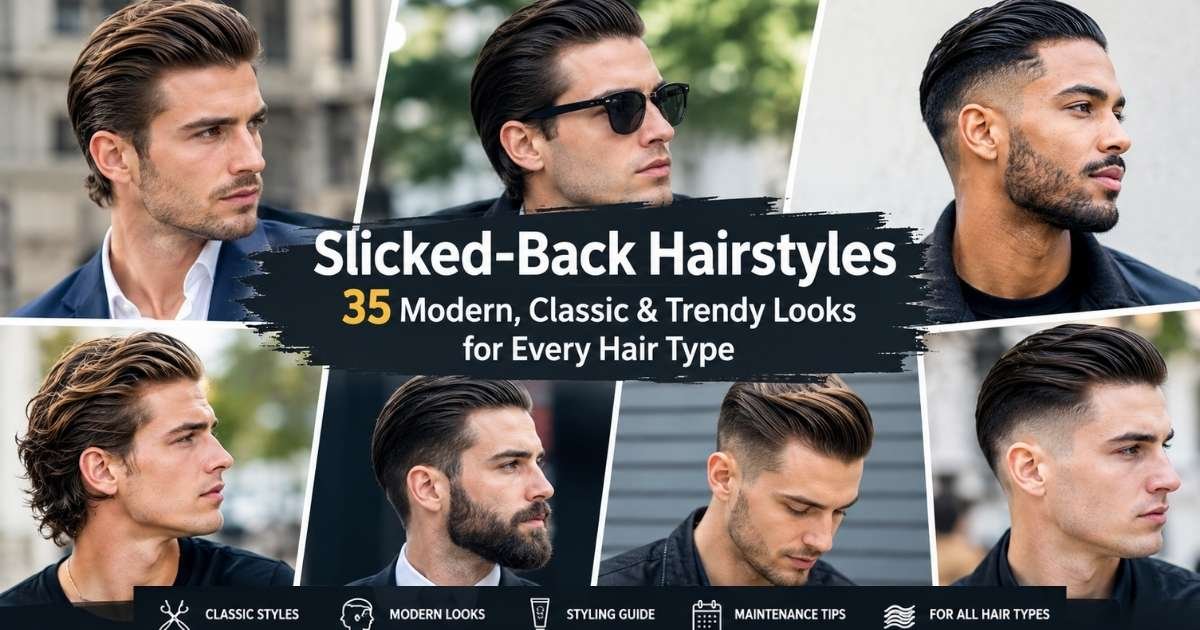
Slicked-Back Hairstyles: 35+ Modern, Classic & Trendy Looks for Every Hair Type
A slicked-back hairstyle sweeps the hair back from the forehead, usually with extra length on top and shorter sides. That description covers a lot of ground, though. A glossy, razor-parted version and a loose, brushed-back one are very different haircuts. They share a direction, not a cut.
This guide helps you sort that out. Every look below is built from four choices: top length, sides, part, and finish (matte, natural, or glossy). Once you know which combination you’re after, it’s easier to pick a style, describe it to a barber, and style it at home.
Results vary with your hair density, texture, hairline, and growth patterns, and with how your barber adapts the cut. Treat the suitability notes as starting points to discuss with a barber, not rules.
What Is a Slicked-Back Hairstyle?
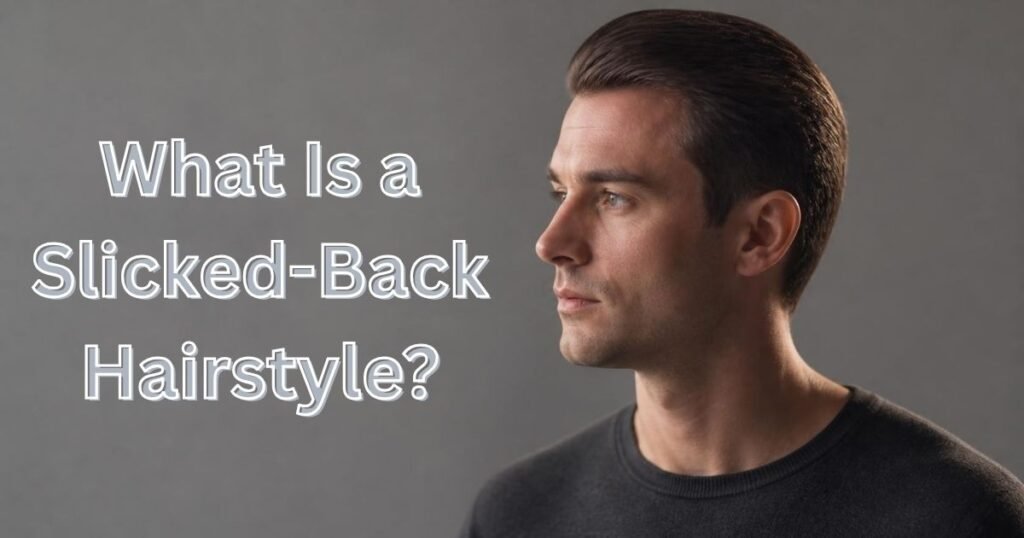
A slicked-back hairstyle directs the hair backward and away from the forehead, so it lies in one smooth or lightly textured sweep. The top is longer than the sides, though the sides can be anything from scissor-blended to faded down to the skin.
“Slick back” describes a direction and a finish, not one specific haircut. That’s why it pairs with so many side treatments, and why a reference photo alone doesn’t tell a barber everything.
The four choices that define any version:
- Top length and volume: how much hair there is to sweep back, and whether it lies flat or has lift.
- Sides: scissor-blended, tapered, faded, or cut much shorter than the top (an undercut).
- Part: none, a soft natural part, or a shaved-in hard part.
- Finish: matte, natural, or glossy.
How much length do you need? As a rough guide, many people find a top of around 2.5 to 4 inches (6 to 10 cm) easier to sweep back and keep there. Shorter hair can work with a firmer product, and longer hair gives more movement but more weight. Density, curl, and hairline all shift that range, so it’s a starting point, not a threshold.
The History of Slicked-Back Hair
Slicked-back hair is associated with the early to mid twentieth century, when oil-based dressings such as brilliantine were used to keep hair flat and glossy for formal wear. It later turned up in several youth subcultures and has resurfaced in different forms since.
What changed most over time wasn’t the direction but the products. Heavy oils gave way to water-based pomades, gels, and clays, which is why today’s versions can look anything from mirror-glossy to barely styled. That flexibility is a big part of why the look keeps returning.
What Makes It Different from a Comb Over or Pompadour?
These styles get mixed up constantly, and barbers and regions don’t always use the terms the same way. The clearest differences are direction, front volume, and part.
| Slick back | Pompadour | Quiff | Comb over | |
| Direction | Straight back | Up and back | Up, then back or to the side | Across, from a side part |
| Front volume | Low to moderate | High, structured | Moderate to high, looser | Usually low to moderate |
| Part | Usually none, or a soft/hard part | Usually none | Usually none | Defined side part |
| Typical finish | Matte to glossy | Often glossy and shaped | Often matte to natural | Varies |
| Styling effort | Low to moderate | Moderate to high | Moderate | Low to moderate |
In short, a pompadour is a slick back with a deliberately lifted front, and a quiff is a looser, less sculpted version of that lift. A comb over travels sideways rather than back. If your reference photo has a lot of height at the front, say so, because it changes both the cut and the styling.
Who Should Try a Slicked-Back Look?
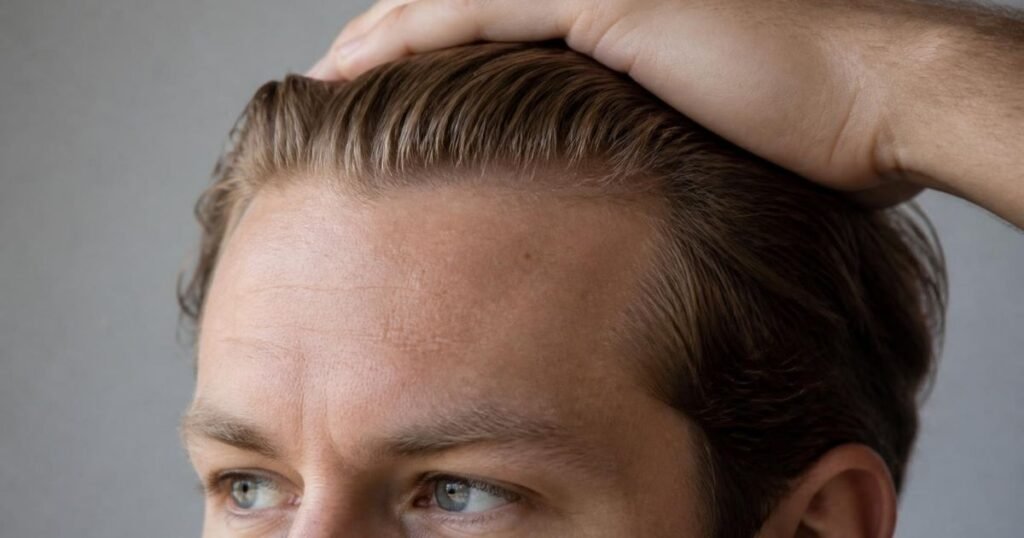
Whether it works for you depends on several things at once: your hair density, texture, hairline, growth patterns, face proportions, and how much time you’ll spend styling. Lifestyle matters too. Some workplaces are relaxed about hair, and others favor a more conservative finish.
Two small checks tell you a lot. Push your dry hair straight back and see whether it stays there or springs forward. Then look at your hairline and any cowlicks (spots where hair grows in a different direction), because those affect how the sweep sits. Entry #34 covers both in detail.
Face Shapes That Suit It Best
“Best” here means “often discussed,” not guaranteed. Face shape is only one input. Top height, how tight the sides are, forehead height, beard shape, and hairline often matter just as much.
| Face shape | What may work well | Worth discussing with a barber |
| Oval | Most proportions tend to be balanced, so many top heights and side finishes can work | Choosing based on hair and lifestyle more than face shape |
| Round | A bit of lift at the front can add vertical emphasis | Tighter sides plus a flat top may emphasize width |
| Square | A softer finish or slightly textured top may balance strong angles | Very sharp, high-contrast sides can accentuate the jaw further |
| Oblong | A flatter, less tall top may help avoid adding length | Excess front height can lengthen the face |
| Diamond | Some fullness at the forehead, with sides not cut too tight, may balance wider cheekbones | How far back the hairline pulls |
| Heart | A slightly looser or lower-volume front may soften a wider forehead | Whether sweeping everything back exposes the forehead more than you’d like |
| Triangle | Volume on top may balance a wider jaw | Side tightness combined with beard shape |
These are tendencies, not verdicts. A barber who can see your actual face and hair will give better guidance than any chart.
Hair Types That Work Well (Straight, Wavy, Curly, Thick, Thin)
Almost any hair type can be swept back. What changes is how much effort it takes and what the result looks like. Many people also combine traits (thick and wavy, or fine and curly), so don’t treat these as exclusive boxes.
| Hair type | What’s usually easier | What takes more effort |
| Straight | Lies back readily and looks smooth | Holding the shape and avoiding a flat top |
| Wavy | Natural movement adds body and softness | Keeping waves from springing up at the front |
| Curly or coily | Can produce a textured, voluminous sweep | Moisture, curl definition, and managing expectations |
| Thick | Plenty of material for a full shape | Controlling bulk and puffing at the sides |
| Thin or fine | Responds well to light, matte products | Preventing a flat look or visible scalp |
The detail for each is in the hair-type section further down.
Classic & Timeless Slick-Back Styles for Men
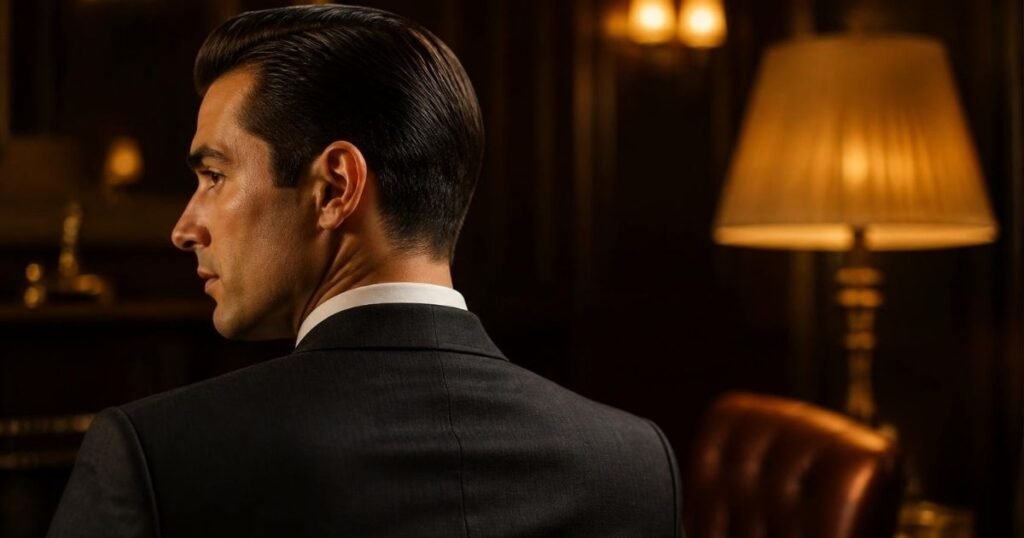
“Classic” here means defined edges, a smooth or lightly controlled top, and conservative contrast between top and sides. Each style below isolates one variable (sides, part, finish, length, edges, or neckline), so you can mix and match. If you like the sides of one and the finish of another, that’s a normal request.
1. Classic Slick Back
This is the reference version the rest are measured against. The top is brushed straight back in a smooth, even sweep, and the sides are tidied with scissors or tapered neatly into the neckline. There’s no deliberate lift at the front and no dramatic contrast.
What to notice: the hairline stays visible and the top lies in one direction. Compare how the sides meet the top in later entries, because that’s usually where styles diverge.
Straight or gently wavy hair of medium density often sits back most easily. Cowlicks or a widow’s peak (a V-shaped point at the hairline) can change how the front behaves, so mention them to your barber. See #34 for how to work with them.
2. Slick Back with Side Part
Here the hair sweeps back but starts from a soft, natural part to one side. The part is usually left to the hair rather than cut in, so it looks relaxed.
A part can suit people whose hair already falls to one side or who dislike the open forehead of a no-part sweep. Following your natural growth direction usually works better than forcing the part to the other side. If you want the line to be sharp and visible, that’s a hard part (see #8).
3. Wet Look Slick Back
This one is defined by finish, not cut. The hair is styled damp with a firm product so it looks glossy and tightly combed, with visible comb lines.
Water-based gels and high-shine pomades are the usual route, and the style depends on even application and tidy edges. There’s a tradeoff on lower-density hair: shine can make the scalp more visible and may feel heavy on very fine strands. The finish comparison later in the article covers how to decide.
Read More About : Comb Over Hairstyles: 30 Styles Guide for Men (2026)
4. Slick Back Undercut
The defining feature of an undercut is disconnection: the sides and back are cut much shorter than the top, with no gradual blend between them. The longer top then sweeps back over that sharp line.
The contrast is strong, and it grows out with a visible “shelf” where the two lengths meet. Keeping the line crisp may require frequent visits, and a heavy top can emphasize differences in density. Compare this to a taper, which blends gradually.
5. Slick Back Taper Fade
A taper shortens the hair gradually, usually focused around the sideburns, ears, and nape. A fade shortens it more dramatically, often up the sides of the head. “Taper fade” is a common blend of the two terms: a gradual shortening that’s more pronounced than a classic scissor taper but gentler than a skin fade. Barbers use these words slightly differently, so describe what you want rather than relying on the label alone.
Paired with a slick back, a taper fade gives a structured look without the harshness of an undercut. If you’d like a precise result, ask your barber what guard numbers they’ll use. These are the plastic attachments that set clipper length. In the US, a #1 guard is roughly 1/8 inch (3 mm), and UK grades run on a similar mm-based scale, though brands vary.
6. Slick Back with Skin Fade
A skin fade (also called a bald fade) tapers the sides all the way down to bare skin, so the shortest part looks shaved. It gives the most contrast against the longer top, and it draws attention to the sweep.
It also shows regrowth sooner than gentler blends, though exactly how soon depends on how fast your hair grows and how dark it is against your skin. If you want to keep it crisp, expect more frequent barber visits than with a scissor-blended side.
7. Classic Slick Back with Medium-Length Hair
With more length on top, the hair has weight, which helps it lie flat but also lets it move. It may fall forward when you lean over or touch it.
This version usually has the top reaching toward the ears or nape when pushed back, with the sides blended by scissors and tidy above the collar. It benefits from a blow-dry or comb to set the direction and a flexible-hold product so it moves without separating. It sits between the structured classic (#1) and the longer styles later (#29).
8. Slick Back with a Hard Part
A hard part is a line shaved or razored into the hair to mark the part. It gives the style a defined edge and a more deliberate, sculpted look.
Because the line is cut in, it needs regular touch-ups to stay sharp. Where it sits matters too. Your natural parting direction and hairline shape affect where a hard part will look natural, so it’s worth asking your barber to mark it with your hair dry. The difference from #2 is simple: #2 uses a part your hair already wants to make, while this one is cut in.
Read More About : The Modern High and Tight Haircut: Styles, Tips, and Everything You Will Need to Know In 2026
9. Slick Back with a Beard
This is a pairing rather than a separate haircut, and the main question is proportion. Sides that fade into the beard can look cohesive, while a longer top with a full beard creates a different balance than a short top with light stubble.
A fuller beard can add visual weight to the lower face, so some people keep the top slightly taller to balance it. Others prefer the contrast of a tightly cut beard with a longer top. Jawline, beard density, and how the fade meets the beard all affect the result, so it helps to discuss both together.
10. Short Slicked-Back Hairstyle
Short slick backs work, but the hair has to be long enough to lie back. If the top is only a half-inch or so, it may stand up or fall forward no matter what you apply.
At short lengths the look is tighter and lower-movement, with the hair combed back and held with a strong product. If your hair is too short right now, growing the top out while keeping the sides neat is often the practical route. Styling specifics for short hair are covered in #32.
11. Slick Back with Scissor-Cut Sides
Instead of clippers and guards, the barber shapes the sides with scissors, usually working over a comb. The result is a softer blend with no clipper lines, and the sides can stay noticeably longer than they would with a fade.
This gives the lowest contrast of any side finish in this article. The sides sit closer to the top in length, so the whole cut reads as one piece. It also grows out gently, without a visible shelf.
The tradeoff is skill and time. Scissor-over-comb work depends on the individual barber, and not every shop offers it as a standard option, so ask first. If you like a softer look but your sides puff out, mention that too, since thicker hair may need weight removed.
12. Slick Back with a Defined Shape-Up
A shape-up (also called a line-up or edge-up) is a crisp outline cut along the hairline, temples, and sideburns, usually with a trimmer or razor. It’s different from a fade or taper: those change the length of the sides, while a shape-up cleans the edge where hair meets skin.
It matters more here than with most styles because a slick back leaves the whole hairline exposed. Sharp edges make the hairline look deliberate. They can also make it look harder or higher than you expect, especially if the line is cut too straight or too far back.
If you have a receding hairline or a widow’s peak, ask for a natural-looking line that follows your hairline rather than a ruler-straight one. Edges soften as hair regrows, so how long it stays crisp depends on your growth rate and how sharp you want it.
Read More About : Ivy League Haircut: 22+ Clean & Timeless Styles for Men
13. Slick Back with a Tapered or Squared Neckline
When you sweep hair back, the back of your head is visible from behind and the side, so the neckline finish is part of the look. There are three common options:
- Tapered: the hair shortens gradually down the nape, sometimes to very short or skin-level. It grows out gently.
- Squared (blocked): a straight horizontal line across the nape, with a hard edge. It looks structured but shows regrowth sooner.
- Rounded: a curved line that follows the nape, somewhere between the two.
Your nape’s growth pattern affects the choice. Some people have a hair swirl or uneven growth there, which can make a squared line look uneven within days. A tapered neckline is often more forgiving in that case, though your barber can see your nape and advise.
Trendy Slick-Back Hairstyles for Modern Vibes
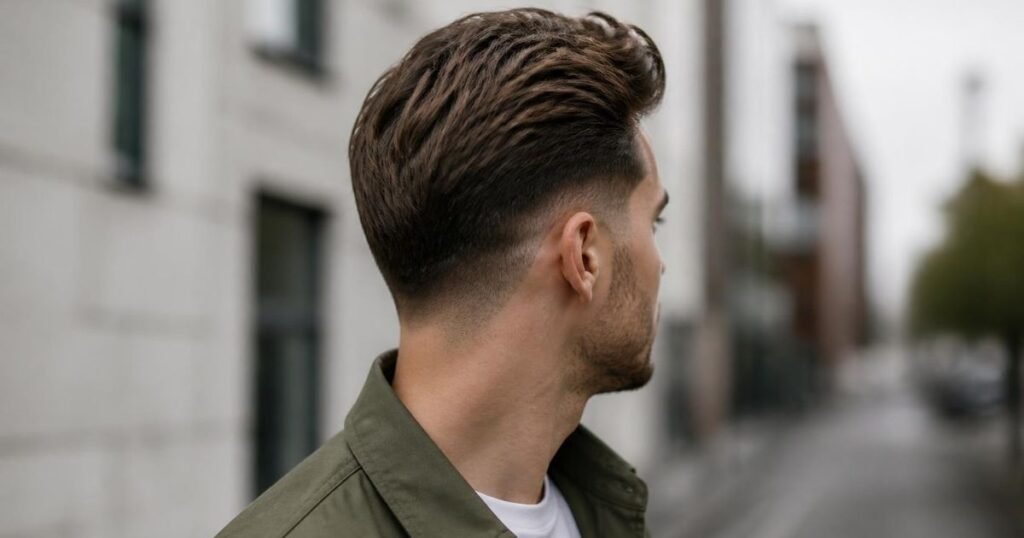
This section covers looser finishes and a wider range of side treatments. These looks lean toward softer, less polished results. That’s a description of the finish, not a claim about popularity.
14. Textured Slick Back
Rather than a smooth, glossy surface, a textured slick back shows some separation between strands and a low-shine finish. Clay, paste, or sea salt spray are typical choices, often combined with a blow-dry for lift at the roots.
Finer or lower-density hair may look fuller with this approach, since matte products add grip without weight. Curly and wavy hair usually needs less product to keep its natural texture.
15. Slick Back with Low or Mid Taper
Where this differs from #5 is where the taper starts and how noticeable it is. A low taper keeps the shortening close to the ears and neckline, while a mid taper begins higher on the sides.
A lower start is generally more subtle and tends to grow out more gently. A higher start looks sharper against the sweep. The side-finish table in the barber section compares the heights directly.
16. Slick Back Quiff
A quiff adds lift at the front while the rest of the hair sweeps back. It’s looser than a pompadour (see the comparison table earlier) and usually takes a blow-dry plus a lightweight product to build height.
The front height interacts with your hairline and face proportions. If you have a receding hairline or a high forehead, it may be worth asking how much lift suits you. If you’d rather build height further back instead, see #25.
Read More About : Buzz Cut Men: 32 Bold & Clean Haircut Styles for 2026
17. Slick Back with Drop Fade
A drop fade curves downward behind the ear instead of running straight around the head, so the fade line sits lower at the back. It follows the shape of the skull and changes the silhouette seen from the side and back.
How pronounced it looks depends on your head shape and ear position, so it’s worth viewing reference photos from the back as well as the front.
18. Slick Back Flow
This look is about length and movement of the hair itself. It suits longer hair that can sweep back and move naturally, with little product beyond something light to control frizz.
It differs from #21 and #22 in that the length is the main feature. The hair is typically past ear level and is allowed to fall in a soft wave or line rather than being set tightly.
19. Slick Back Mohawk
A mohawk keeps a narrow strip of longer hair down the center with very short or faded sides. In the slick-back version, that strip is swept back instead of spiked up.
The key difference from the undercut in #4 is the width of the top section. An undercut leaves most of the top, while a mohawk narrows it to a central band. It’s an assertive look, and the sides need regular tidying to keep the contrast defined.
20. Slick Back with Mid Fade
A mid fade begins roughly in the middle of the sides, between a low and high fade. It’s a middle ground for people who want noticeable contrast without exposing as much of the head as a high fade does.
“Mid” can mean slightly different heights from one barber to the next. Ask where the fade will start in relation to your ear and temple, and show a photo from the side so you both picture the same line.
Read More About : The Caesar Haircut: A Complete Guide for Men Who Want a Sharp, Low-Maintenance Look
21. Loose Slick Back
The hair is swept back with light hold and low tension, so it moves slightly during the day. It’s more forgiving than a tightly set style, because a few strands falling out of place won’t spoil it.
Lower tension is also gentler on the hairline when you wear the style often, which ties into the maintenance section. The difference from #22 is that this one may still use a light product.
22. Brushed-Back Natural Flow
This look relies on technique instead of product. The hair is directed back with a brush or blow-dryer and left with minimal or no styling product.
Hair with a natural backward growth pattern tends to work best here. If your hair resists, you can train it with directional blow-drying while it’s damp. Aim the airflow from the front hairline backward as you brush, and let the hair cool in place before touching it. If it won’t stay, re-dampen it and repeat rather than adding product on top.
23. Slick Back with High Fade
A high fade starts near the temples or higher, leaving a short band of hair on the sides, which creates strong contrast with the top. It also shifts the weight of the cut upward, emphasizing the top.
Because the fade is so visible, it tends to show regrowth sooner, and head shape and hairline matter more than with lower fades.
24. Slick Back with a Burst Fade
A burst fade curves in a semicircle around the ear, with the shortest hair closest to the ear and length building toward the back. It differs from the drop fade in #17, which dips and follows the skull behind the ear. A burst fade leaves more hair at the nape, so the back of the head keeps length while the area around the ear is cut tight.
With a slick back, the top and the longer back can read as one continuous sweep, with the ear framed by a short, clean arc. It’s a more distinctive silhouette than a standard taper or fade.
Because the back stays long, the finished shape depends heavily on how your hair grows at the nape. Show your barber photos from the side and back, since the arc’s size varies a lot from cut to cut.
25. Slick Back with Added Crown Volume
Where a quiff (#16) adds lift at the front, this version builds height further back, over the crown. The hair is swept back in a rounded, raised shape instead of lying flat against the head.
Directional blow-drying does most of the work. Drying the roots upward and back, often with a round or vented brush, sets the lift. A lightweight product or a light spray at the roots helps hold it.
It can suit hair that tends to lie flat at the back, but it depends on your growth pattern. Many people have a crown whorl, a spot where hair spirals outward, and that can fight the lift or show scalp if you have lower density there (see #34 for more on growth patterns). If you notice that, ask your barber to leave a little extra length around the crown.
Read More About : French Crop Haircut for Men: Best Styles & Guide (2026)
Slicked-Back Styles by Hair Type
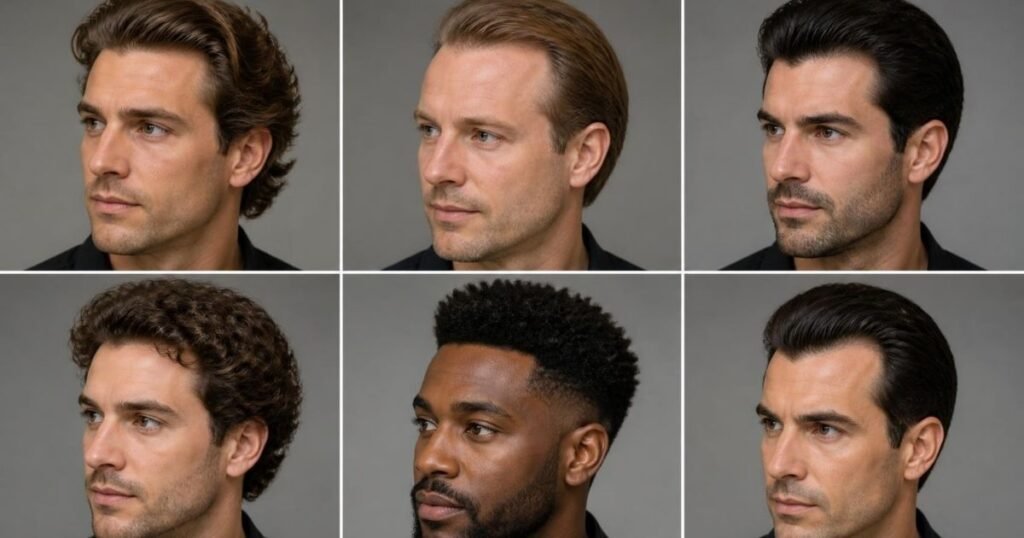
This section isn’t about new looks. It covers what changes when you adapt a slick back to your hair type and growth patterns. Categories overlap, so read more than one if you have mixed traits.
26. Slicked Back for Wavy Hair
Waves often sweep back with little effort, but the front may spring up and the pattern can vary across the head. Working with the direction of the wave, instead of flattening it, usually looks more natural.
- Style while damp, and use a light product such as mousse or sea salt spray.
- A blow-dry with a comb can smooth the front.
- Humidity can make waves puff, so a flexible-hold finish helps.
27. Slicked Back for Fine/Thin Hair
Fine hair has thin individual strands, while thin (or low-density) hair has fewer strands per area. Either can make the scalp more visible when swept back.
- Lightweight, matte-leaning products tend to add body without weighing hair down.
- Blow-drying at the roots can build lift.
- High-shine finishes may emphasize sparse areas.
A barber can advise on length and on any areas where the hair is thinning.
28. Slicked Back for Thick Hair
Thick or dense hair holds a shape but can puff at the sides or resist lying flat.
- Ask about weight removal (thinning or texturizing) for bulk.
- Section the hair and apply product in stages.
- A firmer hold, or a combination of a pomade and finishing spray, may help.
29. Slicked Back for Long Hair
At longer lengths, the challenge shifts from lift to tangles and weight.
- Style damp, detangled hair with a wide-tooth comb.
- Apply product mainly to the top and mid-lengths to avoid greasy ends.
- Wear it loose, tied back, or half up, depending on the hold you want.
This differs from #7 (medium length, tidy above the collar) and #18 (movement as the main feature).
Read More About : Modern Mullet Fade: The Complete Guide to Getting It Right in 2026
30. Slicked Back for Curly Hair
Curly hair can be swept back, but the result depends on curl pattern, length, and density. Expect a defined, textured sweep rather than a flat, glossy one.
- Style on damp hair, in sections, with a wide-tooth comb or fingers.
- Curl creams and gels help control frizz and hold definition.
- Moisture matters, since dry curls are harder to shape.
- Diffusing or air-drying keeps the curl pattern intact.
For tightly coiled hair, see #35.
31. Slicked Back for Straight Hair
Straight hair lies back easily but can look flat, fall forward, or lose hold by the afternoon.
- Blow-dry the roots upward before sweeping back for lift.
- A texturizing product can add grip.
- Cowlicks and the direction of the part can influence how straight hair behaves, so style in the direction of your growth where possible. See #34 if a cowlick keeps winning.
32. Slicked Back for Short Hair
Here the focus is styling. Short hair needs product with enough grip to hold direction, but not so much weight that it clumps.
- Work in the direction of growth, and use a small comb to set the sweep.
- A strong-hold, low-shine product can help short lengths stay put.
- Check the top length with your barber (see #10).
33. Slicked Back for Receding Hairlines
Sweeping hair back exposes the hairline, so it’s worth considering how you feel about that. There are options, but none “hides” a receding hairline.
- A softer front, some texture, or a slightly side-swept variation can change how the hairline reads.
- Avoid very tight, high-shine styles if you want less emphasis.
- Ask your barber how to cut the front for your hairline.
For concerns about hair loss itself, a doctor or dermatologist is the right person to talk to.
34. Slicked Back with a Widow’s Peak or Cowlicks
These are growth-pattern challenges, not hair-type ones. A widow’s peak is a V-shaped point at the center of the hairline. A cowlick is a spot where hair grows against the general direction, often at the front hairline or the crown.
Sweeping hair back puts both on display, and a front cowlick can push strands up or forward no matter how you comb.
- Wet the area and blow-dry it in the direction you want, then let it cool before adding product.
- Leave a little more length at a stubborn front cowlick, since the extra weight can help hair lie down.
- Use a firmer product at the problem spot only, not across the whole top.
- If a cowlick won’t cooperate, a side part (#2) may follow it more naturally than a full sweep.
- With a widow’s peak, working with the point often looks better than hiding it. Ask your barber how the edges should be cut around it.
Read More About : Fade Haircuts for Black Men: 58+ Sharp Styles & Tips In 2026
35. Slicked Back for Coily and Afro-Textured Hair
Coily hair forms tight spirals or zigzags, and the pattern varies from person to person, so there’s no single approach. One thing that applies broadly is shrinkage: coils spring up and the hair looks shorter than it measures, so you may need more actual length than someone with straight hair to get a visible sweep.
- Moisture matters. Styling coily hair on dry strands can cause breakage, so many people work with a leave-in conditioner or cream first.
- A wave brush with regular brushing is one way people train hair to lie backward, sometimes combined with a durag or satin cap. How well it works depends on hair length and pattern.
- Faded or tapered sides with a defined top can create a clear sweep, and a barber who works with your texture can advise on top length.
- Finishes range from a smooth, brushed-back look to a defined, textured sweep. Both are valid, and neither is more “correct.”
- Avoid pulling edges tightly. Hair at the hairline is delicate, and repeated tension can stress it.
How to Style a Slicked-Back Haircut at Home?
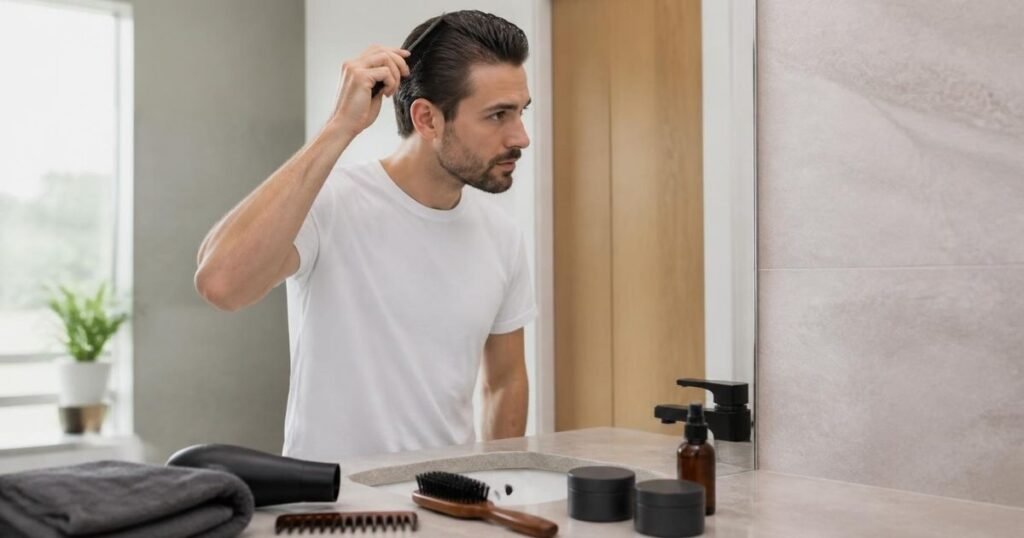
The basics are the same for most hair: start with the right hair state (damp or dry), use a small amount of product, and comb in the direction you want. Your hair type changes the details, so refer back to the section above.
Tools You’ll Need (Combs, Gel, Pomade)
- Towel: damp hair is easier to shape than soaking wet hair.
- Wide-tooth comb: for detangling and spreading product. Wider tooth spacing is gentler on thick, wavy, or curly hair.
- Fine-tooth comb: for a tidy, smooth finish.
- Brush (boar bristle, if you like): can help smooth and distribute product.
- Hair dryer: for directional blow-drying, which sets direction and adds root lift.
- Styling product: gel, pomade, clay, paste, or cream (see the table below).
- Finishing spray: optional, for added hold.
Step-by-Step Styling Guide
- Start with clean or freshly rinsed hair. Towel-dry it until damp.
- Choose your approach. Use damp hair for a glossier finish, blow-dried hair for lift and volume, or dry hair for a matte, textured look.
- Blow-dry in the direction you want. Use your fingers or a brush to direct the hair back, and aim the airflow at the roots for lift.
- Warm a small amount of product between your palms. Start small and add more only if needed.
- Apply from front to back. Section thicker hair first.
- Comb in your preferred direction. Use the wide-tooth comb to spread the product, then the fine-tooth comb to refine.
- Set the finish. Add a light mist of spray if you need extra hold, and leave the hair alone.
If this happens:
- The front falls forward: blow-dry the roots backward and use a slightly firmer product.
- The sides puff out: ask your barber about side length or weight removal, and press down with a little product.
- The top looks flat: lift at the roots with a blow-dryer and avoid heavy products.
- It looks greasy: use less product, or switch to a lighter formula.
- Flyaways around the temples: smooth with a small amount of product or a light spray.
Read More About : Low Blowout Taper for Black Men with a Clean, Sharp Styles (2026)
Product Recommendations by Hair Type
There’s no single best product, because it depends on the finish you want and how your hair behaves. These are product categories, with general characteristics that vary by brand.
| Product type | Hold | Finish | May suit | Watch out for |
| Water-based pomade | Medium to strong | Medium to high shine | Most hair types, especially those that need easy wash-out | Can feel heavy on fine hair |
| Oil- or wax-based pomade | Strong | High shine | Thick or coarse hair | Harder to wash out, can build up |
| Gel | Strong | Glossy, sometimes stiff | Thick hair, wet-look finishes | Can flake or feel stiff |
| Clay | Medium to strong | Matte | Fine or low-density hair, textured styles | Can feel dry |
| Paste or cream | Light to medium | Natural to matte | Wavy, fine, or looser styles | May not hold all day in humidity |
| Sea salt spray / mousse | Light | Matte, textured | Adding body before styling | Can dry hair out |
Tips for Long-Lasting Hold
Styles usually fall because of humidity, oil, weight, or cowlicks. A few habits help:
- Apply thin layers of product rather than one heavy coat.
- Blow-dry as you shape the hair, so the direction is “trained” in.
- Finish with a light spray if you need extra staying power.
- Keep your hands out of your hair, since the oils from your fingers can loosen the hold.
- Choose a product that suits your humidity and hair type. A flexible hold can last better than a stiff one that cracks.
How to Choose Between a Wet Look and a Natural Finish
| Wet look | Natural finish | |
| Look | Glossy, defined comb lines | Soft, matte or low-shine, some separation |
| Typical products | Gel, high-shine pomade | Clay, paste, cream, or just a blow-dry |
| Effort | Moderate, needs neat application | Low to moderate |
| Best for | Formal events, sleek styles | Everyday wear, looser looks |
| Watch out for | Shine can emphasize scalp visibility; heavy feel | Less hold in humidity |
If your workplace is conservative, a neat, low-shine finish is often a safe middle ground. If you have fine hair or lower density, a matte, natural finish may flatter more.
Slick Back Hairstyle Maintenance Tips
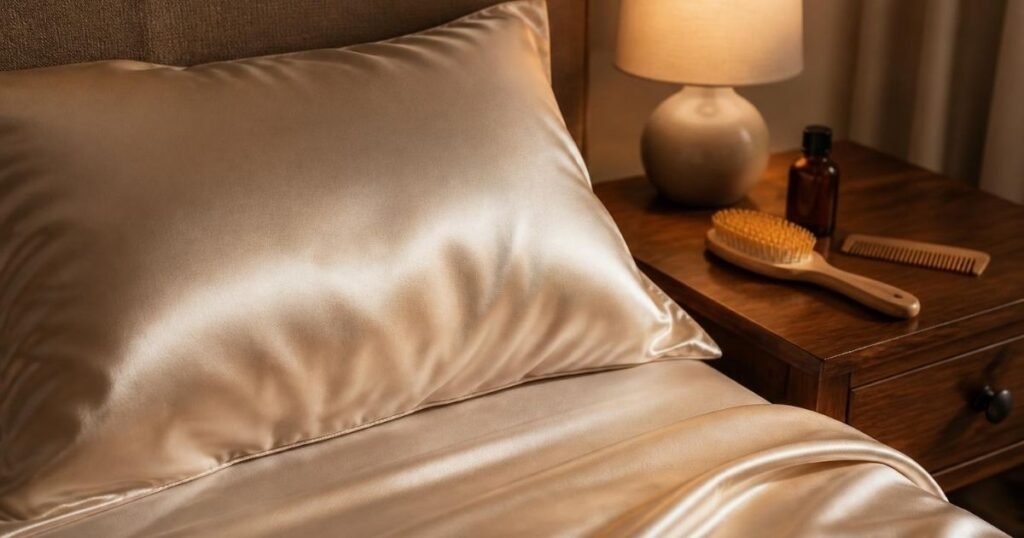
Upkeep has two parts: how you care for your hair day to day, and how often you visit a barber. There’s no universal schedule, so the right rhythm depends on your sides, your hair growth, and your standards.
1. How Often Should You Restyle?
This can mean two things.
How often should you wear it? If you use tight, high-tension styles, rotate with looser looks. Repeated tight pulling on the same area can stress hair in some people, and traction-related thinning is a recognized issue. Varying the tension and the direction is a sensible habit. Washing out product regularly rather than layering over old buildup also helps.
How often should you get it cut? It depends on your sides. A skin fade, hard part, or sharp shape-up tends to look crisp for a shorter time than a scissor-blended side. Hair typically grows roughly half an inch (about 1.25 cm) a month, but this varies. Your barber can suggest a rhythm based on how quickly you outgrow your look.
2. Avoiding Greasiness
Greasiness usually comes from too much product, a heavy formula, or an oily scalp.
- Start with a small amount and add more only if needed.
- Choose a lighter product, such as a cream, matte clay, or soft gel.
- Wash out product buildup regularly, and consider an occasional clarifying shampoo if buildup is a problem (not too often, since it can dry hair).
- Avoid touching your hair through the day.
- To refresh between washes, a quick comb and a small touch of product on dry hair often works better than adding more on top.
3. Nighttime Care
- Take out any tight styling before bed.
- Brush or comb through to remove tangles and spread natural oils.
- A satin or silk pillowcase may reduce friction and frizz.
- A little leave-in conditioner or light oil on the ends can help if your hair feels dry.
How to Ask Your Barber for a Slicked-Back Haircut
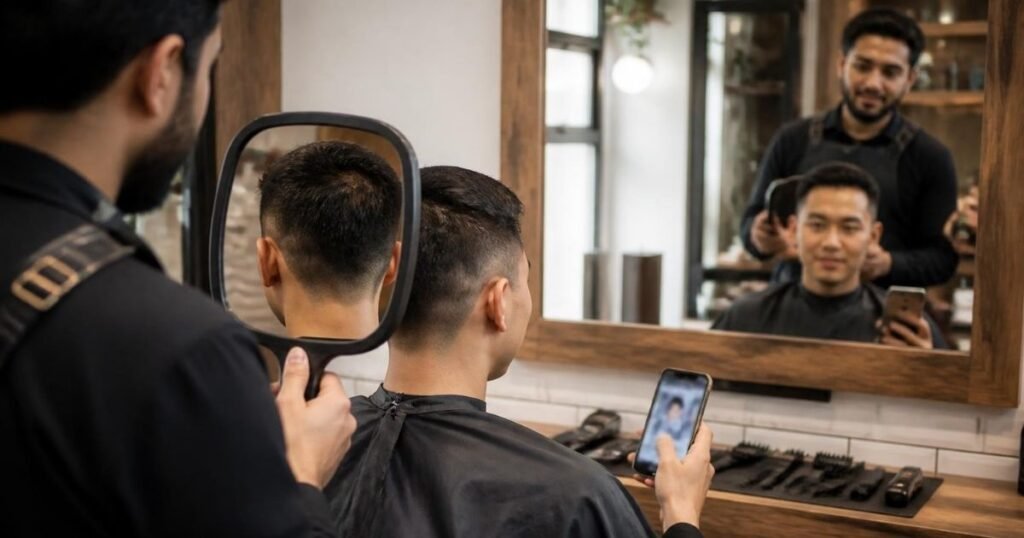
“Slicked back” tells your barber the direction, not the cut. To get what you want, describe the sides, top, part, and finish. No single phrase will produce identical results in every shop, so show as well as tell.
Choosing the Right Top Length and Side Finish
Two decisions shape the cut: how much length to leave on top, and how the sides should look.
For the top, ask your barber to leave enough length to sweep back comfortably, accounting for your growth patterns and any cowlicks. If you want a longer style later, say so.
For the sides, here’s how common finishes compare:
| Side finish | Contrast with top | Regrowth visibility | Notes |
| Scissor-blended | Low | Low | Softest, most gradual (#11) |
| Taper | Low to moderate | Low to moderate | Neat at the neckline and ears (#5, #15) |
| Low fade | Moderate | Moderate | Starts low on the sides |
| Mid fade | Moderate to high | Moderate to high | Starts around the middle of the sides (#20) |
| High fade | High | High | Starts near the temples (#23) |
| Skin fade | High | High | Fades to bare skin (#6) |
| Drop fade | Moderate to high | Moderate to high | Curves down behind the ear (#17) |
| Burst fade | Moderate to high | Moderate to high | Curves around the ear and leaves length at the nape (#24) |
| Undercut | High | High | Disconnected from the top (#4) |
Questions to ask yourself: How much contrast do I want? How often am I willing to get a trim?
Explaining Your Preferred Texture, Parting, and Finish
Tell your barber:
- Finish: matte, natural, or glossy.
- Part: none, soft natural part, or hard part.
- Volume: flat, moderate, lifted at the front, or lifted at the crown.
- Edges: a natural hairline or a sharp shape-up.
- Neckline: tapered, squared, or rounded.
- Daily routine: how long you’re willing to spend styling.
- Concerns: cowlicks, a widow’s peak, a receding hairline, or thinning areas.
Sample phrasing: “I want the top long enough to brush straight back, with a mid taper on the sides, a tapered neckline, and a natural, matte finish. My hair tends to fall forward at the front, so I need it cut to work with that.”
Using Reference Photos to Communicate Your Desired Look
- Choose photos where the person’s hair type and hairline resemble yours.
- Bring more than one angle (front, side, and back) if you can. This matters most for drop fades, burst fades, and necklines.
- Point out what you like: the sides, the top length, or the finish.
- Keep in mind that a photo shows one person’s hair. Your barber may adapt the cut to suit yours.
Read More About : 16+ Blowout Taper Fade Haircuts: Style, Variations & Guide In 2026
Frequently Asked Questions
Is the Slicked-Back Look Professional?
Often, yes, particularly in a neat, low-shine version. Dress codes vary, though, so a conservative workplace may prefer a more natural finish than a high-gloss wet look.
Can You Slick Back Curly Hair?
Often, yes, with a different technique and different expectations. Curly hair usually looks textured rather than flat. See #30 for curls and #35 for tightly coiled hair.
Will Slicking Back Hair Cause Hair Loss?
Slicking back on its own isn’t known to cause genetic pattern hair loss. Repeated tight pulling, however, can contribute to traction-related thinning in some people, so varying tension is sensible. If you’re worried about hair loss, it’s worth seeing a doctor or dermatologist.
How Do I Keep the Style All Day?
Use thin layers of product, blow-dry as you shape, and finish with a light spray. Keep your hands out of your hair. See the long-lasting hold tips above for more.
Final Thoughts
A slicked-back hairstyle is easier to get right when you break it into four decisions: top length, sides, part, and finish. Decide what you want for each, and the rest follows. Small details like edges and neckline can then fine-tune the result.
Remember that results depend on your hair density, texture, hairline, and growth patterns. Bring reference photos to your barber, describe what you like about them, and let them adapt the cut to your hair. If it needs adjusting after a few weeks of styling, that’s normal.

Jake Miller is a barbering and men’s hairstyle enthusiast who shares practical tips, haircut inspiration, and the latest grooming trends at BarberZylo. He enjoys exploring modern and classic hairstyles and helping readers find fresh ideas for their next look.
One Comment