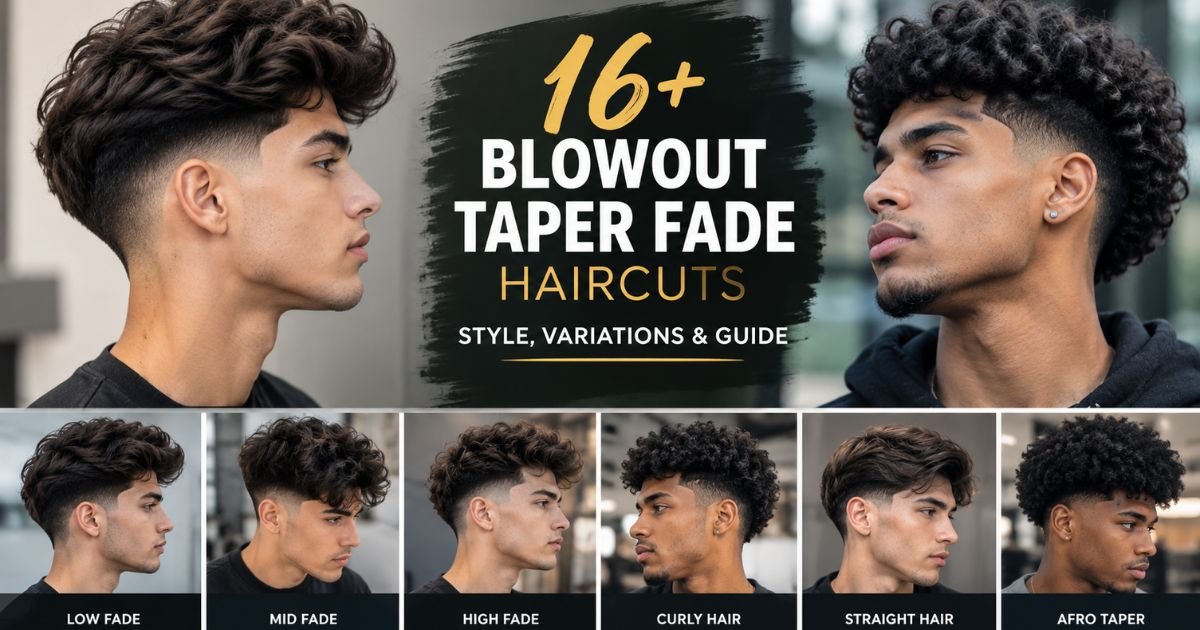
16+ Blowout Taper Fade Haircuts: Style, Variations & Guide In 2026
A blowout taper fade pairs sides that shorten gradually with a top left long enough to be dried up and back, so the hair sits with lift instead of lying flat. This guide covers 16 versions of blowout taper fade haircuts, explains how the cut differs from a regular taper and from a fade, and gives you what you need to brief a barber, style it at home, and keep the shape between appointments.
A quick note on terms. US barbers usually talk about clipper guard numbers, while UK barbers often say grades. They’re close but not identical, so this guide gives millimetres and inches where it matters. Likewise, “blow dryer” and “hairdryer” mean the same thing here.
At a glance
- Sides: Hair shortens gradually toward the ears and neckline, usually without going fully to skin.
- Top: Long enough to be lifted and held. How long depends on your hair type.
- Styling: Usually needs a dryer and a little product. The effort varies with your hair.
- Upkeep: The sides and neckline tend to show growth first. The top usually changes more slowly.
- Best first step: Bring photos from the front, side, and back to your appointment.
Popular Blowout Taper Fade Variations
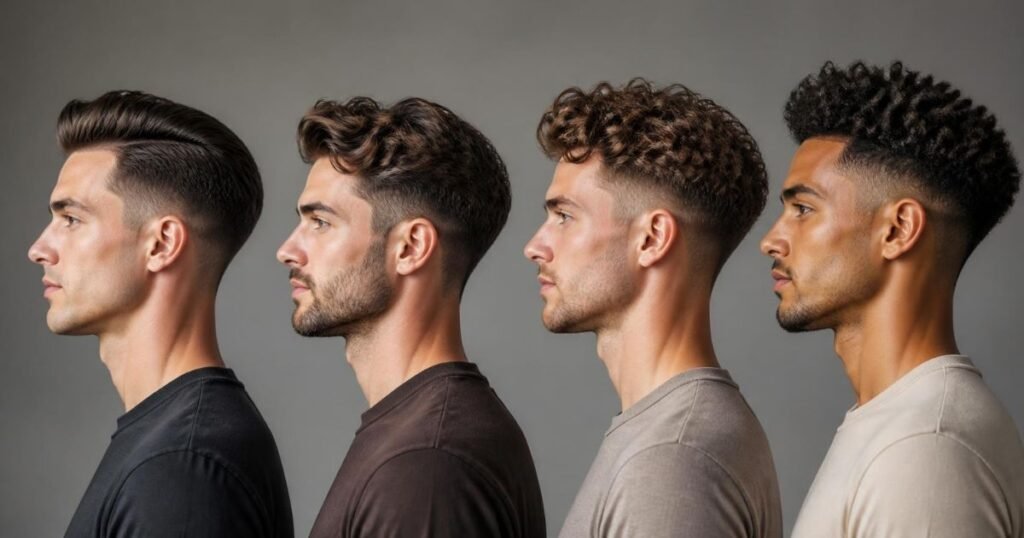
These aren’t 16 unrelated haircuts. They’re combinations of a few choices: how high the taper starts, what your natural hair does, how the top is cut and finished, and whether you add sharp edges or a beard. You can mix them. A mid taper with curly hair and a beard is a perfectly ordinary request.
Use this table to jump to the entries that match your situation:
| Group | Entries | Choose by |
| Baseline | 1 | A starting reference |
| Taper height | 2–4 | How much contrast you want |
| Hair type | 5–8, 14 | Your natural texture and curl pattern |
| Top style | 9–13 | Length and finish on top |
| Add-ons | 15–16 | Edges and facial hair |
1. Classic Blowout Taper Fade
Think of this as the reference point for every other entry. The sides taper down gradually, the neckline blends softly, and the top is long enough to be dried upward and slightly back. The contrast between top and sides is moderate, so it reads as a lifted top rather than a dramatic shape.
A simple way to ask for it: taper the sides, keep the length on top, and blow-dry for lift. It tends to be easiest on straight to wavy hair of medium density, though results depend on your growth patterns and how the barber adapts the cut.
2. Low Blowout Taper Fade
The taper starts low, around the sideburns, the edge of the ears, and the nape, so more hair stays on the sides. That gives the softest contrast of the three heights and a fuller overall outline.
The big practical benefit is how it grows out. With less of a step between the sides and the top, it tends to lose its shape more gradually. “Low” isn’t standardized, though. One barber’s low may sit higher than another’s, so a photo helps more than the word alone.
3. Mid Blowout Taper Fade
The taper starts around temple level, which frames the top more clearly than a low version does. The sides look tidier and the volume on top reads more distinctly.
Because “mid” varies between barbers, describe where the shortening begins relative to your ear and temple. Many people pick it as a middle path, but whether it suits you depends on your head shape, hairline, and how much contrast you like.
4. High Blowout Taper Fade
Here the taper begins high on the head, so the top stands out sharply against short sides. It gives the strongest contrast of the three heights.
That contrast is also the trade-off. Short sides spotlight the top, which means density, hairline shape, and any recession at the temples become more visible. Fine or thinning hair can look sparser against very short sides. It’s worth talking through with your barber. It also shows growth sooner, so it tends to need more frequent upkeep.
Read More About : Types of Fade Haircuts for Men: 50+ Skin Fade Hairstyles to Try in 2026
5. Blowout Taper Fade for Curly Hair
With curls, “blowout” usually means loosening or stretching the curl with a dryer to gain lift and fullness, instead of keeping every curl tightly defined. (If you’d rather keep the curl pattern, see entry 14.)
Curls shrink as they dry, so judge the length of your top by how it looks dry, not stretched. A barber who cuts curly hair regularly can usually read that better. Heat protection and moisture-focused products matter more here, and results depend on your curl pattern and how prone your hair is to frizz.
6. Blowout Taper Fade for Wavy Hair
Waves already bring movement and some natural lift, so many people need less drying effort than someone with straight hair. The styling goal is often to work with the wave instead of flattening it.
Watch for uneven wave direction and cowlicks at the front, which can pull sections the wrong way. Very thick waves can get heavy and may benefit from some weight removal. Light products help keep the movement.
7. Blowout Taper Fade for Straight Hair
Straight hair doesn’t have natural bend to hold lift, so volume comes more from the cut’s structure and the drying technique. Texture cut into the top, a pre-styler, and root-focused drying make a noticeable difference.
The type of straight hair matters. Fine hair can be weighed down by heavy product, while very thick, coarse straight hair can be heavy enough to drop over the course of the day. Neither is a dealbreaker, but both change what you should ask for.
8. Blowout Afro Taper Fade
The top is shaped into a rounded or squared silhouette with a defined taper around it. Volume comes naturally from the hair’s texture, and “blowout” may mean stretching the hair with a dryer and picking it out for fullness.
The silhouette is worth discussing: how rounded or flat the top should be, and how the taper meets it. Moisture and detangling matter for coily hair. Barbers experienced with textured hair can be a real advantage, and terms like “taper,” “shape-up,” and “line-up” can differ between shops.
9. Blowout Taper Fade With Textured Top
Here the texture is built into the cut using techniques like point cutting, razor work, or layering, so the top separates into pieces instead of forming one solid mass. Product then reinforces it.
Thick hair often benefits from weight removal, while fine hair can lose body if it’s over-thinned. If you like this look, you may also see it called a textured crop or a quiff when the length and direction shift.
Read More About : 300+ Low Fade Haircuts for Men: Find Your Perfect Style
10. Blowout Taper Fade With Short Top
This version suits people who don’t have much length to work with or who want minimal styling. The lift is modest, and it dries quickly.
Be realistic about the results. Below a certain length, the shape moves closer to a short textured crop or a small quiff than a full blowout. Curly hair may still build fullness at shorter lengths, while straight hair typically gets less height. A matte product and a quick dry are usually enough.
11. Blowout Taper Fade With Long Top
More length means more movement, but also more weight. A longer top can sweep back with a fluid shape, though it needs more effort to hold its lift.
Layering can lighten the top. Many people find a round brush and a bit of hold product help. It takes more styling time, and if you decide you don’t like it, it takes longer to change. The result sits closer to a pompadour or a slick-back than the shorter versions do.
Photo caption: Show the top from the side to reveal how far it extends and where the weight sits.
12. Blowout Taper Fade With Fringe
Instead of lifting the top back, the front is brought forward or swept to the side over the forehead, while the sides stay tapered.
Forehead height, hairline shape, front cowlicks, and receding temples all influence how a fringe sits. Glasses can also change the balance. Drying the fringe forward first, then adding lift at the roots, tends to give more control.
13. Messy Blowout Taper Fade
The messiness is a finishing choice, not a different cut. It typically means low hold, a matte finish, and a deliberately unfinished look.
It still needs setup: a dryer for lift and a light product to keep pieces separate. Some workplaces may lean toward a tidier finish, which is worth considering. This differs from entry 9, where the texture comes from how the hair is cut.
14. Blowout Taper Fade With Defined Curls
This is the opposite approach to entry 5. Instead of stretching the curls, the volume comes from the shape and clumping of the curls themselves, with the taper giving structure around them.
Styling usually involves a curl cream or gel, scrunching, and a diffuser, then leaving the curls undisturbed while they dry. It borrows the taper and top volume from the blowout style without the stretched dry.
Read More About : Top 40 Mid Fade Haircuts for Men: Fresh, Modern Styles to Try
15. Blowout Taper Fade With Line-Up
A line-up (also called an edge-up, shape-up, or outline) adds a crisp edge along the hairline and temples. It’s a finish added to the cut, not a separate haircut.
Because it highlights hairline shape, receding or uneven hairlines are worth discussing beforehand. A natural line and a sharp line look quite different, and a crisp edge needs more frequent upkeep to stay crisp.
16. Blowout Taper Fade With Beard
The taper blends into the sideburns and beard so the transition looks continuous instead of ending in a visible step.
Beard length and shape interact with your face proportions. Volume on top adds height, while a beard adds weight to the lower face, so the balance between the two matters. Ask your barber to coordinate the sideburns, taper, and beard neckline together.
What Is a Blowout Taper Fade?
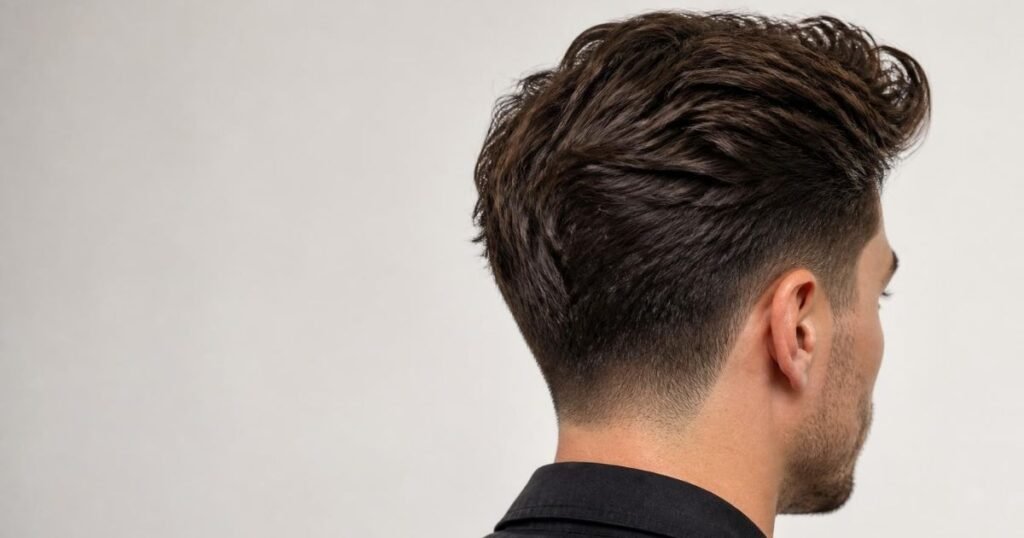
It’s easiest to understand as three parts working together:
- The side taper: hair that gets gradually shorter down the sides and neckline.
- The top length: enough hair on top to be moved and held upward.
- The blow-dried finish: the drying and styling that creates lift and shape.
The last part is worth noticing. “Blowout” describes a styling result as much as a cut. A barber can give you the structure, but the lift still depends on how the top is dried and styled. You’ll also see the style called a blowout taper haircut, and some people use “blowout” for a specific look, so descriptions can vary.
It sits close to other lifted styles. A quiff usually has a more directional, swept-up front, a pompadour typically carries more height and length, and a textured crop is often shorter and more forward. The overlap is real, and photos help you pinpoint exactly what you want.
Blowout Taper Fade Vs Regular Taper Fade
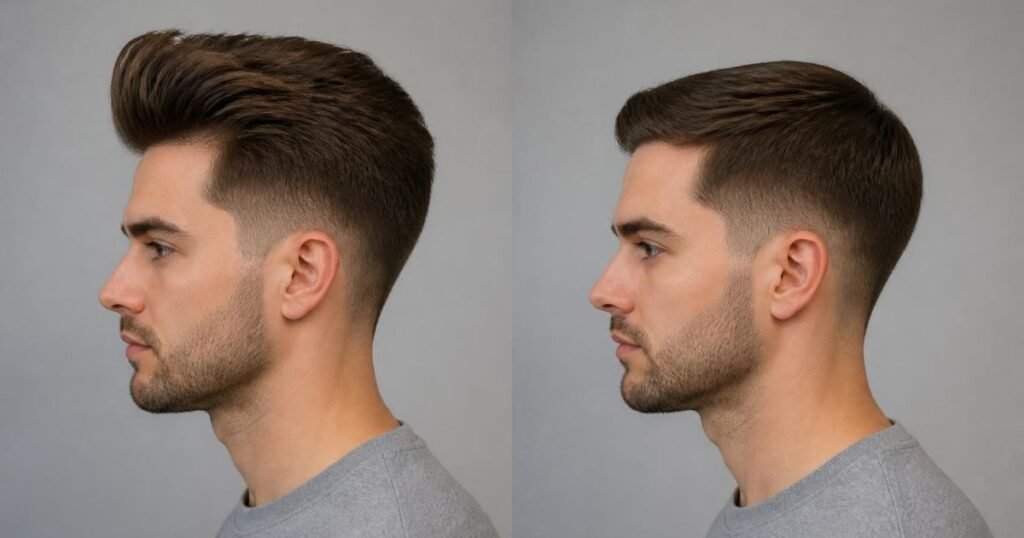
The sides in both can be identical. The real difference is the top: how long it is, how it’s styled, and the silhouette it creates. In this article, “regular taper fade” means a taper where the top is styled without dedicated volume, for example combed, side-parted, worn flat, or lightly textured.
| Factor | Blowout taper fade | Regular taper fade |
| Top length | Long enough to lift | Varies, often shorter or lying flatter |
| Styling method | Dryer plus product | Comb, product, or minimal |
| Silhouette | Taller and fuller | Flatter and more even |
| Daily effort | Usually more | Often less |
| Grow-out look | The top adds weight as it grows | Depends on the top length |
Key Visual and Styling Differences
Look at both from the side. A blowout has visible lift at the roots and a fuller outline above the forehead, while a regular taper’s top tends to sit closer to the head. The parting and direction differ too: a blowout often moves up and back, while a regular taper might be combed over, parted, or brushed forward.
Volume and Finishing Contrast
Volume in a blowout comes from a dryer, a pre-styler, and a light product. A regular taper may use a comb and a small amount of product, or nothing at all. Finish isn’t tied to either style, since both can be matte, natural, or sleek.
Hair that lifts easily may need less help, while very fine or slippery hair may need more.
Read More About : High Fade Haircuts: What They Are & The Best Versions For 2026
Who Should Choose a Blowout Taper Fade?
A blowout taper fade may suit you if:
- You’re comfortable styling with a dryer most days.
- You like visible height on top.
- You have enough length or texture to lift.
A regular taper fade may suit you if:
- You prefer less styling time.
- You like a flatter, more even finish.
- You want a shorter or lower-maintenance top.
Hair physiology is a separate question, and the next sections cover it.
Blowout Taper Fade Vs Blowout Fade
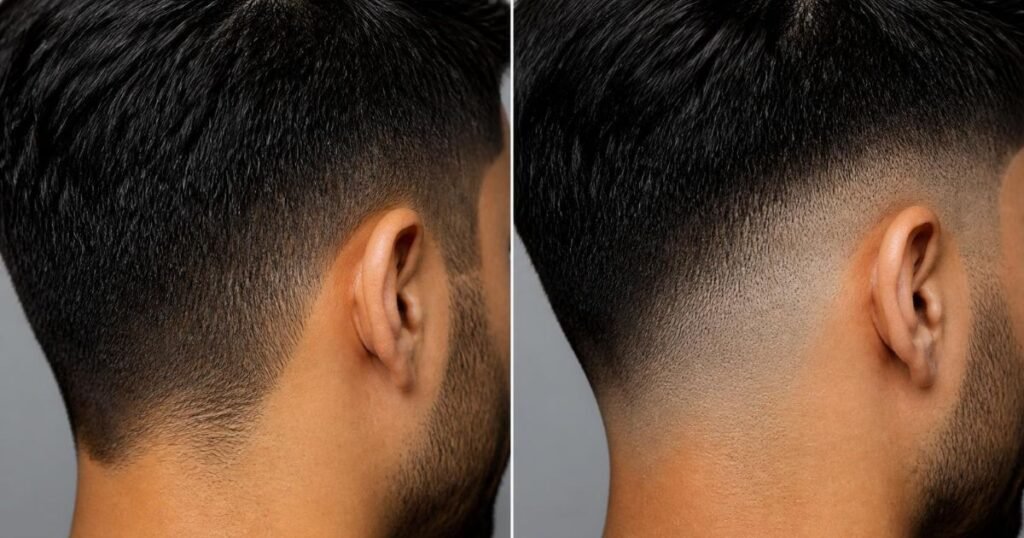
The blowout top is the same in both. What changes is how the sides are cut. Terms vary by barber and region, though, so treat this table as a general guide instead of a strict rule.
| Taper on the sides | Fade on the sides | |
| Shortest point | Usually leaves more length | Can go very short, sometimes to skin |
| Contrast | Softer | More dramatic |
| Overall look | Gradual and natural | Sharper and more graphic |
What Makes a Taper Different From a Fade?
A taper generally shortens hair gradually and usually leaves more length at its shortest point, often around the sideburns and neckline. A fade generally shortens more dramatically, can reach skin, and shows more contrast. “Taper fade” is a common hybrid term that many barbers use for something in between.
Because words differ between shops, describe the result instead of relying on one term:
- Where the shortening starts (relative to your ear and temple).
- How short it gets at the bottom (in guards, grades, or millimetres).
- Whether skin should show.
For reference, common clipper guards run roughly 3 mm (⅛ inch) for a #1 or grade 1, and 6 mm (¼ inch) for a #2 or grade 2, though brands differ slightly.
How the Finished Look Can Differ
A taper looks softer and blends more subtly, while a fade looks starker where it reaches skin. Hair colour, skin tone, and density change how visible the contrast is. A dark fade against light skin reads very differently from a light-coloured fade against dark skin, for example.
The sides also frame the top differently. A fade draws the eye to the top’s outline, while a taper keeps the sides looking fuller. Growth shows sooner on a fade.
Is a Blowout Taper Fade Right for You?
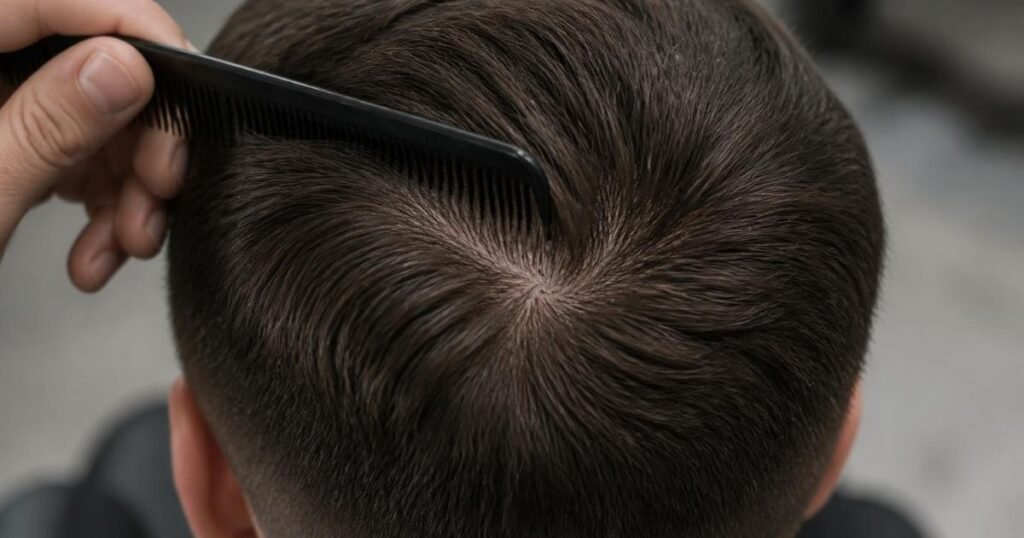
There’s no simple yes or no here. The sections below use “may work well if” and “may be harder if” so you can weigh your own hair against the style. Entries 5–8 above cover hair-type specifics in more detail.
Hair Type and Texture
| Hair type | May help | May take more effort |
| Fine, straight | Light products, root-focused drying | Holding lift through the day |
| Thick, straight | Texture cut into the top | Weight pulling the top down |
| Wavy | Natural movement and lift | Uneven wave direction |
| Curly | Natural body and fullness | Shrinkage, frizz, heat sensitivity |
| Coily | Natural volume | Moisture, shaping the silhouette |
Hair Density and Length
Density means how much hair you have, and strand thickness is a separate thing. Sparse density can make a high taper look starker, while dense hair may need weight removal to avoid feeling heavy.
Length matters too, along with how fast your hair grows. If you’re starting short, it may take time to grow enough for lift, and curls need extra length to allow for shrinkage.
Growth patterns can also affect the result:
- Cowlicks at the front can push the top in an unexpected direction.
- Crown swirls can make the back sit differently.
- Thinning at the crown or temples changes how the top and taper look.
A barber can assess these in person.
Read More About : Low Fade vs Mid Fade vs High Fade: What’s the Key Differences and Which Suits You Best?
Face Shape and Facial Proportions
Face-shape advice is a guide, not a rule. Extra height on top adds visual length to the face, and a higher taper narrows the look of the sides. Forehead height, jaw shape, head shape, ear position, glasses, and beard all play a part.
| Consideration | What it can influence | Worth discussing with your barber |
| Forehead height | How much lift feels balanced | How much height to leave |
| Head shape | How the taper sits | Where to start the taper |
| Ears | How visible the sides are | Taper height near the ears |
| Beard | Overall proportion | Blending and length |
Styling Commitment
Consider time, tools, and weather. Humidity can flatten or frizz the top, and your dress code may shape how relaxed the finish can be. Before your appointment, try the dryer routine at home for a few days.
Quick self-check:
- Do I have a dryer and a few minutes most mornings?
- Am I comfortable using a small amount of product?
- Can my hair handle regular heat?
How to Ask Your Barber for a Blowout Taper Fade?
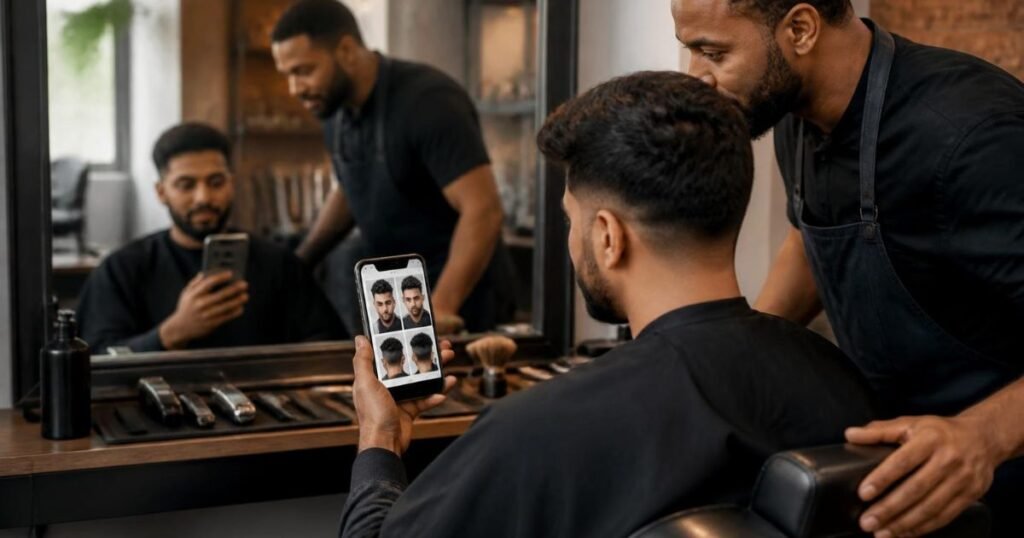
No single phrase guarantees the same result in every shop. What helps is describing what you want, showing photos, and asking how the barber would adapt it to your hair.
Key Terms to Mention
| Term | Meaning | When to use it |
| Taper | Gradual shortening down the sides | Describing side finish |
| Fade | More dramatic shortening, sometimes to skin | If you want more contrast |
| Skin fade | A fade that reaches skin | If you want the very shortest |
| Guard / grade | Clipper length setting | Describing the shortest point |
| Blend | Smooth transition between lengths | Asking for no visible steps |
| Weight | Bulk of hair in an area | Asking to keep or remove bulk |
| Texture | Movement or separation in the top | Describing the top’s finish |
| Neckline | Shape of the hair at the back | Choosing natural or squared |
| Line-up | Crisp edge along the hairline | If you want sharper edges |
| Fringe | Hair brought forward at the front | If you want a forward top |
Length Guidance for Top and Sides
For the top, think about what the length needs to do: it should be long enough to be moved and held by a dryer. As a loose starting point, many people work with somewhere around 5 cm (2 in) or more, measured on dry hair. Curly hair may need more to allow for shrinkage, and fine straight hair may need a different balance. Ask your barber to assess it.
For the sides, don’t rely on a guard number alone. Useful questions to bring:
- Where will the shortest point be?
- How gradually will it change?
- Will skin show?
Importance of Showing Reference Photos
Bring photos from the front, side, and back if you can. Pick images where the hair looks similar to yours in texture and density. Point out what you like: the taper height, the top length, the finish. A “don’t want” photo can help too. Your barber may adapt the look to fit your hair, and that’s normal.
Read More About : Taper vs. Fade Haircut: Which One Should You Ask Your Barber For?
Explain How Much Volume You Want
Use a simple scale: subtle lift, moderate, or big. Add direction: up at the front, back, or forward. Then ask how they’d style it and what daily effort is realistic.
Sample script: “I’d like a mid taper on the sides, blended into the neckline, with the length kept on top so I can blow-dry it up and back. Moderate volume, not too tall. Here are a few photos. Can you tell me how it’d work with my hair?”
How to Style a Blowout Taper Fade at Home?
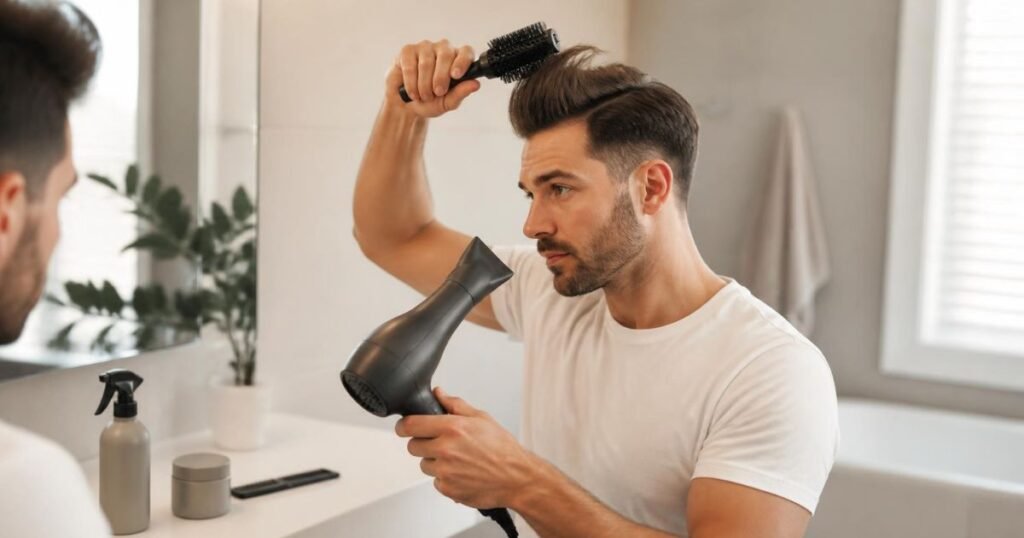
Technique, products, and routine are three separate parts of this. No exact temperatures or timings are needed. Adjust by feel.
Blow-drying Technique for Volume
- Start with towel-dried, damp hair that isn’t dripping. Add heat protection if you like.
- Use a nozzle on the dryer to direct airflow.
- Dry the roots up and back (or forward if you’re styling a fringe).
- Work in sections, using a round brush, vent brush, or your fingers.
- Finish with a cooler setting to help set the shape.
Adjust for your hair type. Fine hair benefits from extra root lift, curly hair may use a diffuser or stretching, and coily hair may use a comb attachment.
What Hair Products Can Help?
Choose by the result you want, not by brand.
| Goal | Product type | Note |
| Root lift and grip | Pre-styler (sea salt spray, mousse, blow-dry lotion) | Applied before drying |
| Matte hold | Clay or paste | Use small amounts |
| Flexible finish | Fibre or cream | Depends on your hair |
| Extra hold | Light hairspray | Optional |
Heavy products can weigh down fine hair, while curly and coily hair may prefer moisture-focused options.
Daily Styling Routine (Simple Steps)
- Start with damp hair.
- Apply a pre-styler at the roots.
- Dry with lift up and back.
- Shape the top with your fingers or a brush.
- Add a small amount of product to finish.
- Set with cool air or a light spray if needed.
How to Keep the Taper Looking Clean?
Between visits, gentle care is usually enough: washing, scalp care, and tidying stray hairs on the neck. Reshaping the taper is better left to a barber, because it’s easy to over-trim and lose the blend. You’ll know it’s growing out when the sides look fuller and the transition looks less crisp. Some barbers offer shorter tidy-up appointments, but that isn’t universal.
How Often Should You Maintain a Blowout Taper Fade?
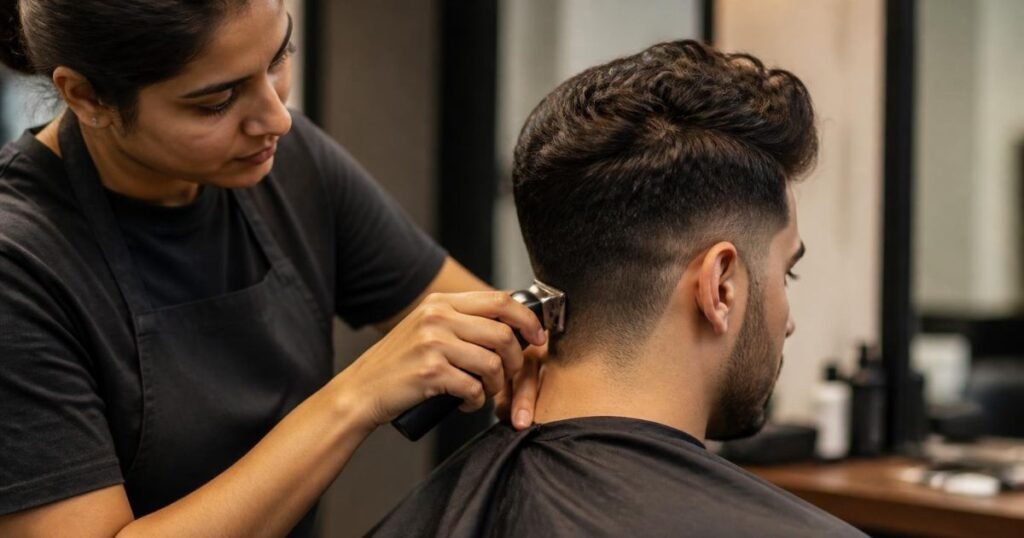
There’s no single right schedule. Think about what changes as your hair grows. The sides and neckline usually show growth first, and the top may get heavier over time.
Recommended Trim Frequency
Several things shift the timing:
Sooner:
- A high taper or skin fade, which shows growth quickly.
- A sharp line-up or a beard blend.
- A strong preference for crisp edges.
- Fast-growing hair.
Later:
- A low taper with softer contrast.
- A relaxed attitude to a slightly softer look.
- Slower-growing hair.
If you want a firm number, ask your barber, since it depends on your hair and how sharp you like it.
Read More About : Low Taper Fade: 25 Best Styles and Grooming Tips for Men
Managing Volume Between Haircuts
Volume mainly comes from styling, not from how often you cut. Flat days, humidity, and product build-up can all take away lift. As the top grows, its weight changes too. To refresh, use the dryer again or mist lightly with water, and keep the product minimal.
Keeping the Taper Sharp Without Overcutting
At maintenance visits, be specific. Ask them to tidy the sides and neckline, leave the top length, or trim only the ends. Some tops need occasional shaping, but repeatedly cutting the top can reduce the length you need for lift.
Try saying: “Just tidy the sides and neckline, and leave the top as it is.”
FAQs
What is a blowout taper?
It’s a haircut with sides that shorten gradually and a top left long enough to be dried upward. Compared with a regular taper, the difference is mostly on top: it’s styled for lift instead of worn flat.
Does a blowout taper fit everyone?
No haircut does. It depends on your hair type, density, hairline, and how much styling you’ll do. See the suitability section for the factors worth weighing, and ask a barber to assess your hair.
What does a blowout mean for a haircut?
It refers to the blow-dried, lifted finish on the top. The cut supports it by leaving enough length, but the volume comes from how the hair is dried and styled.
How Long Does Your Hair Need to Be for a Blowout Taper?
Long enough to be lifted and held, which varies by hair type. Curls need extra length to allow for shrinkage, and fine straight hair may behave differently. Ask your barber to assess it on dry hair.
Is a Blowout Taper Fade Good for Curly Hair?
It can work. There are two approaches: stretching the curls for lift (entry 5) or keeping them defined (entry 14). Results depend on your curl pattern, frizz tendency, and moisture.
How Do You Ask a Barber for a Blowout Taper?
Describe the taper height, the top length, and the volume level, then bring photos. See the barber section for a sample script.
How Often Should You Get a Blowout Taper Fade?
It depends on the contrast and how quickly your hair grows. The sides and neckline usually show growth first, and higher contrast shows it sooner.
Does a Blowout Taper Fade Require Daily Styling?
Usually some styling is needed to get lift, but the effort varies with your hair type and how much volume you want.
Final Thoughts on the Blowout Taper Fade Haircut:
Most of the decisions come down to four things: how high you want the taper, how well your hair type fits the style, how you want the top to look, and how much styling you’ll realistically do. Once you’ve settled those, the rest is a conversation with your barber.
Before your appointment:
- [ ] Photos from the front, side, and back
- [ ] The key terms you want to use
- [ ] A sense of how long you want the top
- [ ] Your preferred volume level
- [ ] An honest idea of your styling time

Jake Miller is a barbering and men’s hairstyle enthusiast who shares practical tips, haircut inspiration, and the latest grooming trends at BarberZylo. He enjoys exploring modern and classic hairstyles and helping readers find fresh ideas for their next look.