
Buzz Cut Men: 32 Bold & Clean Haircut Styles for 2026
A buzz cut is a haircut done with clippers so the guard sets the length. It can be one length all over, or it can taper or fade at the sides. Nearly everything else is a choice about three things: how short the hair is, how the sides are finished, and how the edges are shaped.
This guide covers buzz cuts for men from the shortest options to longer ones. It also explains guard numbers, how face shape, hairline, and hair type may affect the result, and how to describe what you want to a barber. The “32” in the title counts styles, face-shape notes, hair-type notes, and celebrity references, so not all 32 are separate haircuts.
What Is a Buzz Cut for Men?
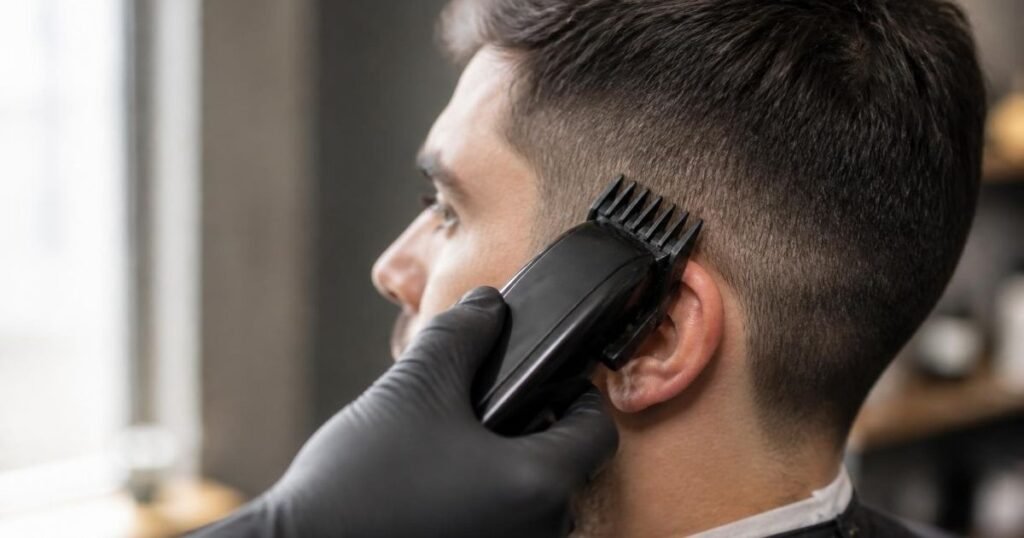
A buzz cut is a short clipper haircut where the guard (the plastic or metal attachment on the clippers) determines the length. Without a guard, the blade alone cuts the hair very close to the scalp.
The simplest version is one length all over. Many people also ask for a taper or fade at the sides and back, which gradually shortens the hair toward the ears and neckline.
Definitions blur at the edges. The brush cut, high and tight, disconnected cut, and long buzz cut all grow from buzz-cut techniques, so this article treats them as buzz-based styles. The crew cut is a close neighbor and is compared separately below.
Barbers and regions use these names differently. A guard number or a length in inches or millimeters is clearer than a style name.
Key Features of Buzz Cuts
Here are the main qualities that define a buzz cut. Each point is covered in more detail later.
1. Length
The hair is short enough that the guard, not scissors, sets the length. Most buzz cuts fall between a bare blade and roughly an inch, with longer versions at the edge of the category. The guard chart shows what each setting leaves behind.
2. Maintenance
A buzz cut needs almost no daily styling, but it isn’t zero upkeep. Edges, necklines, and fades look untidy sooner than the top does, and the scalp may need more care than it did under longer hair.
3. Types
Buzz cuts vary along three lines: length (induction, burr, butch, and longer versions), sides (uniform, tapered, faded), and edges (natural or sharp line-up, with or without a beard). The styles section is organized around those choices.
4. Get Creative
You can add a fade, a line-up, a shaved design, or color. Each one adds upkeep, so decide how much maintenance you’re willing to do before you commit.
5. Popularity
Buzz cuts are common among athletes, people in the armed forces (grooming rules vary by country and branch), and anyone who wants a short, low-effort cut. That’s an observation about who wears them, not a measure of how many people do.
Buzz Cut vs Crew Cut: What’s the Difference?
The short answer: a buzz cut is cut to a short, even length with clippers, while a crew cut leaves the top noticeably longer than the sides and tapers down toward the neckline.
| Buzz cut | Crew cut | |
| Top | Same length as the sides, or very close | Longer, often long enough to lift slightly at the front |
| Sides and back | Uniform, or tapered or faded | Tapered, usually blending up into the top |
| How it’s cut | Mostly clippers with a guard | Clippers on the sides, plus clipper-over-comb or scissors on top |
| Styling | Usually none | Optional light product to shape the front |
| Grow-out | Looks even for a while, then fuzzy | Looks shaggy at the top and sides sooner |
Barbers and regions blur this line. If you’re between the two, say something like “short on the sides, a little length on top,” and give the guard number for the top.
A crew cut tends to suit people who want some styling options. A buzz cut suits people who want none. That’s a preference, not a face-shape rule.
Related styles worth knowing are the flat top, the ivy league, and the high and tight. Each leaves a different amount of length on top.
Who Should Get a Buzz Cut?
A buzz cut may suit you if you:
- Want to skip daily styling
- Work, train, or play sports where hair gets in the way
- Prefer hair that dries almost immediately
- Are comfortable with your head shape being visible
You may want to think twice, or start with a longer guard, if you:
- Rely on hair length to feel comfortable in your appearance
- Dislike how your scalp looks when hair is very short
- Aren’t sure how you’ll feel about the grow-out phase
Pros and Cons of Getting a Buzz Cut
| Pros | Cons |
| Little or no daily styling | Shows head shape, scars, and moles |
| Dries quickly | Scalp is exposed to sun |
| Easy to keep neat | Fades and edges need regular touch-ups |
| Can feel cooler in warm weather | A mistake can’t be undone, only grown out |
| Easy to test different lengths over time | Limited styling variety |
Some of these depend on the individual. Scalp visibility, for example, varies with hair density, hair color, and skin tone.
Best Buzz Cut Styles for Men
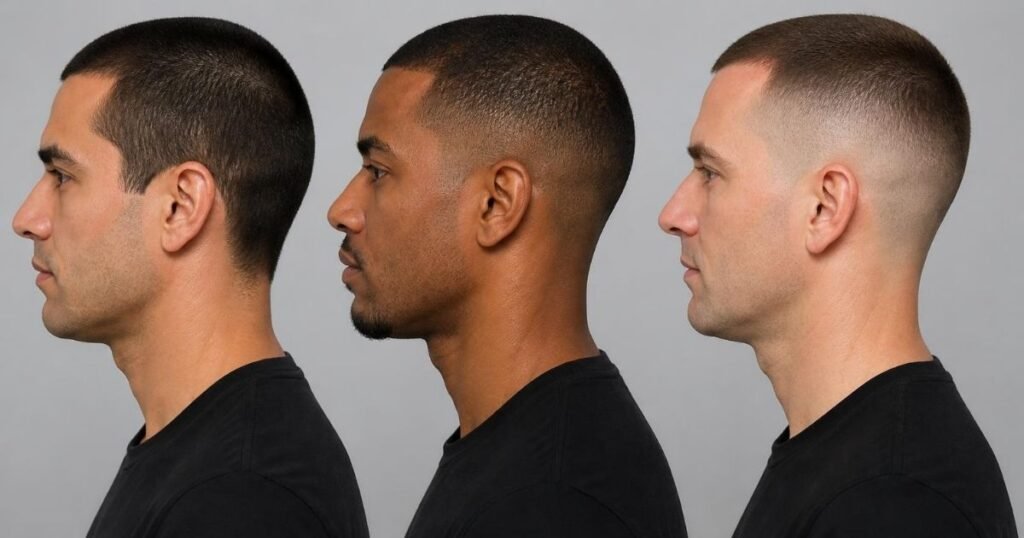
Use this section to explore ideas. A useful way to read it is to pick one option from each group:
- Length: induction, burr, butch, or long buzz
- Sides: uniform, taper, fade, skin fade, or high and tight
- Edges and extras: natural edges or line-up, beard or no beard, design, color
The brush cut, high and tight, disconnected, textured, and long buzz styles sit at the boundary of what counts as a buzz cut. They’re included because they use the same tools and are often requested by the same people.
1. Induction Buzz Cut (Military Classic)
The induction cut is the shortest end of the range, cut very close with the bare blade or the lowest setting. The name comes from military intake haircuts, though practices differ by country.
It differs from a shaved head, which is done with a razor or foil shaver and leaves the scalp smooth. An induction cut leaves a fine shadow of hair.
Because there’s so little hair, it shows head shape, scars, and scalp tone more clearly than any other style here. Density affects how much scalp shows through. “No guard” results also depend on the blade and the clippers, so describe the finish you want in addition to the number.
What to notice in photos: a side profile is the most useful view, because it shows head shape and where the hairline sits.
2. Burr Cut (Short & Uniform)
The burr cut is a step up from induction: very short, but with visible hair. It’s commonly cut with a #1 or #2 guard, though sources and barbers vary.
Many barbers don’t use the name “burr,” so ask by guard number and measurement. At this length the hair is short enough to lie flat on most hair types, which keeps the top looking even.
What to notice: compare the top and sides from above. A good all-over burr cut has no visible steps between sections.
Read More About : The Caesar Haircut: A Complete Guide for Men Who Want a Sharp, Low-Maintenance Look
3. Butch Cut (Thicker & Rugged)
The butch cut is a longer all-over length, often described as roughly #2 to #4, again with variation between sources. This is the step where hair starts showing real body.
At this length natural direction, curl, and cowlicks show more than they do on a burr cut. That can look good or frustrating depending on your hair, which is why it’s a sensible length to test before going shorter.
What to notice: a close-up of the top shows how the hair lies at this length.
4. Brush Cut (Textured Top)
The brush cut leaves enough on top that the hair can stand upright or be brushed forward, usually a little longer at the front than elsewhere, with shorter sides. It sits between a buzz cut and a crew cut or flat top, and the boundaries are blurry.
It’s often cut with clippers plus clipper-over-comb or scissors. Whether the top stands up depends on hair type: stiffer, straighter hair tends to stay upright, while softer hair may lie flatter. Most people need little or no product, though a light matte product can help the front hold its shape.
What to notice: a side view showing how the top height compares to the sides.
5. High and Tight Buzz Cut
The high and tight has very short or faded sides that rise high on the head, with a short top left noticeably longer than the sides. The sharp contrast between the two is what defines it.
Two details to specify are how high the short sides go and how long the top stays. Because the sides are so short, regrowth shows quickly, and the style tends to look best when refreshed regularly.
What to notice: side and back views, where the height of the shortest section is clearest.
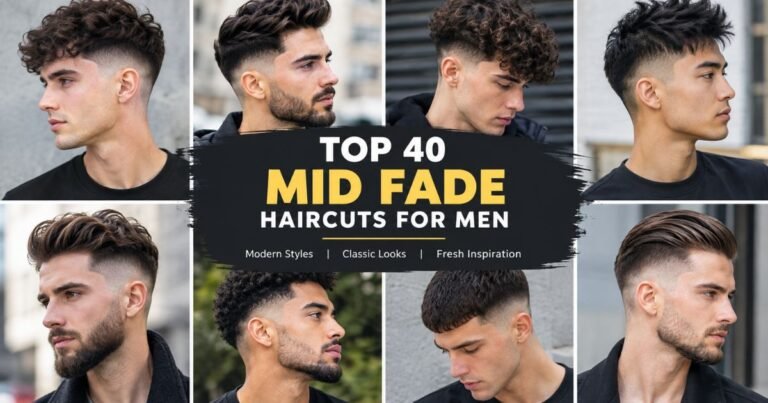
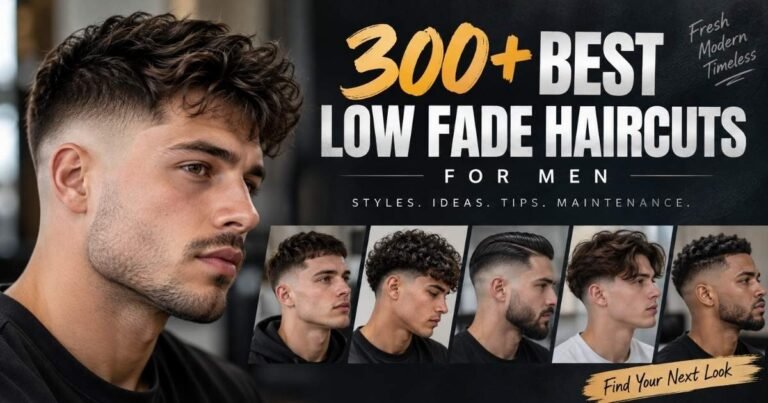
6. Buzz Cut Fade (Low, Mid & High)
A fade blends hair gradually from very short at the bottom to a longer length above. Fade height describes where that blend begins, and it changes how the head’s outline looks.
| Fade height | Where it starts | How it reads |
| Low | Just above the ears and around the neckline | Subtle, keeps most of the sides at length |
| Mid | Around the temples | Balanced, a clear but not extreme change |
| High | Near the upper temples or higher | Strong contrast with the top |
Heights interact with your head shape and hairline, so ask your barber how they’d place it on you. For a deeper comparison, see a dedicated guide to low vs mid vs high fades.
What to notice: three side views side by side, with the starting point of each fade marked.
7. Skin Fade Buzz Cut
A skin fade blends all the way down to bare skin, usually finished with a foil shaver or zero-gapped clippers. That makes it the highest-contrast fade, and also the one that grows out visibly fastest.
Terms vary here: “bald fade,” “skin fade,” and “shadow fade” don’t mean exactly the same thing to every barber. The clearest instruction is whether you want it “down to the skin” or leaving a faint shadow.
A skin fade also shows scars, razor bumps, and contrast between skin and hair more than a longer fade does.
What to notice: a close-up of the bottom edge and neckline.
Read More About : French Crop Haircut for Men: Best Styles & Guide (2026)
8. Tapered Buzz Cut
A taper shortens the hair gradually around the ears, sideburns, and neckline, but usually stops at a short length of visible hair instead of going to skin. In everyday use the words “taper” and “fade” overlap, but a taper is generally subtler and covers less of the head.
It’s often easier to grow out gracefully than a high or skin fade, because the contrast between sections is smaller. If you like a neat outline without a dramatic change, a taper is worth discussing.
| Taper | Fade | |
| Coverage | Mainly ears, sideburns, neckline | Larger area of the sides and back |
| Shortest point | Usually leaves hair | Can go to skin |
| Contrast | Gentle | Noticeable |
| Grow-out | Usually gradual | Faster to look uneven |
What to notice: a close-up of the ear and neckline.
9. Disconnected Buzz Cut
A disconnected cut has a top that’s clearly longer than the sides, with no gradual blend between them. The visible step is a deliberate design choice, and it’s what separates this from a fade.
It sits at the edge of the buzz-cut category and is closer to an undercut in structure. It may suit someone who wants a more distinct shape, though it takes more upkeep to keep the sides crisp.
What to notice: a side view where the step is visible.
10. Line-Up Buzz Cut
A line-up isn’t a separate haircut. It’s a finishing technique, a sharp edge cut along the forehead, temples, and sometimes the neckline or beard. You can choose between a crisp line-up and natural edges.
Hairline shape matters. On a receding hairline, a very sharp line-up can sometimes make the recession more noticeable, so ask your barber how they’d place it. A line-up also grows out faster than the rest of the cut, so it needs more frequent touch-ups to stay sharp.
What to notice: a front close-up of the temples and forehead edge.
11. Buzz Cut with Beard
Adding a beard shifts the balance of the head. More weight at the jaw can change how the shape of the head and face reads, and the relationship between buzz length and beard length is the main decision.
Common approaches include:
- Matching the beard to the buzz length for a uniform look
- Fading the sideburns into the beard so the transition looks continuous
- Keeping a defined beard neckline so the edge stays tidy
Beard density and patchiness affect which approach looks intentional. A patchy beard may look best kept very short or trimmed with the buzz cut.
What to notice: how the sideburn blends into the beard on both a stubble and a fuller beard.
Read More About : Modern Mullet Fade: The Complete Guide to Getting It Right in 2026
12. Buzz Cut Without Beard
Without facial hair, the jawline, ears, and hairline are fully exposed. That puts more weight on the neckline and edges, and on how consistently you shave.
Skin sensitivity matters here too. If shaving irritates your skin, a very short clean-shaven look plus a very short buzz may mean more daily care than you’d expect.
What to notice: how clean the neckline and edges are from the front and side.
13. Buzz Cut with Design (Lines, Stars, etc.)
Designs are patterns shaved into short hair, such as a line through the eyebrow-height area, geometric shapes, or small symbols. They need a skilled barber and surrounding hair that’s short enough to create contrast.
Designs blur as hair grows, and some workplaces and schools restrict them. Bring a reference image and ask how often it would need to be redone.
14. Long Buzz Cut
A long buzz cut uses longer guards, roughly the #4 to #6 range, though barbers vary. At this length the hair has body and can show curl, waves, or direction.
It differs from the butch cut mainly in length and in how clearly natural texture shows. It’s the point where the cut starts to approach a very short crop or a crew cut.
What to notice: the top from above, which shows how your hair behaves at this length.
15. Textured Buzz Cut
At buzz length, “texture” usually means subtle variation in length, often created with clipper-over-comb or scissor work on top. Much of what looks like texture also comes from the hair’s own direction and density.
It differs from a brush cut: the brush cut stands upright, while a textured buzz stays close to the head and varies in length. Ask your barber what variation is realistic for your hair.
16. Dyed Buzz Cuts (Blonde, Pastel, Neon)
Color on short hair is straightforward to do and quick to grow out. Lightening dark hair usually requires bleaching, which can irritate the scalp, and pastels or neon colors need a lightened base.
Roots appear as hair grows, so the look needs refreshing. A professional colorist can advise on scalp sensitivity, and a patch test is sensible before any bleaching or dye.
Buzz Cut Styles by Face Shape

A buzz cut exposes your whole head, so skull shape, ears, hairline, and beard can matter as much as face shape. Treat the notes below as options to discuss with a barber, not rules. Face shape is one factor among several, and the same cut can look different on two people with similar faces.
17. Buzz Cut for Oval Face
Oval faces are often described as balanced, which gives you more flexibility. The more meaningful decisions are usually hairline shape, head shape, and how much contrast you want. Trying a longer guard first can help you see what you prefer.
18. Buzz Cut for Round Face
Round faces have similar width and length. A taper or fade with a bit more length on top may help create the impression of extra length, and a neat beard line can add definition. Preferences and proportions vary, so test a longer length first.
Read More About : Fade Haircuts for Black Men: 58+ Sharp Styles & Tips In 2026
19. Buzz Cut for Square Face
A strong jaw and angular features can look emphasized by an all-over buzz, which some people like. A slightly longer guard or a taper can soften the overall outline. Neither is better. It’s a matter of the look you want.
20. Buzz Cut for Heart Face
A wider forehead and narrower chin means hairline placement and facial hair can both affect balance. A softer hairline and a short beard may help balance proportions, though results vary with how the barber shapes the cut.
Oblong, diamond, and triangle faces follow similar principles: the cut and any facial hair can be used to adjust how the proportions read.
Buzz Cuts for Different Hairlines and Hair Loss
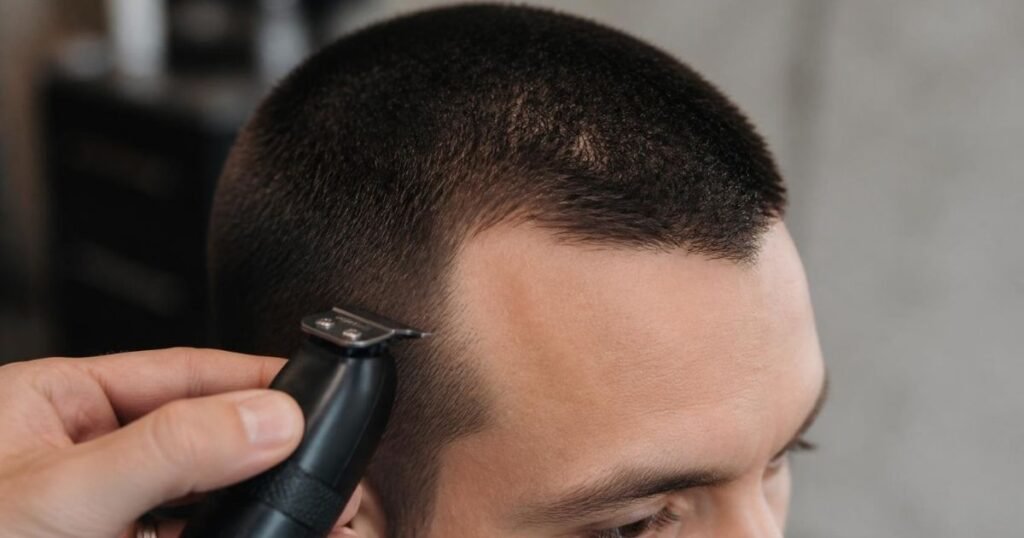
A shorter cut reduces the contrast between hair and scalp, which can make thinning less noticeable. It doesn’t hide or reverse hair loss. If you notice sudden or patchy loss, it’s worth speaking to a doctor or dermatologist.
21. Buzz Cut for Receding Hairline
A short, even length may reduce the contrast around a receded temple or hairline. How well it works depends on how far the recession has progressed and how you feel about the result.
Three things to discuss with your barber:
- Line-up: a sharp line-up can emphasize a receding hairline, while softer edges may look more natural
- Length: very short lengths reduce contrast, but show more scalp
- Shape: temple recession and a widow’s peak each call for different placement
22. Buzz Cut for Balding Men
For crown thinning or overall loss, a short length that matches the density of remaining hair can look more consistent than a longer, patchier cut. Some people eventually move to a fully shaved head, which looks different from a very short buzz.
Whatever you choose, an exposed scalp benefits from sun protection and moisturizing. Hair color, scalp tone, and the pattern of loss all affect how it looks.
Buzz Cut Styles for Different Hair Types & Ethnicities
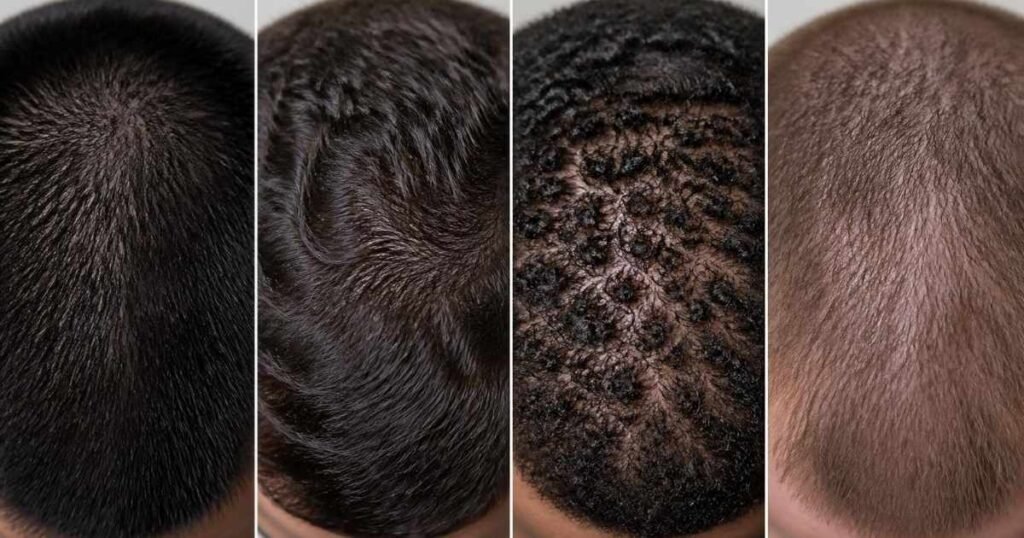
Hair texture, density, and growth patterns vary widely within every background, so the sections below describe common considerations, not rules. The hair-type sections at the end of this part are the most reliable guide.
23. Buzz Cut for Black Men
Many Black men have coily or tightly curled hair, and short cuts, fades, and line-ups are common options. At very short lengths, tightly curled hair can be more prone to razor bumps and ingrown hairs, so clipper technique, scalp care, and moisturizing matter.
If you get bumps, tell your barber. They may adjust technique or guard choice. Hairline shape and texture also vary person to person, so the line-up placement is worth discussing.
24. Buzz Cut for Latino Men
Latino men have a very wide range of hair types, from straight to tightly curled, fine to thick. So the most useful decisions are the ones any short cut involves: matching the guard to your texture and density, and choosing how sharp you want the line-up.
25. Buzz Cut for Asian Men
Asian men also have a wide range of hair types. Some have straight, coarse hair that tends to stand upright at short lengths, and cowlicks or crown whorls can show more clearly when hair is short. If either applies to you, see the straight and thick hair sections below.
26. Buzz Cut for Indian Men
Indian men’s hair ranges from straight to wavy to curly, and from fine to thick. Climate may also matter: in hot, humid weather a short cut can feel more comfortable, while scalp care and sun protection are worth planning for.
Read More About : Low Blowout Taper for Black Men with a Clean, Sharp Styles (2026)
27. Buzz Cut for Wavy or Curly Hair
At the shortest guards, curl may barely show. At longer guards, the curl pattern and growth direction appear. Tightly curled hair may be more prone to ingrown hairs at very short lengths.
A practical approach is to start with a longer guard to see how your hair behaves, then go shorter if you like it. A clean line-up can add structure to the edges.
Buzz Cuts for Straight Hair
Straight hair tends to show growth direction and cowlicks clearly, and scalp can show through at shorter lengths. How the hair lies varies from guard to guard, so check the top from several angles.
Buzz Cuts for Thick Hair
Dense hair can look fuller at a given length, and regrowth shows sooner, which means fades and edges may need earlier touch-ups. A short length doesn’t reduce density. It just means there’s less length.
Buzz Cuts for Fine or Thin Hair
Scalp visibility is the main consideration. A shorter length may reduce the contrast between hair and scalp, but a buzz cut doesn’t add fullness. Ask your barber to test a section before going all the way down.
This differs from hair loss: fine hair is a texture, while balding is a pattern of loss.
Celebrity Buzz Cut Inspirations
Celebrity photos make useful references, but looks change, so check recent photos before using them. Treat the notes below as starting points, and focus on what you’d actually ask for.
28. Travis Kelce Buzz Cut
Kelce has been photographed with very short, cropped hair. As a reference, ask for a short, even top with a tidy neckline and ask the barber how short to go on the sides.
29. Cristiano Ronaldo Buzz Cut
Ronaldo has worn very short crops at various points. If you like that look, a close all-over length with a clean edge-up is a typical way to describe it.
30. David Beckham Buzz Cut
Beckham has worn buzz cuts at different points in his career. If you bring a reference, note which era you mean, since his hair has changed a lot over time.
31. Tom Holland Buzz Cut
Holland has appeared with very short, close-cropped hair. A reference like this is helpful for asking how short to go and for conveying how you want the hairline to look.
32. Conor McGregor Buzz Cut
McGregor has worn short cuts with tight sides at various times. If you use a reference, tell your barber specifically what you like: the sides, the length on top, or the overall shape.
How to Choose the Right Buzz Cut for Your Hair Type and Hairline
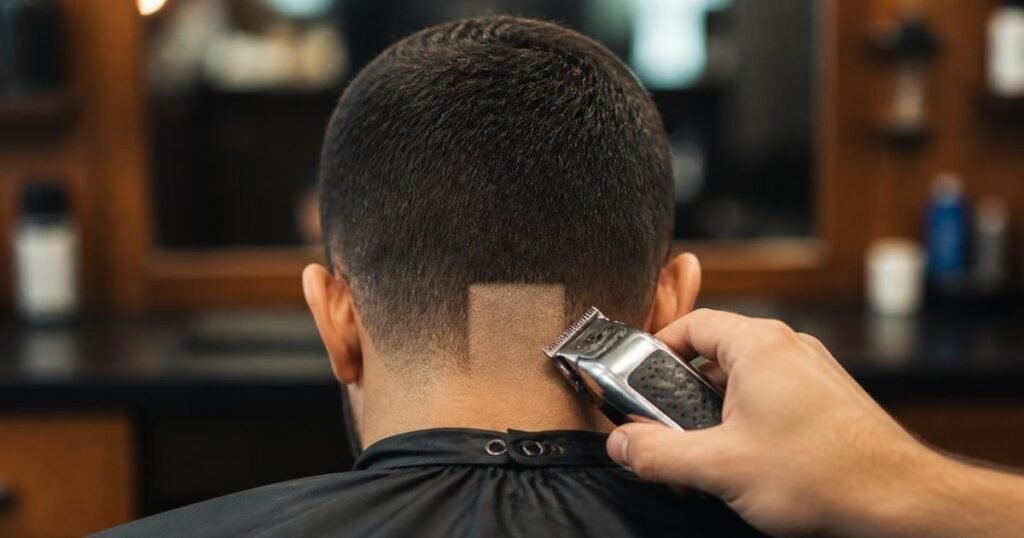
This section turns everything above into a decision path. Rough guide:
| If this applies | Consider this |
| Unsure about the length | Start with a longer guard and go shorter later |
| Low density or visible scalp | Test a section first and decide from there |
| Wavy or curly hair | Start with a longer guard to see how your hair behaves |
| Receding hairline | Discuss line-up options and a slightly longer guard |
| Want zero styling | Uniform cut or a taper |
| Want strong contrast | Fade or skin fade |
Choosing a Buzz Cut Length Based on Hair Density
Dense hair looks fuller at the same length and shows regrowth sooner. Medium density is usually the most forgiving. Sparse hair shows more scalp at every length. In all cases, going shorter later is easier than going longer.
How Scalp Visibility Affects Your Buzz Cut
Scalp visibility depends on contrast between hair color and scalp tone, hair density, and length. It also affects how scars, moles, and head shape look. Ask your barber to show a length on a small section, such as the back, before committing to the whole head.
Choosing Between a Uniform Buzz Cut, Fade, and Taper
| Uniform | Taper | Fade | |
| Look | Even all over | Neat edges, subtle change | Clear blend, strong contrast |
| Upkeep | Lowest | Moderate | Highest |
| Grow-out | Gradual | Fairly gradual | Uneven sooner |
| May suit | Zero-fuss preference | Tidy, understated look | Defined, higher-contrast look |
Choosing a Buzz Cut Based on Your Styling Preferences
If you want no styling at all, a uniform cut or a taper fits. If you’d like to shape the top a little, a longer length with light texture is easier. Think about how much daily effort you actually want: a fade needs more salon time but no product, while a longer top may need a little product to hold.
Buzz Cut Lengths: What Do the Guard Numbers Mean?
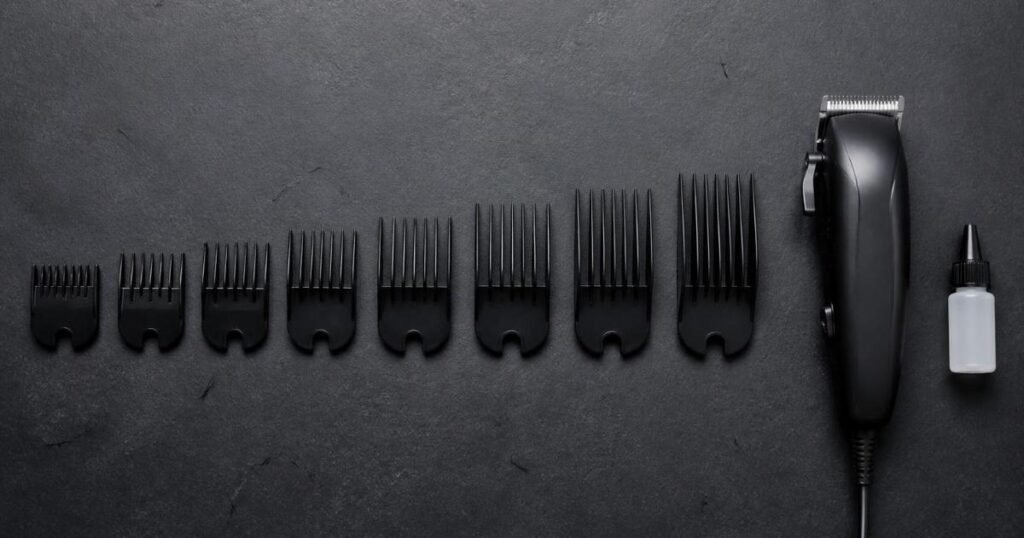
Guard numbers tell you how much hair the clippers leave behind. Numbering varies by brand and region, and the same number can leave a slightly different length with different clippers. In the UK, similar sizes are often called grades and are usually listed in millimeters.
Common Clipper Guard Numbers and Hair Lengths
| Guard | Approx. inches | Approx. mm |
| 0 / no guard | very close (blade only) | about 1–2 |
| #1 | 1/8 | 3 |
| #2 | 1/4 | 6 |
| #3 | 3/8 | 10 |
| #4 | 1/2 | 13 |
| #5 | 5/8 | 16 |
| #6 | 3/4 | 19 |
| #7 | 7/8 | 22 |
| #8 | 1 | 25 |
These are typical values. Check your clippers’ manual, since brands differ.
Choosing Between a Number 0, 1, 2, 3, and 4 Buzz Cut
| Setting | What it looks like | Things to consider |
| 0 / blade only | Very close shadow | Shows scalp, scars, and head shape most |
| 1 | Short but visible | Scalp still shows on lighter or thinner hair |
| 2 | Even, soft-looking | A common starting point for first-timers |
| 3 | More body | Natural direction and cowlicks become visible |
| 4 | Approaching a short crop | Texture and curl show more clearly |
If you’re unsure, start with #3 or #4. You can always go shorter.
How Guard Numbers Affect Scalp Visibility and Hair Texture
The same guard can look quite different on different hair:
- Fine or sparse hair: more scalp shows through
- Thick or dense hair: looks fuller and more even
- Wavy or curly hair: curl pattern appears at longer settings
- Straight hair: growth direction and cowlicks stand out
Buzz Cut Maintenance & Styling Tips

Low styling doesn’t mean zero upkeep. Edges, fades, and scalp care are where most of the work goes.
How Often Should You Buzz Your Hair?
There’s no single right schedule. How often depends on the following:
- Guard length: shorter cuts look overgrown sooner
- Style: fades and line-ups show regrowth before a uniform cut does
- How crisp you like it: some people refresh edges often, others don’t mind a soft look
- Growth rate: which varies from person to person
In general, the neckline and edges lose their sharpness first, then the fade, then the top.
What Clippers & Guard Numbers to Use
For home use, a decent set of clippers with a full guard set and a sharp, clean, oiled blade matters more than the price. Corded clippers tend to keep consistent power, while cordless ones are more convenient. Clean the blade after each use, and replace worn guards, since a cracked guard can leave uneven patches.
For numbers, see the guard chart.
Read More About : 16+ Blowout Taper Fade Haircuts: Style, Variations & Guide In 2026
Styling Products for Buzz Cuts (Texturizers, Creams)
Most buzz cuts need very little product. The most useful items are skin-focused:
| Goal | Product type | When it’s relevant |
| Hydrate scalp | Light moisturizer | Dry or flaky skin |
| Protect scalp | Sunscreen | Any time outdoors |
| Shape a longer top | Light matte clay or paste | Brush cut, textured buzz |
| Soothe after shaving | Aftershave balm | After clean-shaving edges |
Heavy products can build up on short hair, so use small amounts.
DIY Buzz Cut vs Visiting a Barbe
If you’re new to buzz cuts, or you want a fade, a barber is the safer choice. DIY is more reasonable for an all-over cut with a single guard.
DIY Buzz Cut:
Pros: convenient, free, easy to touch up. Cons: easy to make visible mistakes, and the back and neckline are hard to see.
Basic steps:
- Start with a longer guard than you think you need
- Work in sections, moving against the direction of growth
- Check by touch and by mirror as you go
- Go down a guard only if you want it shorter
- Ask a friend to check the back, or accept it won’t be perfect
Visiting a Barber:
A barber can shape the neckline, create a clean fade, and see how your hair behaves in places you can’t. The trade-offs are cost and time.
How to Maintain a Buzz Cut Fade or Taper
Between visits, you can keep the neckline and edges tidy with a trimmer if you’re comfortable. A taper tends to look acceptable for longer than a skin fade does, because it contrasts less. If upkeep matters, tell your barber you’d like the fade to grow out gracefully.
How to Care for Your Scalp After a Buzz Cut
An exposed scalp is more sensitive than it used to be. A few habits help:
- Apply sunscreen to the scalp outdoors, or wear a hat
- Moisturize if your scalp feels dry
- Cleanse gently, since harsh products can irritate
- Watch for ingrown hairs or irritation, and see a professional if they persist
How to Ask Your Barber for a Buzz Cut
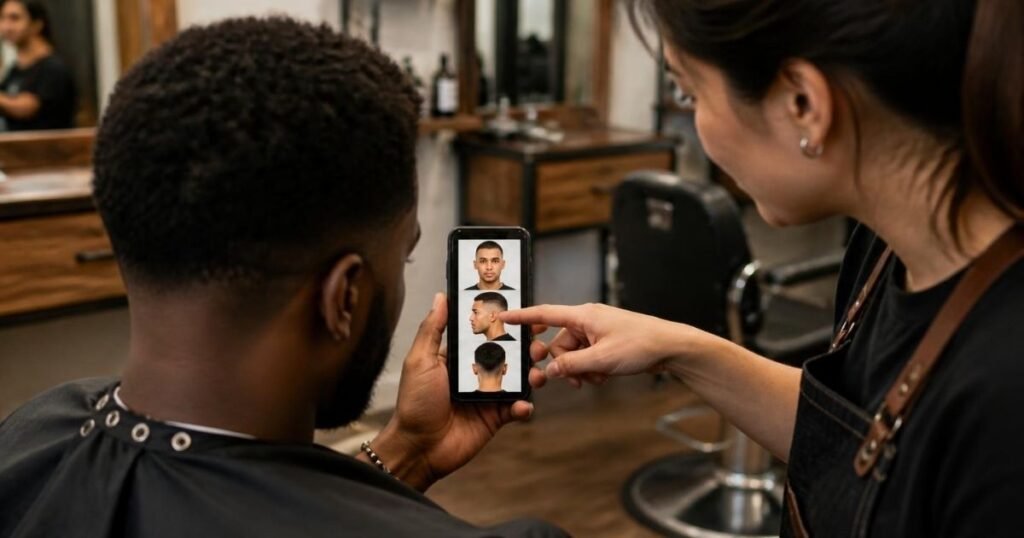
No single phrase guarantees the same result at every shop, but being specific helps a lot.
Explaining Your Desired Length, Fade, and Taper
Decide these before you sit down:
- Top: guard number or length
- Sides and back: uniform, taper, or fade (and how high)
- Fade finish: down to the skin, or leaving a shadow
- Neckline: natural, rounded, or squared
- Edges: sharp line-up or natural
- Beard: blended in or kept separate
An example: “I’d like a #3 on top and a mid skin fade on the sides, with a natural neckline and no line-up. Can you start longer on top so I can see how it looks?”
Say the length in inches or millimeters as well, since guard numbering varies.
Why Reference Photos Help
Names for cuts vary, but photos are clear. Bring front, side, and back views if you can, and say what you like about each. Ask the barber whether it will work with your hair.
What to Tell Your Barber About Your Hairline and Hair Texture
Mention anything that might change the outcome:
- Cowlicks or crown whorls
- Receding or thinning areas
- Scars, moles, or sensitive spots
- A history of razor bumps or ingrown hairs
- How your hair behaves at different lengths
Read More About : Undercut Fade: 45+ Bold & Modern Haircut Styles In 2026
Frequently Asked Questions
Do buzz cuts make men look older?
It depends on your hairline, graying, scalp contrast, facial hair, and grooming. A short cut can emphasize the jaw and facial features, and the effect varies from person to person.
Are buzz cuts unprofessional?
Not inherently. It depends on the workplace and its dress code. A tidy neckline and clean edges generally matter more than the length, though some environments have grooming policies.
Can a buzz cut be stylish?
Yes, when it looks deliberate. A clean neckline, a chosen length, a fade, or a well-matched beard all contribute.
Is a buzz cut good for summer?
Less hair can feel cooler, but your scalp is exposed to the sun. Use sunscreen or wear a hat outdoors.
What buzz cut number should I choose?
If you’re unsure, start with a longer guard and go shorter later. See the guard section for what each setting looks like.
Do girls like buzz cuts on guys?
Preferences vary, and there’s no reliable data suggesting one view. Choose a cut based on how it fits you and how comfortable you feel in it.
Does a buzz cut suit everyone?
No. Head shape, hairline, scalp visibility, and hair type all influence the result. The decision section can help you narrow it down.
Does a buzz cut make hair grow back thicker?
No. Cutting hair doesn’t change the follicle or the thickness of the hair that grows from it. Newly cut hair can feel coarser because the tips are blunt, which is why the myth persists.
How long does it take for a buzz cut to grow back?
Growth varies from person to person. A commonly cited average is about half an inch (around 1.25 cm) per month, so a very short buzz may take several months to reach a longer style. The in-between phase can look uneven, so ask your barber how to shape it as it grows.
Final Thoughts
Most buzz cut decisions come down to three choices: how short, how the sides are finished, and how the edges are shaped. Your hair type, hairline, and scalp visibility affect how those choices look on you.
If you’re unsure, start longer, test a section, and bring photos to your barber. The barber checklist is the quickest way to turn what you’ve read into a cut you’ll be happy with

Jake Miller is a barbering and men’s hairstyle enthusiast who shares practical tips, haircut inspiration, and the latest grooming trends at BarberZylo. He enjoys exploring modern and classic hairstyles and helping readers find fresh ideas for their next look.
2 Comments