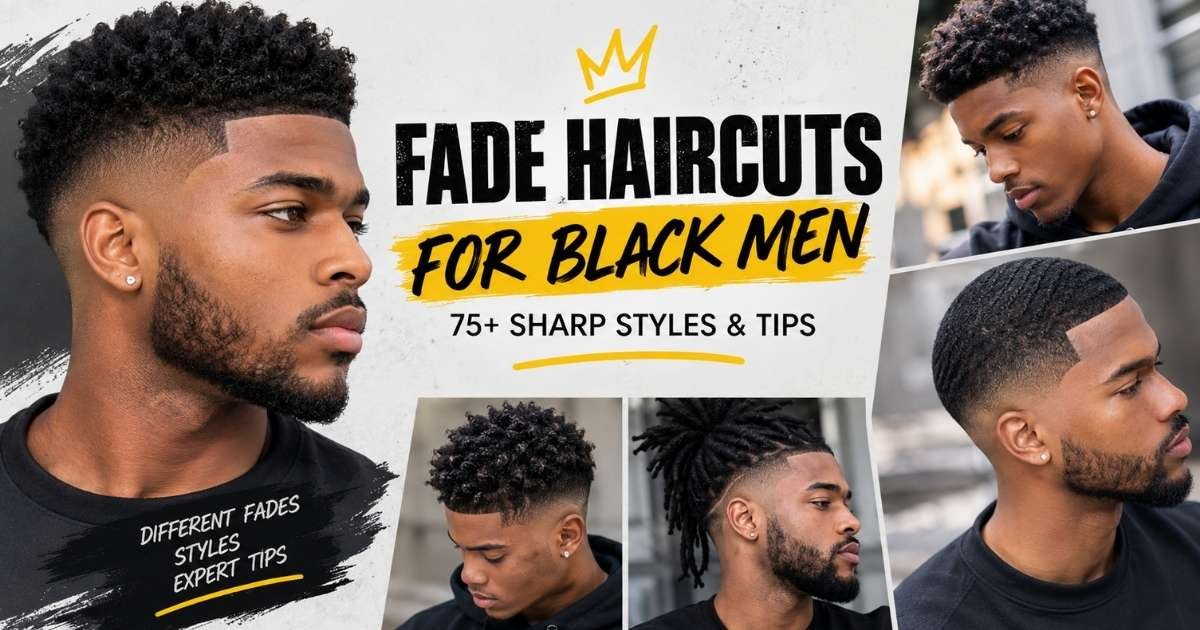
Fade Haircuts for Black Men: 58+ Sharp Styles & Tips In 2026
A fade is a haircut where the hair gets gradually shorter toward the bottom of the head. Where that shortening starts, how short it ends, and what you keep on top are the choices that separate one fade from another. This guide covers all three for Black men, with hair texture in mind. Coily and curly hair responds differently to clippers, shows blending and line work more clearly, and often needs a different aftercare routine.
Barbers don’t all use the same names for the same fade, so the terminology is sorted out early. If you’re short on time:
- Browsing for ideas? Start with Types of Fade Haircuts for Black Men.
- Not sure what suits your hair? Go to Fade Haircuts by Hair Type and Texture.
- Booking an appointment? Jump to How to Ask Your Barber for a Fade Haircut.
What Is a Fade Haircut for Black Men?
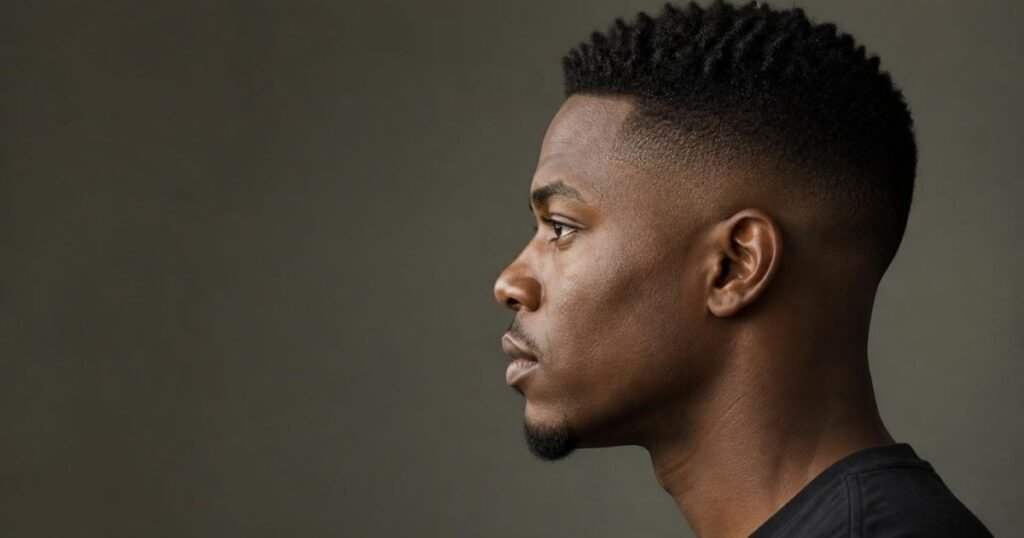
A fade isn’t one haircut. It’s a way of cutting the sides and back so the length changes gradually instead of stopping at a visible line. Most of the vocabulary in this article describes four things about that change: how high it starts, what shape it follows, where it finishes, and where on the head it’s concentrated.
Definition & Cultural Significance
In a fade, hair moves from very short at the bottom, sometimes down to bare skin, to longer hair higher up, with no obvious step between the two. Barbers build this with clipper guards (the plastic attachments that set cutting length), clipper-over-comb work, and often scissor-over-comb on the upper blend. The skill is in the graduation, the smooth shift from one length to the next.
In many Black communities, the barbershop has long been more than a place to get a haircut. It’s a space for conversation, community, and craft, and Black barbers have been central to developing and refining fade techniques. Accounts of where the fade started differ, and the style has roots in both military and civilian barbering. It’s more accurate to say the fade has been shaped by many hands than to credit it to a single origin.
Why It’s So Popular
There’s no survey behind this section, so it sticks to the features that tend to draw people to fades:
- Contrast. Short sides make the top, whether curls, waves, twists, or a crop, the focal point.
- Adjustability. Height and finish can be subtle or dramatic, so the same basic idea works for very different tastes.
- Beard pairing. A fade can run straight into a beard without a visible break.
- Top-style flexibility. It sits under crops, curls, waves, afros, twists, locs, and braids.
- The routine. For many people, the regular barber visit is part of the appeal.
Different Fade Types Overview (Low, Mid, High, Burst, Drop, Taper, Skin, Temp)
Fade names describe different things, which is why they confuse people. Some describe height, some shape, some finish, and one describes placement.
| Term | What it describes | Quick definition |
| Low fade | Height | Starts around or just above the ear and follows the hairline |
| Mid fade | Height | Starts around temple height |
| High fade | Height | Starts high on the sides, near or above the temples |
| Drop fade | Shape | The fade line curves down behind the ear |
| Burst fade | Shape | A semicircular fade around the ear, usually leaving more length at the back |
| Taper | Finish | Gradual shortening that stops at short but visible hair |
| Skin fade | Finish | Blends down to bare skin |
| Temp (temple) fade | Placement | Concentrated on the temples and sideburn area |
These combine freely. A “mid skin fade” is a mid-height fade that finishes at bare skin. A “low drop taper” is a low, curved fade that stops short of skin. When you read a style name, split it into those parts.
Two terms you’ll see often:
- Line-up (also called edge-up or shape-up): a crisp edge cut along the forehead hairline, temples, and sideburns.
- Sponge curls: small, defined coils made by rubbing a textured sponge in circles over short hair.
How Fade Terminology Can Overlap
Fade names aren’t standardized. They shift between barbers, cities, and countries, so two people can ask for the “same” fade and get different results. These are the pairs that blur most:
| Pair | Often means | Where it blurs |
| Taper vs. fade | A taper shortens gradually and stops at visible hair. A fade usually goes shorter, often to skin. | Many barbers say “taper fade” for a taper that goes quite short. |
| Skin vs. bald vs. zero fade | All finish at or near bare skin. | Some barbers use “bald” for a razor-smooth finish and “zero” for clippers with no guard. Others use them interchangeably. |
| Temp vs. temple fade | The same thing in most shops. | “Temp” is slang shortened from “temple.” |
| Low fade vs. low taper | A low fade can end at skin. A low taper keeps visible length. | The difference may only be the last stage. |
| Shadow fade | Often a fade that stops at short stubble rather than skin. | Meaning varies by barber. |
When terms clash, trust a photo and a landmark (“starts at the temple, ends in short stubble”) over the label. Three questions settle most confusion:
- Where does the fade start?
- How short does it end?
- Is the finish bare skin or stubble?
US/UK note: In the US, barbers usually talk about guard numbers and call a sharp hairline edge a “line-up” or “shape-up.” In the UK, “grade” is a common alternative to “guard,” “skin fade” is a very common label, and “line-up” is used less consistently.
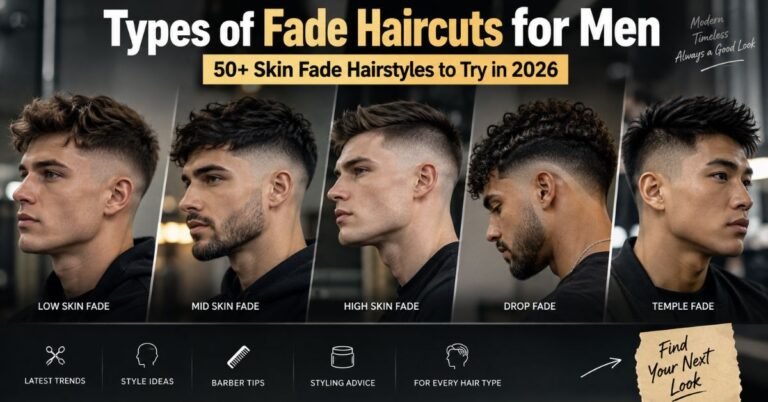
Read More About : Types of Fade Haircuts for Men: 50+ Skin Fade Hairstyles to Try in 2026
Types of Fade Haircuts for Black Men
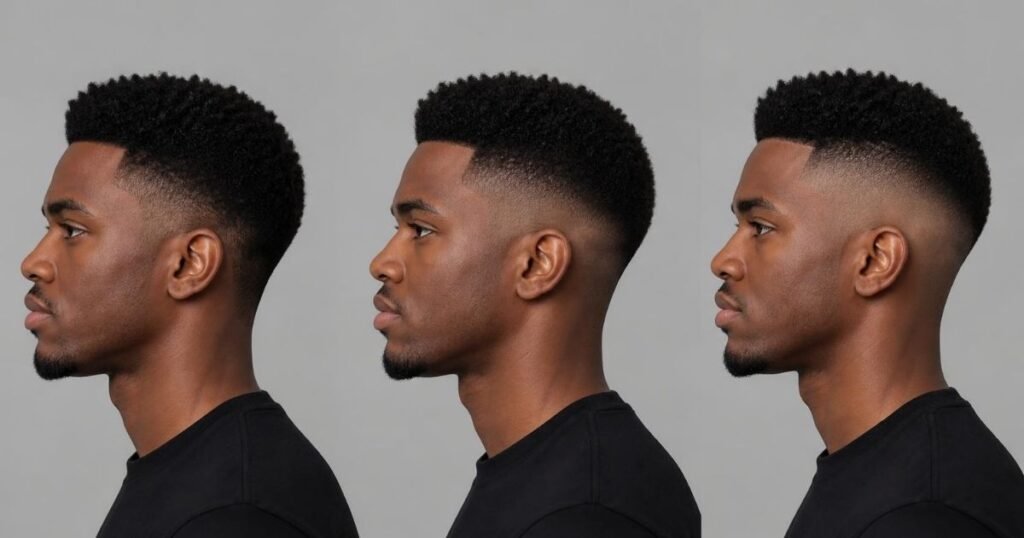
The styles below are grouped by fade type, so you can find the height and finish you like and then see how different tops look with it. The same top styles (waves, curls, twists, afros) recur across groups. Each entry focuses on what the fade changes, and each top style is explained in full once, in the section where it fits best. Names vary by barber, so treat these as starting points for a conversation. The choosing and asking sections help you turn a favorite into a request.
Low Fade Haircuts
A low fade starts around the ear and follows the hairline down toward the nape. It leaves more length on the sides than a mid or high fade, so the contrast is softer. Because it sits close to the ear, how it looks depends on your hairline and head shape. A low fade may suit you if you want a subtle change or more coverage at the sides, and it’s worth asking your barber to show exactly where it will begin.
Low Fade with Waves
With the fade starting low, most of the side of the head stays at a length that suits waves, so the pattern can run down past the temples. Look for waves that flow into the faded zone rather than stopping at a hard edge. The brushing and moisture routine matters more than the cut. See Maintaining Waves.
Low Taper Fade
This pairs a low start with a taper finish, so the shortest point stays as visible hair instead of going to skin. It’s the lowest-contrast option in this guide. The change is most noticeable at the sideburns and the nape. With no bare-skin stage, regrowth tends to look softer. The term itself is covered under Taper Fade Haircuts.
Low Fade Crop
A crop is a short, textured top, often a touch longer at the front. On coily hair, it can be shaped from the natural texture with clippers or scissors, without styling a fringe. Give your barber the top length (a guard number or a measurement) and say whether you want the outline squared off or rounded. Compared with the mid fade version later, this one leaves more hair at the sides.
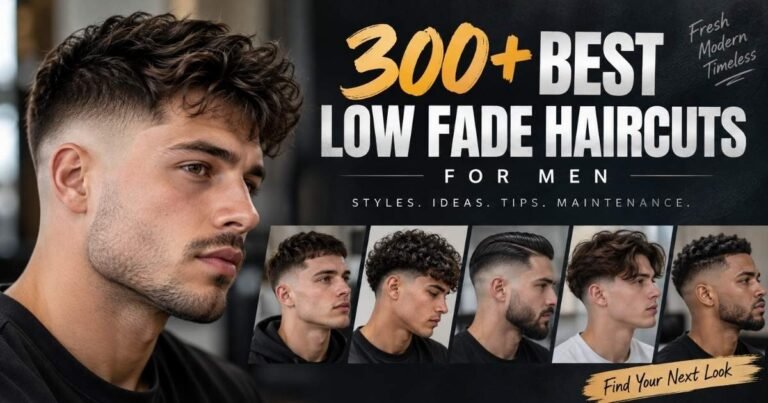
Read More About : 300+ Low Fade Haircuts for Men: Find Your Perfect Style
Low Skin Fade with Afro Curls
Here the fade reaches bare skin while the top keeps its natural curl. The contrast between smooth skin and rounded curls is strong. Skin finishes show regrowth sooner and can irritate sensitive skin or contribute to razor bumps. If that’s a concern for you, ask whether stopping slightly above skin would work.
Low Temp Fade with Medium Curls
“Temp” refers to the temples. The fade is mostly limited to the temple and sideburn area, with a low edge at the back, so the fullness behind the ear and at the nape stays. Medium-length curls tend to hold their shape well here. It’s a reasonable option if you want a defined outline without a big change.
Mid Fade Haircuts
A mid fade starts around temple height. It gives more contrast than a low fade while leaving more room for top styling than a high one. If you can’t decide between low and high, the mid fade is a sensible one to discuss. Ask your barber to point to where it will start on your head.
Buzz Cut with Mid Taper Fade
With a uniform short top, the fade is the whole design. Ask for the top guard number or length separately from the fade. Coily texture shows through a buzz, and a very short top can make crown whorls and cowlicks more visible.
Mid Fade with Beard
The key question is where the fade meets the sideburn and beard. It can flow into the beard with no visible break, or stop with a defined gap. Decide which you want before the clippers start. Beard shape and line work are covered in Fade Haircuts with Beard.
Mid Fade with Curls
Curls need enough length to form, and curly hair shrinks as it dries. A top that looks long when wet or stretched can sit noticeably shorter at rest. Some barbers cut curls dry so they can see the true shape, so it’s worth asking how yours works. The mid fade tightens the sides so the curls become the focus.
Textured Crop with Mid Fade
Compared with the low fade crop, the mid fade adds contrast, so the top stands out more. Texture on top usually comes from point-cutting or scissor work. If your hair is very dense, mention it, since the barber may remove some weight so the top doesn’t look heavy against tight sides.
Read More About : Top 40 Mid Fade Haircuts for Men: Fresh, Modern Styles to Try
Mid Temp Fade with Line Design
This entry means a single shaved line, such as a hard part, cut into the top and sides. More elaborate patterns are under Creative & Bold Fade Styles. A razor line is sharpest right after the cut and softens as hair grows back, so bring a photo showing exactly where you want it.
High Fade Haircuts
A high fade starts high on the sides, leaving little hair there and creating the strongest contrast with the top. It exposes more scalp, so head contour, scars, and skin texture are more visible. It may make the top look taller, and regrowth shows sooner than with a lower fade. Sun protection for the exposed skin is worth remembering.
High Top Fade
A high top is a tall, defined top, often flat or boxy, over sharply faded sides. It differs from a rounded afro because the top is shaped into a deliberate silhouette. How tall you can go depends on your hair’s length and coil pattern, so ask what your barber thinks is achievable.
High Fade with Kinky Top
“Kinky” is a word many people use for their own tight coils, and it appears in style names, so it shows up here. The plain description is a coily top left in its natural pattern. With a high fade, the top becomes the only source of volume, so shaping matters: an even outline and a deliberate edge, whether rounded or squared.
High Skin Fade with Waves
This is one of the highest-contrast pairings for waves. The waves sit on the top and back, and the high skin fade strips the sides, so any patchiness in the pattern is easy to see. It’s worth considering if you’re already committed to a wave routine.
High Fade with Design
A design here means one small carved detail in the faded zone, such as a line or simple shape. A high fade gives more bare area to work with. Fine detail needs a skilled hand and fades quickly as hair regrows, so it suits people who are happy to book frequent touch-ups.
High Fade Afro Haircut
The afro is a rounded, voluminous top over very short sides. Check how the two meet: you want a smooth transition zone rather than a ledge. The higher the fade starts, the more the afro reads as a distinct shape sitting above the sides. Symmetry is judged from the front, so look at your reference photo from that angle too.
Read More About : High Fade Haircuts: What They Are & The Best Versions For 2026
Drop Fade Haircuts
In a drop fade, the fade line curves down behind the ear toward the nape, following the shape of the skull. From the side, the line is lower at the back than at the front. The curve is easiest to see from behind, so check back views in reference photos. Head shape and growth patterns at the nape, such as whorls and cowlicks, affect how smooth the arc looks.
Drop Fade with Waves
The fade line dips behind the ear, so waves near the crown and nape have to be cut and brushed with care. In the back view, the wave direction should look continuous across the curve. A crown whorl can complicate the pattern, so mention it to your barber.
Bald Drop Fade
The curved line ends at bare skin. “Bald” usually means skin-level, though some barbers use it for a razor-smooth finish, so confirm what yours means. Bare skin benefits from moisturizer and sun protection.
Twists Drop Fade
The curving fade line frames the base of the twists, so the arc is visible from the side and back. Twist length, retwisting, and appointment sequencing are covered in Fade Haircuts with Twists.
Curly Drop Fade
This differs from other curly fades by shape, not by the curls. The defining feature is the curve behind the ear. Ask your barber to follow the natural curve of your skull so the line looks balanced from every angle.
Drop Fade with Short Hair
A short top, such as a crop or low buzz, makes head shape and cowlicks obvious, and the fade line does most of the visual work. “Low-maintenance” here refers to styling, not to how often you’ll need cuts. The curve at the nape tends to look untidy as hair grows back.
Burst Fade Haircuts
A burst fade, sometimes called a burst taper, is a semicircular fade that arcs around the ear, typically from the sideburn area to behind the ear. It usually leaves more length at the back instead of fading straight down the nape. It’s often paired with mohawks, faux hawks, and curls. Names vary, so confirm with a photo. It may suit people who want to keep length at the back, and nape shape and growth direction will affect the result.
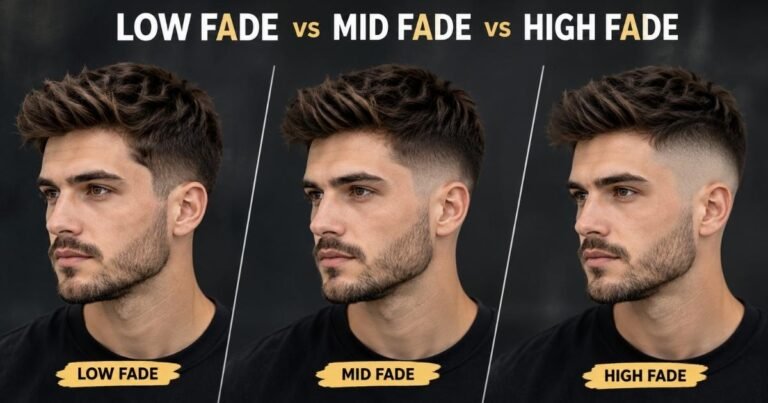
Read More About : Low Fade vs Mid Fade vs High Fade: What’s the Key Differences and Which Suits You Best?
Burst Fade Mohawk
The burst frames the strip of hair on top. Strip width matters: a narrow strip gives stronger contrast, a wider one a softer look. The length left behind the ear can connect to the back of the strip. Mohawk shaping is covered under Creative & Bold Fade Styles.
Twists Burst Fade
The semicircle around the ear exposes a patch of short hair against the twists. Because burst fades keep length at the back, the twists can extend to the nape without a gap. Ask whoever does your twists whether they’d like the fade done before or after.
Bleached Mohawk Burst Fade
Bleach lifts pigment and can dry or weaken coily hair, which is already prone to breakage at the bends in each strand. If you want this look, consult a professional colorist, plan on extra conditioning, and expect root touch-ups as your natural color grows in.
Burst Fade with Sponge Curls
Sponge curls are defined coils on short to medium coily hair, which suits the burst shape well. The coils need enough length to form, so don’t ask for the top to be cut too short beforehand. The burst keeps the area around the ear tidy while the curls carry the texture.
Taper Fade Haircuts
A taper shortens hair gradually, especially at the sideburns and neckline, and usually stops at short but visible hair. “Taper fade” is commonly used for a taper that goes noticeably shorter, and many barbers use the two words loosely. See How Fade Terminology Can Overlap. Because tapers keep some length, they often grow out less abruptly than skin fades.
Taper Fade Faux Hawk
The sides taper softly, so the top reads as a raised center rather than a hard stripe. Styling the top is covered under Faux Hawk Fade. The taper keeps the outline gentle instead of stark.
Afro Taper Fade
A taper keeps some length at the sides, so the afro’s silhouette stays fuller than with a high skin fade. Compare it with the High Fade Afro Haircut: lower contrast, more side volume. Shaping with an afro pick helps keep the outline even.
Temple Taper Fade
This is a light clean-up at the temples and sideburns that preserves most of your length. It’s a reasonable option if you’re growing your hair out or want minimal change, because it leaves very little visible line as it grows back.
Curly Taper Cut
Most of the length stays on the sides, so curls keep their shape, and the neckline and sideburns are tapered for tidiness. The cut tends to grow out gracefully, though periodic trims help maintain the curl shape.
Skin Fade Haircuts
A skin fade finishes at bare skin, usually with clippers cut as close as possible, a foil shaver, or a razor. It offers the highest contrast and the fastest-visible regrowth. On coily hair, close cutting can contribute to razor bumps (pseudofolliculitis barbae), where hair curls back into the skin. If you’re prone to them, talk to your barber about finish length and aftercare, and see a doctor if bumps are painful or persistent.
Bald Fade with Shaved Part
A hard part is a thin line cut into the hair with a razor to define where you part it. It’s crisp at first and softens quickly. Ask for it to sit where your hair naturally parts, and bring a photo of the depth and length you want.
Curly Top
Despite the short name, this is a curly top over a skin fade, with curls left in their natural pattern at a length that lets them form. With the sides at skin level, the curl outline becomes the style, so a neat, even shape matters.
Zero Fade Buzz Cut
“Zero” typically means clippers with no guard and the blade set close. Paired with a buzz-cut top, this needs almost no styling. The tradeoffs are sun exposure on the scalp and possible razor irritation.
Read More About : Taper vs. Fade Haircut: Which One Should You Ask Your Barber For?
Skin Fade Afro
The feature to look at is the blend zone, the band where hair goes from skin to full afro length. A narrow band looks sharper but leaves little room for error. A wider band looks softer and forgives uneven growth.
Wavy Bald Fade
This one is defined by the finish: razor-smooth sides at any height against a wave pattern. Compared with the High Skin Fade with Waves, the point here is the bald finish, not the height. The smooth sides also make any irritation more visible.
Temp Fade Haircuts
“Temp” is short for temple. This fade is concentrated around the temples and sideburn area, leaving the rest fuller. It’s often paired with a line-up, and “temp fade” and “temple fade” are generally used interchangeably.
Temple Fade with Sponge Curls
Because the fade stays at the temples, the sides keep enough coil length to build sponge curls on. (Sponge curls are defined under Burst Fade with Sponge Curls.) The cut’s main job is preserving volume while tidying the outline.
Temp Fade with Line Up
A temp fade is often paired with a crisp line-up at the forehead, temples, and sideburns. The pairing looks sharp but needs frequent touch-ups, and the details are in Fade Haircuts, Hairlines & Line-Ups.
Temp Taper Fade
The taper extends a little further down the sides than a temp-only fade, giving a smoother handoff to the rest of the hair. Unlike the Temple Taper Fade, it’s more about a gradual blend than a minimal clean-up, and it works with various top lengths.
Short Temple Fade Afro
A short natural afro with only the temples cleaned up. The short length keeps the shape rounded and close to the head, and it takes little shaping compared with a taller afro.
Curly Top with Temple Fade
Compared with the skin-level Curly Top above, the temple fade has lower contrast, so the curls sit against hair rather than bare skin. That softens the look and usually makes regrowth less obvious.
Trendy Fade Haircuts with Popular Styles

The previous section was organized by fade. This one is organized by what’s on top or alongside it, so you can start from the style you already have or want. These are pairings, not claims about what’s trending. Each entry covers what the top style needs, such as length, routine, and who to book, instead of repeating fade definitions.
Fade Haircuts with Twists
Twists come in several forms, including two-strand twists, coil twists, and sponge twists. Most need some length to hold their shape, and the style you can wear depends on your texture and length. Often a barber does the fade and a stylist does the twists, and it’s worth asking each of them which order they prefer. Retwisting and hairline tension are the main long-term considerations.
Twists Fade
This is the baseline: twists on top over faded sides. The practical questions are how much top length you need, how high to take the fade, and when you’ll retwist. Moisture matters, since twisted hair can dry out between sessions.
Drop Fade with Twists
This is the same look as the Twists Drop Fade earlier, viewed from a planning angle. The arc behind the ear should sit comfortably under the twists, so make sure the twists are long enough to hold and that the fade is cut with the twist direction in mind.
Sponge Twists with Mid Taper Fade
Sponge twists are made on short hair by twisting it into small spirals with a sponge brush. They need short to medium length. A mid taper keeps the sides tight, which makes the twists look more defined.
Read More About : Low Taper Fade: 25 Best Styles and Grooming Tips for Men
Fade Haircuts with Dreads or Braids
Many people prefer the word “locs” to “dreads,” and both are searched, so you’ll see both. A fade blends gradually, while an undercut has an abrupt contrast. For braids and locs, a common question is order: ask your barber and braider whether the fade or the braiding should come first. Tight braiding can stress the hairline, so it’s worth keeping tension comfortable (see Protecting the Hair and Scalp Between Cuts). Loc stage and length, braid size, and hairline condition all affect what works.
Dread Fade
A gradual blend on the sides with locs on top. The practical points are loc length and weight, how often you retwist, and keeping the faded edges tidy as the sides grow in.
Undercut Dreadlocks
The sides are cut short with a more abrupt change, so the locs stand out as a separate mass. Locs can be worn up, back, or down. The difference from a fade is the lack of gradual blending.
Faded Cornrows
Cornrows run flat to the scalp, so the fade is cut around the braid pattern. Timing matters: the fade is usually fresher if the braiding is done around the same time. Ask about tension, especially at the temples.
Box Braids with Mid Taper Fade
Box braids are larger, square-parted braids, usually with extensions. Braid size, length, and scalp care are the main considerations. A mid taper keeps the sides tidy, but box braids are not a low-effort style, and you’ll need a plan for scalp care between sessions.
Fade Haircuts with Waves
Waves are formed by training short hair into a pattern through regular brushing, moisture, and often a durag or wave cap at night. Results depend on hair texture, curl pattern, density, and growth whorls at the crown and nape. The barber’s role is to cut short, even lengths and create a smooth fade transition. Waves come more easily to some textures than others, and they take patience.
360 Waves Fade
360 waves radiate around the whole head, which usually requires short, even length all over. A very high fade may limit how far the pattern shows, so ask your barber how the fade height will interact with the wave area.
Wave Fade Style
This is the fade-to-wave transition: the edge where the faded sides meet the wave pattern. A smooth handoff makes the waves look intentional. A rough one can look like a patch. Look for it in reference photos.
Waves Fade with Beard
Beard length and direction interact with the wave pattern, because a beard that grows in a similar direction to the waves can look cohesive, while a mismatched one can look busy. Beard lines are covered in the next section.
Fade Haircuts with Beard
A fade and a beard connect at three points: the sideburns, the cheek line, and the neckline. A beard fade blends the beard itself into skin or hair, which is different from the haircut fade. Beard density, patchiness, and tendency toward ingrown hairs all affect the choices you have. Face proportions and beard fullness together determine how much contrast looks balanced.
Read More About : Burst Fade Haircuts for Men: Stylish, Modern Looks & Ideas in 2026
Fade with Beard and Line Up
This look has crisp definition on the cheek line and neckline. A hard line is sharper but needs frequent upkeep, while a natural line grows out more softly. Ask which your barber thinks suits your beard growth.
Curly Fade with Full Beard
The balance here is volume between the top and the beard. A full beard plus voluminous curls can look heavy, so some people shorten one or the other. Discuss with your barber how much of each to keep.
Buzz Cut Fade with Beard
With a short top, the beard becomes the main upkeep. Trimming, line work, and conditioning the beard matter more than styling the hair.
Creative & Bold Fade Styles
Designs, color, and complex shapes raise the skill needed and the upkeep. If you’re considering one, check any workplace or school grooming policy first. A single line is a “line design” (see Mid Temp Fade with Line Design); a pattern counts as a design here.
Mohawk Fade
A mohawk is a strip of length running front to back with short sides. The fade type and strip width define the look. Wider strips are easier to style, and narrower ones give more dramatic contrast.
Faux Hawk Fade
A faux hawk is softer than a mohawk, with sides that aren’t shaved as dramatically short. The top is usually styled upward toward the center. It differs from the Taper Fade Faux Hawk mainly in styling focus: this entry is about how the top is shaped.
Flat Top Mohawk Fade
This pairs a level top with a mohawk strip. Precision shaping is the challenge, since a flat top needs even length and a steady hand. Contrast it with the High Top Fade, which is typically wider and not tied to a strip.
Pomp Fade with Fade Sides
A pomp (pompadour) is swept-up volume at the front. Achieving it with coily hair depends on length and styling approach, and not every texture holds the same lift. Bring a reference photo and ask what length it would take on your hair.
Curly Cut with Undercut Design
Curls on top with a disconnected undercut and a shaved detail on the sides. The shaved detail needs regular touch-ups, while the curls need their usual moisture and shaping.
Dyed Tips with Mid Taper Fade
Coloring the tips may require lightening the hair first, which can dry coily strands. Consult a professional and plan aftercare. This differs from the bleached mohawk because only the tips are colored, so less of the hair is affected.
Fade with Diagonal or Shaved Lines
Razor-cut lines on the sides add pattern. Regrowth softens them quickly, so bring a photo or sketch and expect frequent refreshes if you want them to stay sharp.
Fade Haircuts by Hair Type and Texture
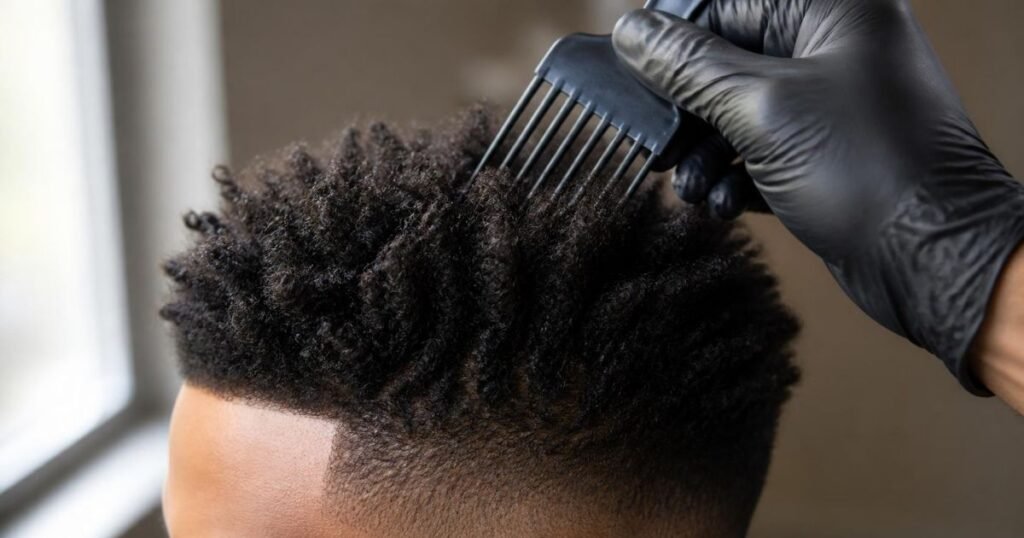
Hair texture changes how a fade looks and behaves, so this section is about choosing parameters: length, fade height, and finish. Hair-typing systems (numbers and letters like 3A to 4C) are a handy vocabulary, but they aren’t universal, and many people have a mix of patterns on one head. Use the table as a rough guide, not a rule.
| Texture | What tends to show | What to consider |
| Wavy | Direction and flow of the pattern | Fade height and how it meets the waves |
| Curly | Defined curls, which shrink as they dry | Enough length for curls to form |
| Coily | Tight coils with noticeable shrinkage | Precision of blending, razor bump risk with close finishes |
| Thick or dense | Weight and bulk on top | Whether the barber removes some weight |
| Short | Head shape and cowlicks | Which fade finishes work with limited length |
| Longer | The transition between top and sides | Blended vs. disconnected look, styling routine |
Fades for Curly Hair
Curl definition depends on length, since cutting too short can lose the curl. Fades can make curls look more defined by contrast. Ask whether your barber uses clippers or scissors on top, and keep curl shrinkage in mind when describing length. Curl pattern and density vary, so a mid taper that works for one person’s curls may need adjusting for another’s.
Fades for Coily or Kinky Hair
Shrinkage means coily hair looks shorter than its true length, so say whether you’re describing stretched or natural length. Tight coils hold sculpted shapes such as high tops and afros well. Fades show blending flaws clearly on this texture, so precision matters. Closer finishes can raise razor bump risk, which is worth discussing if you’re prone to it.
Fades for Wavy Hair
Wave direction and growth patterns decide how a fade looks. Naturally wavy hair and trained waves are different, since naturally wavy hair may need less brushing to show a pattern. If waves are the goal, discuss fade height with your barber, because it affects how much of the pattern stays visible.
Fades for Thick or Dense Hair
Density (how many strands) is different from thickness (how wide each strand is). Dense hair can look heavy on top, and a fade can reduce bulk at the sides. Your barber may also adjust weight on top so the shape sits well against tight sides. Density often varies across the head, so a cut that suits one area may need tweaking in another.
Fades for Short Hair
With limited length, buzz cuts, crops, and short curls are the usual options. Short hair shows scalp, cowlicks, and head contour more. Try to match the fade to your top length: a very short top with a very high skin fade leaves little contrast to play with.
Fades for Longer Hair
The decision is how the long top meets the short sides: blended gradually or disconnected with a more abrupt change. Longer tops need more styling and trimming of ends. Think about how much routine you’ll actually keep up.
Fades with Afro Hairstyles
Shape and symmetry define an afro: how round or squared it is, and how the outline looks from the front. The blend zone, where the afro meets the fade, is where most of the finish shows. Fade height changes the silhouette: a lower fade keeps more side volume, a higher one makes the afro read as a separate shape. For afro-based looks in this guide, see the High Fade Afro Haircut, Skin Fade Afro, Afro Taper Fade, Low Skin Fade with Afro Curls, and Short Temple Fade Afro.
Fades with Twists, Locs, and Braids
Plan for length requirements, appointment order, scalp comfort, and hairline tension. Details and examples are under Fade Haircuts with Twists and Fade Haircuts with Dreads or Braids.
How to Choose the Right Fade Haircut?

No single fade suits everyone. Start with the things that are hard to change (texture, hairline, growth patterns), then move to preferences like lifestyle, upkeep, and facial hair. The final result will vary with your hair and how the barber adapts the cut.
Consider Your Face Shape & Hair Texture
Fade height changes perceived proportions through contrast at the sides and volume on top. As general principles, a higher fade with height on top may add vertical emphasis, while a lower fade keeps more width at the sides. Those are tendencies, not rules. Your beard, top volume, and hairline affect the outcome as much as face shape, so use face shape as one input among several. Texture decides how much length and shaping the top can hold.
Consider Your Hair Density, Head Shape & Growth Patterns
Crown whorls, cowlicks, and nape growth direction affect how a fade lies. Head shape matters too, including bumps, flat spots, and scars, which skin fades and high fades reveal more. Dense hair adds top weight. Ask your barber to point out anything on your head that affects the cut.
Match your lifestyle & grooming habits.
Think about morning time, sweat from the gym or work, helmets or headwear, and how much styling you’ll realistically do. Check any grooming policies at your workplace or school. Consider whether you’ll make regular barber visits and how comfortable you are with home upkeep. A lower-contrast fade may feel easier to live with, but that depends on you.
Choose based on maintenance level
Upkeep is driven by contrast level, hair growth rate, line-up sharpness, wave routines, and color. This table compares style features, not schedules:
| Feature | Effect on upkeep |
| Skin finish | Higher: regrowth shows sooner |
| Taper finish | Lower: softer grow-out |
| Crisp line-up | Higher: edges blur quickly |
| Natural hairline | Lower |
| Waves | Higher: daily brushing and nightly routine |
| Color or bleach | Higher: roots and conditioning |
| Short buzz top | Lower: little styling |
For how to handle upkeep itself, see How to Maintain Fade Haircuts for Black Men.
Pick styles that blend well with facial hair
Higher contrast between the fade and a full beard makes the beard stand out more, while a gradual blend makes the two read as one shape. Beard fullness and density matter, as do hard lines versus natural blending. Style-level detail is in Fade Haircuts with Beard.
Consider Your Hairline and Natural Edges
An uneven, low, or receding hairline, or thinning edges, may affect which fade and line-up work best. A softer edge can be easier to live with if your hairline is uneven. The full discussion is in Fade Haircuts, Hairlines & Line-Ups.
How to Ask Your Barber for a Fade Haircut?
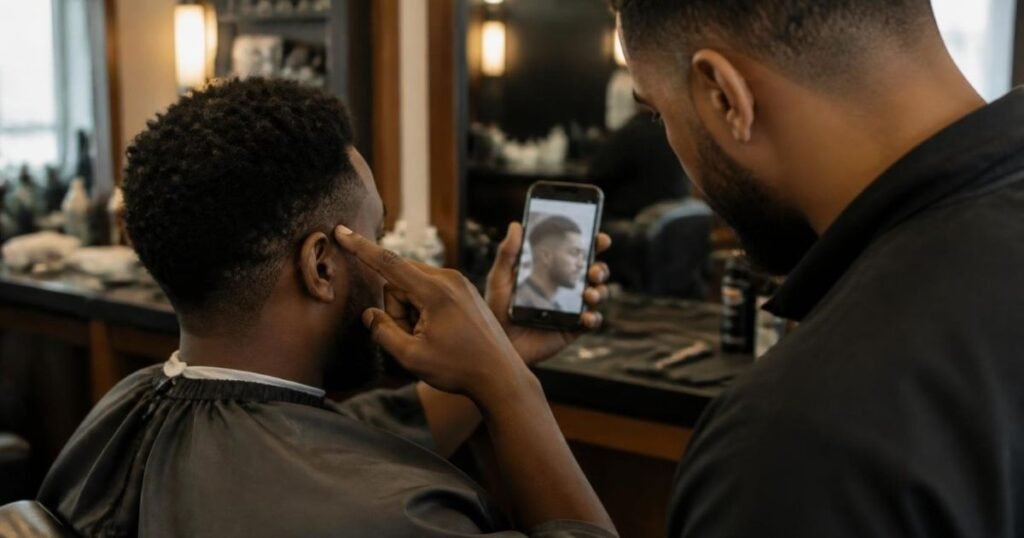
Most fade requests come down to four decisions: height, how short the sides go, what you keep on top, and how the edges are finished. No exact phrase guarantees the same result at every shop, but clear information and photos get you much closer. Here’s an example request you can adapt:
“I’d like a mid fade that starts around my temple and ends in short stubble, not skin. Leave about this much on top (show photo) and keep my hairline natural, no hard line-up. Square off the neckline.”
Specify the Fade Height
Say low, mid, or high, and add a landmark such as “starts around the temple” or “just above the ear.” Confirm it with a photo.
Explain How Short You Want the Sides
Say whether you want skin, stubble (sometimes called a shadow), or a taper-level finish. Guard numbers or grades vary by brand and country, so let the barber show you the guard. If you’re unsure, starting a bit longer is easier to correct, because hair can be cut shorter but not put back.
Describe the Length and Style on Top
Give a length by measurement or guard, mention any part, and say what you want the texture to do: natural, twisted, waved, or shaped. Coily hair shrinks, so say whether you’re describing stretched or natural length.
Decide on Your Line-Up and Hairline
Choose between a soft, natural hairline and a crisp line-up, and say whether the hairline should stay where it is. Mention thinning or uneven areas. Depending on where you live, you may hear “line-up,” “edge-up,” or “shape-up” for the same thing.
Discuss the Neckline
The back edge can be rounded, squared (blocked), or tapered. Tapered necklines are often described as growing out more gradually, though results vary. Tell your barber which you prefer.
Bring Reference Photos
A good set includes front, side, and back views, plus a close-up of the hairline. Choose models whose hair resembles yours, and show what you don’t want too. Keep in mind that a model’s hairline and density differ from yours.
Mention Your Hair Texture, Hairline, or Growth Patterns
Mention razor bump tendency, sensitive skin, cowlicks, thin spots, and any growing-out goals. Then ask what adjustments your barber would make.
Before the clippers start, confirm:
- Where the fade starts
- Where it ends (skin, stubble, or taper)
- Top length
- Hairline and line-up preference
- Neckline shape
How to Find the Right Barber?
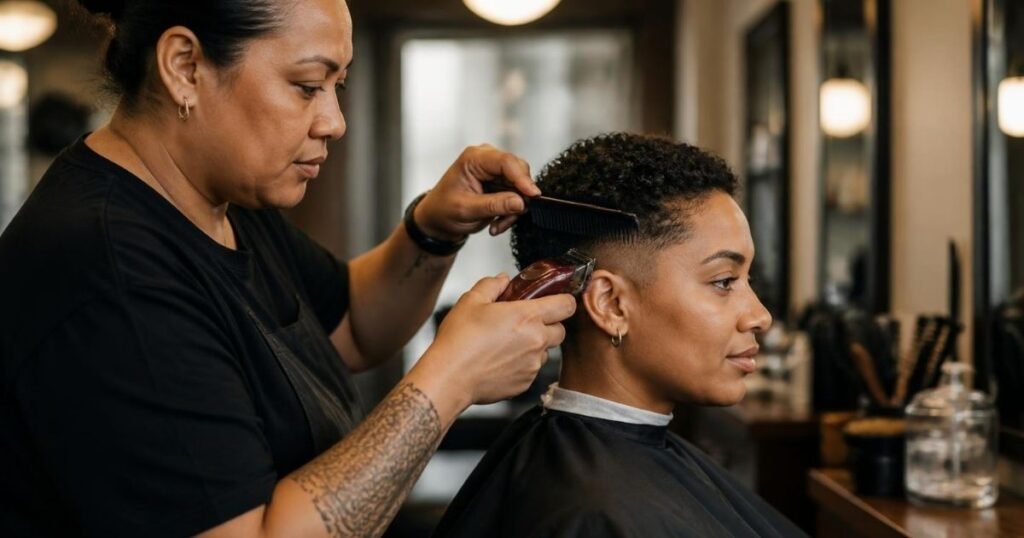
Skilled barbers work across textures, but experience varies, so look for someone who regularly cuts hair like yours. A low-risk first visit, with a modest change instead of a dramatic one, tells you a lot.
See Their Work First
Look at their photos for smooth gradients with no patchy or stepped zones, symmetry, natural-looking hairlines, textures similar to yours, and consistency across many posts. Photos are the best-case results, so look for variety instead of one standout.
Get Recommendations
Ask friends or coworkers specific questions: how long the cut stayed sharp, how the barber handles irritation, and whether the barber listens.
Ensure They Specialize in Black Hair
Reframe this as “regularly cuts coily and curly textures.” You can ask:
- Do you cut hair like mine often?
- How do you handle razor bumps?
- Can you build or maintain waves?
Prioritize Precision & Clean Lines
Precision means smooth blending, symmetry, even lines, and a tidy neckline. A sharper line isn’t always better if it doesn’t suit your hairline. Also look at hygiene: clean tools and fresh neck strips.
Communicate Your Desired Look Clearly
Give feedback during the cut and check the mirror before the barber finishes. Use the method in How to Ask Your Barber for a Fade Haircut so both of you are working from the same picture.
Fade Haircuts, Hairlines & Line-Ups
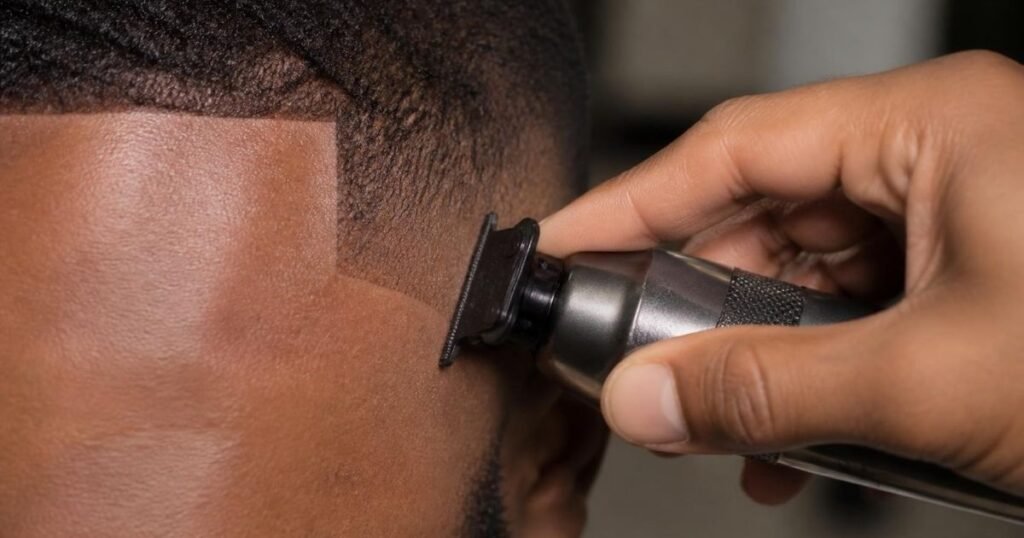
Your hairline shapes how a fade frames your face, and it’s a common source of disappointment when ignored. This section covers the difference between a natural hairline and a line-up, how hairline shape affects the result, and how to decide.
Natural Hairline vs. Sharp Line-Up
A natural hairline is soft and lightly tidied. A line-up cuts a crisp edge at the forehead, temples, and sideburns.
| Look | Effort | How it grows out | May suit |
| Natural hairline | Lower | Softly | People wanting minimal upkeep or with uneven hairlines |
| Sharp line-up | Higher | Edges blur quickly | People who enjoy frequent touch-ups |
Repeated aggressive line-ups can make a hairline look like it has moved back, so ask your barber to keep the line close to where it naturally sits.
How Your Hairline Can Affect the Finished Fade
Hairlines vary: straight, rounded, widow’s peak, M-shaped, uneven, receding, or low. A fade highlights asymmetry, so an uneven hairline shows more. A barber may adjust fade start height, line-up shape, or top length to suit yours.
Keeping Temple and Edge-Up Areas Clean
These areas show regrowth first. Ask whether your barber offers quick touch-up visits. The at-home routine is in Keeping edges and lines sharp.
Consider Your Natural Hairline Before Choosing a Fade
A quick check:
- Even hairline: most fades and line-ups are open to you.
- Uneven hairline: consider a softer edge and ask the barber to balance it.
- Receding or thinning edges: discuss a gentler line-up, and consider raising it with a doctor if the thinning is new or fast.
How to Maintain Fade Haircuts for Black Men?
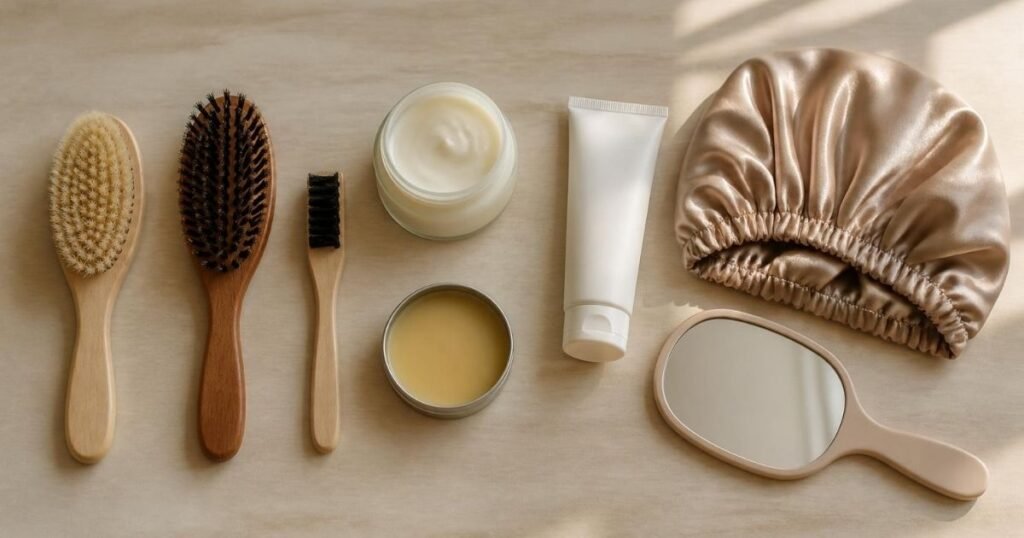
Maintenance has two parts: keeping the fade tidy and keeping your hair and scalp healthy. Routines vary, and no product or habit guarantees a result.
Recommended trim frequency
How often you need a trim depends on how fast your hair grows, how much contrast your fade has (skin versus taper), how sharp you like your line-up, your standards, your budget, and your top style. Signs it’s time:
- The blend zones look fuzzy
- Regrowth shows at the temples or neckline
- The top has lost its shape
There’s no one right interval, so ask your barber how long your specific cut will stay sharp.
Products to use (brushes, creams, pomades)
The right tools depend on your texture and goals. Start simple and add products as needed.
Brushes
A soft brush smooths hair daily. A firmer wave brush helps train waves. A fade or duster brush clears loose hair after a cut. Match the stiffness to your scalp sensitivity.
Creams and pomades
Creams add moisture, definition, and light hold. Pomades give more hold and shine, and they come in water-based and oil-based types. Edge control helps smooth the hairline. Use small amounts, because heavy buildup can weigh hair down and clog the scalp.
Keeping edges and lines sharp
At home, use a mirror, make light passes, and follow your barber’s outline. Edge control smooths edges but doesn’t cut them. If you trim, be careful: razors near thin edges or sensitive skin can cause irritation, and it’s often better to leave the lines to your barber.
- Do: Work slowly and keep to the existing outline.
- Don’t: Reshape your hairline on your own or press hard.
Moisturizing and Conditioning Tips
Tightly coiled strands can make it harder for natural scalp oils to travel down the hair, so many people find moisture routines helpful. A typical routine includes a gentle shampoo (frequency varies), conditioner, a leave-in product, and a sealant if it works for you. At night, a bonnet, durag, or satin pillowcase can reduce friction. If flaking or itching keeps returning, talk to a professional.
Maintaining Different Fade Styles
Different tops need different routines.
Maintaining Waves
A typical wave routine includes brushing, moisture, nightly wrapping, and clearing buildup. Patience matters because waves develop over time. Keep the sides tidy so the pattern stays visible.
Maintaining Curls
Curls usually benefit from a curl cream, finger-combing or gentle brushing, and a refresh with water or light moisturizer. Sponge curls need periodic re-shaping, and trims keep the outline sharp.
Maintaining Twists, Locs, and Braids
These styles need retwisting or re-parting, scalp care, buildup control, and attention to tension. Faded edges will grow in and may look untidy before the style itself needs redoing, so plan around that.
Protecting the Hair and Scalp Between Cuts
- Razor bumps and irritation: Keep the area clean, avoid picking, and see a professional if bumps are severe or painful.
- Sun: Exposed scalp, especially after high or skin fades, can burn, so apply sunscreen.
- Dryness and flaking: Moisturize the scalp and avoid harsh products.
- Tension: Avoid persistent pulling at the hairline, since tight styles worn for long periods can contribute to hair loss there (traction alopecia).
This is general information, not medical advice.
Frequently Asked Questions
What is the most popular fade haircut for Black men?
There’s no reliable data to point to one winner. Low and mid fades are often a comfortable starting point because they keep more length at the sides, but the right choice depends on your hair, hairline, and taste.
What fade works best with curly hair?
It depends on your curl length and goals. A mid taper keeps more curl length at the sides than a skin fade. See Fades for Curly Hair.
Are fade haircuts good for all face shapes?
Fades can be adapted to many face shapes, but the result depends on top volume, beard, and cut details. Treat face shape as one factor, not a rule.
What’s the difference between a taper and a fade haircut?
A taper shortens hair gradually and stops at short but visible hair. A fade usually goes shorter, often to skin. The terms overlap, so confirm with a photo.
What is the difference between a low, mid, and high fade?
They differ in where the fade starts: around the ear for low, around the temples for mid, and higher for high. The higher it starts, the more contrast you get.
How often should Black men get a fade?
It depends on growth rate, finish, and how sharp you like the lines. Skin fades and crisp line-ups show regrowth sooner. Ask your barber how long yours will last.
Can you get a fade with an Afro?
Yes. Fade height changes the silhouette: lower keeps more side volume, higher makes the afro stand out as a separate shape. See Fades with Afro Hairstyles.
What fade works well with waves?
It depends on your wave goals. Lower fades may leave more area for the pattern to show, while higher fades give more contrast. Talk through it with a barber who knows waves.
Can you get a fade with twists, locs, or braids?
Yes. Length, appointment order, and hairline tension matter. See Fade Haircuts with Twists and Fade Haircuts with Dreads or Braids.
How do I ask my barber for a specific fade?
Give the height, finish, top length, and hairline preference, and bring photos. A short version: “Mid fade, ends in stubble, this much on top, natural hairline.” The full method is in How to Ask Your Barber for a Fade Haircut.
Is a skin fade the same as a bald fade?
Often yes, but not always. Some barbers use “bald” for a razor-smooth finish, while “skin fade” may still leave a trace of stubble. Confirm with a photo.
Final Thoughts
Choosing a fade comes down to a few decisions: how high it starts, how short it ends, what you keep on top, how your hairline is treated, and how much upkeep you’ll take on. Once those are clear, the style names matter less than the picture you and your barber share.
Before your next appointment:
- Pick two or three reference photos, including a side and back view.
- Decide on the fade height and finish.
- Note your hairline preference.
- Ask how long the cut should stay sharp.
For more, look into related guides on taper vs. fade, wave maintenance, beard grooming, and low-maintenance cuts.

Jake Miller is a barbering and men’s hairstyle enthusiast who shares practical tips, haircut inspiration, and the latest grooming trends at BarberZylo. He enjoys exploring modern and classic hairstyles and helping readers find fresh ideas for their next look.