
French Crop Haircut for Men: Best Styles & Guide (2026)
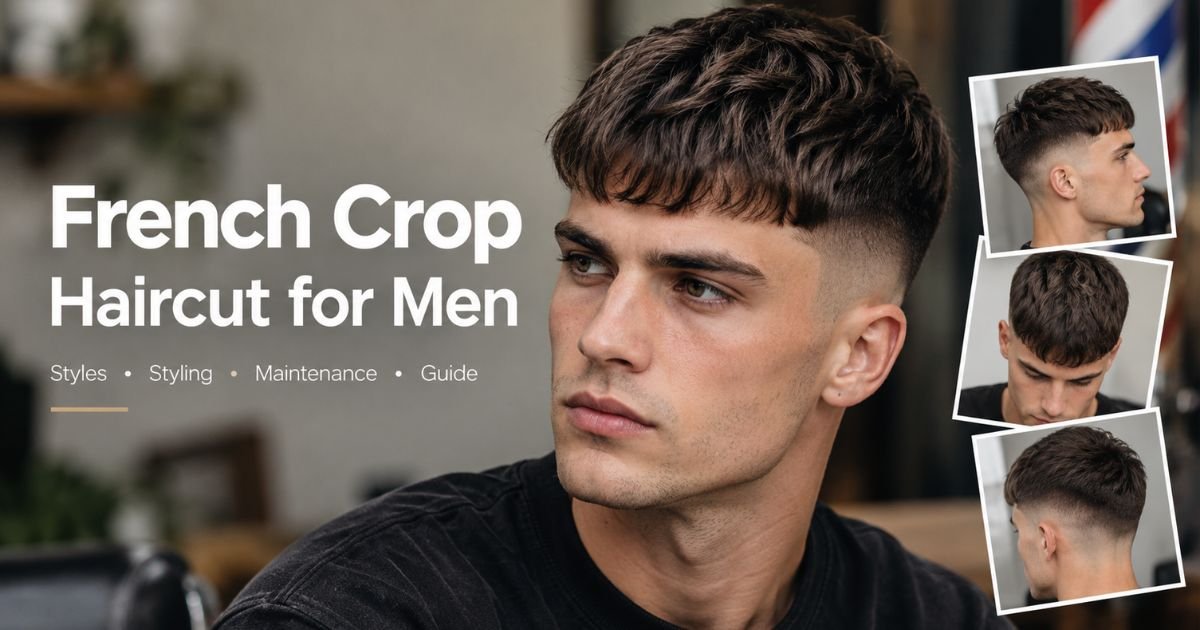
A French crop haircut is a short haircut with a short fringe (what US readers often call bangs) that falls or is combed forward across the forehead, sitting over sides that are cut much shorter. The top has just enough length to form that fringe, and the sides and back are usually tapered, faded, or clipped close.
This guide explains what defines the cut, how its main variations differ, and who may find it easier or harder to wear. It also covers how to ask a barber for it, how to style it, and how to compare it with similar cuts like the Caesar, textured crop, and crew cut. Barbers don’t always agree on names for these cuts, so the advice leans on specific details you can point to, like fringe length, top length, and side finish.
What Is the French Crop?
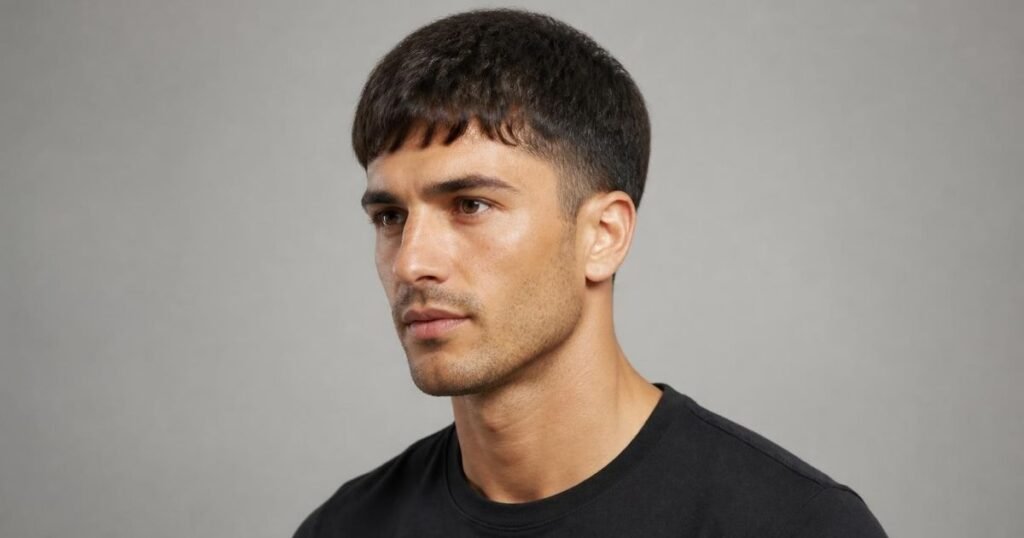
Four features make a French crop recognizable:
- The fringe: Short, cut across the forehead, and styled forward. It can have a straight, blunt edge or a broken, choppy one.
- The top: Long enough to push forward, but still short overall. Many barbers work with roughly one to two inches (about 2.5 to 5 cm) at the front, though this changes with hair type, hairline, and the look you want.
- The sides and back: Noticeably shorter than the top, finished with a taper, a fade, or an undercut.
- The finish: Neat and defined, or loose and tousled, depending on how the top is cut and styled.
The fringe is the constant. If the hair falls forward in a short fringe over shorter sides, it’s a French crop family cut, whatever the side finish. Everything else (fade or taper, blunt or choppy, neat or messy) describes which version you’re getting.
Your hair’s behavior matters just as much as the cut itself. Density, how the hair grows at the front, and where your hairline sits all affect how the fringe lies, so two people can ask for the same cut and end up with slightly different results.
The Best French Crop Variations for Men
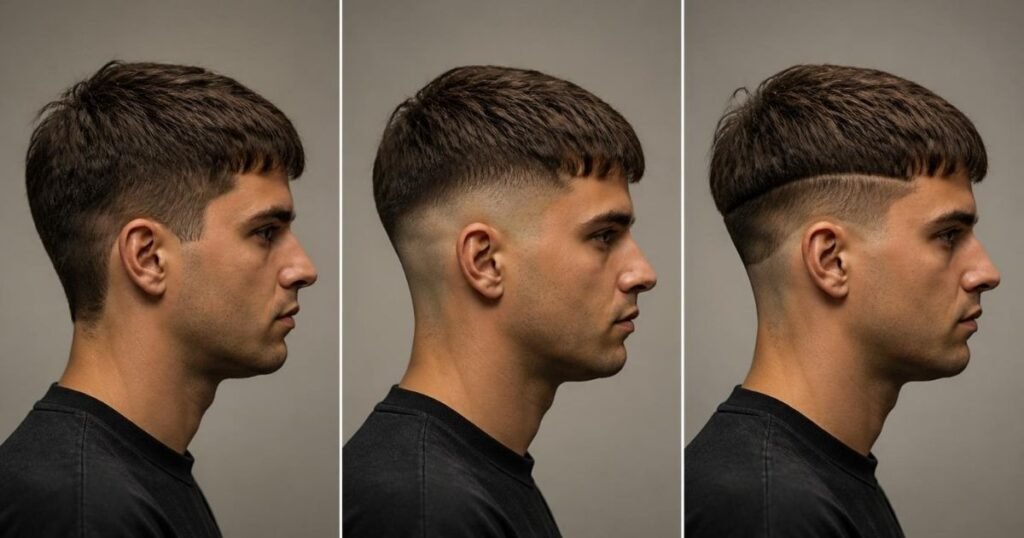
The versions below aren’t ranked. They differ in three ways: how the sides are finished, how the top is cut and styled, and how your hair type changes the result. Use this table as a quick orientation, then jump to the version that interests you.
| Version | Side contrast | Main difference |
| Classic | Low to moderate | Even fringe, conservative side blend |
| Fade | Moderate to high | Sides shorten gradually, often to very short |
| Taper | Low to moderate | Shortening concentrated around ears and neckline |
| Messy | Depends on sides | Loose, piecey top finish |
| Burst fade | Moderate | Fade curves around the ear |
| Undercut | High | Visible jump between top and sides |
| Textured | Depends on sides | Texture is cut into the top |
| Curly | Depends on sides | Fringe adapted to curl pattern |
1. Classic French Crop
The classic version is the reference point most other versions build on. The fringe is short and fairly even, the top follows your natural growth direction, and the sides are shortened without strong contrast. A barber usually blends them so there’s no abrupt step.
Because it’s understated, it tends to suit settings where you want a neat, low-key look. It also works as a starting point if you’re new to the cut, since you can ask for more contrast or texture at your next visit.
What defines it:
- A short fringe with a fairly even edge
- Sides that blend gradually, without sharp contrast
- A top that mostly follows how your hair already wants to fall
Front growth matters here. If your hair grows forward naturally, the classic cut takes little effort. If it parts, swirls, or lifts at the front, you may need to talk with your barber about fringe length and direction.
2. French Crop Fade
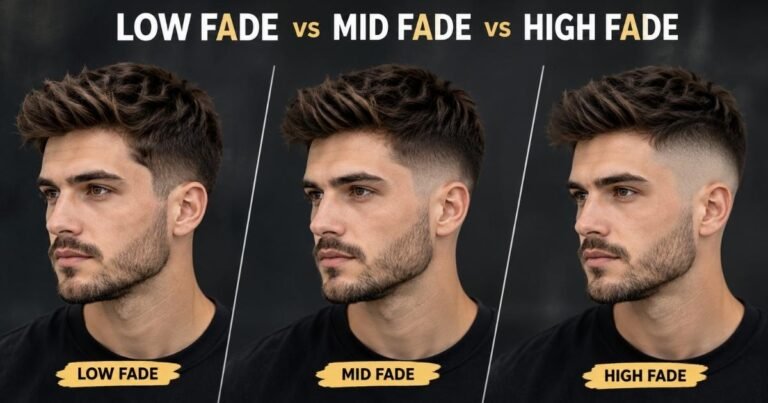
A fade means the hair gets gradually shorter down the sides and back, often to very short or to the skin, with no visible step between lengths. Adding one to a French crop increases the contrast between the top and the sides.
Fade height changes the look:
| Fade type | Where it starts | General effect |
| Low fade | Just above the ear and around the neckline | Subtler, more length stays on the sides |
| Mid fade | Around the temple level | More noticeable contrast, balanced |
| High fade | Higher up the sides of the head | Strongest contrast, most dramatic |
A skin fade is one option within any of these, where the shortest section is taken down to bare skin. It isn’t required. A barber can also stop at a very short guard length for a softer result.
Higher fades usually show regrowth sooner because the short areas are larger and the contrast is easier to see. Head shape, ear position, and hairline details at the temples and neckline also affect how a fade looks, and a cowlick at the nape can complicate a low fade.
3. French Crop with Taper
A taper shortens the hair gradually around the ears and the neckline, but usually less dramatically than a fade. The upper sides stay longer, and the shortening is concentrated at the edges. In practice the terms overlap, and “taper fade” is a common request that sits between the two.
Compared with a fade, a taper tends to give a softer outline and a more gradual grow-out. It may suit someone who wants the French crop shape without strong contrast.
| Taper | Fade | |
| Where it shortens | Mainly around ears and neckline | Larger area of the sides and back |
| Contrast | Softer | Often stronger |
| Grow-out look | Usually more gradual | Can look grown-out sooner |
Some barbers will take a taper very close at the neckline, so look at examples rather than relying on the word alone.
4. Messy French Crop
The messy version is mostly a styling finish rather than a separate cut. The top is left loose, piecey, and low in shine, so the fringe looks undone instead of combed. It can sit over taper, fade, or classic sides.
The look usually relies on a top with some length and movement. Wavy or naturally textured hair may reach this look more easily, while fine, straight hair may need more help holding texture. A matte product or a light salt spray is a common starting point, and the styling section below covers the process.
If you want texture that’s built into the cut rather than created each morning, the next-but-three version is the one to look at.
Read More About : Types of Fade Haircuts for Men: 50+ Skin Fade Hairstyles to Try in 2026
5. French Crop with Burst Fade
A burst fade curves around the ear in a semicircle, usually leaving more length at the back and nape while the sides shorten around the ear. The front stays the same, with the same short fringe, but the shape around the sides and back changes.
It’s a good fit if you want a visible detail without changing the overall silhouette. Because the effect shows mostly at the sides and back, a front photo won’t tell a barber what you mean, so bring side and back angles too.
Execution varies between barbers. Ear shape and hair growth at the nape can influence how the curve sits, so it’s worth discussing before the clippers come out.
6. French Crop Undercut
An undercut clips the sides short and keeps the top much longer, leaving a visible jump in length instead of a gradual blend. The term “disconnected” describes this: the top and sides don’t merge.
Paired with a short fringe, the result is high in contrast, with a clear line separating the two lengths. That line also makes grow-out more noticeable, since the sides need to be re-clipped to keep the gap crisp. Because the contrast draws attention to head shape and hairline, it’s worth discussing with your barber how to place the line.
If you’re deciding between an undercut and a fade, the question is whether you want a visible step or a smooth transition.
7. Textured French Crop
In this version, the texture is cut into the top rather than created with product. Barbers use techniques like point cutting (snipping into the ends with the tips of scissors to break up the edge), texturizing shears (scissors with notched blades that remove some bulk), or a razor to create a choppy, uneven fringe.
The result is a fringe with a broken edge instead of one straight line. It tends to keep some shape between wash days, which may suit anyone who wants texture without a long routine. It can also help with density, since removing some weight keeps thick hair from sitting too heavy.
Very fine hair is the main caution. Too much texturizing can make a fine fringe look sparse, so let your barber know how much volume you want to keep.
A useful way to describe the choice is blunt versus choppy. A blunt fringe has a defined horizontal edge, while a choppy fringe has a softer, broken edge. If you want to see the difference, compare a close-up of each fringe line.
Read More About : 300+ Low Fade Haircuts for Men: Find Your Perfect Style
8. Curly French Crop
Curls change how this cut behaves. They spring up as they dry, so a fringe that looks long when wet can sit noticeably shorter once it dries. The fringe may also curl or bounce instead of lying flat, and the top tends to take a rounder shape than it would with straight hair.
A few points to discuss with your barber:
- Whether they’re comfortable cutting curls, and whether they cut dry, damp, or in sections
- How much shrinkage to expect, so the fringe doesn’t end up shorter than you wanted
- Whether the fringe should be left slightly longer to allow for spring
- How to style the cut so the curls are defined instead of flattened
Looser curls and tighter coils behave differently. With tighter coils, a barber may choose a different fringe treatment than they would for wavy hair. Showing a reference photo of someone with a similar curl pattern is usually more useful than describing it.
Who Does the French Crop Work For?
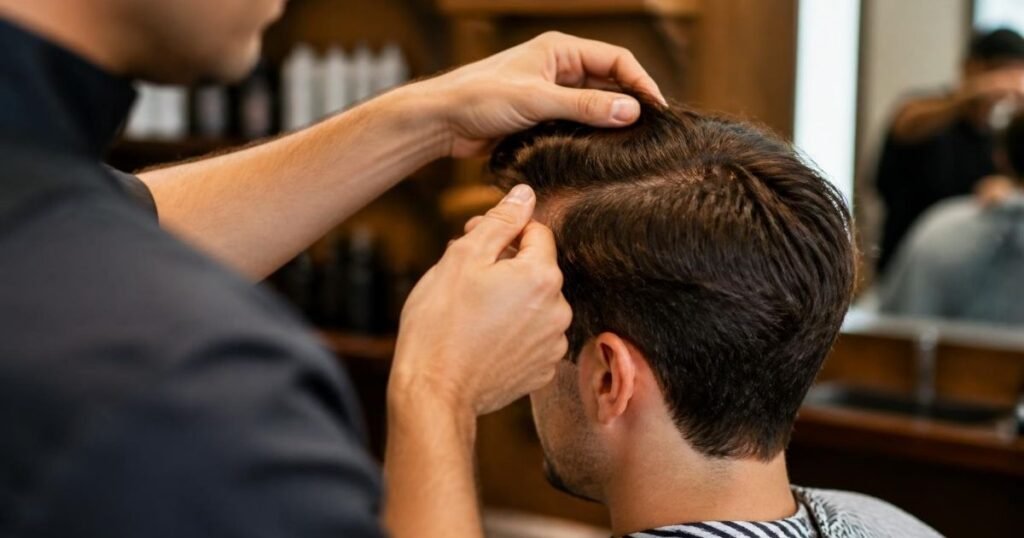
There’s no reliable “this is the haircut for your type” rule here. The cut tends to be easier or harder depending on a handful of things, and it helps to check them before booking.
Hair density and strand thickness. Thick, dense hair can hold a fringe well, but it may need weight removed so the top doesn’t stand out or sit bulky. Fine hair can lie flat and may need lighter products and careful texturizing. Strand thickness and density are different things, since you can have fine strands in large numbers or thick strands that are sparse.
Growth patterns. A cowlick at the front can push the fringe sideways or make it lift. A crown whorl can send the top in a different direction from the fringe. A widow’s peak, a V-shaped point at the center of the hairline, can pull the fringe into a point. None of these rule the cut out, but they change how the fringe needs to be cut and styled.
Hairline and forehead. A high forehead or a receding hairline affects how long the fringe should be and where it should sit. An uneven hairline can be softened or emphasized, depending on the fringe cut.
Texture. Straight hair tends to show the fringe line most clearly. Wavy hair adds movement. Curly and coily hair need the adaptations covered in the curly section above.
Face shape. Face shape is one input among many, and it’s the least decisive. A fringe changes how the forehead reads, and the side finish changes how the head and jaw look. Beyond that, hairstyles can be adjusted by length, fade height, and texture, so a barber’s adaptation often matters more than the face shape label.
Lifestyle. Think about how much time you’ll spend styling and how often you’re willing to book a trim. Those preferences usually push the choice toward a taper or a fade more than hair type does.
A simple check: look at how your hair behaves when it’s a little longer at the front, and show your barber photos of it. That tells them more than a face shape name.
Situations worth raising with a barber before committing:
- A strong front cowlick or a crown that pushes the fringe off-center
- Noticeable recession at the temples
- Very fine or very sparse hair at the front
- Tight curls or coils
- A hairline you’d like the fringe to hide or work around
How to Tell Your Barber What You Want?
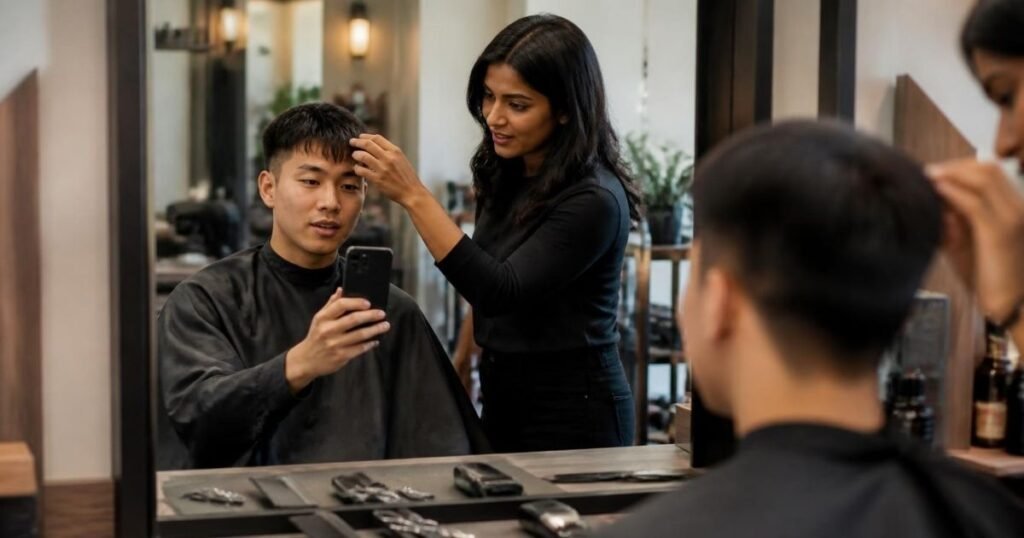
Names for these cuts vary by barber and by region, so a single phrase won’t produce the same result everywhere. The most reliable approach is to describe a few specific details and back them up with photos.
Details to settle:
- Fringe length and edge: Where it should end relative to your eyebrows, and whether it should be blunt or choppy
- Top length: How much length to leave at the front, and how much through the crown
- Side finish: Taper, fade (and which height), burst fade, or undercut
- Neckline: Rounded, squared, or tapered
- Styling direction: Forward, slightly to one side, or left loose
Guard sizes: If your barber talks in clipper guard lengths, note that numbering differs. In the US, guards are commonly called by numbers, and in the UK, you may hear grades. The exact lengths can vary by brand, so ask the barber to confirm what they mean in inches or millimeters if precision matters.
Sample wording you could adapt:
“I’d like a short fringe that sits above my eyebrows, with a bit of texture on the top. Taper the sides and back, and keep the neckline natural. Here’s a photo of the look I’m after.”
Tips for reference photos:
- Bring at least two: one front view and one from the side or back
- Choose photos with hair similar to yours in thickness and curl pattern
- Say what you like in each, such as the fringe edge, the side blend, or the overall shape
Ask how the cut will work with your hair’s growth pattern, and how they’d style it. If a barber says part of the photo won’t work with your hair, that’s useful information, and you can ask for the closest alternative.
How to Style a French Crop at Home

Styling is usually short, but the order of steps matters more than the product. This is a general routine you can adjust.
- Start with damp hair. Towel-dry until it’s no longer dripping. Styling on soaking-wet hair makes it harder to control direction.
- Set the direction. Dry the fringe forward, using your fingers or a comb as you go. With a blow dryer, keep the airflow pointed in the direction you want the hair to lie. Even a minute of this can help a stubborn front sit better.
- Choose a product to match the finish. For a defined look, a small amount of matte clay or paste works well. For a softer hold, a cream may do the job. For a looser, textured finish, a sea salt spray applied to damp hair can add grip.
- Apply a small amount. Warm it between your palms, then work it through the top, starting at the back and finishing with the fringe.
- Shape and finish. Push the fringe forward, then separate a few pieces with your fingertips if you want more texture. Stop when it looks right, since extra product tends to weigh the fringe down.
Adjusting for hair type:
- Fine hair: Lighter products and smaller amounts, since heavy ones can flatten it. A little texture spray at the roots may help with a flat top.
- Thick hair: Firmer hold, plus a cut that removes some weight.
- Wavy or curly hair: Products that support the curl pattern, and less brushing against it.
Troubleshooting:
- The fringe lifts at the front: Blow-dry it forward while it’s damp, then use a little more hold.
- A cowlick splits the fringe: Dry it against the direction it fights, then set it with product. If it keeps winning, ask your barber about adjusting the cut around it.
- The top looks flat: Use less product, or apply a texture spray before drying.
- You want a neat look without daily blow-drying: A textured cut, plus a bit of product on towel-dried hair, is often enough.
How to Maintain a French Crop
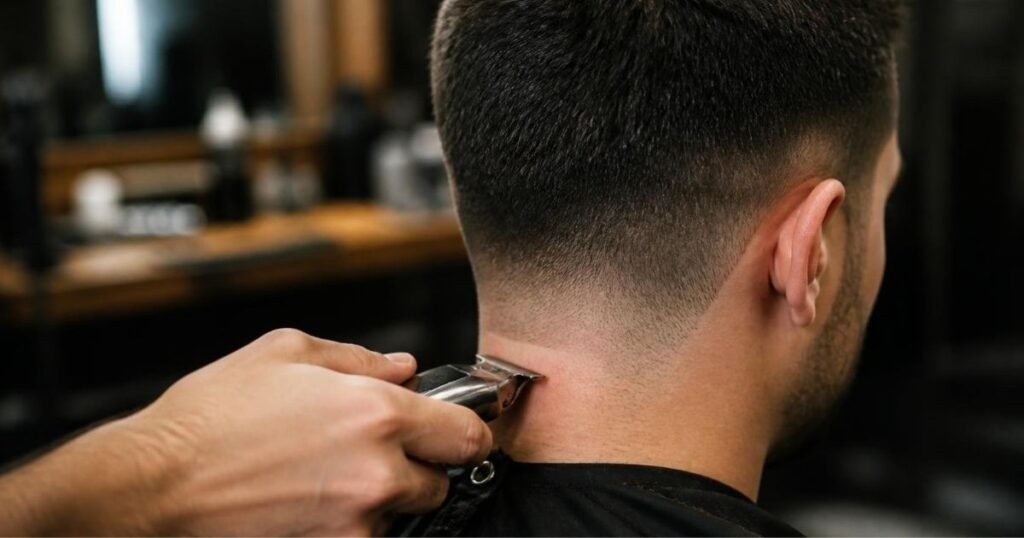
Upkeep depends less on the French crop itself and more on the choices you make around it. A few things drive how often you’ll want a trim.
| Factor | Effect on upkeep |
| Side contrast | Tighter fades and undercuts show regrowth sooner than soft tapers |
| Fringe length | A short fringe can reach the eyebrows or past them within a few weeks |
| Growth speed and density | Fast-growing or dense hair can look grown-out earlier |
| Personal tolerance | Some people book early to keep lines sharp, others prefer a softer grow-out |
As a general pattern, high-contrast sides look grown-out sooner, while softer tapers can stay presentable for longer. The fringe tends to be the first thing people notice, so some trim it more often than the sides.
Between visits:
- Keep the neckline tidy if you’re comfortable doing it yourself, or leave it for the barber
- Wash and condition regularly, and look after your scalp, since short hair shows dryness and flaking more easily
- Trim only the fringe if it starts to bother you, and be careful not to cut it shorter than intended
Growing it out: The awkward stage is when the sides catch up with the top. A taper can make this less obvious, since the transition is gradual. If you’re moving away from the cut, a barber can help shape the in-between stage instead of leaving it to grow unevenly.
How the French Crop Haircut Compares to Similar Cuts
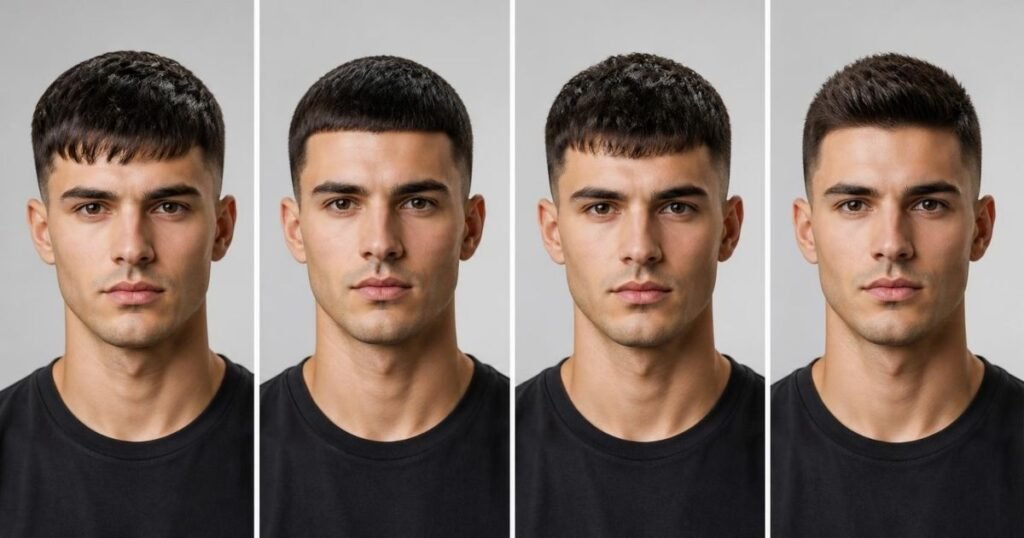
These cuts overlap, and barbers don’t always use the names consistently. The table shows typical differences, but expect exceptions.
| French crop | Caesar cut | Textured crop | Crew cut | |
| Fringe | Short, forward | Short, often straight across | Varies, may be forward or swept | Usually none hanging forward |
| Top length | Short to medium | Short, often even | Short, with cut-in texture | Short, slightly longer at front |
| Typical styling | Forward, neat or messy | Forward, minimal | Piecey, textured | Up or back, or left natural |
| Side finish | Taper, fade, or undercut | Often tapered | Often tapered or faded | Tapered or faded |
French Crop vs. Caesar Cut
Both have a short fringe, and some barbers treat the names as nearly interchangeable. The commonly cited difference is that a Caesar is often shorter and more uniform on top, with a straight horizontal fringe, while a French crop tends to have a little more length or texture and is often paired with a more noticeable fade or taper.
If you’re between the two, don’t rely on the name. Tell your barber how long you want the fringe, whether the top should be even or textured, and how short the sides should go.
French Crop vs. Textured Crop
“Textured crop” is usually a broader term for a short top with texture cut into it, which may or may not fall forward. A French crop is a crop with a specific forward fringe. Because of that overlap, many barbers will give you something very similar for either request.
The more useful distinctions are fringe direction (forward versus swept or lifted) and top length. If the photo you’re bringing shows a fringe falling forward, say so.
French Crop vs. Crew Cut
A crew cut is short all over, with the top slightly longer at the front and usually styled up or back, or left short, rather than falling over the forehead. The French crop reverses the idea: the length is at the front, and it’s directed forward.
If you’re switching from a crew cut, the top will need time to grow before a fringe can form. Mention that to your barber so they can leave enough length for it.
Read More About :Top 40 Mid Fade Haircuts for Men: Fresh, Modern Styles to Try
FAQs About the French Crop Haircut
Is the French crop haircut suitable for men with a receding hairline?
It can be, depending on the recession pattern and how much hair you have at the front. A short fringe can soften the hairline, but one cut too short or too straight may draw attention to an uneven hairline. Talk through fringe length and texture with your barber, and bring a photo of someone with a similar hairline if you can.
How often do I need to get a French crop trimmed?
It depends mainly on how tight the sides are and how quickly your hair grows. Sharper, higher-contrast sides tend to look grown-out sooner than a soft taper. The maintenance section explains the factors in more detail.
What products work best for styling a French crop?
Matte paste or clay gives a defined finish, a cream offers softer hold, and sea salt spray adds grip for a looser, textured look. The best choice mostly depends on hair type, with lighter products suiting fine hair and firmer ones suiting thick hair. See the styling section for the full routine.
Can men with thick hair pull off the French crop?
Often, yes. Thick hair can hold a fringe well, but the top may need weight removed through texturizing so it doesn’t sit bulky. A strong growth pattern at the front is worth mentioning too. The textured version above shows how cut-in texture can help.
Can you get a French crop with curly or wavy hair?
Yes, with some adaptation. Wavy hair adds movement and often suits a looser finish. Curly hair shrinks as it dries and the fringe may spring up, so the length and technique need to be planned around that. The curly French crop section covers what to discuss with your barber.
Is a French crop a low-maintenance haircut?
Daily styling can be quick, sometimes just a little product on towel-dried hair. Appointment frequency is a separate question, since tighter sides and a short fringe need more regular trims to keep their shape. How low-maintenance it feels depends on which of those matters more to you.
Conclusion
Choosing a French crop mostly comes down to three decisions. First, pick the side finish that matches how much contrast and upkeep you want: a taper for softer, a fade for sharper, or an undercut for the most visible contrast. Second, think about your hair’s density, front growth, and hairline, since they shape how the fringe sits. Third, bring photos from more than one angle and describe the fringe length, top length, and side finish you want.
Before your appointment, make sure you can answer three questions: how short do you want the fringe, how much contrast do you want at the sides, and how much styling time are you willing to give it each day? With those settled, your barber has what they need to adapt the cut to your hair.

Jake Miller is a barbering and men’s hairstyle enthusiast who shares practical tips, haircut inspiration, and the latest grooming trends at BarberZylo. He enjoys exploring modern and classic hairstyles and helping readers find fresh ideas for their next look.
4 Comments