
The Caesar Haircut: A Complete Guide for Men Who Want a Sharp, Low-Maintenance Look
A Caesar haircut is a short cut with the hair on top brushed forward into a short fringe (bangs, in US terms) that sits roughly straight across the forehead. The sides and back are cut shorter, and there’s no side part. If you want a neat, compact shape that doesn’t ask for much in the morning, it’s one of the simpler short cuts to understand.
“Low-maintenance” needs one qualification. Daily styling can be quick for many people, but upkeep depends on how the sides are finished and how your hair grows. A faded Caesar, for example, usually needs more frequent barber visits than a tapered one. This guide covers how the cut works, which variations exist, how it differs from the French crop and buzz cut, what to consider about your own hair, and how to ask for it and look after it.
Quick facts
| Top | Short and fairly even, brushed forward (commonly somewhere around 1–2 inches / 2.5–5 cm, though this varies by hair type and barber) |
| Fringe | Short, roughly horizontal, usually sitting above the brow |
| Sides and back | Tapered or faded, finished with a neckline |
| Part | None |
| Daily effort | Can range from a quick comb to a few minutes with product |
| What affects upkeep | Taper or fade, growth rate, hair density, how crisp you like the neckline |
What is a Caesar Haircut?
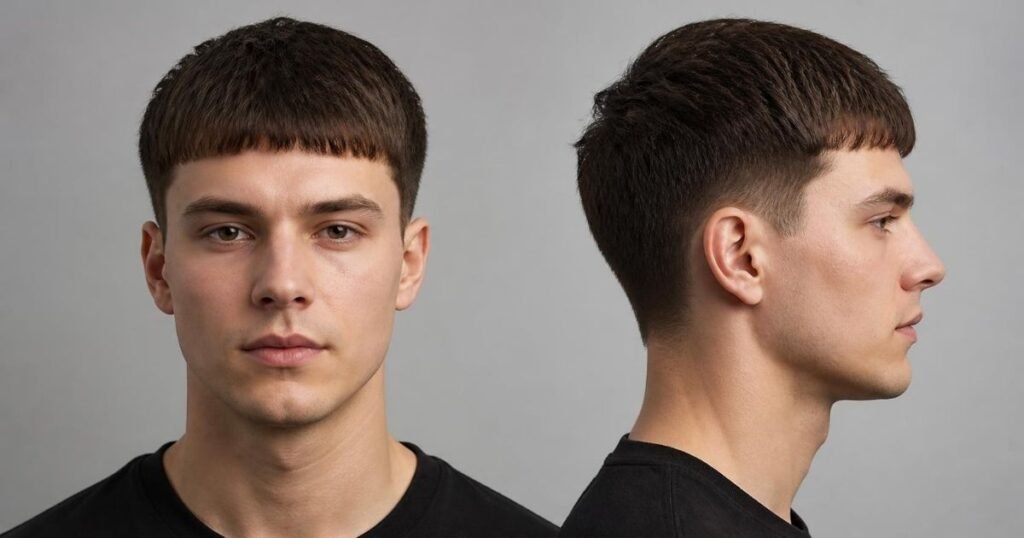
The Caesar haircut is a short men’s cut built around a forward-brushed top and a short fringe. The hair on top is kept fairly even in length, combed toward the forehead, and cut so the front edge sits across the forehead in a roughly horizontal line. The sides and back are cut closer, which keeps the overall shape compact.
The name is usually linked to Julius Caesar and the short, forward-combed hair seen in Roman portraits. That connection is a popular association rather than a documented line of descent, and Caesar was a Roman general and dictator, not an emperor. Treat the name as a label for the look rather than a history lesson.
Terminology also varies between barbers and regions. Some use “Caesar cut” and “French crop” almost interchangeably, and others draw a line based on length and texture. The comparison section below covers this, but the practical takeaway is that a photo will always communicate more reliably than a name.
Key Features of a Caesar Haircut
When you’re looking at reference photos, these are the details that define the cut:
- Forward-brushed top. The hair moves toward the forehead rather than back or to a side.
- A short, roughly horizontal fringe. It typically sits above the brow, though where it lands depends on your forehead height, hairline shape, and hair type.
- Fairly even top length. It isn’t heavily layered, and the length is similar from front to crown.
- Shorter sides and back. These are finished with a taper or a fade (explained in the variations below).
- No defined part. The shape comes from direction and length, not from a parting line.
- A finished neckline. This can be tapered, rounded, or squared, and it changes how sharp the cut looks from behind.
It helps to know what a Caesar isn’t. A longer top that can be swept back or parted belongs to a different family of cuts, and so does a single-length clipper cut with no fringe (a buzz cut).
How Long Should a Caesar Haircut Be?
There isn’t one correct length. Think in three zones instead.
Top. The top is short and fairly uniform. The range given above is approximate, and the right length for you depends on how your hair behaves. Hair that springs up or curls needs more length to look the same as straight hair cut shorter.
Fringe. Describe this against landmarks, not just inches: “just above the eyebrows” or “about halfway down the forehead” communicates more clearly than a measurement. Your own forehead height changes how a given length looks.
Sides and back. These are usually cut with clippers. Guard numbers describe the length left behind, but sizes vary slightly by brand, so treat these as approximate:
| Guard (US) | Approx. length | UK equivalent (approx.) |
| #0.5 | 1/16 in (1.5 mm) | Grade 0.5 |
| #1 | 1/8 in (3 mm) | Grade 1 |
| #2 | 1/4 in (6 mm) | Grade 2 |
| #3 | 3/8 in (10 mm) | Grade 3 |
A fade blends down to very short hair or skin, while a taper shortens more gradually and usually stays longer at its shortest point (more on both below).
If your hair is curly or coily: Hair often looks shorter once it dries and springs up (shrinkage), so a fringe cut at a given length when wet or stretched can sit noticeably higher on the forehead when dry. Ask your barber to check the length with your hair dry.
Why Men Still Choose the Caesar Cut Today
There’s no reliable popularity data behind any claim about the Caesar’s standing, so the better question is what the cut does well. Its appeal comes from its structure.
- A short routine for many people. With a short top and no part to arrange, many people can finish with a comb and a small amount of product, or none. How little depends on your hair’s natural direction and texture.
- It changes how much forehead shows. The fringe covers part of the forehead, which some people like, particularly if they feel their forehead is prominent. It’s a styling choice, not a guarantee of coverage.
- Adjustable sides. A taper reads as understated, while a fade creates more contrast. The same top works with either.
- It pairs easily with a beard. The short top and compact shape give a beard room to be the focus.
- A contained shape. There’s little length to manage, which many people find makes it easier to keep tidy.
Trade-offs worth knowing:
- Fringe growth is easy to notice because there’s so little length.
- Faded sides need more frequent visits than tapered ones.
- You can’t part it or sweep it back without changing the cut’s character.
- Cowlicks and unusual hairline shapes can complicate the fringe. The suitability section below covers this.
Popular Caesar Men’s Hairstyles
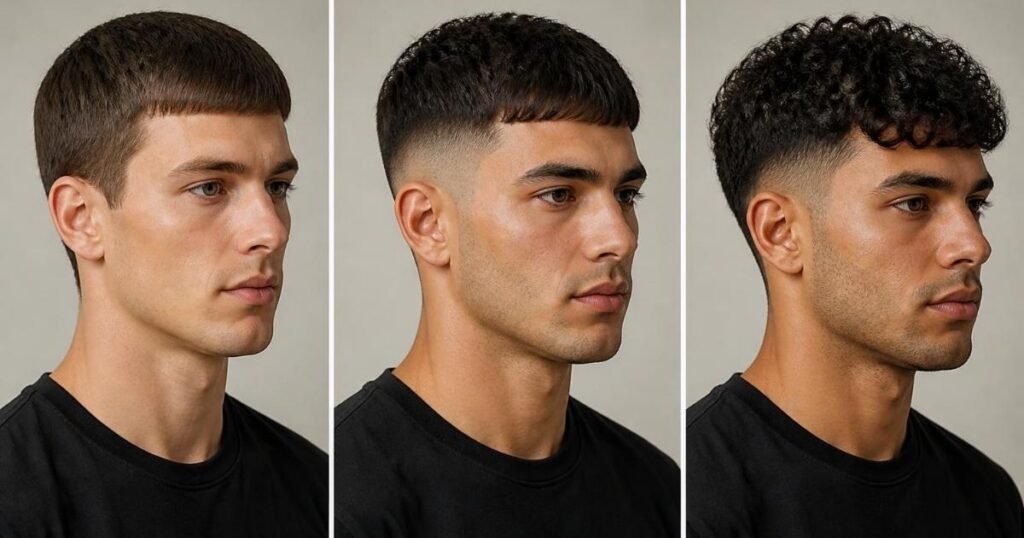
Caesar variations come down to three choices: how the sides are finished, how the top is cut and textured, and how the cut works with your hair type or other grooming. Here’s the quick map before the detail.
| Variation | What changes | Upkeep consideration |
| Classic | Even top, straight fringe, tapered sides | Taper softens gradually |
| Fade | Sides blend shorter, with more contrast | Blend loses its crispness sooner |
| Textured | Top cut or styled for separation | Depends on the cutting method |
| Long | Longer top and fringe | More styling, and grows into a longer crop |
| Curly | Curls kept on top, short sides | Needs curl-aware cutting |
| With beard | Beard blended into the sides | Haircut and beard upkeep overlap |
Classic Caesar
The classic version is the baseline the others modify. The top is even, the fringe is straight, and the sides are tapered, meaning the hair gets shorter gradually toward the ear and neckline without necessarily reaching skin. It has little texturizing and no dramatic contrast.
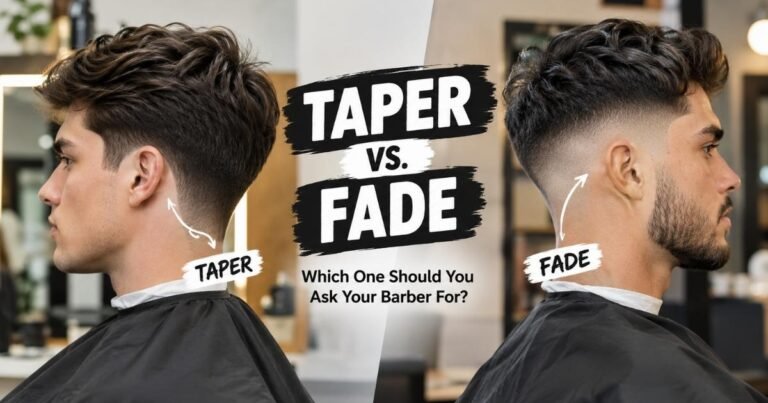
Compared with a fade, a taper looks softer and tends to grow out more gradually. That generally means the cut keeps its shape a bit longer before it looks overgrown.
To ask for it: “Even the top brushed forward with a straight fringe, and a short taper on the sides.”
Caesar Fade
In a Caesar fade, the sides blend down to very short hair or skin, which creates more contrast between top and sides. The fade’s name reflects where it starts:
| Fade | Where it starts | Effect |
| Low | Just above the ear and around the neckline | Subtle, with the most hair left |
| Mid | Around the temple area | A clear but moderate contrast |
| High | Higher on the head | The strongest contrast |
The higher the fade, the more of your head shape and scalp is visible, which is worth thinking about if you have scalp scarring, a bumpy head shape, or hairline concerns. The blend also softens sooner than a taper’s does, so a faded Caesar tends to need more frequent visits.
Textured Caesar
“Textured” can mean two different things, and it helps to separate them. One is cutting technique: a barber may use point cutting (snipping into the ends), texturizing shears, or scissor-over-comb work to remove weight and create separation. The other is styling: a matte product that lets the ends separate.
The result is a fringe that’s less blunt, with a slightly broken, softer edge instead of a ruler-straight line. Different barbers use “textured” to mean different amounts of this, so showing a photo helps.
Thick hair may benefit from weight removal because it can otherwise sit heavy and stand away from the forehead. Fine hair is different. Too much texturizing can thin the fringe out, so it’s worth discussing how much is right.
Long Caesar
A long Caesar keeps the top and fringe slightly longer. That extra length lets you push the fringe a little to one side or lift it at the front, which gives you more styling options.
The boundary is worth knowing. Once the top is long enough to part or sweep back, it’s drifting toward a different cut. Longer hair also shows more of its natural behavior: waves may bend or lift, and a front cowlick becomes more noticeable. Expect a bit more styling effort and a faster grow-out into a longer crop.
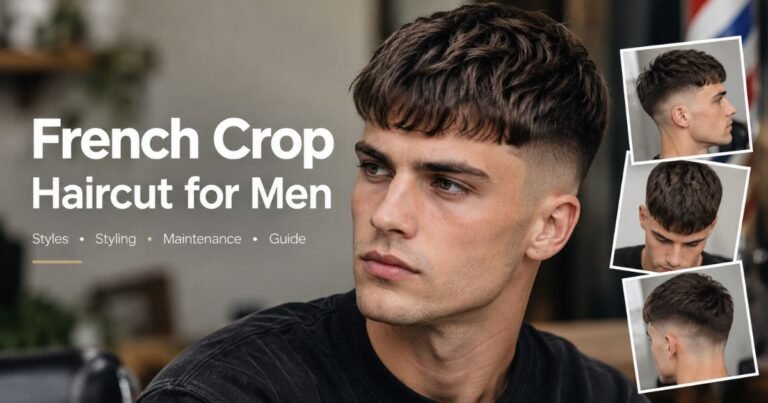
Read More About : French Crop Haircut for Men: Best Styles & Guide (2026)
Curly Caesar
On curly or coily hair, the Caesar looks different from the straight-hair version. The fringe follows your curl pattern, so it forms curls or coils along the forehead rather than a straight line. The goal is a defined, tidy shape that works with the hair’s natural direction.
A few things matter more here:
- Cutting dry. Many barbers who work with curls cut dry to see how the hair falls.
- Length. Going too short can change the curl shape and reduce definition on top, so it’s worth keeping enough length for the curls to form.
- Sides. Tapering or fading the sides keeps attention on the curls.
Look for a barber with experience cutting your curl pattern, and consider describing the fringe as “following my natural curl” rather than as “straight across.”
Caesar with Beard
A short top and a beard can look intentional when they’re proportioned together. Stubble or a short beard tends to sit comfortably with a close Caesar, while a fuller beard shifts the balance toward the lower face, so the top may need a little more length or texture to avoid looking small.
The details that tie the two together:
- Blending. The fade or taper on the sides can flow into the beard, so there’s no abrupt jump between hair and beard.
- Matching lines. A crisp neckline and cheek line go well with a defined fringe.
- Synced upkeep. Booking both on the same visit keeps the whole shape consistent.
Beard density and face proportions affect how this looks, so it may be worth discussing with your barber how to blend yours.
Caesar Haircut vs. French Crop vs. Buzz Cut

These three get confused, and the confusion is partly real. Terminology overlaps, and some barbers use “Caesar” and “French crop” almost interchangeably. What follows is how the difference is commonly described, so use it as a guide and not a rule.
| Caesar | French crop | Buzz cut | |
| Top length | Short and fairly even | Often a little longer | One clipper length throughout |
| Fringe | Short and roughly horizontal | Short, may be more textured or slightly longer | None |
| Texture | Can be blunt or textured | Often more textured and tousled | None |
| Sides | Taper or fade | Often a fade | Same length as the top, or faded |
| Styling effort | Low to moderate | Moderate | Almost none |
| Grow-out | Fringe grows over the forehead | Gains length and movement | Grows evenly |
How to choose:
- If you want a visible fringe with a short, tidy top, the Caesar is the closest match.
- If you want more movement and texture on top, a French crop or textured Caesar may be closer to what you’re after.
- If you want the least styling possible and no fringe, a buzz cut is simpler.
A fringed crew cut (a short top with a slightly longer front) also overlaps with the Caesar. When in doubt, show a photo and ask how your barber would cut it.
Who This Haircut Works Best For
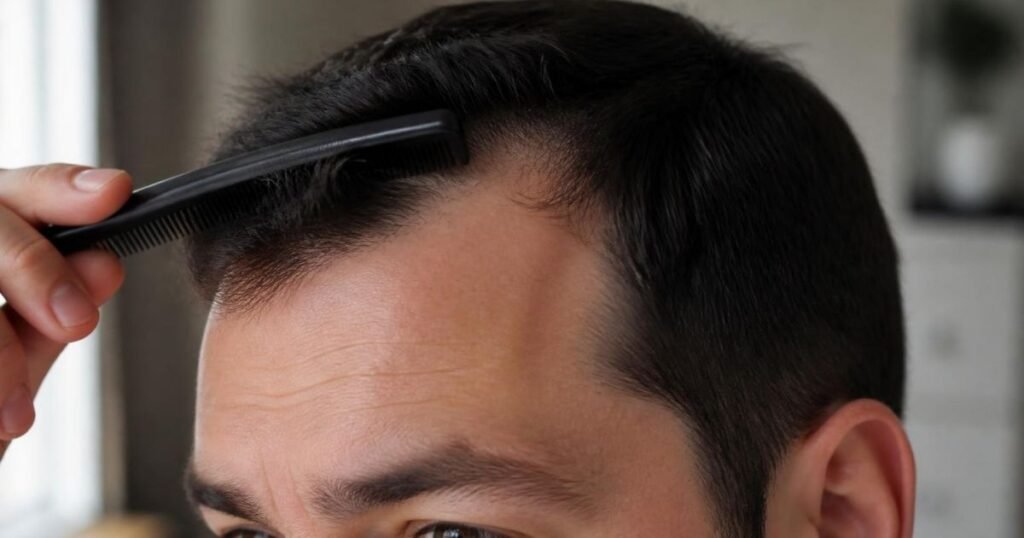
No haircut is guaranteed to suit a whole group of people. The result depends on how your hair behaves, where your hairline sits, your forehead and face proportions, and how much time you’ll spend on it. A quick self-check can help:
- Where does your hairline sit, and is it even across the front?
- Do you have a cowlick at the front?
- How does your hair behave when it’s short? Does it lie flat, spring up, or curl?
- How much time do you want to spend styling?
- How do you feel about frequent trims?
It may be harder if you have a strong front cowlick that pulls the fringe the wrong way, very uneven front hairline growth, or no patience for regular visits to keep the shape sharp. None of these rule it out, but they’re worth raising with your barber.
Caesar Haircut for Straight, Wavy, and Curly Hair
| Hair type | What to expect | What to discuss |
| Straight | The fringe lies flat and shows the cut line clearly. Cowlicks and fine hair can show more. | Fringe length, and how to add body if hair looks flat |
| Wavy | The fringe may bend, flip, or lift, and humidity can change the shape. | Slightly more fringe length to control movement |
| Curly and coily | Shrinkage, a rounder fringe line, and a more defined texture. | A barber experienced with your pattern, cutting dry, leaving enough length |
If you have a front cowlick, ask the barber to cut with the growth direction instead of against it. A fringe that fights the hair’s natural direction is the usual reason it sticks up or splits.
Caesar Haircut for Thick, Fine, and Thinning Hair
Density changes how the fringe sits and how much work it takes.
Thick hair. Bulk can push the fringe away from the forehead. Weight removal and some texture may help it lie more naturally.
Fine hair. Fine hair can look flat and may show scalp if it’s cut very short. Light products and a matte finish may add apparent body. If you’re wondering how to avoid making fine hair look flat, leaving a little more length on top and avoiding heavy product usually helps.
Thinning hair. A fringe changes how existing hair is arranged, not how much of it there is. Results depend on where the thinning is and how the cut and styling are handled, so it’s worth discussing with your barber.
If hair loss is sudden or worrying, a doctor or dermatologist is the right person to ask, not a barber or an article.
Caesar Haircut for Different Face Shapes
Face shapes are rough categories, and many faces mix them. Beards, glasses, and hair texture also change the overall look. Treat these as starting points for a conversation, not rules:
| Face shape | A possible consideration |
| Oval | Balanced proportions often work with many fringe lengths, so it may come down to preference. |
| Round | Some added height and texture on top may help avoid a flat look, and a higher fade can add a vertical line. |
| Square | A softer, textured fringe edge may soften a strong jaw, while a straight fringe keeps it more angular. |
| Oblong | A fringe can visually shorten a long forehead, and extra height on top may emphasize length. |
| Diamond | A fringe may add width at a narrower forehead, and very tight sides can emphasize the cheekbones. |
| Heart | A slightly softer, longer fringe may cover part of a wider forehead. A beard can balance a narrower chin. |
| Triangle | Some fullness on top and in the fringe may add width above a wider jaw. |
The adjustable levers are fringe length, top height, and side contrast. A barber who can see your face can usually judge those better than any chart.
Caesar Haircut for a Receding Hairline
A few terms help here. Temple recession is hair loss at the corners of the forehead. An M-shaped hairline is one where the temples recede while the center holds. A widow’s peak is a V-shaped point at the center of the forehead.
A forward-combed fringe can soften how defined the front hairline looks, because the hair sits across the area instead of exposing it. That’s the reason many people with a receding hairline consider the cut.
There are limits. Deeper recession, thin front hair, or a very short fringe may still show the hairline, and a perfectly even fringe line can look uneven against irregular growth. Options to discuss with your barber include a slightly softer or textured fringe edge, and less contrasting sides if a high fade draws attention to the temples.
No cut hides recession completely, and how well this works depends on your particular hairline.
How to Style a Caesar Haircut

Many people can wear a Caesar with very little work, but the effort varies with hair type and the finish you want. There are two ends of the range:
- A soft, natural finish. Comb or air-dry the fringe forward with little or no product. This is the answer if you want a haircut that looks good without blow-drying.
- A defined, textured finish. Use a small amount of product and shape the fringe and top with your fingers.
Which one suits you depends on your hair. Straight, fairly thick hair that lies forward naturally may need almost nothing, while fine, wavy, or cowlicked hair usually needs a bit more.
Choosing the Right Styling Product
Choose based on the finish you want and how your hair behaves, not on a product being the “best.” Start with a small amount, because it’s easier to add than remove.
| Product type | Finish and hold | May suit | Watch out for |
| Matte clay | Matte, medium to strong hold | Thicker hair, textured looks | Can feel heavy on fine hair |
| Paste | Low shine, flexible hold | Most hair types | Can build up |
| Cream | Natural, light hold | Fine or curly hair | Too little hold for stubborn hair |
| Light pomade | Some shine, smoother finish | A neater, combed look | Can look greasy if overused |
| Sea salt spray | Matte, grainy, textured | Adding body to fine hair | Can dry out hair |
| Texturizing powder | Lift and grip | Fine, flat hair | Can leave residue |
| Curl cream or mousse | Defined curls, lighter hold | Wavy, curly, coily hair | Too much can weigh curls down |
Very heavy, shiny, or high-hold products can stiffen the fringe or weigh down fine hair. Curl pattern, humidity, and scalp oiliness also affect what works.
How to Style the Fringe and Add Texture
- Start with towel-dried or damp hair. The fringe sets more easily when it’s slightly damp.
- Set direction (optional). Blow-dry on low heat while brushing the fringe forward. This helps with cowlicks and waves.
- Warm a small amount of product. Rub it between your palms until it’s evenly spread.
- Work it through from the back toward the front. Starting at the crown helps avoid overloading the fringe.
- Set the fringe. Use your fingers or a comb to bring it forward.
- Add texture. Separate the ends with your fingertips in small sections.
To get texture without looking spiky, use less product than you think you need, work it in horizontally instead of pinching the ends upward, and choose a flexible matte product over a strong-hold one.
Common problems and fixes:
- Fringe sticking up: Dampen it, comb it down, and try a dab of light product. A persistent front cowlick may need a slightly longer fringe or a cut that follows its direction.
- Fringe looking flat: Use a light texturizer and avoid heavy products. Lift gently at the root.
- Fringe flipping: More length or a different growth-direction cut may help.
- Stubborn front cowlick: Blow-dry against the swirl first, then set forward. If it keeps winning, talk to your barber about working with it.
- Humidity: A cream or light-hold product may keep wavy and curly hair from frizzing.
Read More About : Modern Mullet Fade: The Complete Guide to Getting It Right in 2026
How to Ask Your Barber for a Caesar Cut

The name alone isn’t reliable, because “Caesar” means slightly different things to different barbers. Combine the name with specifics and photos, and no single phrase will guarantee the same result in every shop.
What to Tell Your Barber
Decide on these beforehand:
- Top: length and texture (blunt or textured).
- Fringe: position (relative to the brow) and shape (straight or softened).
- Sides and back: taper or fade, fade height, and how short.
- Neckline: tapered, rounded, or squared.
- Line-up: whether you want the edges around the front and sideburns cleaned up.
- Your hair: any cowlick, hairline concern, or density issue.
- Styling: how much time you plan to spend.
Example scripts:
Classic taper: “I’d like a Caesar cut: even top brushed forward with a straight fringe just above my brows, and a short taper on the sides and back with a tapered neckline.”
Textured fade: “I’d like a textured Caesar: a short, forward fringe with some separation, a mid fade on the sides, and a squared neckline. I have a cowlick at the front, so what would you adjust?”
You can also ask how the top will be cut. Clippers (with or without a guard) create a very even top. Scissors, including scissor-over-comb work, give more control over the fringe and a softer edge. Many barbers use both, so you don’t need to choose, but it’s worth asking which they’d use on your hair.
Short glossary:
| Term | What it means |
| Fringe (bangs in the US) | The hair at the front that falls over the forehead |
| Taper | Hair that gets gradually shorter toward the neckline and ears |
| Fade | A blend that goes to very short hair or skin |
| Guard (US) / grade (UK) | Clipper attachment that sets the length |
| Line-up | Clean edges at the front hairline and sideburns |
| Neckline | The shape of the hair at the back of the neck |
| Texturizing | Cutting that removes weight and creates separation |
How to Use Reference Photos to Get the Desired Cut
Photos are the most reliable way to communicate, because “short” means different things to different people.
- Bring two or three photos, ideally front and side views.
- Choose people with similar hair. A photo on thick, straight hair won’t tell you how it would look on fine or curly hair.
- Say what you like and don’t. Point to the fringe, the fade height, or the neckline.
- Consider a “don’t want” photo to rule things out.
- Remember photos may be filtered or edited. Ask what’s realistic for your hair.
- Take a photo after the cut, and note what was done so you can repeat it.
How to Maintain the Look Between Visits

There are two kinds of upkeep: how often you visit the barber, and what you do at home. They’re separate, and a cut can be easy on one and demanding on the other.
How Often Should You Trim a Caesar Haircut?
There’s no universal interval. How often you’ll want a trim depends on:
- Side finish. Faded blends tend to soften sooner than tapers.
- Growth rate and density. Fast-growing or dense hair shows growth sooner.
- Your tolerance for growth. Some people are happy with a bit of softness, and others want the edges crisp.
- The neckline. A sharp neckline looks fuzzy sooner than a rounded one.
Signs it’s time:
- The fringe reaches your brows or eyes.
- The fade blend looks soft or uneven.
- The neckline looks fuzzy.
- The shape feels heavier on top.
If you’d like a number, ask your barber for an interval based on your hair, because they can see how fast yours grows.
If you decide to grow it out, the fringe lengthens first, and the cut gradually becomes a longer crop and then a medium-length style. A barber can shape the in-between stages so it doesn’t look unkempt.
Read More About : Fade Haircuts for Black Men: 58+ Sharp Styles & Tips In 2026
How to Keep the Fringe and Shape Looking Neat
- Reset the fringe with a little water and a comb.
- Tidy the neckline carefully, if at all. A straight fringe line is unforgiving, so leave it to the barber. If you’re confident, light cleanup at the neckline and sideburns is manageable.
- Ask about a quick cleanup. Some barbers offer fringe or neckline touch-ups between full cuts, but it varies.
- Wash according to your hair type. Oily hair may need more frequent washing, and curly or coily hair often benefits from less. Clarify occasionally to remove product build-up.
- Coordinate with your beard. Booking both together keeps lines consistent.
- Protect your scalp. Short sides expose more skin, so consider sun protection.
Frequently Asked Questions
Is the Caesar haircut still in style?
It’s an established cut that barbers recognize, and I can’t point to data on how popular it is right now. Whether it feels current mostly depends on the finish: texture, fade, and length change the character a lot. See the variations above.
When should I have my Caesar haircut cut?
When the shape starts to go. That might be the fringe reaching your brows, the sides losing their blend, or the neckline looking fuzzy. The timing varies with your sides and hair, so see the trim section above.
May I have a curly cut with a Caesar haircut?
If you mean “can a Caesar work with curly hair,” yes, it can. Keep enough length on top for the curls to form, allow for shrinkage, and look for a barber experienced with curls. The hair type section has more.
Does a Caesar haircut work for thinning hair?
It may, depending on where the thinning is. The fringe rearranges existing hair and doesn’t add density, so results vary. See the thick, fine, and thinning hair section.
Is a Caesar haircut good for a receding hairline?
It can be worth considering, since a forward fringe may soften how defined the hairline looks. How well it works depends on how deep the recession is. The hairline section covers the details.
Does a Caesar haircut require daily styling?
Not necessarily. A natural finish can take very little effort, and a defined, textured one takes a bit more. See how to style it.
What is the difference between a Caesar haircut and a French crop?
They overlap, and some barbers use the terms interchangeably. The French crop is often described as a little longer and more textured. The comparison table has the full breakdown, and a photo settles it at the barbershop.
Conclusion
The Caesar is a short cut defined by a forward-brushed top and a short, roughly horizontal fringe. Most of what you’ll decide comes down to a few choices:
- For a conservative look, ask for a taper.
- For more contrast, ask for a fade.
- For a softer front, ask for a textured fringe.
- For curls, keep the length and find a barber who knows your pattern.
For your next visit, pick two or three reference photos, note anything about your hair worth mentioning (a cowlick, hairline shape, or density), and talk it through with your barber. They can see how your hair grows and adapt the cut to fit it.
If you’re still deciding between similar cuts, a guide to the French crop is a good next read.

Jake Miller is a barbering and men’s hairstyle enthusiast who shares practical tips, haircut inspiration, and the latest grooming trends at BarberZylo. He enjoys exploring modern and classic hairstyles and helping readers find fresh ideas for their next look.

2 Comments