
39+ Hairstyles for Men with Fine Hair: The Ultimate Guide
Fine hair behaves differently from the hair in most haircut photos. It can fall flat soon after styling, lose lift at the crown by lunchtime, or clump into stripes when you add too much product. A well-chosen cut does a lot of the work for you, which is why this guide starts with the cuts themselves: 29 hairstyles for men with fine hair, followed by 10 celebrity reference looks, then everything you need to choose, style, maintain, and describe one to your barber.
One distinction will make the rest easier to use. “Fine” describes how narrow each strand is. It doesn’t tell you how many hairs you have (density) or whether you’re losing hair (thinning). Some men have fine strands and plenty of coverage; others have fine strands and less of it. If you’re not sure which applies to you, the sections on what fine hair is and how it differs from thin hair will help, and you’re welcome to read them first.
A few quick notes on terms. Fringe means the hair at the front hairline (bangs in the US). Clipper attachments are called guards in the US and grades in the UK. Barbers don’t always use style names the same way, so bring photos whatever you ask for. And every cut below is a starting point, not a promise: how it turns out depends on your density, your growth patterns, and how your barber adapts it.
| If your priority is… | Entries worth a look first |
| Very little styling | Crew Cut, Caesar Cut, Regulation Cut, Short Textured Crop with Taper |
| More lift at the front | Classic Quiff, Textured Crop, Mop Top |
| Keeping length | Bro Flow, Medium-Length Layered Cut, Wavy Shag, Mop Top |
| A receding hairline or high forehead | Textured Fringe, French Crop, Caesar Cut |
| Less visible scalp | Low Taper with Textured Top, Short Textured Crop with Taper, Textured Crop |
Best Hairstyles for Men with Fine Hair
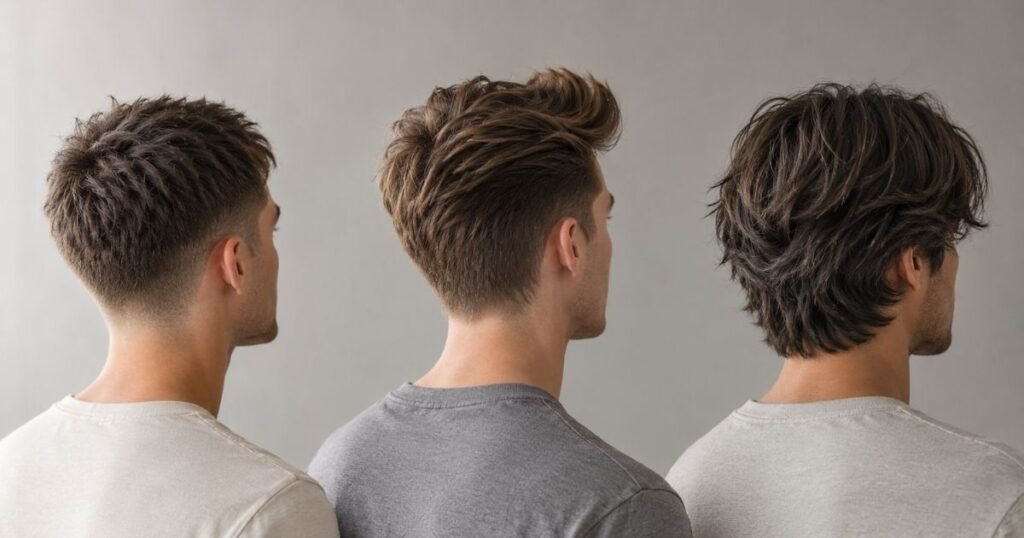
Each entry opens with its length and shape, so you can scan for what you want. Shorter cuts (crops, crew cuts, tapers) generally need less styling and have less hair to flatten. Medium-length cuts keep more movement but ask more of your haircut, your products, and your blow-dryer. These terms come up throughout:
- Taper: the sides and back get gradually shorter toward the ears and neckline, usually leaving a little length at the shortest point.
- Fade: a blend that goes much shorter, often down to bare skin. Low, mid, and high describe where the blend starts.
- Layers: hair cut at different lengths so it moves and stacks instead of falling as one piece.
- Texturizing: cutting that breaks up the ends or removes bulk. On fine hair, light usually works better than heavy.
- Weight: how much hair bulk sits in an area. Fine hair often looks better with some weight left in the ends, so they don’t turn wispy.
| Taper | Fade | |
| How short it goes | Gradually shorter, usually keeping some length | Blends much shorter, often to skin |
| Typical placement | Neckline, sideburns, around the ears | Sides and back, starting low, mid, or high |
| Contrast with the top | Softer | Stronger |
| As it grows out | Usually looks tidy for longer | Edges tend to soften quickly |
Textured Crop
A textured crop has short sides and a short, choppy top that usually falls forward into a brief fringe. The texture comes from the cutting, most often point cutting, where the barber snips into the ends with the tips of the scissors so the hairs sit at slightly different lengths and separate instead of lying in one flat sheet.
That separation is why it suits fine hair so often: you get visual grip and some movement without piling on product. The risk is overdoing it. Too much texturizing can leave wispy ends and make lower density more obvious, so it’s worth asking for texture while keeping some weight at the tips.
Top length is the main decision. It needs to be long enough to move and short enough that gravity doesn’t flatten it, and your barber can judge that by watching how your hair falls when it’s dry. For daily styling, a small amount of matte paste or clay worked through dry hair and pushed forward is usually enough.
French Crop
The French crop pairs short sides with a slightly longer top and a short fringe cut straight across, sitting above the eyebrows. That fringe is what separates it from the Textured Crop: shorter, blunter, and deliberately cropped rather than falling long and piecey. The sides are commonly tapered or faded.
For fine hair, a straight-cut fringe tends to hold together better than a feathered one, which can turn see-through. If you have a high forehead, a fringe like this may help balance proportions. If your temples sit well back, ask how your barber would cut the corners so the fringe doesn’t look boxed in.
Check for a cowlick at the front hairline, too. It can push a short fringe upward, and a barber who sees it on dry hair can cut with it instead of against it. Styling is minimal: a little matte clay, with your fingers pushing the fringe forward.
Scissor Cut
A scissor cut is a technique more than a shape. Instead of clippers on the sides and back, the barber works with scissors, often scissor-over-comb: the comb lifts the hair and the scissors trim whatever pokes through. The blend is softer than a clipper blend and can follow the way your hair actually grows.
That softness suits fine hair when you’d rather avoid a hard line between short sides and visible scalp, and it usually grows out gently. The trade-offs are time and skill. It generally takes longer than clippers, and the result depends heavily on the barber. Because it works with almost any shape here, you ask for it alongside a cut, for example “scissor-cut sides with a soft taper,” and see how your barber interprets it.
Crew Cut
A crew cut has short, tapered sides and a top that’s a little longer, with the most length at the front. It’s designed to need almost no styling, so everything rides on the shape. Front length matters: a touch more lets hair lift slightly, while cut too short it can lie flat against the scalp.
It sits next to a few similar cuts. The Ivy League (next but one) leaves enough top length to part, the Regulation Cut is tighter and tidier, and a buzz cut is a single clipper length all over. How a crew cut looks on fine hair depends on your hairline and how visible your scalp is on top, which varies a lot between people. If you’re unsure, ask your barber to start a little longer; hair can always come off.
Read More About : 45+ Best Hairstyles for Men with Straight Hair
Textured Fringe
A textured fringe is a front section longer than the sides and top, cut so it falls in separate pieces instead of one flat curtain. It’s the base for the choppy, side-swept, angular, and curly fringes later in the list, so the shared advice lives here.
Fine hair can make a fringe look see-through, and heavy product can clump it into stripes. Ask your barber to keep weight at the ends and add texture inside the fringe rather than thinning the edge. To keep a fringe in place through the day, style it in the direction it naturally grows, add a light matte product, and finish with a light-hold spray if needed. A fringe that fights a cowlick will rarely stay put, however much product you use.
Ivy League
The Ivy League is a crew cut with more length on top, enough to comb across or part to the side, with tapered sides and a tidy neckline. That ability to part is the difference between the two.
On fine hair, a part can show a visible scalp line, especially if it’s combed flat. Styling dry or just-damp hair with a light product, and lifting the roots before you comb, keeps it softer. Keep enough top length to part without the hair collapsing, but not so much that it loses its neat shape.
Slicked Back
Slicked back hair is combed straight back from the forehead, with enough length on top to stay in place. It’s a tougher call for fine hair: combing everything back puts the whole scalp in view, and wet-look finishes clump strands into stripes.
If you like the shape, a matte or low-shine product usually looks less revealing than a glossy one, and blow-drying the hair back first gives it body before you add anything. It differs from the Pompadour in height (this one lies flatter) and from the Bro Flow in finish (this one is styled and held, the Bro Flow is looser and dries more naturally). It tends to look better with reasonable density at the front.
Pompadour
The pompadour is defined by height: hair at the front is swept up and back, usually over shorter sides. It’s taller and more structured than the Classic Quiff, though many barbers use the two names loosely, so show a photo that makes the height you want clear.
For fine hair, it’s one of the more demanding styles. You need enough length at the front for the hair to stand, a round brush or comb with a blow-dryer to lift it, and a light but dependable hold. Volume that starts at the roots generally lasts longer than volume created by gluing strands together. Expect it to soften over the day, and consider a lower, softer version if you want less upkeep.
Caesar Cut
The Caesar cut is a short top of fairly even length combed forward, finishing in a short, straight fringe. It’s lower effort than almost anything else on this list and needs little more than a towel-dry and a touch of product.
Compared with the French Crop, it’s usually more uniform and less textured, with a flatter fringe line. That straight line can draw attention to the hairline, so if you have a receding hairline, ask your barber whether a slightly softer, more broken-up edge would sit better on you.
Read More About : 50+ Best Hairstyles for Men With Wavy Hair From Fades to Shaggy Cuts
Side Part
A side part combs hair to one side along a defined line. The part works best where your hair already wants to fall, so look at it dry and without product before you decide. A forced part fights cowlicks and sits flat.
To stop a side part from looking flat on fine hair, dry the roots up and away from the part first, then comb it into place, and use a light product or a little powder at the root for grip. A shaved “hard part” sharpens the line, but it also adds contrast against the scalp, which fine hair may not need.
Faux Hawk
A faux hawk raises a ridge of hair along the center of the head, with shorter sides that are tapered or faded but not shaved bare like a true mohawk. It looks different from the Spiky Haircut because the height runs down the middle instead of across the whole top.
It’s possible on fine hair, but demanding. The center needs enough length to stand, plus firm yet light hold and a blow-dryer. A shorter ridge usually holds better than a tall one, and a little powder at the roots can help. Tapered sides give the ridge more definition.
Spiky Haircut
A spiky haircut is a short top styled up into separate points. Fine strands often won’t stand without firm product, which adds weight and shine. A softer version with small, loose points and matte clay usually reads better and survives the day more easily.
It’s usually paired with short, tapered sides. Unlike the Faux Hawk, the points spread across the whole top, so there’s no single central ridge.
Messy Layered Hair
Messy layered hair is a short-to-medium tousled top with layers that let pieces move independently. This entry is about the finished look. The cutting structure behind a layered style is covered in the Medium-Length Layered Cut, further down.
Layers can give fine hair movement, but too many can leave stringy ends. Light layering that keeps the tips full tends to be the safer request. Styling is easy: let it air-dry or rough-dry it, then work in a little texture spray with your fingers.
Bro Flow
The bro flow is a medium-length style, usually long enough to cover the ears, that’s brushed or pushed back and left relaxed. It dries more naturally than a Slicked Back style and relies on movement, not hold.
On fine hair it can go limp or look stringy at the ends, so some light layering and sensible trims to keep the ends full make a difference. Rough-drying the roots back for lift, instead of letting the hair dry flat, helps too. Be prepared for awkward in-between stages if you’re growing out from something shorter.
Read More About : Wolf Cut vs Shag: The Real Differences and How to Choose the Right One
Side-Swept Fringe
A side-swept fringe sweeps the front hair across the forehead to one side. It’s a styling direction rather than a cutting shape, which is how it differs from the Angular Fringe next.
The key is working with your growth pattern. If the hair at the front naturally falls to the left, swept right will keep fighting you. Ask your barber where your hair grows from at the front, and style it with a light product so it holds without clumping.
Angular Fringe
An angular fringe is cut on a diagonal, usually longer on one side and rising to shorter on the other. Where the Side-Swept Fringe is about how you style it, this one is about how it’s cut.
A crisp line can look fuller on fine hair than a feathery edge, but it takes a precise cut and a barber who has checked your growth direction. A reference photo helps here more than any description.
Classic Quiff
The classic quiff lifts the front up and back, with shorter sides. It’s softer and often lower than a Pompadour, with more forward lift and less structure.
Lift comes mostly from blow-drying, not product: dry the roots up and back, and don’t forget the crown, where fine hair tends to go flat. A little mousse on damp hair and a light-hold finish is usually enough. You don’t need a lot of length to get the shape; moderate front length with tapered sides often suffices.
Wavy Shag
A wavy shag is a layered, choppy cut that works with natural wave, often with a fringe and shorter layers around the crown. Waves can create the look of volume on fine hair, and layers add body, but heavy layering can thin out the ends.
A diffuser on low heat and a light texture or sea salt spray bring out the wave without weighing it down. Humidity can change how it behaves, so you may style it differently from day to day. It’s looser and shaggier than the Mop Top, which is rounder and fringe-heavy.
Read More About : 35+ Best Haircuts for Men With Thinning Hair
Messy Textured Medium Cut
This is a medium-length cut where the texture is built into the haircut, rather than created entirely by styling. “Messy” describes the finish, but it still needs an underlying shape or it just grows into a shapeless mop.
On fine hair, spray a light texture product onto damp hair and let it dry naturally, then add a little matte clay. It differs from Messy Layered Hair by how it’s achieved: here the cut does the work.
Choppy Fringe
A choppy fringe is a Textured Fringe taken further, with pieces deliberately cut at uneven lengths. On fine hair, some choppiness helps stop strands clumping together, but go too far and the fringe starts to thin out.
Ask for choppiness through the ends, not heavy thinning near the roots, and consider how much texture you want by showing a photo with the right amount.
Curly Fringe
A curly fringe lets natural curl form the front. Curls spring up as they dry, so a fringe that touches the eyebrows when wet may sit well above them when dry. Some barbers prefer to cut curly hair dry for that reason.
Fine curls can be weighed down by rich creams, so a lightweight curl mousse or cream and a diffuser tend to work better. If your hair is tightly coiled, shrinkage is even greater; look for a barber comfortable with your texture and show photos of similar hair.
Mop Top
The mop top is a rounded, full shape: longer on top, with the fringe brought forward and the sides covering at least the tops of the ears. Because the shape depends on volume, it can look flat or heavy on fine hair without light layering and a bit of blow-drying.
It’s different from the Bro Flow, which is brushed back, and from the Textured Fringe, which is shorter overall. Keeping the sides a little shorter or lightly tapered may help avoid a helmet-like shape.
Read More About : Men Hairstyles for Thin Hair: 30+ Proven Cuts That Boost Volume
Regulation Cut
“Regulation cut” is an informal term, usually meaning a short, tidy, tapered, military-inspired shape. Definitions vary by barber and country, so a photo matters more than the name.
It needs almost no styling and is stricter than the Crew Cut. The short length also shows the hairline and scalp more clearly, which some men like and others don’t, so consider starting a little longer.
Burst Fade
A burst fade curves around the ear in a semicircle and arcs into the nape, leaving length through the center of the back. It’s usually paired with a longer top, such as a textured crop or a mullet-style shape.
On fine hair, the contrast between the faded area and the longer top can make the top look fuller, but it also shows skin. Your barber can adjust how high and how tight the fade goes, so discuss it before cutting.
High Skin Fade
A high skin fade starts high on the sides, near the temples, and blends down to bare skin. “Skin” refers to how short it goes; “high” refers to where it starts.
The strong contrast can frame the top and make it look denser, or it can emphasize lower density, depending on your hair and scalp tone. Skin fades also show regrowth quickly, so they tend to need more frequent visits to stay sharp. Here’s how fade height compares:
| Fade height | Where it starts | Fine-hair consideration |
| Low | Near the ears and neckline | Subtle; keeps more natural hair on the sides |
| Mid | Around the temples | Moderate contrast; a common middle ground |
| High | Above the temples | Strongest contrast; shows the most scalp |
Short Textured Crop with Taper
Where the Textured Crop is mostly about the top, this version focuses on the sides: a taper keeps some natural hair at the shortest point instead of going to skin. The result is neat all around without strong contrast.
It’s a sensible choice if you want a crop but aren’t sure about a fade. Style the top the same way as the Textured Crop: matte product, worked through dry hair, pushed forward.
Low Taper with Textured Top
Here the taper starts low, around the sideburns, ears, and neckline, and the top is flexible: it can be a crop, a fringe, or a quiff. Because a low taper leaves more hair on the sides than a fade, it tends to look softer on lower density and less dramatic as it grows out.
It’s a good option if you want a neat finish but aren’t ready for something drastic, and it gives you room to change the top later.
Read More About : 22+ Best Hairstyles for Receding Hairlines (2026 Guide)
Short Side Part with Texture
This is the casual, shorter cousin of the Side Part. The part is soft instead of razor-straight, and the top has texture so it doesn’t lie in a flat sheet.
Finger-styling with a little matte product, instead of combing it flat, helps avoid that flat look. Since the cut is short, it needs little upkeep, and the part can be adjusted day to day.
Medium-Length Layered Cut
This entry covers the cutting structure that medium-length styles rely on: where layers start, how much weight is removed, and how the lengths blend down. For fine hair, the aim is usually movement without losing fullness at the ends.
A common approach is a few light layers through the top to add lift, with the lengths below kept fuller. Too many short layers can leave the ends looking thin, so ask where your barber plans to place them and why. Asking for light layers that add texture without losing length is a clear way to describe it. Your growth patterns matter here too: a strong crown swirl or front cowlick affects where layers should sit.
Celebrity-Inspired Hairstyles for Men with Fine Hair
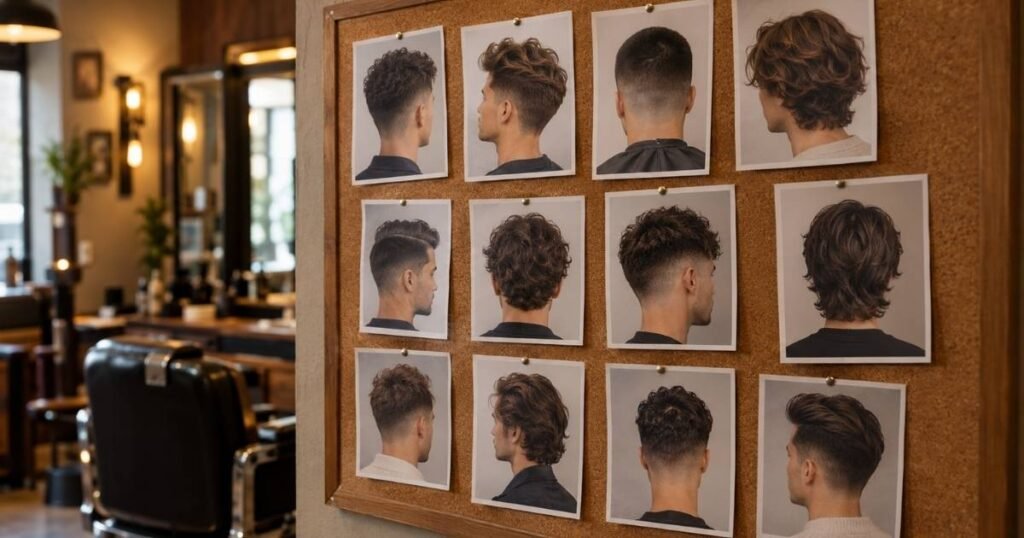
A reference photo often explains a haircut better than words can, but it shows one person’s haircut, not their strand width, density, or product routine. Looks also change over time, so choose a recent photo and treat these as starting points. For each one, we describe what’s visible in the cut and what you might adapt for fine hair, and we point back to the matching entry above instead of repeating it.
Nicholas Hoult’s Short Textured Haircut
A short, choppy top with sides kept neat but not shaved close, so the top shows visible separation instead of one smooth sheet. It’s a close relative of the Textured Crop. The detail to adapt is top length: fine hair needs enough length to show texture, but not so much that it flops. A side-profile photo helps your barber see where the length sits.
How to Style:
Towel-dry, then rough-dry with your fingers. Once it’s dry, rub a pea-sized amount of matte paste or clay between your palms and work it through from back to front.
Tom Hiddleston’s Grown-Out Thinning Hair
In many photos, this look is a medium-length top swept back or to one side, with some natural wave and longer sides. It sits between the Bro Flow and the Medium-Length Layered Cut. If your hair has natural movement, ask your barber to cut with it and keep the ends full. A photo can’t tell you whether your wave pattern matches.
How To Style:
Apply mousse to damp roots and let the hair dry naturally or with a diffuser. Push it back and to one side with your fingers, and finish with a small amount of lightweight cream.
Taron Egerton’s Crew Cut With Widow’s Peak
A short crew-style cut that leaves the hairline’s V-shaped point at the center of the forehead visible. A widow’s peak is a hairline shape, and having one isn’t in itself a sign of hair loss. The cut follows the Crew Cut: tapered sides and a top that’s a little longer at the front. The choice to make is whether to show the peak or soften it. A short, brushed-up front shows it, while a fringe brought forward covers it, so decide first and tell your barber.
How To Style:
Very little is needed. A touch of light clay or pomade through dry hair, brushed up and slightly to one side, is plenty. Heavy product tends to flatten a short cut.
Read More About : 25+ Best Haircuts for Oval Face Men (2026 Guide)
Jamie Dornan’s Thinning Classic Hairstyle
A short, classic shape with a side part, tidy tapered sides, and some height at the front. It’s closest to the Side Part and the Ivy League. The height comes from drying the roots up and over, not from product, so it takes a few extra minutes with a blow-dryer.
How To Style:
Work mousse into damp roots, blow-dry up and back, then set the part with a comb. Finish with a little light clay or powder at the front for grip.
David Beckham’s Short And Cropped Hairstyle
His haircut has changed many times, so check a current photo before relying on one. A short cropped version generally has tapered or faded sides and a slightly longer top with light texture, close to the Short Textured Crop with Taper. If the photo includes a beard, remember that facial hair changes how a haircut reads, so your own beard shape will affect the result.
How To Style:
Use a small amount of matte clay or paste worked through dry hair, focusing on the ends so the texture looks defined but not stiff.
Michael Fassbender’s Textured French Crop
Short, textured hair with a forward fringe and tapered sides, essentially the French Crop. The fringe is the part to talk through: how long, how straight, and how it meets the temples. Mention any cowlick at the front hairline.
How To Style:
Mist a light texture or sea salt spray onto damp hair and let it dry. Then add a little matte clay and push the fringe forward, separating it slightly with your fingers.
Brad Pitt’s Grown Out Fine Hair
A grown-out, medium-length look, often brushed back or to the side, in the territory of the Bro Flow. It works when the ends stay full and the hair has enough movement not to hang straight. If you’re growing out a shorter cut, ask your barber for shaping trims that keep length instead of cutting back to a crop, and be ready for awkward in-between stages.
How To Style:
Use a small amount of mousse on damp roots and blow-dry back for lift. A light spritz of sea salt spray can add texture, but use it sparingly because it can dry hair out.
Read More About : Spiky Hairstyles for Men: 17+ Bold & Textured Styles
Leonardo DiCaprio’s Slicked Back Hair With Side Parting
Hair combed back from the forehead with a side part and enough length to stay put, a mix of Slicked Back and Side Part. The thing to weigh is scalp visibility and shine: combed back flat and glossy, fine hair shows more scalp than it does with a matte, softer finish. Tell your barber where your hair naturally parts before they cut.
How To Style:
Blow-dry from damp with a comb, directing the hair back, then add a small amount of light cream or pomade. Comb through once and stop. Too much product tends to clump fine hair.
Hugh Jackman’s Thinning Hairstyle
Shorter sides with more length and lift at the front, a shape close to the Classic Quiff with a side-swept feel. The contrast between the neat sides and the fuller top does much of the work. How full the front looks depends on your own density and how well you can dry the roots.
How To Style:
Apply a light volumizing mousse to damp roots and blow-dry them up and back. Add a little root powder if you want extra lift, and set it with a flexible-hold spray.
Daniel Craig’s Fine Receding Hairstyle
A short, textured crop with neat edges and very little styling, near the Textured Crop and the Caesar Cut. Keeping the top length modest keeps the contrast between hair and scalp lower, which some men find easier to live with. It won’t look the same on every hairline or density, so try it with your barber’s input.
How To Style:
Almost nothing is needed. A touch of matte clay worked into dry hair is enough to define the top.
What Is Fine Hair in Men?
Fine hair means each individual strand is narrow in diameter. That’s the whole definition. It says nothing about how much hair you have, how healthy it is, or whether it’s thinning.
It helps to separate three traits that often get lumped together:
- Strand width (fine, medium, coarse): how wide each hair is.
- Density: how many hairs grow in a given area of scalp.
- Texture: whether the hair is straight, wavy, curly, or coily.
You can have fine strands with high density, or coarse strands with low density, and either can be straight or curly. That’s why two men who both say they have fine hair can need quite different cuts.
Fine hair often behaves in recognizable ways, though not in every case. It may fall flat soon after styling, lose lift at the crown, clump when you use too much product, look weighed down or greasy sooner, and show more scalp when density is also lower. When hair falls flat shortly after styling, the fix is usually in the cut and the drying, not heavier product.
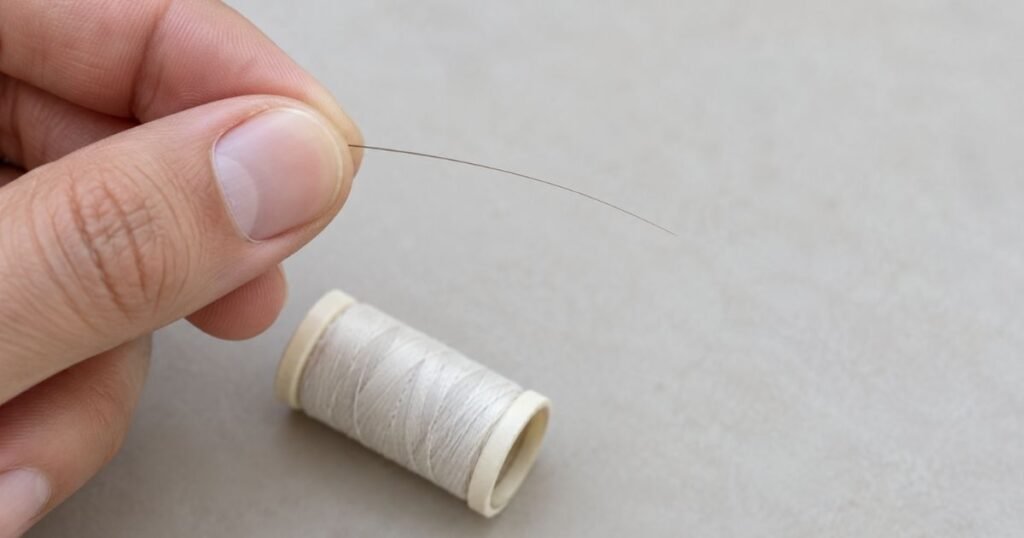
A rough check at home: roll a single strand between your finger and thumb. If you can barely feel it, it’s likely fine, and comparing it with a piece of sewing thread can help. For density, look at your part in bright light when your hair is dry. If scalp is clearly visible through a normal part, your density may be lower. Neither check is a diagnosis, and a barber can often tell you quickly what they see.
Fine hair isn’t a flaw to correct. It’s a trait that responds well to the right shape and a lighter touch.
Fine Hair vs. Thin Hair: What Is the Difference?
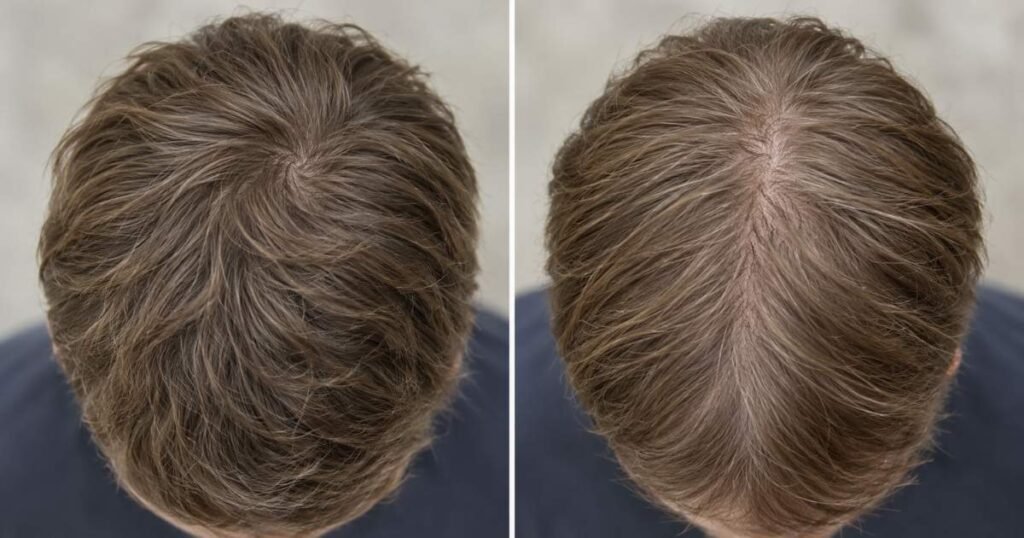
People say “thin” to mean at least three different things, and the right haircut changes depending on which one you mean. If you searched for men’s hairstyles for thin hair, it’s worth working out which of these describes you.
| Term | What it describes | How it can show up | What it changes about haircut choice |
| Fine hair | Narrow individual strands | Hair that goes flat, clumps with heavy product, or lacks body | Favors light products, root lift, and texture that keeps the ends full |
| Thin (low-density) hair | Fewer hairs per area of scalp | Scalp showing through, especially on top or under bright light | Favors lengths and textures that reduce contrast and add apparent fullness |
| Thinning hair | Density gradually reducing over time | A wider part, more scalp, receding temples, or a visible change from before | Same style principles as low density, plus a conversation with a professional |
The three can overlap. A man can have fine, low-density hair that’s also thinning, or fine hair with plenty of density that isn’t thinning at all. Most of the styles in this guide work across the first two, and the receding and low-density sections below cover the specifics.
On when to ask a professional: gradual thinning is common in men, and a haircut can change how it looks but not what’s causing it. If you notice sudden shedding, patchy loss, scalp itching, pain, or redness, or if thinning is progressing quickly, a GP or dermatologist is the right person to ask. They can explain what’s going on and what options exist.
How to Choose the Right Haircut for Fine Hair
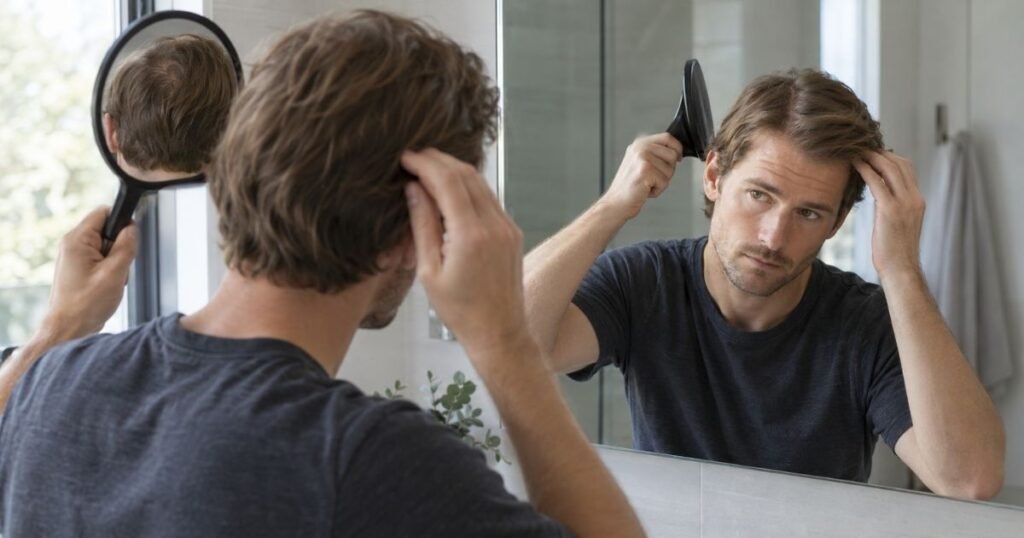
Choosing works best as a sequence, not a leap to a favorite photo. Start with four questions:
- How fine is your hair, and how dense? Think about strand width and whether scalp shows.
- Which way does it move? Straight, wavy, or curly, and where are the cowlicks?
- What is your hairline doing? Receding, a widow’s peak, or a high forehead?
- How much time will you spend styling each day?
Then decide on length first. Shorter cuts need less styling and leave less to flatten, but they also put the hairline and scalp on show and leave little room to change your mind. Longer styles give you movement and more ways to style, but they ask for more care: the ends need to stay full, and you’ll probably want a blow-dryer. If you’re torn between a short cut and a longer style, one reasonable approach is to start at a middle length and adjust from there.
After length, match the texture (crop, fringe, quiff), then adjust for hairline and density using the sections below.
Best Haircuts for Straight Fine Hair
Straight fine hair tends to lie flat and can show part lines or scalp more readily, because there’s no curl to build volume. What usually helps is shape and texture built into the cut, not products added afterward.
The Textured Crop, French Crop, Caesar Cut, Classic Quiff, and Side Part are all worth discussing with your barber. Each gives the hair something to do: separation in the crop, a defined edge in the Caesar, lift in the quiff.
A couple of cautions. Over-thinning with texturizing shears can make straight, fine ends look transparent, so keep the ends full. And part your hair where it naturally falls instead of forcing a line it doesn’t want, since a forced part flattens quickly.
Best Haircuts for Wavy or Curly Fine Hair
Wave and curl change the picture in a helpful way: they create visible volume and body that straight fine hair doesn’t have. They also bring shrinkage, frizz in humid weather, and a tendency for fine curls to be weighed down by rich products.
The Wavy Shag, Curly Fringe, Messy Textured Medium Cut, and Mop Top all use natural movement. Ask your barber how they’d cut around your pattern, since some prefer cutting dry so they can see how the curls spring up. Light layering can help avoid a heavy, triangular shape. Stay with lightweight mousse or cream and let a diffuser do the work. If your hair is tightly coiled, shrinkage is greater still, so look for a barber with experience in your texture.
Best Haircuts for Fine Hair with a Receding Hairline
A receding hairline means the front hairline, especially at the temples, has moved back. It’s different from a naturally high or mature hairline that has always been there, and from a widow’s peak, which is simply a V-shaped point at the center. Hairlines also shift gradually in many men with age. If recession is recent or progressing quickly, it’s worth asking a professional about it.
For the haircut itself, texture brought forward often works well. The Textured Fringe, French Crop, and Caesar Cut keep the front covered and shift attention to the texture, and short, neat tapers around the temples help avoid a messy edge. Styles that sweep everything back or across deserve more thought, such as a fully Slicked Back style or a combover, because they can draw attention to the hairline instead of away from it. A high forehead raises similar questions: a short fringe may balance proportions, but it depends on your features.
Best Haircuts for Fine Hair with Low Density
Low density is mostly about scalp visibility. The goal is usually to reduce the contrast between hair and scalp and keep the top looking even, without relying on heavy product.
Moderate, even lengths with texture on top often work well, such as the Textured Crop, Short Textured Crop with Taper, or Low Taper with Textured Top. A taper keeps more hair at the sides than a fade does, which can look softer. Very high-contrast fades may frame the top nicely or draw the eye to sparse areas, so discuss it before committing. Hair and scalp color matter too: dark hair on a pale scalp tends to show more contrast than lighter or grey hair. Matte finishes usually look less revealing than glossy ones, and styling the top slightly forward or lifted generally reads better than combing it flat.
How to Style Fine Hair to Look Fuller
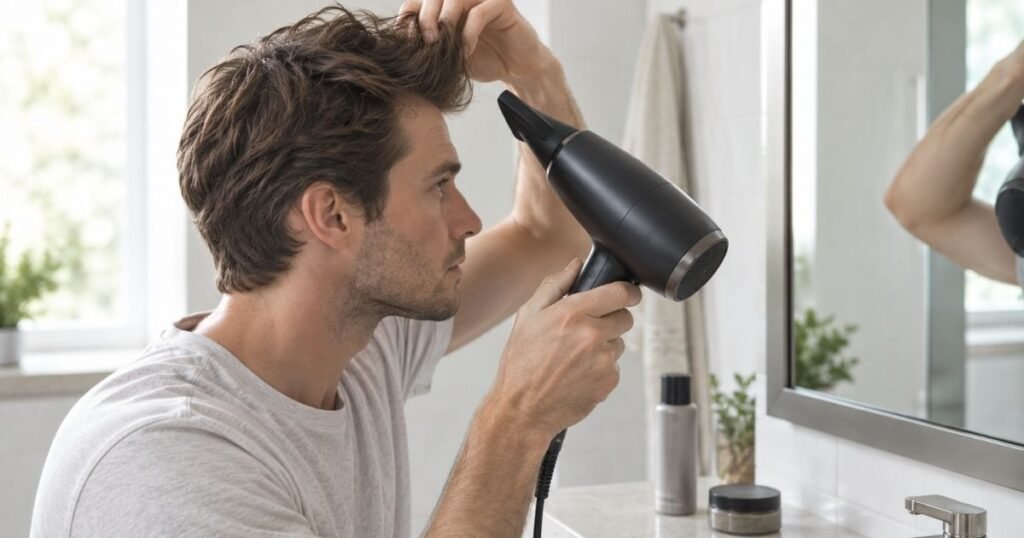
Styling can change how full hair looks. It can’t change how much hair you have. With that expectation set, the same basic routine works for most of the cuts above:
- Towel-dry gently until the hair is damp, not dripping.
- Apply a small amount of mousse or sea salt spray at the roots.
- Blow-dry for lift, roots first.
- Switch to cool air for the last pass to set the shape.
- Add a small amount of matte styling product with dry hands.
- Finish with a light-hold spray only if the style needs it.
Air-drying works for tousled, shorter cuts too. You just get less lift at the roots. The next three sections cover products, technique, and the usual slip-ups.
Choosing the Right Styling Products
The aim with fine hair is body without weight: light formulas, small amounts, built up gradually. Warm a pea-sized amount in your palms and work it through with your fingers or a comb instead of dabbing it on in one spot, which is how strands end up clumping together and finishing greasy.
| Product | What it does | Fine-hair note |
| Mousse | Adds body and light grip to damp hair | Often a good first step. Too much can feel stiff or crunchy |
| Sea salt or texture spray | Adds grit and separation | Can dry hair out if overused. Works on damp hair before drying, or on dry hair for texture |
| Volumizing powder | Adds grip at the roots and a matte finish | Useful at the crown. Apply lightly so it doesn’t look chalky |
| Matte clay or paste | Defines and separates the ends | Use a small amount. Heavier formulas can flatten fine hair |
| Light cream | Smooths and adds soft hold | Suits longer or wavy hair. Too much looks greasy |
| Pomade | Adds hold and often shine | Shinier formulas show more scalp. Water-based versions are often lighter and easier to wash out |
| Hairspray | Holds the finished shape | A light or flexible hold keeps hair from feeling stiff |
| Dry shampoo | Absorbs oil and adds grip | Can double as a root-lift product on second-day hair |
Blow-Drying Techniques for More Volume
Most of the lift in fine hair comes from how you dry it. Start with damp hair rather than soaking wet, and use a heat protectant if you blow-dry regularly.
- Rough-dry the roots first. Point the airflow at the roots and move the hair against the direction it normally falls, using your fingers.
- Use the concentrator nozzle, the narrow attachment on the end of the dryer, to aim the airflow at the area you want to lift.
- Treat the crown separately. Fine hair often lies flat there, so dry it upward and forward before settling it back.
- Shape the front last. For a quiff, lift up and back. For a fringe, dry it forward and then to the side to set the direction.
- Finish with a few seconds of cool air to set the shape.
- For waves, use a diffuser on low speed and cup the hair instead of ruffling it as it dries.
Keep the heat moderate. Very hot settings tend to damage hair over time.
Common Styling Mistakes That Make Fine Hair Look Flat
| Mistake | Why it flattens hair | What to do instead |
| Starting with heavy product | Adds weight and clumps strands | Start with a small amount of a lighter product and build up |
| Conditioner on the roots | Adds weight where you need lift | Focus conditioner on the mid-lengths and ends |
| Skipping the blow-dry, then adding more product | Product can’t replace lift at the roots | Dry the roots first, then add a little product |
| Combing damp hair flat to the scalp | Sets the hair in a flat shape | Lift the roots as it dries, then comb |
| Fighting a cowlick | The hair springs back and looks messy | Style with the growth direction and tell your barber about it |
| Applying product in one spot | Creates clumps and greasy patches | Rub it between your palms and work it through evenly |
| Letting product build up | Weighs hair down over time | Wash thoroughly, and consider an occasional clarifying shampoo |
| Heavy texturizing at the haircut | Leaves thin, wispy ends | Ask your barber to keep weight in the ends |
How to Care for Fine Hair

Good care keeps fine hair light enough to style. Day to day, a few habits make the biggest difference:
- Choose a lightweight shampoo and rinse thoroughly. Leftover residue weighs fine hair down.
- Condition the mid-lengths and ends, not the roots. Short hair may need very little.
- Pat or squeeze when towel-drying instead of rubbing, since wet hair is more fragile.
- Use a heat protectant before blow-drying and keep the temperature moderate.
- Wash your scalp, not just the lengths. Oil and product build-up are common reasons fine hair looks limp.
How often to wash depends on your scalp and how much product you use. Some fine hair gets oily quickly and some doesn’t, so adjust to what your hair does. No shampoo permanently changes strand width, so treat claims of thicker strands with some skepticism. Products can add temporary body, which is a different thing.
Maintenance Tips for Fine Hair
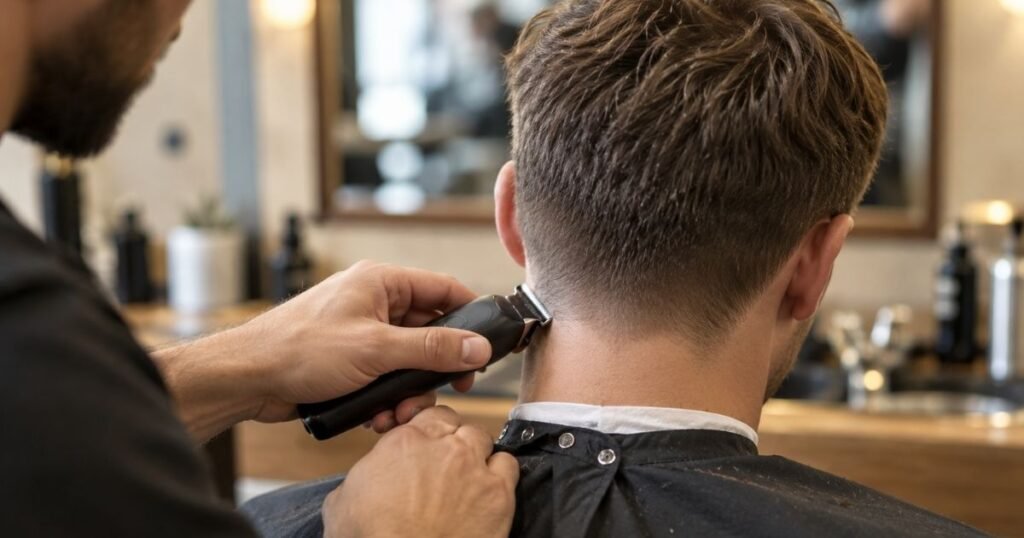
How much upkeep you need depends more on the cut than on your hair type. This table shows how different styles tend to behave as they grow out:
| Style type | How it tends to grow out | Notes |
| Skin fades and high-contrast fades | Edges soften quickly | Look sharpest for a shorter time |
| Tapers | Gradual, and usually stays tidy for longer | Neckline and sideburns may need tidy-ups |
| Scissor-cut sides | Soft and natural | Fewer defined edges to lose |
| Short crops and crew cuts | The shape shifts as the top lengthens | Fringe length changes how the style sits |
| Medium-length layered cuts | Forgiving overall | Ends need shaping so they don’t get stringy |
Ask your barber what interval suits your cut and how fast your hair grows, because it varies from person to person. Between visits, a quick neckline or sideburn tidy-up can extend the life of a cut. Humidity and seasonal changes can alter how hair behaves, so you may need to adjust your products. If your hair starts behaving differently from how it used to, mention it at your next appointment.
How to Ask Your Barber for Fine Hair Cuts
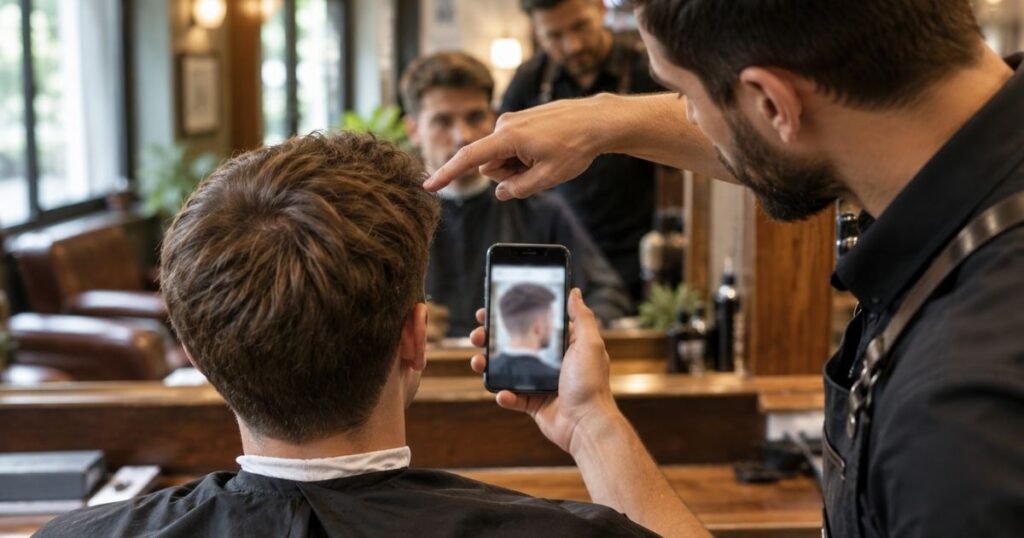
No single phrase guarantees the same result at every barbershop, so the goal is to give your barber enough information to adapt the cut to your hair. A checklist you can run through before you sit down:
- Bring photos showing the front, side, and back, ideally on hair similar to yours.
- Say what you have: fine hair, lower density if that applies, where your cowlicks are, and where your hair naturally parts.
- Describe top length using the photo or a landmark such as your eyebrows or ears, or ask to start longer.
- Specify the sides and back: taper or fade, how high, how short, and clippers or scissors.
- Explain how much texture you want, whether light, medium, or strong, and ask to keep weight in the ends.
- Mention the fringe and part: length, straight or broken up, and direction.
- Say how much time you’re willing to spend styling.
Some phrasing you can adapt to your own words:
- “I have fine hair, and I want texture without losing weight in the ends.”
- “Could you scissor-cut the sides with a soft taper instead of a fade?”
- “I’d like enough texture to separate the hair, but not so choppy that it looks thin.”
- “The hair at my front doesn’t like to go that way. Can you cut with the cowlick?”
It also helps to ask questions: How would you cut this for my hair? How will it look as it grows out? What product would you use?
Barbers don’t always use the same words for the same thing, so it’s worth clarifying these terms:
| Term | What people usually mean | Why to clarify |
| Fringe / bangs | Hair at the front hairline | Naming differs between the UK and US |
| Guard / grade | A clipper attachment size | Numbers can vary by brand and region |
| Taper / fade | Gradual shortening vs. a blend that goes much shorter | See the comparison table earlier in this guide |
| Caesar / French crop | Short, forward fringe | The two overlap, so a photo helps |
| Pompadour / quiff | Volume at the front | Height and structure vary between barbers |
| Crew / Ivy League / regulation | Short, tapered cuts | The top length differs |
| Layers / texturizing / thinning shears | Cutting for movement vs. removing bulk | Thinning shears remove bulk. On fine hair they can leave sparse ends, so ask how your barber plans to use them |
Haircuts That May Not Work as Well for Fine or Thinning Hair
None of these are off-limits. They’re simply harder to get right on fine hair, so it helps to know what you’re taking on. Several styles earlier in the guide, including the Pompadour, Faux Hawk, Spiky Haircut, and High Skin Fade, appear with the same caveats.
| Choice | Why it can be challenging | When it may still work | Alternative to consider |
| Long, heavily layered cuts | Many short layers can leave thin, see-through ends | When the layers are light and the ends stay full | Medium-Length Layered Cut with light layers |
| Long, blunt lengths | Ends can look stringy and collapse flat | With enough density and regular shaping | Bro Flow or Mop Top |
| High skin fades on low density | Strong contrast can emphasize sparse areas | When the top has good coverage and the contrast flatters | Low Taper with Textured Top |
| Glossy slicked-back styles | Shine and combing back show more scalp | With a matte finish and good density at the front | Classic Quiff or Side Part |
| Combovers | Hair swept across a wide area can look sparse and draw attention | Rarely | Short textured crop or French Crop |
| Spiky or very tall styles | Need firm hold, which weighs fine hair down | In short, soft versions | Textured Crop |
| Heavy texturizing | Removes bulk that fine hair can’t spare | In light, targeted amounts | Point-cut ends with weight kept |
| Styles that fight a strong cowlick | The hair springs against the cut | When the cut follows the growth direction | A shape built around the cowlick |
Frequently Asked Questions About Hairstyles for Men with Fine Hair
What is the best haircut for thinning hair on top male?
There isn’t a single best cut, but a few principles help: moderate top length with texture, shorter tapered sides to keep contrast lower, and matte products. The Textured Crop, Caesar Cut, and French Crop are good starting points to discuss with your barber. Avoid sweeping long hair across the top. If the thinning is recent or progressing quickly, check with a GP or dermatologist.
What is the best haircut for a bald spot on top of the head?
No haircut hides a bald spot completely. Reducing contrast can help: a shorter, even length through the top with some texture can make the area less noticeable, and some men choose a very short or buzzed look so the spot blends in. Patchy or sudden bald spots can have medical causes, so it’s worth having them checked.
How to hide thinning hair on top men?
It’s more realistic to make it less noticeable than to hide it. A textured cut at moderate length, root lift from blow-drying, and matte products usually help. Root powders or fibers can add a temporary look of density if applied lightly. Combing long hair across the area tends to draw the eye instead.
What’s the best hairstyle for thin hair?
It depends on whether you mean low density or thinning, and on your hairline. For low density, shorter textured cuts such as the Textured Crop or French Crop are a good place to start. The section on fine hair with low density has more detail.
What haircuts to avoid with thin hair?
Combovers, glossy slicked-back styles, high-contrast fades on sparse areas, and long layered cuts with thin ends are typically harder to get right. The section on haircuts that may not work as well covers the reasoning and alternatives.
How to style thinning hair on top?
Dry the roots upward with a blow-dryer, use a little mousse or powder at the root, and add a small amount of matte product to the ends. Keep everything light so it doesn’t flatten the top.
What haircut gives volume to men’s hair?
A cut can support volume, but it doesn’t create it alone. Moderate length on top with shorter sides, as in the Classic Quiff, Textured Crop, or Mop Top, gives hair room to lift, and blow-drying does the rest.
What exactly is fine hair?
Fine hair has narrow individual strands. It’s separate from density (how many hairs you have) and texture (straight, wavy, curly, or coily).
Do I have thin or fine hair?
Possibly both. Roll a strand between your fingers: if you barely feel it, it’s likely fine. Check your part in bright light: if scalp shows clearly, density may be lower. The section comparing fine and thin hair lays out the differences.
Can you fix having fine hair?
It isn’t something that needs fixing. The cut, drying technique, and light products can change how fine hair behaves and how full it looks, but they don’t change the strand itself.
Can fine hair be thickened?
Strand width is largely set by genetics and doesn’t change much with products. What you can do is add temporary body with the right cut, mousse or powder, and blow-drying. If your concern is losing density rather than naturally fine strands, that’s a question for a doctor or dermatologist.
Conclusion
Fine hair responds well to the right shape and a lighter touch. A few decisions do most of the work. Work out whether you’re dealing with fine strands, lower density, or thinning, since the advice differs. Pick a length you’ll actually keep up, then match the texture and shape to your hair and hairline. Take photos and your concerns to the barber and ask how they’d adapt the cut. Then let the blow-dryer and a small amount of product do the rest.
If thinning is a worry, a GP or dermatologist is the right next step alongside any haircut.

Jake Miller is a barbering and men’s hairstyle enthusiast who shares practical tips, haircut inspiration, and the latest grooming trends at BarberZylo. He enjoys exploring modern and classic hairstyles and helping readers find fresh ideas for their next look.


One Comment