50+ Types of Fades for Black Men: From Clean Cuts to Bold Looks
A fade blends short hair on the sides and back into longer hair on top, with no visible step between the lengths. That one idea stretches from a subtle fade with a fuller top to a skin-level blend with razor lines and a mohawk. This guide shows 50+ types of fades for Black men, then explains the choices behind them (height, finish, top shape, and detail work) so you can describe what you want in plain terms.
A photo shows one person’s hair, though. How a fade looks on you depends on your curl or coil pattern, density, hairline, growth direction, and beard, and on how your barber adapts the cut. Use the looks below to build a shortlist, then use the sections on choosing and maintaining a fade to narrow it down.
What Is a Fade Haircut?

A fade is a haircut where hair gets shorter gradually from the top of the head down toward the ears and neckline, often ending at very short hair or bare skin. The defining feature is the blend: a smooth shift from long to short instead of a hard line. Everything else is a choice, including how high the blend starts, how short it ends, and what happens on top.
Barbershop terms vary by region and by barber. “Skin fade,” “bald fade,” “zero fade,” “line-up,” “shape-up,” and “edge-up” are used in overlapping ways across the US, UK, and elsewhere. When in doubt, show a photo and describe what you want to see.
How a Fade Haircut Works
Barbers build a fade mostly with clippers, working in bands from the shortest length at the bottom to longer lengths higher up. They then blend the bands together using clipper-over-comb work, small clipper adjustments, and sometimes scissors. Because the hair is graduated (cut in gradually changing lengths), the eye reads one smooth shade instead of separate stripes.
It helps to treat a fade as four separate decisions:
- Starting height: how high on the head the blend begins (low, mid, or high).
- Finish: how short the shortest area gets, from a soft shadow to bare skin.
- Top: the length and shape of the hair above the blend, such as curls, waves, a crop, a high top, or a mohawk strip.
- Edges: the hairline, temples, sideburns, neckline, and any line-up or design.
Two details matter especially for textured hair. Shrinkage means tightly coiled hair looks much shorter than its stretched length, so a top length that sounds generous on paper can look shorter in the mirror. And hair density affects how visible the blend is: dense hair against skin makes a sharper contrast, while finer or sparser hair can look softer.
Difference Between a Taper and a Fade Haircut
A taper also shortens hair gradually, but it usually stays concentrated around the sideburns and neckline and tends to leave more length overall. A fade covers more of the sides and back and typically goes shorter, often to skin or close to it. “Taper fade” is a common blended term, and not every barber draws the line in the same place.
| Taper | Fade | |
| Where the blend happens | Mostly sideburns and neckline | Larger area of the sides and back |
| How short it gets | Usually keeps more length | Often goes to skin or near it |
| Contrast with the top | Softer | Can be subtle or strong, depending on height and finish |
| Common pairing | Longer or fuller tops where you want a gentle edge | Almost any top, from crops to mohawks |
The practical takeaway: describe how short you want it at the bottom and how high you want the blend to start, and bring a photo, rather than relying on one word.
Popular Types of Fades for Black Men: Styles for Every Hair Type

These fade haircut ideas for Black men cover different fade haircut styles across tight coils, curls, waves, twists, and locs. Each entry points out something to notice and, where it helps, something to ask your barber. Terms like burst, drop, and disconnected are explained the first time they come up. Treat each photo as a reference, not a prediction of how it will look on your hair.
Clean Line Up Fade with Beard
Look at where the fade meets the beard: the sideburn and cheek area should shift gradually from short hair into fuller beard rather than stopping at an edge. A sharp line-up (a crisp, defined hairline) frames the forehead and temples. Beard density and patchy areas affect how smooth the transition can look, so ask your barber to blend into your beard as it actually grows.
Curly High Fade
The blend starts high on the sides, leaving a rounded cap of defined curls on top. The contrast between tight sides and soft curls is the whole look. Curls need some length to form, so very short hair may read as texture rather than curls, and moisture levels will change how defined they look day to day.
Wavy Skin Fade
Waves brushed in one direction on top, with the sides taken down to skin. A skin finish leaves no shadow, so regrowth tends to show sooner than with softer finishes. Waves follow your natural growth direction, which is why a barber will usually study how your hair lies before cutting. More on that in the waves section further down.
Bald Fade with a Shaved Side Part
A bald fade goes all the way to skin, and the part is a line razored into the hair on top. Notice that the line sits where the hair already wants to fall. A part that fights your natural direction can look forced and may need more upkeep. Hard parts and natural parts are compared later in the guide.
Shape-Up Low Fade
The blend sits low, hugging the ears and neckline, while a shape-up squares off and sharpens the front hairline and temples. Because the fade starts low, more hair stays above the ears, which tends to look gentler than a high blend. If your temples are rounded or uneven, a barber may soften the shape rather than square it, and razor work can irritate sensitive skin.
Burst Fade Faux Hawk
A burst fade curves in a semicircle around the ear and leaves longer hair at the back of the neck. Here it frames a faux hawk, a raised center ridge on top that’s softer than a shaved-sided mohawk. From the side, notice how the burst makes the ridge look taller. Top density helps the ridge hold its shape.
Wavy Low Fade
The waves are similar to those in a wavy skin fade, but the low blend leaves more hair on the sides, so the wave pattern can continue lower down the head. The look is softer and less exposed than a high or skin version. If you like waves but not a lot of visible scalp, this is the kind of height to discuss.
High Skin Fade Waves
High start plus skin finish gives the strongest contrast of the wave looks. With so much scalp visible, head shape becomes part of the haircut, and the smaller area on top puts the wave pattern front and center. It shows regrowth quickly, so expect to refresh edges sooner than you would with a low blend.
Read More About : How Often Should You Trim a Fade? 5 Timing Tips by Fade Type
Temple Fade Sponge Curls
A temple fade concentrates the blend around the temples and sideburns, usually with a line-up, and is sometimes called a “temp fade.” On top, curls are formed by working a sponge or similar tool through short hair in small circles. Results depend on length and texture: some hair forms defined coils, other hair gives a rounder, fuzzier texture.
Wavy Bald Fade with a Shaved Line
A shaved line is a thin accent razored into the hair, usually near the hairline or side. It’s different from a part, which divides the top, because it’s decorative. Fine lines like this tend to soften as hair regrows, so they’re often a short-lived detail.
Curly Undercut Fade
An undercut keeps the sides short and the top noticeably longer, with a clear break between them. An undercut fade adds a blend on the sides while keeping that top weight. Ask whether you want the top connected to the sides or left disconnected, and give your barber a sense of how long the curls should be.
Disconnected Side Part Fade
“Disconnected” means there’s a visible step between the longer top and the faded sides, with no blending between them. Add a part and you get a very graphic look. The top needs enough length for a part to fall properly, and a part that follows your natural direction usually sits more convincingly.
Skin Fade with Curly Top
Compare this with the curly high fade: the finish is what changed. Skin-level sides make the curls look fuller by contrast, and they also mean more exposed scalp to look after. A moisturizer and sun protection for the shaved areas are worth thinking about.
Natural Fauxhawk with Line Up
“Natural” here means the shape comes mostly from the cut and your hair’s own texture rather than heavy product. The ridge runs down the center, the sides are tapered, and the line-up keeps the edges crisp. Without a burst around the ears, the effect is cleaner and more minimal than the burst version above.
High Top Fade
The top is left tall and the sides are faded. How tall it can go depends on your texture, density, and how long you’ve grown it. This one rewards patience: growing a high top usually means living through a stretch of in-between length first. The flat top section later compares high tops with similar shapes.
Zero Fade Buzz Cut
The top is clippered short all over and the sides fade down to the shortest clipper setting (the “zero” part). Styling effort is minimal. The tradeoff is that a buzz shows everything: head shape, cowlicks, scars, and where the hairline sits. “Zero” and “skin” are often used interchangeably, but they aren’t always the same, which the bald fade section sorts out.
Read More About : How to Ask Your Barber for a Fade: High, Mid & Low Fades (2026)
Textured Crop Top Fade
A crop is a short top, usually cut to a fairly uniform length with a blunt or softly textured finish. In this version natural texture does the work, so there’s little to style. A crop sits close to the hairline, which means hairline shape and density have a big influence on how it looks.
Low Fade Crop
The same crop idea with a low blend, so the edges are softer and more hair remains around the ears. Choose this over a higher blend if you want a crisp but understated look. A low fade is also easier to blend into a beard for many people.
Short Afro Bald Fade
The skill here is the top: an evenly rounded short afro, shaped so the outline looks balanced from every angle. Underneath, the bald fade goes to skin. Because of shrinkage, the afro will look shorter and tighter than its stretched length suggests, so it helps to talk about the finished shape rather than a number of inches.
Taper Fade Curly Fauxhawk
A taper keeps more hair at the sides than a skin fade, which gives this fauxhawk a gentler edge. The curls form a raised center ridge that doesn’t need the harsh contrast of a shaved side. It’s a reasonable middle ground if you like the shape but not the scalp exposure.
Skin Fade High Top
Take the high top and take the sides to skin. This is a high-contrast look, with tall hair against bare sides. It also puts more weight on the barber’s precision, since a skin finish leaves less room to hide uneven blending. Scalp care matters here.
Afro Mohawk with Shaved Temples
A strip of afro-textured hair runs down the center while the temples are cut in sharply, not blended. Notice the width of the strip, which changes the whole feel: narrow reads edgier, wider reads fuller. Density matters, since a thin strip on sparse hair can look patchy.
High Burst Fade Haircut
This is a burst that starts higher, exposing more of the area around the ear. How it looks can depend on ear position and head shape, so it may be worth asking your barber how high is too high for you. Compared with the shorter burst above, more scalp is visible and the contrast with the top is stronger.
Low Taper Fade
The subtlest option in the gallery: hair is short at the sideburns and neckline, and the hair around the ears stays. People often choose it when they want a neat finish without much scalp showing. As described in the taper section, some barbers call this a low fade and others call it a taper, so a photo helps.
Faded Mohawk for Curly Hair
Faded sides, curls down the middle. Curls need enough length to show their pattern, and the strip may need moisture to keep that definition. If you’re deciding between this and a faux hawk, the difference is how defined the sides are and how narrow the strip is.
Zero Fade Coils
Coils on top, sides taken to the zero level. The coils show up best when the hair is long enough to spiral, and many people use a coil-defining cream or a sponge to encourage the pattern. Results depend on your coil pattern, so treat styling advice as a starting point.
Curly Burst Fade with a Part
This combines a burst around the ear with a part through the curls. The part sits above the burst, so the two shapes work together: the burst rounds the sides, the part adds a diagonal line. You need enough top length for the curls to separate cleanly along the part.
Read More About : 50+ Best Hairstyles for Men With Wavy Hair From Fades to Shaggy Cuts
High Fade with Kinky Top
“Kinky” is a common search term and a descriptor many people use for very tightly coiled hair, often called 4C. Others prefer “coily.” The high fade makes the top look fuller by contrast. Dense coils tend to hold a shape well, but shrinkage means the top will look shorter than it measures.
Curly Cut with an Undercut Design
Patterns such as lines or shapes are cut into the short undercut sides. Designs depend on the barber’s skill and a steady hand, and they blur as hair regrows. If you want to keep one looking sharp, plan on more frequent visits.
Bald Fade Kinky Crop
A short, tightly coiled crop over a bald fade is a high-contrast, low-styling look. Moisture is the main upkeep issue, since short coils can look dry and dull without it. Compared with the tapered curly crop later on, the bald finish makes the edges far more dramatic.
Mohawk Fade for Natural Curls
The curls here are left natural, with little added product. That keeps daily effort low, but your curl pattern decides how the strip behaves: looser curls may flop to the sides, tighter ones stand up on their own. Strip width and length are worth settling before the clippers come out.
Flat Top Mohawk Fade
The strip is cut to a level, squared-off surface. It’s a demanding shape, so bring reference photos and ask the barber if they’re comfortable with it. Density and length affect whether the top can reach a convincingly flat plane.
Undercut High Top
A tall top over short, disconnected sides instead of a gradual blend. Compare it with the high top fade earlier: there the sides blend into the top, here there’s a visible break. The disconnect gives a more graphic outline, and the top may look taller by contrast.
Kinky Mohawk High Fade
A coily strip with a high blend on both sides. The higher the blend, the more the strip stands out as a separate shape. If you’re choosing between this and a lower fade, think about how much scalp you’re comfortable showing and how often you’ll refresh the sides.
Textured Temple Fade
The blend centers on the temples, with a textured top above. Notice how the temple work frames the hairline. A well-defined natural hairline gives the barber something to work with, while a hairline that’s uneven may call for a softer approach.
Pomp Fade
A pompadour is a top that’s lifted and swept up or back, here paired with faded sides. On coily or curly hair, the effect comes from length, shaping, and sometimes picking or blow-drying, and results vary by texture. It needs a longer top than most looks in this gallery, so expect a grow-out phase.
Tapered Curly Crop
Short curls with a light taper at the edges. Compared with the bald fade crop, contrast is lower and the shape looks softer. It’s a reasonable fit for people who want a professional, neat look with a modern edge and minimal daily styling.
Undercut Dreadlocks
Locs are kept on top while the sides are cut short. Look at where the locs end and the undercut begins: a clear transition matters. Retwisting is a separate routine from fade upkeep, and it helps to find a barber familiar with locs. Locs and dreadlocks are used interchangeably in searches; many wearers prefer “locs.”
Read More About : Modern Mullet Fade: The Complete Guide to Getting It Right in 2026
Textured Skin Fade
A skin finish with a textured top, such as twists, coils, or loose curls. The sides stay smooth while the top has natural movement. As with other skin finishes, regrowth and scalp care are the main practical considerations.
Curly High Fade with Lines
Shaved lines are cut into the faded area of a curly high fade. The lines sit in the blend, not the top, so they interact with it: dark hair, light skin, and the lines in between. Because the lines are cut close to the skin, they tend to soften with regrowth.
Fade with Diagonal Lines on Top
Here the lines are shaved into the top hair itself, not the sides. That requires the top to be short enough for the lines to show. They tend to grow in noticeably, so if you want the look to stay sharp, plan on regular touch-ups.
Bleached Mohawk Burst Fade
A lightened strip paired with a burst fade, so the color contrast and the shape contrast stack. Bleach can dry or weaken hair, especially hair that’s already dry, so a conversation with a colorist is worth having. Hair condition affects how well it holds up.
Top Fade with a Temple Undercut
“Top fade” isn’t a standard barbering term, so barbers may interpret it differently. What this look shows is faded sides, a longer top, and temples cut in. If you want something similar, describe those three parts and show the photo rather than using the name.
Graduated Low Fade
Graduated means the lengths step down gradually, here with a long, gradual transition sitting low on the head. Compared with the low taper fade, the blend zone is more visible and stretched out. It tends to read as soft and deliberate.
Short Curls with a High Fade
A shorter top than the curly high fade, with tighter curls and the blend starting high. The shorter top reads as sharper and more structured. Curl pattern decides how much definition shows at this length.
360 Waves with a Beard
360 waves run around the whole head, in a pattern radiating from the crown. They’re a commitment: the pattern depends on a routine of brushing and protection, covered in the waves section. Here the beard adds another element to coordinate, so the fade should be planned with beard shape in mind.
Wave Fade Style
The thing to notice here is the transition zone where the fade meets the wave pattern. A good blend follows the direction the waves travel, so the pattern doesn’t seem to stop abruptly at the clipper line. That depends on both hair growth direction and the barber’s attention to it.
Drop Fade with a Natural Twist
A drop fade follows the curve of the skull and dips lower behind the ear, so the blend sits lower at the back than at the front. Here it frames a top of natural twists. That downward curve is the identifying detail, and it’s what makes it different from a low fade that runs roughly level.
Buzz Cut Curls with Temple Shave
Very short curls, with the temples shaved in. A temple shave is cut in cleanly, whereas a temple fade blends gradually. The look is minimal, but it depends on hairline shape because there’s little hair to hide irregularities.
Curly Taper Cut
The softest look in the gallery: curls kept full, with a light taper at the sideburns and neckline. It’s a good example of how a fade-adjacent cut can be low-contrast and easy to live with. Ask for a taper and describe how much length you want left on the sides.
Read More About : Fade Haircuts for Black Men: 58+ Sharp Styles & Tips In 2026
Latest Fade Haircuts Ideas

For a faster scan, use any photo, from this guide or elsewhere, to check four things: where the blend starts, how short it gets at the bottom, what shape the top takes, and how the hairline and edges are finished. Those four details are what you’ll need to describe the cut to a barber.
Save two or three images you like rather than one. Ideally include front, side, and back views, since a fade that looks great from the side can look different from behind. If your saved photos show different heights or finishes, that’s useful too, because it tells your barber what you do and don’t want.
Fade Haircut Trends in 2026
The popularity of fade variations shifts over time, and this guide doesn’t rely on trend data. What follows are fade variations that barbers commonly offer and that readers often ask about. Each is described briefly here, with fuller explanations in the sections that follow.
Drop Fade
The blend line curves downward behind the ear, following the shape of the skull, so it sits lower at the back than at the temples. That curve separates it from a low fade, which tends to run roughly level, and from a burst fade, which is concentrated around the ear. It works with many tops, from curls to twists.
Burst Fade
A semicircular blend around the ear, with the hair at the nape left longer. Often paired with mohawks, faux hawks, and curls. The full explanation is in the special fades section.
Skin Fade
The shortest part of the fade reaches bare skin. How that differs from a bald or zero fade is covered in the bald fade section.
Waves Fade
For waves, the fade has to cooperate with the pattern. The blend usually starts where the waves end, and a barber will often follow the direction the hair grows. Brushing routines and wave care come later, in the textures section.
Twists Fade
Tapered or faded sides frame a top of twists, which keeps the twists as the focal point. The twists carry their own shape and upkeep, so the fade and the twists run on separate schedules.
High Fade with Design
A high blend with shaved lines or shapes in the faded area. The designs depend on barber skill and tend to blur as hair grows back, so they’re worth planning around a barber visit.
Faded Cornrows
A fade on the sides with braided cornrows on top. Braid care is separate from fade timing: the sides can regrow while the braids still look fresh, and vice versa.
Temple Fade
A blend concentrated at the temples and sideburn area, usually finished with a line-up. Names vary between barbers, with “temp fade” common in the US, so a photo is the surest way to communicate it.
360 Waves Fade
Waves around the whole head, with the fade starting at the edge of the pattern. This is the most commitment-heavy wave look, and it depends on hair type and routine.
High-Top Fade
A tall top with faded sides. The flat top section later compares high tops with flat tops and box fades.
Afro Taper Fade
A rounded afro with a gentle taper at the edges. Compared with the short afro bald fade in the gallery, there’s usually more length on top and a softer transition at the sides.
Read More About : 16+ Blowout Taper Fade Haircuts: Style, Variations & Guide In 2026
Textured Hairstyles with Fades

A fade changes how natural texture reads. When the sides are short and smooth, the top looks fuller and more defined. These five pairings show the visual effect; care and cutting advice for each texture comes later.
Afro Combination
Rounded volume against a tight blend. The shape of the afro is the point, so the outline matters more than any single length.
Waves Pattern
Waves look striking next to faded sides because both are smooth. The contrast is in the pattern: dark ripples against a lighter shadow.
Dreadlock Style
Locs paired with faded sides create a crisp boundary between structured hair and clean edges. The result depends on loc length and where the locs start.
Twist Creation
Short twists on top with faded sides. The twists add movement without much length.
Curly Hair Fade
Defined curls against a blend. Curl definition is the main variable: tighter curls look compact, looser curls look softer.
Fade Variations by Height
Height describes where the blend starts. Here’s a quick visual orientation, with a deeper comparison further down.
Low Fade Styles
The blend sits near the ears and neckline, leaving most of the sides longer.
Mid Fade Options
The blend starts around the temple level, a middle point between low and high.
High Fade Looks
The blend starts higher on the head, with more scalp visible and more contrast against the top.
Read More About : Undercut Fade: 45+ Bold & Modern Haircut Styles In 2026
Specialized Fade Styles
Some fades are defined by the shape on top. Here’s what each looks like at a glance.
Mohawk Fade
A distinct center strip of longer hair, with the sides cut short and faded.
Box Fade
A squared-off top over tight sides, giving a geometric, boxy outline.
Buzz Cut Fade
Very short hair on top, with a blend down the sides. Minimal styling.
Faux Hawk Fade
A raised center ridge without shaved-sharp sides, softer than a true mohawk.
Flat Top Haircut
A level top surface with faded sides. A direct comparison with high tops and box fades appears later.
Bald Fade
The blend ends at bare skin. Finish terminology is covered later.
Line-Up and Detail Work
Detail work is what gives a fade its finished look. Here are the options you’ll see.
Shape-Up Techniques
Shaping sharpens the hairline, usually across the forehead and temples, so the edge looks defined. Bring a photo and mention how far back you want the line.
Hard Part Design
A part razored into short hair for a defined divider. It’s decorative as well as functional.
Line-Up Precision
A good line-up looks crisp but still follows your natural hairline. Problems usually come from lines set too harshly or too far back, which can make the face look different than you intended. If you prefer a softer edge, say so.
Low, Mid, and High Fade Haircuts Explained
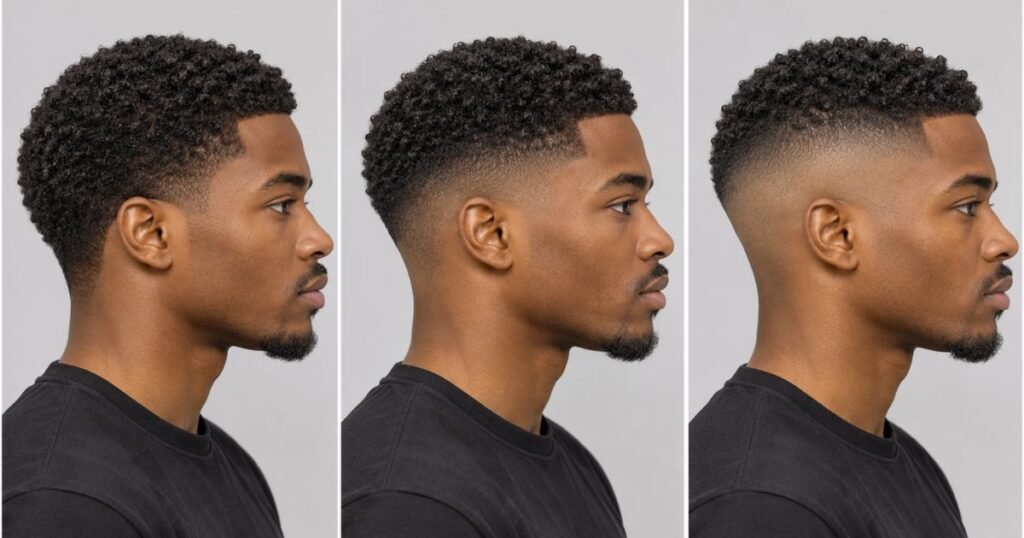
Fade height is the first choice most people make, and it’s often the one that changes the look the most. Height sets how much hair stays on the sides and how much scalp shows. It’s separate from finish, which is how short the bottom gets. A low fade can end at skin, and a high fade can end at a soft shadow.
A reference photo from the side is the clearest way to communicate height, since people picture “low” and “high” differently.
Low Fade Styles
A low fade starts near the ears and neckline, leaving more hair on the sides. It’s often considered a lower-contrast option and tends to read as understated. If you’re looking for low fade haircuts for Black men that work with a fuller top, this height gives you the most length at the sides to blend into.
Mid Fade Haircuts
A mid fade begins around the temple level, which splits the difference. It gives more shape than a low fade without the full exposure of a high one. Mid fade haircuts for Black men are often a reasonable starting point if you’re unsure how much contrast you want.
High Fade Haircuts
A high fade begins higher on the head, showing more scalp and creating strong contrast against the top. Head shape and hairline can influence how it looks, so it may be worth asking your barber how high works for you. High fade haircuts for Black men often pair with volume on top, which the blend helps emphasize.
Low vs. Mid vs. High Fade: What’s the Difference?
| Low fade | Mid fade | High fade | |
| Where the blend starts | Near the ears and neckline | Around the temple level | Higher on the head |
| Contrast with the top | Softer | Moderate | Stronger |
| Side hair remaining | Most | Some | Least |
| Scalp exposure | Less | Moderate | More |
| Things to discuss | How much length to keep on the sides | How the blend meets the temples | Head shape, hairline, and how often you’ll refresh |
Regrowth shows differently depending on both height and finish, and it varies by person. Treat the table as a general guide and ask your barber how your own hair behaves.
Fade Haircuts for Different Black Hair Textures
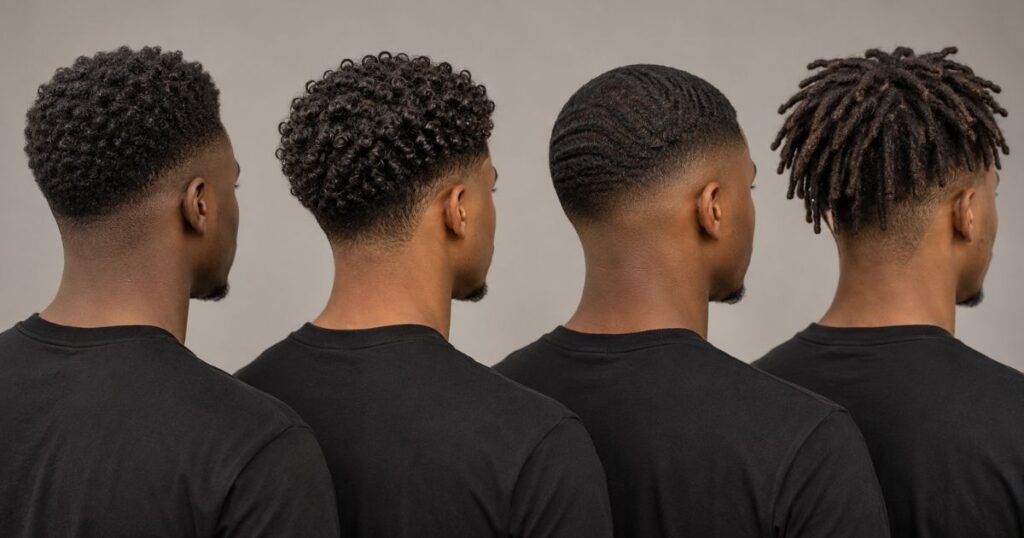
Black men’s hair covers a wide range: tight coils, springy curls, waves, twists, and locs, sometimes on the same head. Texture changes how a fade looks, how much length you need on top, and how you care for the result. Four factors recur throughout this section: curl or coil pattern, density, shrinkage, and moisture.
Fades for 4C and Kinky Hair
4C describes very tightly coiled hair, and “kinky” is a common search term for the same range, although classification systems are informal and not everyone agrees on them. Shrinkage is the main practical issue: coils pull up, so length that looks decent when stretched can look quite short. A barber can show you how the hair behaves before cutting.
Dense coils tend to hold shape well, so crops, high tops, and mohawks can all be reasonable options. Because the hair is so tight, the blend can look especially dramatic against skin. Clipper work on coily hair can be more demanding, and razor irritation, including razor bumps, can be more common in tightly coiled hair. If you’re prone to bumps, mention it, and consider a finish that isn’t cut as close.
There’s no single best fade for 4C hair. The better question is which top length, height, and finish suit your density, hairline, and routine.
Fades for Curly Hair
Curly hair needs enough length for curls to form, and how much depends on your pattern: tighter curls can show at shorter lengths, looser curls may need more. Moisture and product matter for definition, and typical approaches include leave-in conditioners, creams, or a sponge for shaping. A subtle fade with a fuller top is a good option if you want to highlight your curls, since the shorter sides draw attention upward.
If curls are on the thin side, a very high fade can make the top look smaller by contrast. A mid or low blend may keep proportions more balanced, though your own hair and head shape will affect that.
Fades for Waves
Waves form when hair is trained to lie in one direction, so a fade for waves should follow your growth direction. Brushing consistently, keeping hair moisturized, and protecting it at night, often with a satin or silk cap, are the usual practices. Results vary, and it can take time for a pattern to develop.
The fade matters for waves because a blend that cuts across the pattern can break its flow. Many people with waves choose a low to mid blend with a skin or shadow finish. 360 waves cover the whole head, whereas waves on top only affect the crown and the front, and the 360 version is more demanding to keep up.
Fades for Twists and Coils
Twists are sections of hair twisted into rope-like strands, and coils are tight spirals that can be formed naturally or encouraged with products. Twists keep their shape for a while but need their own upkeep. The sides, meanwhile, regrow on a different timeline, so the fade may need a refresh before the twists do.
Sponge curls and twist-outs are related but distinct techniques: sponge curls use a tool to shape short hair, while twist-outs involve twisting and unraveling longer hair. If you’re not sure which look you’re after, a photo avoids confusion.
Fades for Locs and Dreadlocks
Many wearers prefer “locs,” while “dreadlocks” is still widely used in searches. A fade pairs naturally with locs because it keeps the edges tidy while the locs remain the focus. Think about how long your locs are and where they start: a fade that rises too high can expose roots and affect how the locs sit.
Retwisting is a separate maintenance routine from the fade, and scalp care matters because locs can trap buildup. Not every barber works with locs regularly, so it’s worth asking about experience first.
Read More About : Burst Fade Haircuts for Men: Stylish, Modern Looks & Ideas in 2026
Special Fade Haircuts for Black Men That Stand Out

The earlier overview showed what these looks are. Here’s how they work, what to ask for, and what to expect. Most depend on the shape of the top, so density and length matter more here than in simpler fades.
Mohawk Fade
A mohawk has a defined center strip with the sides cut short or faded. People use “mohawk,” “faux hawk,” and “frohawk” differently, so the quickest way to avoid a mix-up is to show a photo. Decide how wide the strip should be, how long, and whether you want sharply shaved sides or a blend.
A wider strip tends to look fuller and softer, while a narrow strip looks more dramatic. Styling may involve a light product to shape curls or coils, and the sides will need regular attention to keep the contrast.
Faux Hawk Fade
A faux hawk has a raised center ridge, but the sides are blended instead of shaved, so the contrast is gentler than a mohawk. The ridge is created mainly by styling the top upward, with length held in the center and shortened toward the sides. That makes it an easier step if you like the shape but aren’t ready to commit to a full mohawk.
Ask your barber how the sides will blend into the ridge, and whether they’ll keep some length in the center. Density on top helps the ridge hold its shape.
Buzz Cut Fade
A buzz cut fade has a very short top and a blend down the sides. Styling is minimal, but it’s not entirely maintenance-free: the short length shows head shape, scars, and uneven growth, and the scalp may need moisturizing and sun protection. Asking for a “zero” on the sides means different things to different barbers, so describe how short you want it.
Flat Top Fade
A flat top has a level top surface, usually with faded sides. It’s often confused with high tops and box fades, so here’s how they differ:
| High top | Flat top | Box fade | |
| Top shape | Tall, can be rounded or shaped | Level, flat surface | Squared-off with defined corners |
| Sides | Faded or undercut | Faded | Tight, faded |
| How it’s shaped | Length and styling | Precision cutting to a flat plane | Clipper-over-comb to define the box |
| Barber skill needed | Moderate | High | High |
Length and density affect how well the top can reach a level plane, and sparse spots will show more. If you want one of these, bring photos from several angles and ask whether your hair supports it.
Bald Fade
This is where terminology tangles. Barbers often use “skin fade,” “bald fade,” and “zero fade” in overlapping ways:
- Skin fade or bald fade: the blend ends at bare skin, usually using a foil shaver or razor.
- Zero fade: the clippers are set to the shortest possible setting, which can leave a faint shadow instead of bare skin.
- Shadow fade: the blend stops a little above skin, leaving visible short stubble.
Some barbers treat these as the same thing, others as distinct. Skin fade haircuts for Black men are popular because the contrast with the top is strong, but a skin finish also shows regrowth sooner and needs care. Moisturize the exposed scalp, protect it from sun, and watch for irritation. If you’re prone to razor bumps, discuss alternatives like a zero or shadow finish.
Burst Fade
A burst fade curves in a semicircle around the ear, and the hair at the back and nape is left longer. It’s different from a drop fade, which dips behind the ear and continues around the head, and from a taper fade, which is a gentler blend along the edges.
Burst fades are commonly paired with mohawks, faux hawks, and curls, because the rounded blend frames a raised top. Ask your barber where the burst should start and end, how short it should go, and whether you want the nape longer or tapered.
Line-Up and Fade Haircuts for Black Men: What Makes Them Stand Out
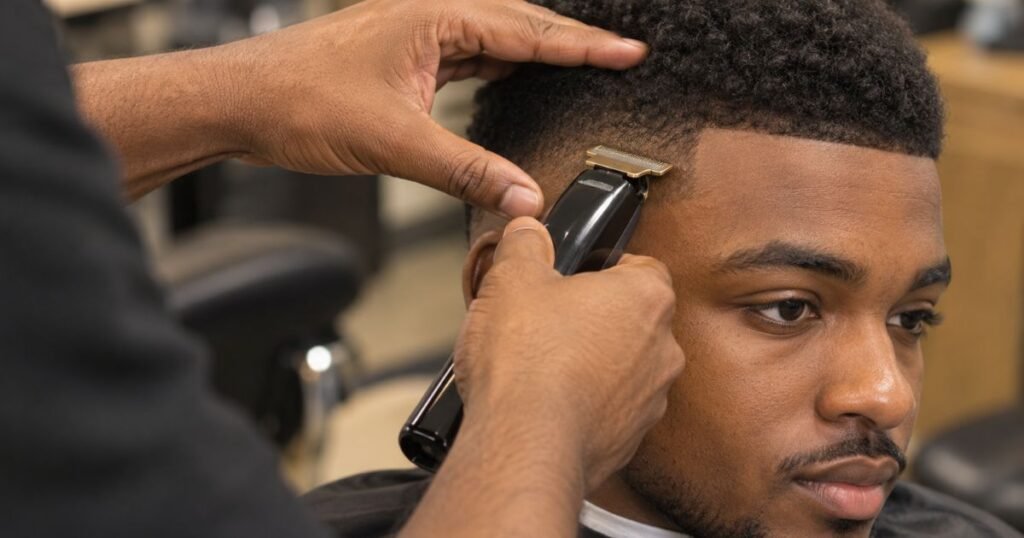
The line-up is the sharp edge that frames a fade. It can look minimal or dramatic, and it’s a big part of why a fresh cut looks crisp. It also makes a few decisions for you: how far the hairline moves, how harsh the edge is, and how soon it needs a refresh.
What Is a Shape-Up?
A shape-up, line-up, and edge-up are closely related terms for defining the hairline, usually with a trimmer or razor along the forehead, temples, and sometimes the sideburns and neckline. Usage varies by region and barber, so it’s worth describing what you want rather than relying on one word.
A good shape-up should follow your natural hairline, not invent a new one. If you want a softer result, tell your barber you prefer a natural-looking edge, and mention if you’re worried about the line being set too far back.
Hard Part vs. Natural Side Part
| Hard part | Natural side part | |
| How it’s made | A line razored into the hair | Created by combing or brushing |
| Look | Sharp, defined | Softer, follows hair direction |
| Regrowth | Fades quickly | Looks consistent as hair grows |
| Hair length needed | Can be done on very short hair | Needs enough length to fall |
A natural part follows how your hair already grows, so it tends to be easier to live with. A hard part adds definition but needs touch-ups sooner.
How a Line-Up Changes a Fade Haircut
A line-up frames the face, makes the fade look more polished, and gives the haircut a clear boundary. The tradeoff is upkeep: a sharp line grows out faster than a soft blend, and razor work on the forehead and temples can irritate sensitive skin.
Before you commit, think about how sharp you want the edge, how far back you’re comfortable with, and how often you’re willing to refresh it. If your hairline is uneven or receding, a barber can often suggest a version that suits it.
How to Choose the Best Fades for Black Men
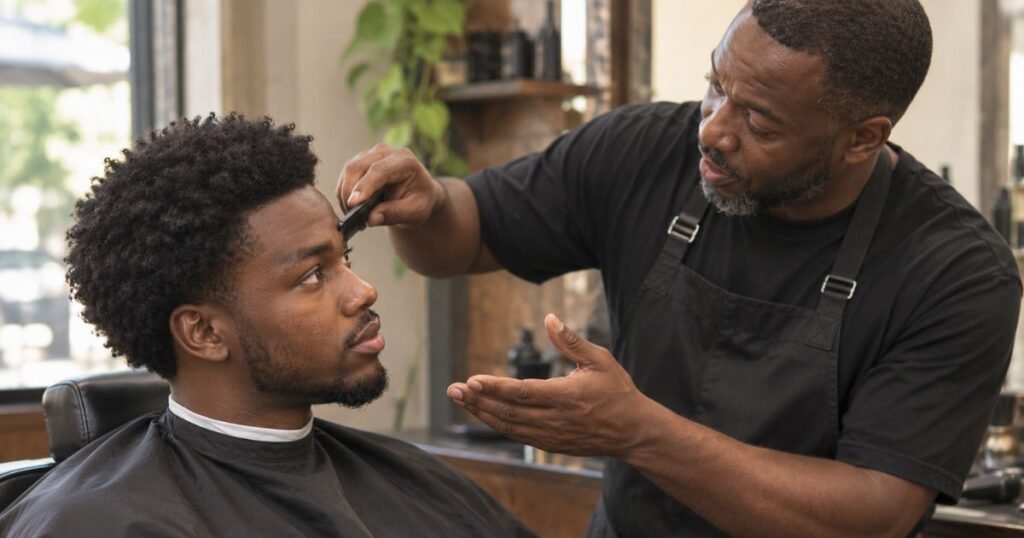
There isn’t a single best fade, because the right one depends on your hair, your hairline, your routine, and how you want to look. Here are the main factors, and how each might point you in a direction.
Choosing a Fade Based on Hair Texture
Start with your natural texture. Tight coils tend to hold structure and can suit crops, high tops, and mohawks. Curls need enough length to show definition. Waves depend on growth direction and routine. Density matters too: dense hair shows contrast sharply, while finer hair can look softer. For specifics, see the textures section above.
Choosing a Fade Based on Face Shape
Face shape is one factor among several, alongside head shape, hairline, beard, and top length. A high fade may add height and emphasize angles, while a lower fade can keep proportions softer, but individual results vary and there’s no rule. If your face is round, a taller top may help create vertical emphasis for some people. If it’s long, a lower fade and a less tall top might keep proportions balanced. These are starting points to discuss with your barber, not guarantees.
Hairline and density also matter. A receding or uneven hairline may change how a line-up or high fade looks, and thinner areas can look different against a blend. A barber can often adapt the cut to your hairline, which tends to matter more than a generic face-shape rule.
Choosing a Fade Based on Maintenance
Higher contrast and skin finishes tend to show regrowth sooner, so they may call for more frequent visits. Low fades with a softer finish generally grow out more gradually. Designs and sharp line-ups also need touch-ups to stay crisp.
If you want a haircut with minimal daily styling, a short top with a low or mid blend is generally less demanding than a tall, shaped top or a wave routine. Be realistic about the time and money you’re willing to spend.
Choosing a Fade Based on Personal Style
Consider your workplace, your beard, and your daily routine. A neat professional look with a modern edge might be a low or mid fade with a natural line-up. A bolder look might use a high fade, a mohawk, or designs. Dress codes vary, so a quick check of your workplace norms is worth it before choosing a more dramatic style.
A simple way to narrow it down: pick a height you’re comfortable with, choose a finish that suits your skin and upkeep tolerance, then pick a top that works with your texture. Bring photos of that combination to your barber.
How to Maintain a Fade Haircut
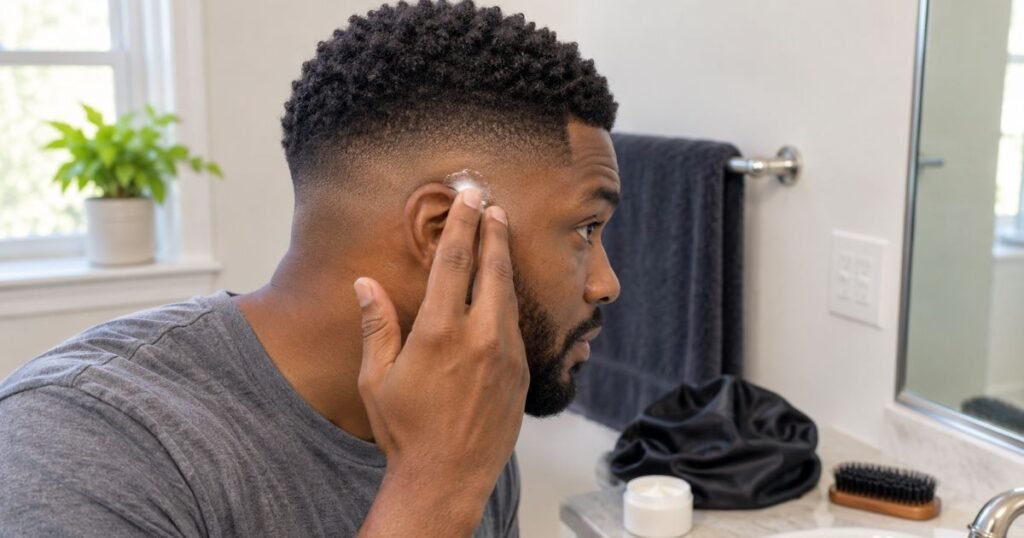
A fade looks its best when the blend is fresh, and it changes as hair grows. Maintenance comes down to timing your barber visits, caring for your scalp, and handling the top. Here’s a practical approach without fixed schedules, since growth rates and preferences vary.
How Often Should Black Men Get a Fade?
There’s no universal interval. It depends on how fast your hair grows, how high and short the fade is, how sharp your line-up is, and whether you have a beard or an event coming up. Skin fades and sharp line-ups show regrowth sooner than low, soft fades.
A practical method is to notice when the blend starts to look soft or the line-up loses its edge, then book slightly before that point. Some barbers offer line-up-only visits that can extend the time between full cuts. If you want a more specific range, ask your barber, who can see how your hair grows.
How to Maintain a Fade Between Barber Visits
- Moisturize: Coily and curly hair dry out easily, and dry hair looks dull and can make the blend look less crisp.
- Cleanse gently: Use a mild cleanser, and avoid over-washing.
- Protect at night: A satin or silk cap, or a du-rag, can help preserve waves and reduce friction.
- Brush if you have waves: Consistent brushing helps keep the pattern.
- Protect your scalp: Skin fades expose more scalp, so use sun protection when you’re outdoors.
- Keep touch-ups light: Tidying the neckline is different from reshaping the fade. Leave the blend and hairline to your barber.
If razor bumps are a concern, shaving or trimming with the grain, avoiding very close passes, and keeping skin clean and moisturized may help. If irritation persists, see a dermatologist.
To keep a fade looking balanced as hair grows, tidy only the neckline and sideburns, moisturize, and avoid cutting into the blend.
Products That Help Maintain a Fade and Healthy Scalp
Products vary by hair type, so think in categories:
- Gentle cleanser or shampoo
- Moisturizer or leave-in conditioner
- Light oil or butter for dryness
- Curl cream, coil cream, or a sponge for definition
- Wave pomade for waves
- Soft brush
- Scalp soother or aftershave balm for skin fades
- Sun protection for exposed scalp
Heavy products can build up, especially on dense or low-porosity hair, so start light. Whether you need sulfate-free products depends on your hair and scalp; some people find them gentler, while others use a variety.
Frequently Asked Questions
How often should I get my fade haircut touched up?
It depends on your hair growth, the fade height, finish, and line-up. Skin fades and sharp edges show regrowth sooner. See the maintenance section for a way to decide.
Can I maintain my fade at home between barber visits?
Light upkeep, like tidying the neckline and moisturizing, is reasonable. Reshaping the fade or hairline is better left to a barber, since small mistakes are hard to hide.
Which fade style works well for men with receding hairlines?
It depends on your hairline pattern, the density on top, and your preferences. Some people choose a slightly softer line-up and a blend that doesn’t emphasize the receding areas; others prefer a higher fade. Ask your barber to look at your hairline and suggest options.
How do I communicate the fade I want to my barber?
Bring photos and describe what you see, because words like skin, bald, and zero fade mean different things to different barbers. A short checklist helps:
- Starting height: low, mid, or high
- Finish: shadow or skin
- What to tell a barber about the sides and top: how short the sides, how much length on top, and what shape
- Line-up and sideburn style
- Beard blend, if you have one
- Reference photos from the front, side, and back
- Confirm terms, since names vary between barbers
How long does it take to grow out a fade?
It depends on your growth rate and what you’re growing toward. Expect some awkward in-between stages. Keep the edges tidy and moisturize to make the phases easier to manage.
How do I care for my scalp after getting a skin fade?
Moisturize, use a gentle cleanser, and protect the scalp from the sun. Watch for irritation or bumps, and see a dermatologist if they persist.
What face shapes may suit high fade haircuts?
Face shape is only one factor. Some people find a high fade complements an oval or square face, but head shape, hairline, beard, and top length matter too. Discuss it with your barber instead of relying on a rule.
What is the best fade haircut for Black men with 4C hair?
There’s no single best. Think about your density, how much top length you want, and how much contrast you prefer. See the section on 4C and kinky hair for more.
How can I prevent my fade from looking uneven as it grows out?
Tidy the neckline and sideburns lightly, keep hair moisturized, and brush if you have waves. Avoid cutting into the blend yourself.
What is the most popular fade haircut for Black men?
There’s no reliable single measure. Low, mid, high, taper, and skin fades are all widely requested, and popularity varies by region and barber.
What fade works best with curly hair?
It depends on your curl pattern and the length of your top. A fade that leaves enough length for curls to form is a good starting point, and the sides can be adjusted for contrast. See the curly hair section.
Are fade haircuts good for all face shapes?
Fades can be adapted in height, finish, and top length, so many people can find a version that works. The result varies by person and by how the barber adapts the cut.
What’s the difference between a taper and a fade haircut?
A taper usually stays concentrated at the sideburns and neckline and keeps more length, while a fade covers more of the sides and often goes shorter. Barbers use the terms differently, so show a photo.
Conclusion
Choosing a fade comes down to three decisions: how high the blend starts, how short it finishes, and what shape the top takes. Pair those with your hair texture, hairline, and how much upkeep you want, and you have a clear brief for your barber.
Before your next appointment, save three reference photos showing front, side, and back, and be ready to describe the sides and the top. Results vary with your hair and with how your barber adapts the cut, so treat the photos as a starting point for a conversation.

Jake Miller is a barbering and men’s hairstyle enthusiast who shares practical tips, haircut inspiration, and the latest grooming trends at BarberZylo. He enjoys exploring modern and classic hairstyles and helping readers find fresh ideas for their next look.