Men Hairstyles for Thin Hair: 30+ Proven Cuts That Boost Volume
A haircut can’t add hairs you don’t have. What it can do is change how much scalp shows, where the eye lands, and whether your hair looks flat or full. That’s why hairstyles for thin hair work as a set of trade-offs: contrast, length, texture, and direction. You balance them against where you’re thinning and how much time you’ll spend styling.
This guide covers 26 cuts and explains what makes each one recognizable, what to watch for on thin or fine hair, and how it differs from similar styles. The later sections cover choosing by thinning pattern, talking to your barber, styling, maintenance, and products. If you’re not sure where you stand, start with the thinning pattern section below, then jump to the cuts. If your hair loss is sudden, patchy, or accompanied by itching or pain, see a doctor first. A haircut can’t diagnose anything.
What Causes Thinning Hair in Men?

The most common cause is male pattern hair loss, which is driven by genetics and hormones. Over years, affected follicles shrink (follicle miniaturization), so each one grows shorter, finer hair until some stop producing visible hair. It usually starts at the temples or the crown, and it tends to progress slowly.
Other causes look different from the outside:
- Temporary shedding after illness, surgery, major stress, or rapid weight loss
- Health and nutrition factors, such as thyroid problems or low iron, and some medications
- Tension on the hair from tight styles worn for years
- Scalp conditions that cause irritation or flaking
Worth getting checked by a doctor or dermatologist:
- Hair coming out suddenly or in clumps
- Round or irregular bald patches
- Itching, burning, pain, redness, or scaling on the scalp
- Thinning alongside other symptoms, or in someone quite young
Treatments exist, and a professional can discuss what’s appropriate. This article covers haircuts and styling, which change how thin hair looks. They don’t affect hair loss itself.
Thin Hair vs. Fine Hair: What’s the Difference?
People use “thin” and “fine” interchangeably, but they describe different things, and the difference changes which cut makes sense.
| Term | What it describes | What you notice |
| Fine hair | Hair strand diameter: each strand is narrow | Hair feels light, lies flat easily, and can go limp with heavy product |
| Low density | How many hairs grow in a given area | Scalp shows through, especially under bright light or when hair is wet |
| Thinning | A change over time | Hair looks less full than it used to, or the part widens |
You can have any combination. Someone with fine but dense hair may never see much scalp but struggle with flatness. Someone with thick strands and low density may have little trouble with volume but plenty of scalp visibility. If your main issue is fine strands rather than lost density, many of the same cuts apply, but the focus shifts toward lift and lightweight styling and away from coverage.
A rough self-check: look at the top of your head under good light with dry, flat hair. If you can see scalp between hairs across a broad area, density is part of the picture. Hair color matters too. Dark hair against a light scalp creates strong contrast, while light, blond, or gray hair against a similar scalp tone tends to be more forgiving.
How the Pattern of Thinning Affects Your Haircut
Where you’re losing coverage matters more than how much. Each pattern creates a different problem for a barber to solve.
| Pattern | How it looks | What it changes for a haircut |
| Receding hairline | Temples move back, often forming an M shape or a more pronounced widow’s peak | Front coverage and hairline shape become the priority |
| Thinning crown | Hair around the crown whorl (the spiral at the back-top of the head) opens up | Direction and length at the back matter most |
| Diffuse thinning | Density drops across the whole top, and the part widens | Overall contrast and texture matter more than any one area |
| Thinning on top | The front-to-mid top loses coverage while the sides stay dense | The gap between top and sides becomes the problem |
Most men have a mix, and patterns shift over time. Whatever your pattern, a haircut works through three levers:
- Contrast. The sharper the line between hair and scalp, or between dense and sparse areas, the more obvious thinning looks.
- Direction and length. Hair brushed forward or to the side can cover thin areas, but only if it’s long enough to reach and light enough to stay put.
- Texture. Strands that overlap at different lengths look fuller than strands lying in one smooth sheet.
You’ll see these three ideas repeated in the cuts below.
Best Hairstyles for Thinning Hair in Men

The cuts below are grouped loosely, but each entry is written to be read alone. Results depend on your density, growth direction, hairline, and how your barber adapts the cut, so treat each description as a starting point for a conversation rather than a promise.
A few terms before you start. In the UK, a fringe is what Americans call bangs. Clipper guards are numbered in the US and graded in the UK, and the lengths differ slightly between brands, so use these as rough guides:
| US guard | UK grade | Approximate length |
| #1 | Grade 1 | ⅛ in (3 mm) |
| #2 | Grade 2 | ¼ in (6 mm) |
| #3 | Grade 3 | ⅜ in (10 mm) |
| #4 | Grade 4 | ½ in (13 mm) |
Because naming varies between barbers, it’s safer to describe length in inches or millimeters and bring a photo.
Quick-pick table. Lengths are approximate and will vary with hair type and how the barber cuts it.
| Style | Top length | Daily effort | Often considered when |
| Textured Crop | 1–3 in (2.5–7.5 cm) | Low to medium | Temple recession, overall thinning |
| French Crop | 1–2 in (2.5–5 cm) | Low | Temple recession |
| Scissor Cut | Varies | Low to medium | You want softer, lower-contrast sides |
| Crew Cut | ½–1½ in (1.3–4 cm) | Low | Mild or even thinning |
| Buzz Cut | ⅛–½ in (3–13 mm) | Very low | Advanced or diffuse thinning |
| Textured Fringe | 2–4 in (5–10 cm) | Medium | Front and temple coverage |
| Ivy League | 1½–3 in (4–7.5 cm) | Low to medium | A neat look with some top length |
| Slicked Back | 3 in+ (7.5 cm+) | Medium | Mild recession, reasonable density |
| Pompadour | 3–5 in+ (7.5–13 cm+) at the front | High | Good front density |
| Caesar Cut | 1–2 in (2.5–5 cm) | Low | Front coverage with minimal styling |
| Side Part | 2–4 in (5–10 cm) | Low to medium | Off-center thinning |
| Faux Hawk | 2–4 in (5–10 cm) at center | Medium | Density along the center |
| Spiky Haircut | 1½–3 in (4–7.5 cm) | Medium | A short, soft lift |
| Messy Layered Hair | 3–5 in (7.5–13 cm) | Medium | Movement at medium length |
| Bro Flow | 5 in+ (13 cm+) | Medium | Moderate density, grown-out look |
| Side-Swept Fringe | 3–5 in (7.5–13 cm) | Low to medium | One-sided recession, a widening part |
| Angular Fringe | 3–5 in (7.5–13 cm) | Medium | Asymmetrical recession |
| Classic Quiff | 3–4 in+ (7.5–10 cm+) | Medium to high | Moderate lift |
| Wavy Shag | 4–6 in+ (10–15 cm+) | Medium | Natural waves |
| Messy Textured Medium Cut | 3–5 in (7.5–13 cm) | Low to medium | A low-effort medium length |
| Choppy Fringe | 2–4 in (5–10 cm) | Medium | A piecey, textured front |
| Curly Fringe | 2–4 in (5–10 cm) | Medium | Curly hair |
| Mop Top | 4–6 in (10–15 cm) | Medium | Soft front coverage |
| Regulation Cut | 1–2 in (2.5–5 cm) | Low | A tidy, low-maintenance cut |
| Burst Fade | Varies | Low to medium | You want a curved fade around the ears |
| High Skin Fade | Varies | Medium | A bold look with a dense top |
Textured Crop
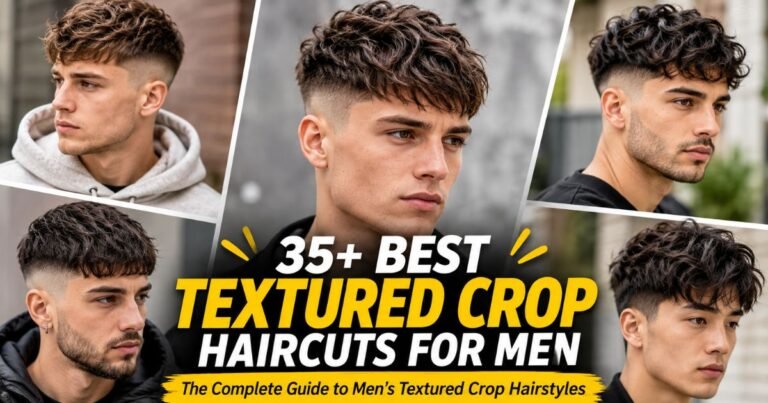
The textured crop pairs short, tapered or faded sides with a slightly longer top that’s cut to look choppy and is pushed forward. The texture usually comes from point cutting, where the barber snips into the ends with the tips of the scissors, or from razor work, so the strands sit at different lengths instead of in one flat sheet.
That unevenness is what makes it useful for thin hair. Overlapping strands read as more hair, and the forward direction softens temple recession. It’s lighter and choppier than a French crop, which has a more even top.
Fine, straight hair can fall flat, so a little texturizing spray at the roots helps. A strong cowlick at the front can fight the forward direction, which is worth mentioning to your barber.
French Crop
The French crop is defined by its fringe: a short, fairly straight line of hair sitting above the forehead, with short sides and a top cut to a relatively even length. It’s neater and less piecey than a textured crop.
For temple recession, the fringe covers the front edge without needing much length, and styling is minimal: a small amount of paste, pushed forward. The main risk is the fringe line itself. A ruler-straight edge can look stark if your hairline is uneven or your recession is one-sided, so ask the barber to soften the line with light point cutting. Because the shape depends on precision, it loses its definition fairly quickly as it grows.
Scissor Cut
A scissor cut isn’t a silhouette. It’s a method, and it can produce several of the cuts in this list. Instead of clippers on the sides, the barber uses scissors, often with scissor-over-comb technique: the comb lifts the hair, and the scissors trim whatever rises above it.
The result is usually a softer, more gradual edge than a clipper fade, with less contrast between the sides and the top. That can help when sparse areas sit next to denser ones, because there’s no hard border for the eye to catch on. The trade-offs are time, skill, and often cost, and the shape tends to grow out more gently.
If you want to ask for it, you could say you’d like the sides blended with scissors rather than faded to skin. If your barber doesn’t do this, a longer clipper guard with a soft blend gets you part of the way.
Read More About : 45+ Best Hairstyles for Men with Straight Hair
Crew Cut
The crew cut is a short classic: sides and back tapered close, with a top that’s slightly longer and graduated, often about half an inch to an inch and a half. Depending on your hair, the front can stand up a little or lie flat.
It suits thin hair mostly because it keeps weight light, so hair doesn’t flop or separate, and the contrast between sides and top is low compared with a skin fade. Styling can be as simple as towel drying and a little paste.
It differs from a buzz cut because the top is longer than the sides, and from an Ivy League cut because the top is too short to part. If scalp visibility bothers you at very short lengths, asking for slightly more length on top often helps.
Buzz Cut
A buzz cut uses one clipper length all over, sometimes with a gentle taper at the edges. For many men with thinning hair, its main benefit is that it removes the contrast between denser and sparser areas. With nothing to part or separate, uneven coverage is far less noticeable, and daily effort is close to zero.
There are trade-offs. A buzz cut shows your head shape, any scars, and the exact outline of your hairline, and a scalp with little coverage gets more sun exposure. It also doesn’t change density, and dark hair on a light scalp can still show scalp even at a uniform length.
Length matters. Very short guards show more scalp, while a slightly longer one, around #3 or #4 (grade 3 or 4), often looks softer. It’s also worth asking whether to keep a natural, slightly soft edge at the hairline instead of a sharply defined line-up, which can emphasize recession.
Textured Fringe
This is the general forward-fringe style: a top of roughly two to four inches, cut with texture and brushed forward over the front hairline. It’s one of the more direct ways to cover temple recession, and the entries that follow (side-swept, angular, choppy, curly) are variations on its direction, geometry, or texture.
It does depend on front density. If the fringe is too long or too heavy on fine hair, it can clump into thin strands and look see-through, so the goal is a length that holds its shape instead of hanging. Ask your barber to texture the ends while keeping enough body in the fringe, and to leave it long enough to cover without dropping into your eyes.
To style it, dry it forward with your fingers and use a small amount of matte paste.
Ivy League
The Ivy League is a longer crew cut. The sides are short and tapered, but the top is long enough, roughly an inch and a half to three inches, to comb to the side or back while still looking cropped. That length is what separates it from a crew cut (too short to part) and from a longer side part.
Because it can be combed either way, you can part it on the side where you have more density or comb it off the forehead. A lower, softer taper on the sides keeps contrast down. Terms vary by region and barber (you may hear it called a Harvard clip), so describe the top and side lengths and show a photo.
Read More About : 50+ Best Hairstyles for Men With Wavy Hair From Fades to Shaggy Cuts
Slicked Back
Slicking hair straight back exposes the forehead and temples, so it’s less forgiving than forward styles. It tends to work better when the hairline is largely intact, density is decent, or recession is even and you’re comfortable showing it.
The bigger practical issue is product. Wet-look, high-shine finishes can bunch strands together and reveal more scalp between them. Lighter or matte products, applied to dry or nearly dry hair, usually look fuller. Blow-drying the roots upward and back with a comb adds lift.
Short tapered sides keep the shape from spreading outward. If your crown is thin, note that sweeping hair back can also expose the way it parts there.
Pompadour
The pompadour is about front height: hair swept up and back from the forehead, with shorter sides, and typically three to five inches or more at the front. It’s a high-effort style that needs blow-drying and some hold.
Height creates a lot of apparent volume, but on thin hair it can also create space underneath where scalp shows, so it generally needs good density at the front. A lower, softer version often works better than a dramatic one. Volumizing mousse or a light powder at the roots can help it hold.
It’s easy to confuse with the classic quiff. The pompadour is higher and smoother, while the quiff is lower and looser.
Caesar Cut
The Caesar cut keeps the top short and fairly even, often one to two inches, with a short fringe brushed forward and tapered sides. Its appeal for thin hair is simplicity: there’s little to style, and the fringe covers the front edge without much length.
In practice it overlaps heavily with the French crop, and barbers use the two names loosely. The Caesar is usually the plainer, more uniform of the two. The catch is that very short, even hair shows regrowth quickly, so the shape softens sooner than a longer cut would.
A straight-across fringe can also make a pronounced widow’s peak stand out. If that’s your situation, ask for the line to be slightly broken up.
Side Part
A side part is defined by the part itself: a visible line, with hair combed to one side. It works at many lengths, so it’s less a specific cut than a styling direction.
Part placement matters more than anything else. A part along your natural line, with hair falling the way it grows, usually sits more convincingly than one forced against it. If your part is widening, moving it a little can help, and it’s often worth placing the part where density is stronger. Combing long strands across a bare area tends to draw attention to it, so it’s usually better to keep the length moderate.
It differs from a side-swept fringe, which has no hard line, and from the Ivy League, which is a specific cut that happens to part well.
Read More About : 39+ Hairstyles for Men with Fine Hair: The Ultimate Guide
Faux Hawk
A faux hawk lifts a strip of hair along the center of the top, with the sides kept shorter but not shaved bare like a true mohawk. The sides typically blend into the top rather than ending in a hard edge.
It needs density along the center, since that’s where the visual weight sits. High-contrast sides can draw attention to thinning at the temples, so a softer blend and moderate height tend to work better than a tall, dramatic version. If your crown is the weak spot, keeping the height toward the front and middle instead of the back may help.
Styling usually involves a pliable paste and a little hairspray to keep the lift.
Spiky Haircut
A spiky haircut has a short, layered top styled upward in separate points. That’s also its risk on thin hair: spikes pull strands apart, and gaps between them can show scalp.
Short, soft, small-scale spikes with a pliable matte product tend to look fuller than rigid, widely spaced ones. Very fine hair often can’t hold large spikes anyway. Compared with a textured crop, where hair is pushed forward and loosely separated, spiky styling pushes everything up. Compared with a faux hawk, it works across the whole top rather than a center strip.
Messy Layered Hair
Messy layered hair is a medium-length cut, roughly three to five inches, with layers cut at different lengths to create movement. Layers remove weight, which helps hair move and look less limp. But too many on fine or sparse hair can leave the ends wispy and see-through.
A few longer layers that keep density at the ends usually look fuller than aggressive layering. It’s worth telling your barber that you want movement without thinning out the ends.
Air-drying with a little texturizing spray often does the job. This entry is about how the layers are cut. The medium cut covered later is about the finish and day-to-day routine.
Bro Flow
The bro flow is a grown-out look: hair long enough to cover the ears and sometimes reach the neck, swept back or to the side with natural movement. Length magnifies whatever density you have. Where hair is thin, long strands can look stringy, and swept-back lengths expose the temples.
It tends to look best with moderate density and a hairline that isn’t receding sharply. Regular trims matter more than usual, since the shape depends on the ends looking healthy, and a barber can remove weight at the nape and sides to keep the outline tidy.
Growing out takes months and goes through an awkward in-between stage. A lightweight cream can add control without weighing hair down.
Read More About : 35+ Best Haircuts for Men With Thinning Hair
Side-Swept Fringe
A side-swept fringe brings the front hair diagonally across the forehead, covering one side or the temples. Unlike a side part, there’s no hard line, which can help if you’re dealing with a widening part.
It works best when you have enough front density to reach across, and it can suit one-sided recession by sweeping toward the thinner side. Dry it in the direction you want it to lie, then finish with a little paste. Compared with the angular fringe, it’s softer and relies on direction rather than a cut line.
Angular Fringe
An angular fringe is cut on a diagonal, longer on one side and shorter on the other, creating an asymmetrical line across the forehead. That asymmetry can balance one-sided recession.
The geometry needs a precise cut. A hard diagonal can look stark if the hair is wispy, so ask for a soft, textured edge. It also grows out faster than a rounder fringe, because the angle loses definition as the hair lengthens.
Classic Quiff
The classic quiff lifts the front up and slightly back, with tapered sides. It sits between a side part and a pompadour: more lift than the first, less sculpted than the second.
A moderate quiff can give an impression of fullness without needing the density a tall pompadour demands. A short blow-dry that dries the roots upward, plus a light mousse or powder and a flexible hold, is usually enough. Heavy hold tends to flatten and clump thin hair. Because the front is lifted off the forehead, it exposes the hairline, so it suits men comfortable showing it.
Wavy Shag
The wavy shag is a layered medium-to-long cut with choppy, tousled layers and natural waves. Waves add bulk, since the strands don’t lie flat against the scalp. That’s why wavy hair can look fuller than straight hair of the same density.
It works best when density is reasonable. Shags rely on a lot of layering, and on fine or sparse hair the layers need to be restrained so the shape doesn’t become see-through. Air-drying with a texture or sea salt spray, and scrunching gently, suits it. Straight hair can be given a wave, but expect more styling.
Read More About : The Modern High and Tight Haircut: Styles, Tips, and Everything You Will Need to Know In 2026
Messy Textured Medium Cut
This entry is about the finish more than the cut. It’s a medium-length style, around three to five inches, designed to look deliberately undone, and its main advantage is a natural-looking textured finish without daily blow-drying.
A practical routine is to towel-dry, apply a texturizing spray or light cream, rake through with your fingers, and let it dry. If your hair falls flat after styling, a quick burst of dryer heat at the roots helps, and heavy wax tends to make things worse.
It’s a good fit if you want low-maintenance grooming and a shape that looks intentional even when slightly disheveled.
Choppy Fringe
A choppy fringe is cut with deliberately uneven ends, using point cutting or razor work, so strands separate into pieces. It’s rougher and more separated than a standard textured fringe.
On fine hair, that separation can become gaps. The choppiness should come from the cutting technique, not from removing bulk. Ask your barber to point-cut the ends and keep density in the fringe, and to be cautious with thinning shears there, since they remove hair rather than shape it.
Length is usually two to four inches. Styling is a pea-sized amount of matte paste worked through with your fingertips.
Curly Fringe
A curly fringe puts natural curls forward on top, usually with shorter tapered sides. Curls create natural bulk, so curly hair can look fuller than straight hair of the same density.
A few things are worth planning for. Curls shrink as they dry, so the length you see wet isn’t what you’ll get dry, and a barber who cuts curls dry or works with your curl pattern often gets better results. Where density is low, scalp can show at the roots between curls. Moisture matters, and diffusing or air-drying generally keeps curls defined, while brushing dry curls tends to break up the pattern.
For coily hair, a soft taper and a gently shaped hairline usually look more natural than very sharp edges.
Read More About : 22+ Best Hairstyles for Receding Hairlines (2026 Guide)
Mop Top
The mop top is a longer, rounded cut, usually four to six inches, with hair falling forward over the forehead and often over the ears. It offers soft front coverage, and the rounded shape gives an impression of fullness.
On very fine hair, though, length can mean flatness. And if the cut is too uniform and heavy, it can look like a bowl. Ask for texture through the ends and some shaping around the ears. Unlike a bro flow, which sweeps back or sideways, the mop top falls forward.
Regulation Cut
“Regulation cut” is a term that varies. It generally means a short, tidy, military-style cut with tapered sides and a short top, but some barbers use the name for what others call a crew cut.
Because of that, the name is less helpful than a description. Give your barber the approximate top and side lengths, say whether you want the sides tapered, and show a photo. It’s a low-maintenance option that needs little product, and it keeps contrast moderate.
Burst Fade
A burst fade is a fade shape, not a top style. The fade curves in a semicircle around the ear and down toward the nape, leaving length on top and often at the back. It’s frequently paired with a faux hawk or a textured fringe.
Where the fade curves, skin shows around the ear. If your temples are thinning, a high-contrast burst can emphasize the area, so a lower, softer fade that starts just above the ear and leaves a little length at the temple is often easier on thin hair.
High Skin Fade
A high skin fade takes the sides down to bare skin, with the fade rising high up the head, often to temple level or above. It creates strong contrast with the top.
That contrast can work against thinning hair: it draws attention to any sparse areas on top and to the temple line. It may suit someone whose top is relatively dense or who wants a bold look. If you want a fade but less contrast, a taper, a low fade, or a mid fade is often easier to live with.
It also grows out quickly in terms of how it looks, since the sharp contrast is what makes it noticeable.
How to Choose the Right Haircut for Thinning Hair

With so many options, it helps to narrow by asking four questions:
- Where am I thinning? Your pattern points to certain cuts.
- How much contrast am I comfortable with? Soft blends and low tapers keep thinning less obvious.
- How much length do I want? There’s a trade-off between coverage and weight.
- How much time will I spend styling?
The sections below take the pattern question first, then hair type and routine.
Best Haircuts for a Receding Hairline
For temple recession, the options often considered are forward-brushed styles: the textured fringe, French crop, or Caesar cut. For one-sided recession, the side-swept or angular fringe can balance things. Shorter cuts like the crew cut or Ivy League are another route, since they reduce the contrast between the hairline and the rest.
Hairline proportions matter. A high forehead or pronounced widow’s peak can make a straight fringe look stark, while a softer, broken fringe tends to sit more naturally. Some men choose to go short all over so the recession looks like part of the shape. Swept-back styles expose the hairline, which some men are comfortable with and others aren’t.
Best Haircuts for a Thinning Crown
At the crown, hair grows in a spiral from the whorl. When density drops there, the spiral can widen and open up. Keeping a bit of length on top so the hair lies across, or a short textured top, often helps more than shaving the back and sides close, which creates hard contrast around the crown.
If you’re dealing with a visible crown swirl, a barber can cut the back-top slightly longer and work with the growth direction instead of fighting it. The crown is hard to see yourself, so take photos from behind and above, or ask someone to, and show your barber.
Read More About : Slicked-Back Hairstyles: 35+ Modern, Classic & Trendy Looks for Every Hair Type
Best Haircuts for Diffuse Thinning
When density is low across the whole top and the part is widening, lower contrast and even lengths tend to do more than any single trick. Shorter, uniform cuts such as a crew cut or a moderate buzz cut keep things consistent. Texture helps, and softer blends keep sides from standing out against the top.
Long layers tend to work against you, because thin hair at length shows the part and leaves sparse ends. If you’re choosing a cut for a widening part, a fringe that falls forward avoids a hard line altogether. Diffuse thinning can have causes beyond pattern hair loss, so it’s reasonable to get it checked if it came on quickly.
Choosing a Cut for Your Hair Type and Styling Routine
Hair type changes how a cut behaves:
| Hair type | What to consider |
| Straight | Shows scalp more easily because strands lie flat, so texture and forward direction help |
| Wavy | Waves add natural bulk, which suits medium lengths like the shag |
| Curly | Curls add volume, but shrinkage means the dry length is shorter than it looks wet |
| Coily | Density can look different, and a soft taper with a gently shaped hairline often works well |
Routine matters just as much. Cuts that need little more than towel drying and a touch of product include the crew cut, French crop, Caesar cut, and regulation cut. Medium effort covers the textured crop, textured fringe, side part, and messy medium styles. The pompadour, quiff, and slicked-back styles generally take the most time. If you’d like a style that works without daily blow-drying, shorter cropped cuts and wavy medium cuts are the usual candidates.
On length, there’s a middle zone, roughly one to three inches on top, where hair is long enough to be textured and directed but short enough to stay light. It’s not a rule, just a useful place to start the conversation.
How to Ask Your Barber for Thinning Hair Cuts
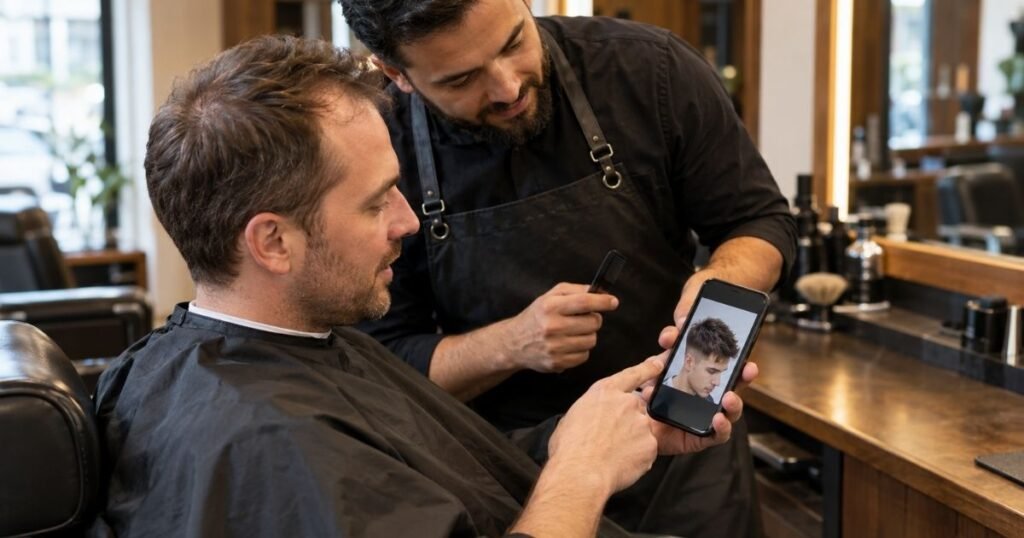
The most useful thing you can bring is a clear picture of what you want and what worries you.
Before the appointment:
- Bring two or three reference photos showing the front, side, and top, ideally on hair with similar color, density, and hairline.
- Take photos of your own head from the front, sides, and above, especially the crown.
- Decide what bothers you most: the temples, the crown, the part, or overall flatness.
In the chair:
- Say where you’re thinning and what you’d like to minimize.
- Describe length in inches or millimeters instead of relying on names.
- Ask how the cut will look as it grows out.
- Ask how the barber plans to add texture, and whether they’d use point cutting or thinning shears.
- Ask what products and styling approach they’d suggest.
| Term | What it means |
| Taper | Hair gradually gets shorter toward the neckline and sideburns, usually with a subtle change |
| Fade | A more dramatic gradual shortening, often down to skin |
| Guard or grade | The clipper attachment that sets cutting length |
| Point cutting | Snipping into the ends with scissor tips to create texture |
| Thinning shears | Scissors with teeth that remove some hair as they cut |
| Scissor-over-comb | Trimming hair that rises above a comb, often used for soft blends |
| Line-up (shape-up) | A defined edge at the hairline |
| Weight | The visual heaviness of hair at certain points |
A sample way to start: “I’m thinning at the temples and I’d like to keep the front covered. I’d like about two inches on top, textured, with the sides tapered rather than faded to skin. Can we look at this photo?”
No phrase guarantees the same result in every shop, so photos and measurements do more than names. A good barber will also tell you honestly if the cut you’ve chosen might not work on your hair.
How to Style Thin Hair to Look Fuller

Styling hair without weighing it down is mostly about restraint.
- Start with damp, not dripping, hair. Towel dry first. Too much water dilutes products and slows drying.
- Add root support if needed. If your hair falls flat, a little volumizing mousse or texturizing spray at the roots helps.
- Blow-dry for root lift. Dry the roots first, lifting them with your fingers, and work in a couple of directions before settling on the final one. Use low to medium heat, and finish with a cool setting to help the shape hold.
- Use a small amount of product. Warm a pea-sized amount of matte clay or paste between your palms, then work it through from back to front with your fingertips. Add more only if you need to.
- Finish lightly. A light hairspray holds the shape without stiffening it.
A few extras: change your part now and then if hair gets limp, avoid pressing hair flat with your hands, and wash product out at night so buildup doesn’t weigh hair down. Heavy, shiny products are the most common reason thin hair clumps and shows scalp.
Maintenance Tips for Thinning Hair

There’s no universal schedule, because it depends on the cut. Short cuts with strong contrast, like fades and crops, show grow-out sooner, while softer, lower-contrast cuts hold their shape longer. The simplest approach is to ask your barber how often your specific cut needs refreshing and how to maintain shape between visits.
Day to day:
- Be gentle. Avoid rough brushing or towel-rubbing when hair is wet.
- Keep heat moderate. Excess heat can leave fine hair brittle.
- Avoid constant tension. Tight hair ties on longer hair pull on the roots.
- Protect the scalp. Where scalp shows, sunscreen or a hat helps prevent sunburn.
- Wash out product regularly. Buildup makes hair look flatter and clumpier.
Maintenance keeps a cut looking its best, but it doesn’t reverse hair loss.
Best Products for Men With Thinning Hair

This section covers styling products, not hair-loss treatments. Those are a medical conversation. It also doesn’t recommend specific brands, so you can choose based on your hair.
| Product type | What it does | Thin-hair consideration |
| Matte clay or paste | Adds texture and hold with a flat finish | A small amount works better than a heavy application |
| Texturizing or sea salt spray | Adds grip and separation | Can dry out hair if overused |
| Volumizing mousse | Adds lift at the roots | Best applied to damp hair before drying |
| Light hairspray | Holds the shape | Choose flexible hold over stiff |
| Texture powder | Adds lift and grip | Can look chalky if too much is used |
| Lightweight conditioner | Smooths ends | Apply to ends only so roots aren’t weighed down |
Heavy pomades and high-shine gels tend to clump strands, which can reveal more scalp. Some men also use cosmetic hair fibers or scalp-coloring sprays to reduce contrast. These are cosmetic, they work best when matched closely to your hair color, and they wash out.
Haircuts That Can Make Thin Hair Look More Noticeable
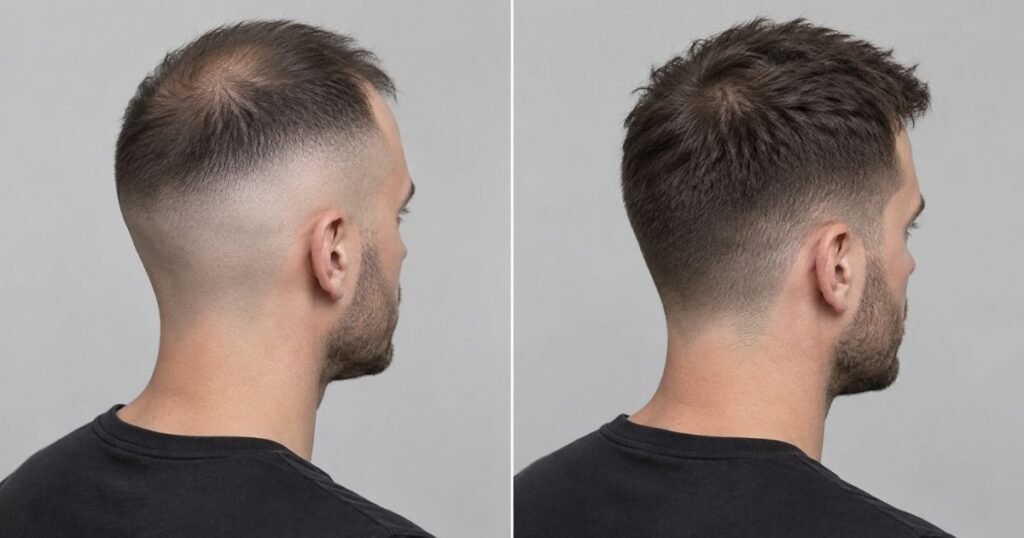
Rather than banning styles, it helps to understand what makes thinning more visible, so you can adapt.
- High contrast between sides and top. A skin fade next to sparse hair on top draws the eye. A taper or lower fade softens it.
- Long strands combed across a bare area. This usually draws attention. A shorter, textured cut tends to look more natural.
- Wet-look or heavy products. They clump strands and expose scalp. Matte, light products usually look fuller.
- Over-thinned layers. Too much layering or thinning shear work leaves sparse ends. Ask for texture without removing bulk.
- Hard, straight lines. A ruler-straight fringe or sharp line-up can emphasize recession. A slightly broken edge looks softer.
- The same part every day. Hair trained in one direction can show a widening line. Moving the part can help.
- Too much length on fine hair. Long, flat hair can look stringy. A shorter or more layered cut can add body.
- Excessive lift. Very tall styles create space underneath. Moderate height usually looks fuller.
Read More About : Comb Over Hairstyles: 30 Styles Guide for Men (2026)
FAQ: Hairstyles for Men With Thinning Hair
What is the best haircut for men with thinning hair on top?
There isn’t one best haircut. It depends on your thinning pattern and how much contrast you’re comfortable with. Textured crops, crew cuts, and short fringes are often considered, because they keep weight light and reduce contrast. See the section on choosing a cut for pattern-specific options.
What is the best haircut for a bald spot on the crown?
A slightly longer top that lies across the crown, with a softer blend on the sides, often works better than very short sides. A barber can cut with the growth direction. If the spot is new or growing quickly, it’s worth having it checked by a doctor.
What are the best hairstyles for thin hair?
Styles that keep contrast low, add texture, and direct hair forward or to the side tend to work well. Examples include crops, crew cuts, and textured fringes. Your hair type and routine matter as much as the cut itself.
Which haircuts can make thin hair look fuller?
Cuts that add texture and lift, such as textured crops, quiffs, and curly or wavy styles, can create an impression of fullness. Low-contrast tapers also help, because they avoid drawing attention to sparse areas.
What haircuts should men with thin hair avoid or adapt?
Rather than avoiding styles outright, adapt them. Soften high fades, avoid combing long strands across bare areas, and go easy on thinning shears. The section on haircuts that make thin hair more noticeable explains how.
Is short or long hair better for men with thinning hair?
Neither is universally better. Short hair reduces contrast and is easier to maintain, but it can show more scalp. Longer hair can cover and move, but on thin hair it can look stringy. A middle length often gives the most flexibility.
How can men style thinning hair to look fuller?
Dry the roots with some lift, use a small amount of matte product, and finish with a light hold. Avoid heavy or shiny products, and wash product out regularly so hair doesn’t get weighed down.
Can a haircut make thinning hair look thicker?
It can change how full your hair looks, through texture, direction, and lower contrast, but it can’t change actual density or treat hair loss. For sudden or patchy thinning, see a doctor.
Conclusion
Choosing among hairstyles for thin hair comes down to four things: where you’re thinning, how much contrast you’re comfortable with, how much length you want, and how much time you’ll spend styling. Start with the pattern, shortlist two or three cuts, and bring photos to your barber along with a clear description of what bothers you.
Expect to adjust. The first cut is a starting point, and small tweaks to length, texture, or part usually do more than switching styles entirely. If your hair loss is sudden, patchy, or accompanied by other symptoms, check in with a doctor or dermatologist.

Jake Miller is a barbering and men’s hairstyle enthusiast who shares practical tips, haircut inspiration, and the latest grooming trends at BarberZylo. He enjoys exploring modern and classic hairstyles and helping readers find fresh ideas for their next look.