
38+ Curly Hairstyles for Men Best Trending Hairstyles, Products & Care Routine
A curly haircut that looks great in a photo can turn out very differently on your head. Curl tightness, hair density, and how much your curls spring up as they dry all change the result. This guide pairs a gallery of curly hairstyles for men with the practical parts that usually get figured out later: how to choose, what to tell your barber, how to style the cut, and how to keep it looking good between appointments.
You’ll find more than 38 looks here, since a few entries cover close variations such as different fade heights and fringe types. Each one has a short tag for its type, length, and relative upkeep. Those upkeep labels are general guides, not promises, and the gallery isn’t ranked. Every head of hair behaves a little differently, and barbers adapt cuts to the person in the chair.
What Is Curly Hair in Men?

Curly hair is hair that grows in waves, curls, or coils instead of lying straight. The pattern is generally linked to genetics and to the shape of the hair follicle, and it can vary from one part of your head to another.
That structure explains a few things you’ll see throughout this guide. Curly hair often looks fuller than it is, because curls take up more space than straight strands of the same length. It also tends to run dry, because scalp oils have a harder time traveling down a bent strand. And it looks shorter when dry than when wet or stretched out, an effect known as shrinkage that we’ll come back to when choosing a cut.
“Curly” is a wide category. A man with loose waves and a man with tight coils both have curly hair in the everyday sense, but their haircuts, products, and routines can look quite different.
What’s Your Curl Type?
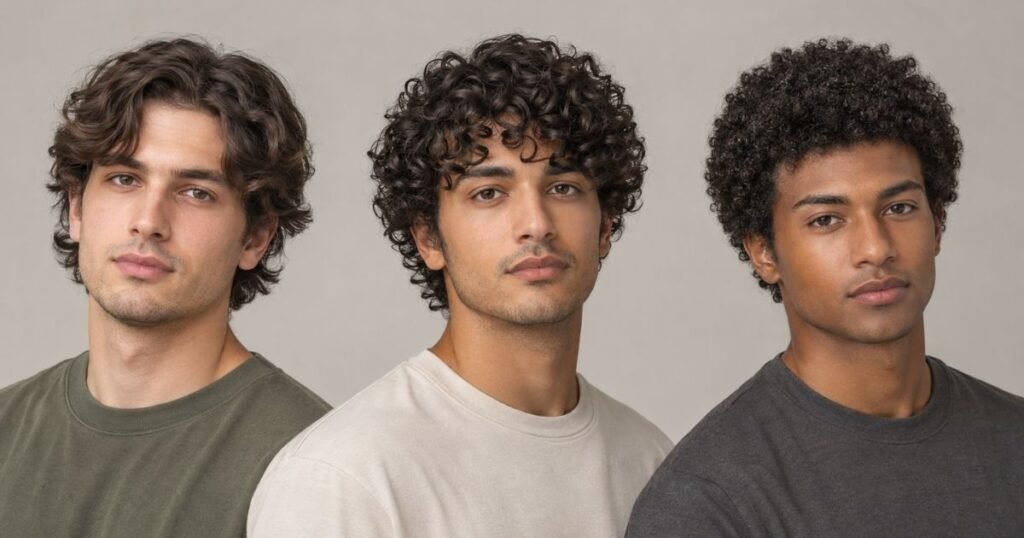
Knowing your curl pattern helps you pick a realistic style and a routine that fits. The most common shorthand is the 2/3/4 system: wavy, curly, and coily. It’s a useful starting point, not a precise science, and plenty of people have a mix of patterns on the same head. The back may be looser than the crown, for example.
To check yours, wash your hair and let it air-dry without product. Then look at how it forms on its own, especially around the crown and temples.
| Type | Typical look | Common challenge | What it often means for cuts |
| Wavy (Type 2) | S-shaped bends, often flatter at the roots | Can fall flat or get weighed down by heavy product | May look wavy rather than curly when cut very short; texture products can add lift |
| Curly (Type 3) | Defined spirals or ringlets that clump together | Frizz at the surface, shrinkage, humidity | Responds well to shape-focused cuts; length changes how the curls look |
| Coily (Type 4) | Tight coils or zigzag patterns, often dense | Dryness, fragility, the strongest shrinkage | Benefits from gentle handling and a barber comfortable with coily hair |
Wavy (Type 2)
Many men with wavy hair don’t think of themselves as curly, but they often land here. Waves tend to form a loose S-shape, and the roots can look flat while the ends bend. Heavy products can pull the pattern straight, so lighter formulas usually suit wavy hair better.
Several entries below lean wavy-friendly, including surfer curls and the curly fringe. If you want a more defined curl than your hair naturally gives, a perm is one route, and we cover it in its own entry.
Curly (Type 3)
Type 3 hair forms spirals or ringlets, and the curls often group into clumps. Clumping can help definition, since curls that stay together look more uniform, but it’s also where frizz tends to show up if the surface layer gets rough or dry.
Shrinkage is noticeable here, and humidity can change how tight the curls look from one day to the next. Many of the shape-based cuts in this guide, such as tapers, crops, and layered styles, are designed with Type 3 hair in mind.
Coily (Type 4)
Coily hair forms tight coils or a zigzag pattern, and it’s often dense. It also tends to be the driest and most fragile pattern, so gentle handling matters. Shrinkage can be dramatic: a section that looks quite long when stretched may sit much closer to the head when dry.
Coily hair needs its own approach to moisture and shaping, and it isn’t interchangeable with Type 3 advice. It’s reasonable to ask a barber how much experience they have with coily hair before booking. The curly afro entry below covers the rounded shape specifically.
Popular Curly Hairstyles for Men

Browse by tag and by group, then use the sections after the gallery to narrow down. Fades and tapers show up in many entries, so here’s a quick reference first.
Fade and taper in a minute
- Taper: hair shortens gradually, mostly around the sideburns and neckline. It usually keeps more length than a fade.
- Fade: the sides and back blend down to very short hair or skin, with stronger contrast. Fades are described by height: low, mid, or high.
- Skin vs. shadow: a skin (or bald) fade goes down to bare skin, while a shadow fade stops just short of it.
- Clipper guards: attachments that set cutting length. Guard numbers are commonly described in eighth-of-an-inch steps (a #1 leaves about 1/8 inch, or 3 mm), but sizing can vary by brand and region.
| If you want… | Look at | What it generally involves |
| Short and low-effort | Short Curly Hair, Curly Crew Cut, Curly Textured Crop, Natural Curly Hair | Shorter length, less daily styling |
| Sharp sides, curls on top | The taper and fade entries, Curly Undercut | Contrast between sides and top; more frequent cleanups |
| A statement shape | Curly Mullet, Curly Mohawk, Burst Fade, Curly Wolf Cut | Distinct silhouette; more upkeep |
| A fringe | Curly Bangs, Curly Fringe, Curly Edgar, Curly Curtain Bangs, Curly Bowl Cut | Front length matters; shrinkage affects the result |
| Volume on top | Curly Quiff, Curly Pompadour, Curly Top Fade, Broccoli Cut, Curly Slick Back | Length on top; some styling effort |
| Medium length and movement | Medium Length Curly Hair, Curly Flow, Surfer Curls, Curly Bob, Messy Curly Hair, Curly Middle Part | Enough length for shape; moderate effort |
| Layers and texture | Layered Curly Hair, Curly Shag, Curly Wolf Cut | Weight distribution matters |
| Long hair | Long Curly Hair, Curly Ponytail | More detangling and trimming of the ends |
| A different texture | Curly Perm | A chemical process with extra aftercare |
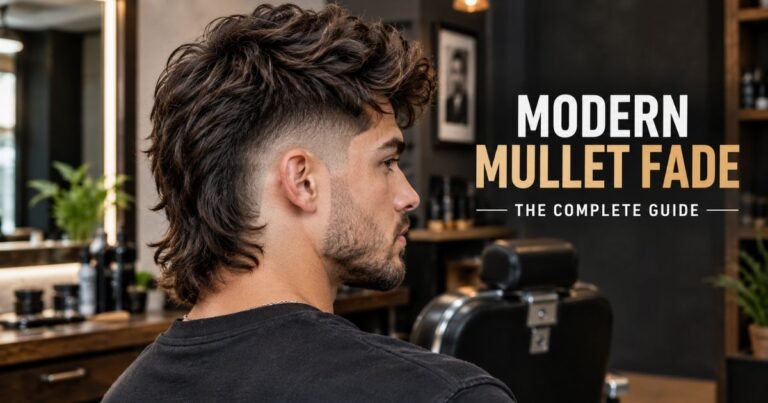
Curly Mullet
Statement shape · Short top and sides, long back · Higher upkeep
A mullet is defined by contrast: the front and sides stay short, often faded, while the length gathers at the nape. With curls, the back becomes a soft, springy tail instead of a straight drop. A curly wolf cut also has longer nape hair, but it’s layered all over, while the mullet’s front tends to be shorter and tidier.
Curls at the nape can behave differently from the ones on top, and they may rub against collars. Ask how the back will be shaped.
Ask your barber for: how short you want the top and sides, how far the length should reach down the back, and how the sides should blend. Check profile and back views in your reference photos.
Low Taper Fade Curly Hair
Taper · Short sides, curly top · Moderate upkeep
This is the gentle option. The sides shorten gradually around the sideburns and neckline, but most of the side length stays, so the curls on top flow into the sides instead of stopping at a hard line. Compared with a low fade, it shows less skin and a softer transition.
Pay attention to the neckline. Once it grows out and looks fuzzy, the shape loses its neatness. It may suit more conservative settings, though dress codes vary. In photos, look at the back view to see how the taper line sits against the curls.
Burst Fade Curly Hair
Fade shape · Short sides, longer back · Higher upkeep
Instead of running level around the head, a burst fade curves in a semicircle around the ear and fades out behind it. The hair at the back stays longer, which is why it pairs naturally with mullets and wolf cuts.
A drop fade, covered below, curves lower and follows the skull toward the nape. If you’re asking for a burst fade, bring a photo that shows the ear area clearly and say how much length you want to keep at the back.
Taper Fade Curly Hair
Terminology · Short sides, curly top · Moderate upkeep
“Taper,” “fade,” and “taper fade” get used loosely, and barbers don’t always agree on the boundaries. This table shows the general differences.
| Taper | Fade | Taper fade | |
| How it shortens | Gradually, mostly at the sideburns and neckline | Blends down higher up the sides and back, to very short hair or skin | A gradual blend that finishes with a fade at the bottom (varies by barber) |
| Contrast | Softer | Stronger | In between |
| Skin showing | Usually little | Can be a lot, especially with a skin fade | Some, near the edges |
| Regrowth | Often more forgiving | Often shows regrowth sooner | In between |
If you’re choosing between a taper and a fade for curls, think about contrast. A taper keeps a softer look and more side length. A fade creates a sharper edge that makes curls on top stand out. Neither is better in general, and the right pick depends on how much contrast you want and how often you’ll visit the barber. When in doubt, show a photo, because the label matters less than the look.
Short Curly Hair
Short · Short overall · Lower upkeep
Short is relative. It can mean a close crop with a hint of curl or a short top that still forms visible spirals. Shrinkage decides how it actually looks: tighter patterns tend to keep visible curl at shorter lengths, while looser patterns may look wavy or flat when cropped.
Barbers may use clippers, scissors, or scissor-over-comb on the sides, depending on the shape. Ask them to leave enough length on top for the curls to form, and show a photo of your hair in its natural state so they can judge how it behaves.
Curly Hair Fade
Fade overview · Short sides, curly top · Higher upkeep
Here’s the fade in general. Height changes how much contrast you see.
| Fade height | Where it starts | What it tends to look like |
| Low | Just above the ears and nape | Subtle, leaves most of the side hair |
| Mid | Around temple level | More visible contrast, balanced |
| High | Higher on the sides, toward the temples and above | Strong contrast, more skin or very short hair showing |
A fade blends from long to short, while an undercut doesn’t blend at all; it creates a visible step between the top and the short sides. Fades look sharpest soon after a cut and can need more frequent cleanups. If you have thinning areas or a sensitive scalp, tell your barber before choosing skin-level lengths. The fade entries that follow only add what’s different about each.
Mid Fade Curly Hair
Fade · Short sides, curly top · Higher upkeep
A mid fade starts shortening around temple level, which makes the transition more visible than a low fade without going as high as a high fade. A mid taper keeps more length, so check the next entries if you want something softer.
Head shape and ear position change how this reads. Tell your barber whether you want a skin or shadow finish.
Curly Bangs
Fringe family · Short to medium top · Moderate upkeep
Bangs (US) and fringe (UK) refer largely to the same thing: hair that falls forward over the forehead. The variations come from how the edge is cut and how the sides are handled.
| Style | Front shape | Part | Sides |
| Bangs / fringe | Falls forward, often with a soft or textured edge | Usually none | Varies |
| Curtain bangs | Longer, center-split, sweeping to the sides | Center | Blends into longer sides |
| Edgar | Blunt, straight-across line | None | Short, often faded |
| Bowl cut | Rounded all around | None | Same rounded shape as the top |
Shrinkage matters most at the front. A fringe cut while wet can spring up much shorter when dry, so many people ask for it to be cut dry or left a little longer. Front cowlicks and forehead height also affect where the hair sits.
Low Fade Curly Hair
Fade · Short sides, curly top · Higher upkeep
Unlike the low taper, a low fade gets noticeably shorter at the bottom, so more skin or very short hair shows around the ears and nape. The effect is a clearer edge around the ear, with most of the side length kept above it.
If you wear a beard, tell your barber, because the fade is often shaped to connect to it. Ask about the finish, whether skin or shadow, since that’s what changes how sharp the bottom looks.
Long Curly Hair
Long · Long all over · Moderate to higher upkeep
Long curls often fall past the ears and toward the shoulders. The weight of the length can stretch the pattern, so curls may look looser than they did when shorter. Split ends and tangles also matter more, so regular trims and gentle detangling help.
If you’re growing it out and want to keep the sides neat, ask your barber to tidy around the ears and nape while leaving length on top. Show a photo of how long you want to get. In pictures, notice how the hair falls at the sides, since that’s where the shape either holds or widens.
Drop Fade Curly Hair
Fade shape · Short sides, longer back · Higher upkeep
The fade line “drops” as it moves behind the ear, curving down toward the nape instead of running level. A burst fade curves tighter around the ear, so the two can look similar from the front and different from the side.
Head shape and the hairline at the back change how a drop fade looks, so a profile photo helps your barber see what you mean.
Read More About : 56+ Best Hairstyles for Men With Thick Hair (2026)
Mid Taper Curly Hair
Taper · Short sides, curly top · Moderate upkeep
A mid taper shortens at mid-height but keeps more length than a mid fade. That means less skin and a softer edge, which some people prefer for a lower-contrast look. The decision usually comes down to how visible you want the transition to be.
Curly Wolf Cut
Layered · Medium · Moderate to higher upkeep
Shorter layers around the crown and top, with longer length at the nape, create a shaggy silhouette. Compared with a mullet, the contrast is softer and the layers run all over. Compared with a shag, a wolf cut often has more pronounced crown-to-nape variation, though barbers use these terms inconsistently, so a photo is safer than a name.
Density and curl pattern change how it looks. Layers can add movement, but too many in finer hair may leave the ends looking thin. Say where you want the layers to start and how much length to keep at the back.
Curly Bob
Medium · Jaw to neck length · Moderate upkeep
A bob here means a rounded, mostly one-length shape that sits near the jaw or neck. Shrinkage is the main risk. A bob cut wet can spring up much higher when dry, and a bottom-heavy shape can appear if the weight isn’t distributed evenly.
Ask your barber to check the length on dry hair or leave extra. Describe the shape you want, whether rounded or more tapered at the back, not just a length in inches.
Curly Flow
Medium · Medium to long, ear-covering · Lower to moderate upkeep
Flow hair moves back and to the sides, usually covering the ears. The shape comes from length and growth direction, not from sharp lines. Surfer curls are looser and more textured, while medium-length curly hair is the broader category this fits into.
Hairline and cowlicks affect which way the hair wants to go. Ask for bulk to be removed where it puffs, while keeping the length.
Broccoli Cut
Rounded top · Short sides, full top · Moderate upkeep
The silhouette is the point: a domed, rounded top on short sides. A bowl cut is uniform all around, while a broccoli cut has a clearer difference between top and sides. A textured crop is flatter and shorter.
Dome size and side length are the details to specify. Sides grow out faster than the top reads as short, so expect to revisit the barber to keep the proportions.
Read More About : 59+ Best Afro Hairstyles for Men ( 2026 Guide)
Curly Perm
Chemical service · Varies · Higher upkeep
A perm uses a chemical process to create curls in hair that isn’t naturally curly. It’s one route for men with straight or wavy hair who want curls, and the results depend on hair condition, the rod size, and the stylist.
Talk to a stylist experienced with perms before committing. Hair that’s already damaged or chemically treated may react differently. Ask what pattern to expect, what aftercare is needed, and how the curls will grow out, since the permed section and the new growth will look different over time.
Curly Edgar
Fringe family · Short sides, blunt fringe · Moderate upkeep
An Edgar pairs a blunt, straight-across fringe with short, often faded sides. The sharp line is the signature, and it’s harder to keep on curls than on straight hair, because curls can spring up and make the line look uneven.
Discuss cutting the fringe dry, and bring a photo, since the name can mean slightly different things by region. A bowl cut is rounder, and a standard fringe is softer.
Curly Fringe
Fringe family · Medium top · Moderate upkeep
This fringe falls forward and covers part of the forehead, with a softer edge than an Edgar. Forehead height, front growth direction, and humidity all change how it sits.
Ask for a length that hits where you want it when dry, and mention how you usually wear your hair.
Curly Shag
Layered · Medium · Moderate upkeep
Choppy layers all over create texture and face-framing pieces. Density matters: more layers can add movement but also frizz and visible ends. Barbers may use “shag” and “wolf cut” differently, so show a photo.
Read More About : Asian Hairstyles for Men: Find the Right Haircut for Your Face Shape
Curly Undercut
Disconnected · Very short sides, longer top · Higher upkeep
An undercut has no gradual blend: the sides are cut short and the top stays long, creating a step. This is what separates it from fades and tapers. The sides can look rough as they grow out, so the shape tends to need regular tidying.
Top length is the main decision, so bring a photo showing how long you want it.
Curly Mohawk
Statement shape · Short sides, central strip · Higher upkeep
A central strip of length runs front to back, with short or faded sides. Strip width is the key decision, and the crown’s growth pattern can influence how it sits. Tell your barber how wide and how tall you want it.
Curly Ponytail
Styling option · Long · Low to moderate upkeep
This is a way to wear long curls, not a cut. Soft elastics and a looser hold are gentler than tight ties, and pulling too hard at the hairline can be rough on thinner edges. Leaving a few pieces out around the face softens the look.
Curly Afro
Coily shape · Medium to long, rounded · Moderate upkeep
The afro is a rounded shape built on Type 4 hair, and it depends on shaping more than on length. Barbers who work with coily hair often shape it so the outline stays even, sometimes with tapered sides.
Moisture and gentle handling are the priorities, and shrinkage is at its strongest here. Ask a barber experienced with coily hair, and don’t assume a Type 3 routine will fit.
Layered Curly Hair
Layered · Medium · Moderate upkeep
Layers redistribute weight so the hair doesn’t pile up at the bottom. On dense hair this can reduce bulk and create a more balanced shape. On fine or low-density hair, too many layers can leave the ends looking thin.
Say where you want the layers to start, and tell your barber what you’re trying to fix, such as puffiness or a heavy base.
Read More About : The Buzz Cuts For Asian Men: 17 Masculine, Simple, Stylish & Easy Styles Options
Curly Curtain Bangs
Fringe family · Medium · Moderate upkeep
Curtain bangs split in the center and sweep to each side, framing the face. They sit longer than a standard fringe and blend into the rest of the hair.
Front cowlicks can interfere with the part. Ask where the shortest piece should land, such as cheekbone or chin, and show a photo.
Curly Textured Crop
Short · Short top, tapered sides · Lower upkeep
A short, textured top leans forward, with tapered or faded sides. A French crop usually has a straighter, blunter fringe, while curls create the texture naturally here. A crew cut is more uniform.
It tends to be a lower-effort cut, but curls still need moisture and definition to avoid looking dry.
Curly Middle Part
Parting · Medium · Lower to moderate upkeep
This is about the part itself. Whether hair falls evenly on both sides depends on your natural part, cowlicks, and head shape. To find your natural part, comb damp hair and see where it wants to split.
If your curls grow in different directions, working with the natural part usually looks better than forcing a straight line.
Natural Curly Hair
Natural · Medium · Lower upkeep
This approach leaves the hair as it grows, with occasional shape trims. It isn’t zero maintenance, because curls still need moisture and gentle handling, but it can cut down morning styling for men who enjoy a more relaxed look. Messy curly hair, below, is styled to look undone.
Curly Top Fade
Top volume · Short sides, lifted top · Higher upkeep
The main decision here is top length: how much to leave above a fade and how to keep it lifted. Dense or thick curls hold height more easily, while finer hair may need more support.
Bring a photo showing the top length you want, since “volume” means different things to different people.
Medium Length Curly Hair
Medium · Medium · Moderate upkeep
Medium usually sits between a short crop and shoulder length, often around the ears to the collar. This range gives curls enough room to form while keeping weight manageable. The sides can stay natural or be tapered.
Read More About : Hairstyles For Men with Big Foreheads (That Actually Work in 2026)
Curly Quiff
Top volume · Short sides, longer front · Moderate to higher upkeep
The front is lifted up and swept back, with shorter sides. A pompadour is bigger and sleeker, while a quiff is usually shorter and more textured, which suits curls well. Blow-drying direction matters for the lift.
Curly Slick Back
Sleek · Medium to long top · Moderate to higher upkeep
Sleek and curly pull in different directions. Looser curls may flatten more easily, while tight coils can resist. A receding hairline can also be more visible when hair is pushed back.
Comb or brush in the direction you want while hair is damp. A pomade or gel can hold it.
Curly Bowl Cut
Fringe family, rounded · Short sides, rounded top · Moderate upkeep
A uniform rounded shape. A broccoli cut is domed on top, while an Edgar has a straighter fringe. Face proportions may change how a rounded outline reads, so check with your barber.
Curly Crew Cut
Short · Very short top, tapered sides · Lower upkeep
A crew cut keeps the top short and mostly uniform, with tapered sides. A buzz cut is a single length, while a textured crop is longer on top. Looser curls may show less texture at this length.
Curly Pompadour
Top volume · Short sides, long top · Higher upkeep
Volume is swept up and back, and the top needs length to build height. Fine or low-density hair may struggle to hold it, and humidity can pull it down.
Read More About : Diamond Face Shape Hairstyles Men: 15+ Best Looks for a Sharper Style
Messy Curly Hair
Textured · Medium · Moderate upkeep
This is styled to look undone, but it still needs a good shape underneath. A salt spray or light texture product can help. Natural curly hair is less styled.
Surfer Curls
Beachy · Medium · Lower to moderate upkeep
Loose to medium ringlets at medium length, with a lived-in feel. Salt spray can be drying for some hair, so use it sparingly.
How to Choose the Right Curly Hairstyle
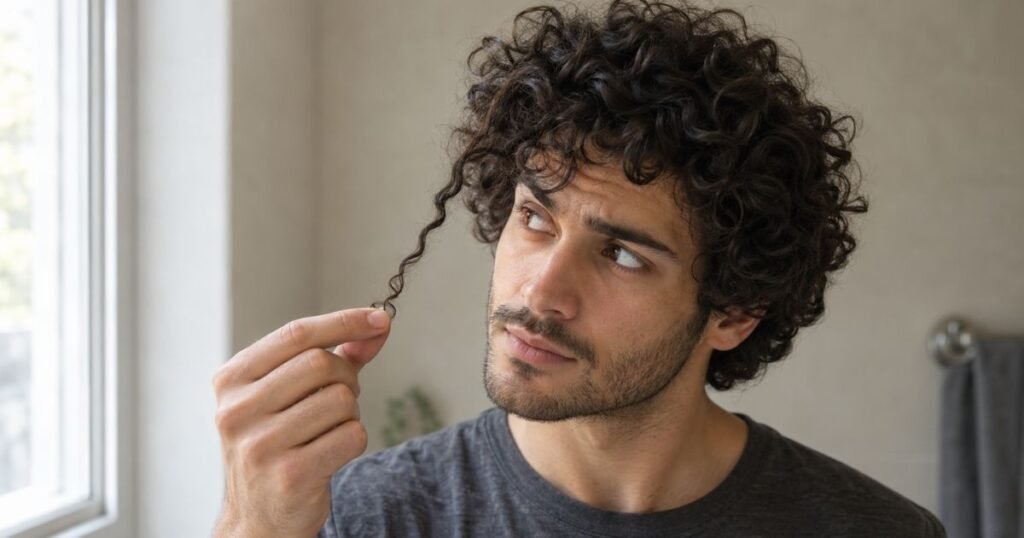
Start with practical constraints: the length you have and the effort you’ll put in. Then consider your hair traits, such as curl pattern, thickness, and density. Face proportions come last, because they influence the result but rarely decide it.
By Face Shape
Face-shape guidance is a starting point, not a rule. Beard, hairline, density, and how your barber adapts the cut all change the result.
| Face shape | Often-discussed goal | Styles to look at | Caveat |
| Oval | Keeping balanced proportions | Most styles | Often considered adaptable |
| Round | Adding vertical emphasis | Quiff, pompadour, top fade | Very full sides may add width |
| Square | Softening or embracing angles | Flow, curtain bangs, layered; or a strong crop | Both approaches can work |
| Oblong or long | Avoiding extra height | Fringe, medium flow, fuller shapes | Very tall tops may lengthen the face |
| Diamond | Balancing wide cheekbones | Fringe, fuller sides | Depends on forehead and jaw |
| Heart | Balancing a wider forehead | Medium length, flow | Depends on chin width |
| Triangle | Adding volume on top | Quiff, pompadour, textured top | Sides may need less width |
By Hair Density
Density is how much hair you have and how much scalp shows. It’s separate from strand thickness.
| Density | What to consider |
| Thick or dense | Bulk and puffiness; layers or tapered sides may help; drying takes longer |
| Medium | Flexible for most shapes |
| Lower or thinning | Shorter sides or enough top length may look fuller; high-contrast fades can reveal scalp |
If you have thick curly hair, ask your barber about weight distribution, meaning where the bulk sits, to prevent a heavy, widening shape.
By Lifestyle & Maintenance Level
| Effort | Example styles | What the effort involves |
| Lower | Short crops, crew cut, natural curly hair | Wash, moisturize, minimal styling |
| Moderate | Medium flow, curtain bangs, layered cuts | Regular styling, occasional trims |
| Higher | Fades, quiffs, pompadours, mullets | Frequent cleanups, more styling time |
Humidity, sports, and dress codes also matter. Sharp fades need more frequent visits than longer cuts, which can grow out gradually.
By Curl Pattern, Hair Thickness & Shrinkage
Curl pattern changes how a cut looks. Tight coils can hold a dome or a defined edge, while looser waves may need a different approach.
Strand thickness is how wide each hair is: fine, medium, or coarse. Fine strands can look limp under heavy products, and coarse strands can feel stiffer. This is separate from density.
Shrinkage is the wet-to-dry length difference. Curls look longest when wet or stretched and shortest when dry. The effect varies with pattern, curl elasticity, hydration, and humidity. To gauge it, gently stretch a dry curl and compare it to how it sits naturally. Then ask your barber to cut dry, or to leave extra length on fringes and bobs.
By Hair Length & Styling Preferences
| Current length | Options | What to expect |
| Short | Crops, tapers, fades | Fast changes, little room to adjust |
| Medium | Flow, layered, curtain bangs | Most flexibility |
| Long | Long layers, ponytail | More detangling and trimming |
Styling preferences matter too. If you want a wash-and-go, choose a shape that works with your natural pattern. If you like sleek or volume looks, you’ll need more time and styling products.
What to Ask Your Barber for Curly Hair

Describing the shape and how your hair behaves usually gets better results than naming a style. Some barbers have more experience with curls than others, and asking is reasonable. No single phrase guarantees the same result everywhere.
| Term | What it means | When to use it |
| Guard number | Clipper attachment length | When asking for short sides |
| Fade vs. taper | Blend level and contrast | When choosing sides |
| Line-up | Sharpened hairline edges | For a crisp front |
| Neckline | Shape at the nape | For fades and tapers |
| Layers | Varied lengths to redistribute weight | For bulk control |
| Weight removal | Taking out bulk | For puffiness |
| Thinning vs. texturizing | Tools that reduce density | Ask how they’ll be used |
Ask for Shape, Not Length
Describe the outline you want: rounded, tapered, or squared. Say how long you want it when dry, and mention shrinkage if it’s a concern. You could say: “I want it to sit around my ears when dry, with a rounded shape on top.” Ask whether they’ll cut wet or dry.
Request Layers for Curl Control
Layers can reduce bulk and improve balance, but they can backfire on fine or low-density hair. Say what you want to fix, such as a heavy base or puffiness, and where layers should start.
Avoid Over-Thinning the Curls
Thinning or texturizing tools remove density. Heavy use can leave curls frizzy or puffy. Instead of banning thinning, ask where and how much weight they’ll remove.
Bring a Curly Hair Reference Photo
Choose photos with a similar curl pattern, density, and hairline. Bring several angles, and a photo of something you don’t want. Show your hair in its natural state. The final result will vary.
How to Style Curly Hair for Men

Wash & Condition Curly Hair
Focus shampoo on your scalp for scalp health and conditioner on the lengths. Rinse well, then squeeze out water instead of rubbing.
Apply Product on Damp Hair
Apply to damp, not dripping, hair. Start with a small amount and add more if needed. Rake product through, then scrunch. A common order is leave-in first, then cream, then a hold product. To keep curls from being weighed down, avoid heavy layering on fine hair.
Air-Dry or Use a Diffuser
| Method | Pros | Trade-offs |
| Air-dry | Gentle, no heat | Slower; can flatten some hair |
| Diffuser | Faster, adds volume | Needs low heat and a heat protectant |
| Blow-dry | Fast, smooths | Higher frizz and heat risk |
Finish Without Touching Too Much
Avoid touching curls while they dry. If your hair feels crunchy from a hold product, gently scrunch it once it’s fully dry to release the stiffness.
How To Build Your Curly Hair Routine

Here’s a flexible template, and an example only:
- Wash day: shampoo, condition, detangle, apply products, dry.
- Between washes: refresh and re-style.
Choose a Washing Schedule That Suits Your Hair
There’s no single schedule. It depends on scalp oiliness, activity, products, climate, and pattern. Start somewhere and adjust based on how your hair and scalp feel. Co-washing, meaning washing with conditioner, is an option.
Condition and Detangle Without Rough Handling
Detangle with conditioner in, using fingers or a wide-tooth comb, from the ends upward. Avoid dry brushing, and expect shorter hair to need less.
Apply Leave-In Products When Needed
Leave-ins can help with dryness, long lengths, or tight patterns. Use curl-enhancing leave-in products lightly, since too much can cause buildup.
Dry and Refresh Curls Between Washes
To refresh curls the next morning, mist them lightly with water, add a small amount of product, and re-scrunch. A quick diffuse can help. To make curly hair easier to manage in the morning, many people style at night and protect it while sleeping.
Adjust Your Routine for Your Curl Pattern
| Pattern | Moisture needs | Product weight | Styling |
| Wavy | Lower | Lighter | Texture-focused |
| Curly | Moderate | Medium | Definition-focused |
| Coily | Higher | Richer | Shape and moisture-focused |
Maintenance Tips for Curly Hair

Don’t Overwash Curly Hair
Signs of overwashing include dryness, frizz, and a tight feeling. Instead, rinse or co-wash on off days.
Keep Hair Hydrated
Curly hair often runs dry, so moisture retention matters. Conditioner and leave-in help, and deep conditioning can be added periodically. Porosity describes how readily hair takes in and holds moisture, and online tests are informal. Some people also talk about protein-moisture balance: if hair feels mushy, it may want more protein, and if it feels brittle, more moisture. There’s no simple home test, so adjust gradually.
Get Regular Trims
There’s no one-size interval. It depends on the style:
| Style type | What drives timing | Signs it’s time |
| Fades and tapers | Regrowth shows quickly | Fuzzy neckline, softer edges |
| Fringes | Length in the eyes | Fringe in your eyes |
| Medium and long | Shape and split ends | Widening shape, split ends |
Ask your barber what interval suits your style.
Protect Curls from Heat Damage
Use a heat protectant, low heat, and a diffuser. Signs of damage include dryness and loosened curls.
Manage Frizz Without Weighing Down Your Curls
| Cause | Fix |
| Dryness | Conditioner and leave-in |
| Rough handling | Gentle detangling |
| Humidity | Light products and a hold product |
| A cut that doesn’t fit | Ask for weight distribution |
To stop curls from puffing out at the sides, ask your barber to shape the weight so it doesn’t widen. To add volume without creating frizz, use a diffuser and avoid touching while drying.
Protect Curly Hair While Sleeping
A satin pillowcase or cap is commonly recommended to reduce friction, though it isn’t rigorously proven. Gather long hair loosely, and avoid sleeping on damp hair.
Best Hair Products for Curly Hairstyles
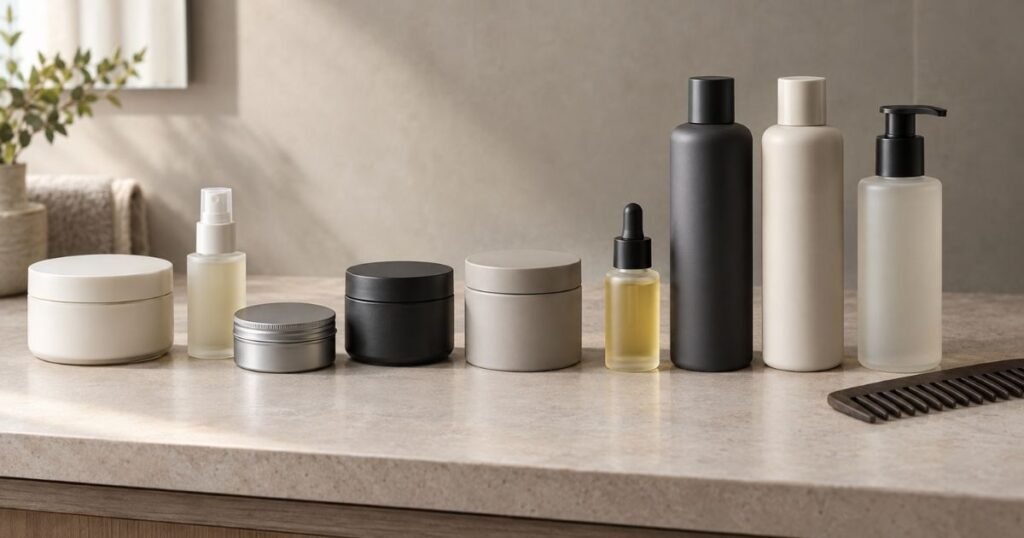
Choose by function, not brand.
| Product | What it does | Hold and finish | Good for | Watch-outs |
| Styling cream | Shapes and controls | Light to medium | Most curls | Too much can feel greasy |
| Sea salt spray | Texture and volume | Light, matte | Looser curls | Can dry hair |
| Pomade | Sleek control, shine | Medium to firm | Slick back, pompadour | Buildup |
| Molding paste | Flexible hold | Medium, matte | Crops, quiffs | Can feel heavy |
| Texture clay | Structure, bulk | Firm, matte | Short to medium | Heavy on some hair |
| Argan oil | Seals, shine | None | Dry ends | Weighs down fine hair |
| Clarifying shampoo | Removes buildup | n/a | Product users | Drying |
| Conditioner | Softens, detangles | n/a | All curls | Rinse well |
| Leave-in and curl cream | Moisture, definition | Light | Dry curls | Buildup |
| Gel and mousse | Hold and definition | Varies | Defined curls | Can feel stiff |
Styling Cream
Styling cream shapes and controls curls. Hold varies by formula, so check the product description.
Sea Salt Spray
Adds texture and volume, mostly for looser curls and waves. It can be drying, and it works best on damp hair.
Pomade
Pomade gives sleek control and shine for slick-back and pompadour looks. Water-based formulas rinse out more easily than oil-based ones. Use small amounts.
Molding Paste
Molding paste offers flexible hold and a matte finish, which suits shaped tops like crops and quiffs.
Texture Clay
Clay adds structure and bulk with a matte finish. It washes out, and may feel heavy on coily hair.
Hydrating Argan Oil
Oil helps seal moisture and adds shine. Use sparingly, since it can weigh down fine hair.
Clarifying Shampoo
Clarifying shampoo removes buildup occasionally. It can be drying, so follow with conditioner. It’s not a daily shampoo.
Hydrating Conditioner
Rinse-out conditioner softens and detangles the lengths. It’s different from leave-in and deep conditioner.
Leave-In Conditioner and Curl Cream
These provide moisture and definition as a base layer. Styling cream shapes, while leave-in conditions.
5 Common Mistakes With Curly Hair (And How To Fix Them)

| Mistake | Why it matters | Fix | Read more |
| Ignoring shrinkage when choosing a cut | Hair can look much shorter dry | Ask for a dry check | Shrinkage section |
| Too much product | Weighs curls down | Start small | Products |
| Rough handling | Causes frizz | Detangle gently | Routine |
| Using a straight-hair routine | Can dry curls | Add conditioner | Routine |
| Unclear barber communication | Mismatch | Bring photos | Barber section |
FAQs About Curly Hairstyles for Men
What haircut is best for curly hair?
There’s no single best cut. For low effort, look at short crops. For volume, a top fade or quiff. For sharp contrast, a taper or fade.
Which face shape is best for curly hair men?
None. Curls can work with most face shapes. See the face shape section for how round and long faces are often approached.
What length is best for curly hair men?
It depends on pattern, density, and effort. Short is lower effort, medium is flexible, and long needs more care. Shrinkage affects all of them.
Can men with short hair still get a curly hairstyle?
Yes. Very short cuts may show less curl, especially with looser patterns.
Are curly hairstyles hard to maintain?
It depends on the style. Fades need frequent cleanups, while a natural look needs less styling but still needs moisture care.
How do I prevent frizz in my curly hair?
Keep hair hydrated, handle it gently, and avoid touching while it dries.
Is air-drying better than blow-drying curls?
Neither is universally better. Air-drying is gentler but slower. Diffusing is faster and adds volume, with a heat protectant.
What products work best for styling curly hair?
It depends on the goal: cream for definition, salt spray for texture, paste or clay for hold.
What should I ask my barber for when cutting curly hair?
Describe the shape, discuss dry length and shrinkage, and bring photos.
How often should I trim my curly hair?
There’s no single interval. It depends on the style, and signs include a fuzzy neckline or split ends.
What does the 3:2:1 haircut rule mean?
In barbering, it usually refers to a clipper guard pattern for short cuts: a #3 on top, #2 on the sides, and #1 at the edges. Guard sizing can vary by brand, and terminology varies, so ask your barber what they mean. For curly hair, it applies mainly to very short cuts.
Conclusion
Choosing among curly hairstyles for men comes down to three steps. Pick a style based on your length, effort level, and hair traits. Talk to your barber using shape language and photos. Then build a simple routine that keeps your curls moisturized and defined. Results vary from person to person, so treat the styles here as starting points to adapt with your barber.

Jake Miller is a barbering and men’s hairstyle enthusiast who shares practical tips, haircut inspiration, and the latest grooming trends at BarberZylo. He enjoys exploring modern and classic hairstyles and helping readers find fresh ideas for their next look.



3 Comments