22+ Best Hairstyles for Receding Hairlines (2026 Guide)
If your hairline has started moving back, the haircut you choose can change how noticeable it is. The right one depends on a few things: where the recession is happening, how dense your hair is, what your hair does naturally, and whether you’d rather work with the hairline or play it down.
This guide covers 22 styles, plus a few close variations like low and mid fades, and explains what each one actually does at the temples and front. You’ll also find help choosing between them, wording for your barber, styling steps, and honest notes on products and hair care. “Best” here doesn’t mean a ranking. It means styles worth considering, judged on how much hairline they expose, how much upkeep they need, and how forgiving they are across different hair types.
No haircut works the same way on everyone, so treat these as starting points to talk through with your barber.
| If your priority is… | Approaches worth discussing | Styles in this guide |
| Minimal daily effort | Very short, even length | Buzz Cut, Crew Cut, Shaved Head |
| Softening the temples with hair that falls forward | Short forward fringes | French Crop, Caesar Cut, Textured Crop, Side Swept Fringe |
| Keeping height or a defined shape | Lifted or parted tops with carefully handled temples | Quiff, Pompadour, Side Part, Ivy League, Comb Over, Taper Fade |
| Keeping length | Longer front pieces and layers | Curtain Hair, Middle Part, Flow Haircut, Long Layered Cut, Tousled Shag |
| A bolder statement | Strong shape or contrast | Modern Mullet, Faux Hawk, Spiky Hair, High Fade |
What Is a Receding Hairline?

A receding hairline is a frontal hairline that has moved backward over time, usually starting at the temples. The corners deepen first, and in many men the front edge eventually takes on an M shape as the temples retreat while the middle holds.
It helps to separate three things that often get lumped together:
| Term | What it means |
| Mature hairline | A modest, stable shift back from the teenage hairline, common in adulthood |
| Receding hairline | Ongoing or more pronounced movement back, often at the temples |
| Thinning | Reduced hair density, which can happen at the front, the crown, or all over |
These can overlap, which is why “hairstyles for men with thinning hair” and hairstyles for receding hairlines aren’t quite the same search, even though many of the same cuts help with both.
The most common cause of recession in men is male pattern hair loss, which is linked to genetics and hormones and tends to progress gradually with age. Pace and pattern vary a lot between people. Professionals sometimes describe the stages using the Norwood scale, but you don’t need it to choose a haircut.
A quick self-check: compare a few photos taken a year or two apart in similar light. If the temples look clearly deeper, or hair is thinning noticeably, a GP or dermatologist can tell you whether loss is ongoing and what your options are. This article is about haircuts, not diagnosis or treatment.
Best Hairstyles for Receding Hairlines

Most of the styles below work through one of five mechanisms:
- Reducing contrast. Very short, even hair makes the hairline less of a focal point.
- Softening with forward or sideways movement. Hair falls over the temples or forehead.
- Adding height or structure. The eye is drawn up and along the shape rather than to the corners.
- Framing with length. Longer front pieces sit over the temples.
- Breaking up the edge with texture. A choppier or messier edge makes the line less defined.
Each entry also notes a realistic limit, because almost every style can emphasize recession in the wrong circumstances. Tight temple fades, hard line-ups (a razor-sharp outline at the hairline), heavy shine, and hair combed straight up and back are the usual culprits.
A note on terms: American barbers say “bangs” where British barbers say “fringe,” and clipper lengths are called “guard numbers” in the US and often “grades” in the UK. Sizes vary by brand, so showing a photo beats quoting a number.
One more thing before the list: for most of these cuts, the length at the front matters more than the length overall.
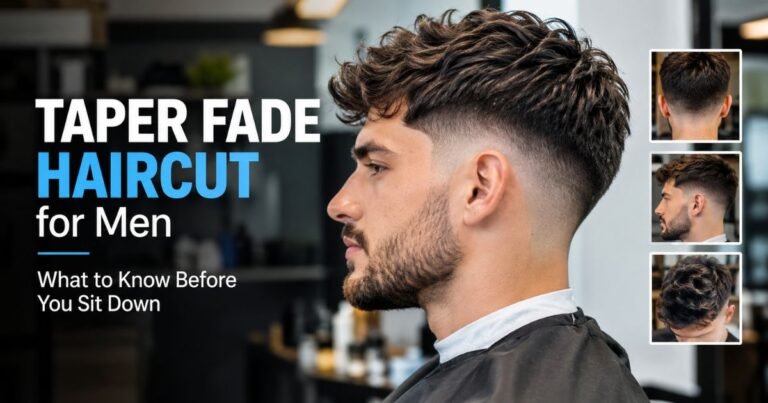
Taper Fade
Approach: tidy sides, flexible top. Effort: low to moderate.
A taper shortens the hair gradually down the sides and back, usually concentrating the change around the ears and neckline. A fade travels higher and gets shorter, sometimes down to bare skin. A taper fade sits between the two: a visible gradient, but a softer one than a high skin fade.
The temple is where this cut succeeds or fails. A soft, blended temple keeps the recession looking like part of one continuous shape. A tight, closely shaved one can spotlight it.
What to ask for:
- Keep the taper longer around the temples
- Leave enough length on top to fall forward or sweep across
- Avoid a hard line-up at the front
Sides lose their gradient as they grow, so tapered cuts need more regular tidy-ups than longer, softer styles. Curly and coily hair can taper well, though it helps to find a barber comfortable with those textures.
French Crop
Approach: forward fringe. Effort: low.
The French crop pairs short sides, often faded, with a short top cut and a blunt fringe that falls straight across the forehead. It’s recognizable by that horizontal line. Think of it as a more structured, more contrasty relative of the Caesar cut below.
Because the fringe falls forward, it can cover the forehead corners where recession is most visible. That only works if there’s enough hair at the front to form a convincing line. Dense, straight to slightly wavy hair tends to hold the shape most easily. A strong cowlick at the front can push the fringe upward, and if the temples are very sparse, the fringe may stop short of them.
It air-dries well, and a bit of matte paste is usually all it needs.
High Fade
Approach: contrast. Effort: moderate to high.
A high fade starts the shortening high on the sides, around the temple or above, creating strong contrast between the sides and the top. Here’s a quick comparison with the other fade heights:
| Fade | Where it starts | Effect |
| Low fade | Just above the ear and neckline | Subtle, most hair left on the sides |
| Mid fade | Around the middle of the sides | Balanced, the usual middle ground |
| High fade | Near the temples and upper sides | Bold, most visible contrast |
This one is a judgment call. Because bare or very short hair sits right beside the hairline, a high fade can make thin temples more noticeable. It tends to look best when the top has density and structure to balance it. If your temples are sparse, a mid fade or taper is often worth raising with your barber instead.
Sharp fades also show regrowth quickly, so expect to keep up with them. A beard blends into a high fade smoothly if you wear one.
Textured Crop
Approach: forward movement plus texture. Effort: low to moderate.
A textured crop has a short-to-medium top cut with visible separation, usually made with point cutting (snipping into the ends) or texturizing, and a forward fringe over faded or tapered sides. Compared with the French crop, the top is choppier and less blunt.
The broken-up edge helps because a soft, irregular fringe doesn’t create a hard line for the eye to follow. Texture can also give fine hair more dimension, though cutting it too choppy on low-density hair can leave visible gaps. Very thick hair may need weight removed so it doesn’t puff out.
Try asking for texture on top, a fringe long enough to sit over the temples comfortably, and a soft temple blend. A matte clay or paste adds separation without shine.
Ivy League
Approach: neat, parted. Effort: moderate.
The Ivy League is a short classic cut with tapered sides and a top just long enough to part or brush to the side. It’s sometimes called a Harvard clip, and you can think of it as a longer, more flexible crew cut.
Its big advantage is range: the same cut can be parted for the office or brushed forward on weekends. The risk is the part itself. A part on the side where recession is deeper can reveal the hairline, so a soft part or a brushed-forward version may suit you better. A pomade or light cream gives a tidy finish; keep shine modest if your hair is fine.
Read More About : 45+ Best Hairstyles for Men with Straight Hair
Modern Mullet
Approach: shape over cover. Effort: moderate.
The modern mullet keeps the sides and top shorter and the back longer, often with texture throughout. The contrast between short front and longer back is what defines it.
It doesn’t hide a receding hairline, and it isn’t trying to. Attention shifts to the overall silhouette, which some men find a relief. It also takes patience to grow out, and how it reads depends on the environment you’re in.
Wavy or thicker hair gives the back more body. Ask your barber how short to take the sides, how much length to keep at the back, and whether the top should be textured or smooth.
Pompadour
Approach: height. Effort: high.
A pompadour sweeps volume up and back from the front, with short sides and a much longer top. It’s the biggest of the lifted styles.
Here’s the honest part: lifting hair up and back moves it away from the hairline, so it can make recession more visible rather than less. It tends to work best with mild to moderate recession and good density, where the volume reads as intentional rather than sparse. Tapered temples can help.
It needs daily styling, usually a blow-dry and a firmer product like pomade or paste. Low density can make the height look see-through, and strong cowlicks can fight the lift.
Side Part
Approach: structure. Effort: moderate.
A side part is a deliberate dividing line with hair combed to one side, typically over tapered sides. Where the part sits, and whether it’s hard (shaved or sharply defined) or soft, changes the look considerably. A hard part defines the line; a soft one blurs it.
Parting on the side with more hair at the front usually works better, and a very high part can expose a receding corner. Ask for a natural or soft part and talk through placement with your barber. Pomade or a cream gives control, but fine hair tends to look better with low shine.
It shares ground with the Ivy League (length and cut) and the comb over (see below), but a side part is about the parting, not the cut.
Caesar Cut
Approach: forward fringe. Effort: very low.
The Caesar cut is short, fairly even in length, with a straight fringe brushed forward and sides kept short. It’s the simplest of the fringe cuts: less contrast and less structure than a French crop.
The straight forward line can cover a modest recession, but it needs some hair at the front to work. If the temples are deeply recessed, a barber may leave a little more length up front. Straight and wavy hair usually hold the line best. On fine hair, cutting it too short can look patchy.
Styling is minimal: brush it forward, maybe add a touch of paste.
Read More About : 50+ Best Hairstyles for Men With Wavy Hair From Fades to Shaggy Cuts
Quiff
Approach: height. Effort: moderate.
A quiff lifts the front hair up and slightly back, with the top longer than the sides. It’s usually shorter and looser than a pompadour, with more natural movement, though barbers use the two names loosely.
Like the pompadour, a quiff raises the visible hairline, so density and front length matter. Straight or wavy hair with some body suits it. Low density can flatten and separate. A blow-dry for lift and a matte clay for hold is the usual approach.
Faux Hawk
Approach: bold shape. Effort: moderate to high.
A faux hawk raises a ridge of longer hair down the center while the sides stay shorter, without the shaved sides of a true mohawk. Pushing hair toward the middle can leave the temples more exposed, especially if the sides are cut tight.
Thicker hair holds the ridge more easily. Fine hair needs more product and may look thin along the sides. Ask your barber to keep the sides blended rather than closely clipped if the temples are a concern.
Comb Over
Approach: directional movement. Effort: moderate.
Two very different things share this name. The modern comb over has a defined part, short or faded sides, and enough length on top to sweep across. The old-style version pulls a few long strands across the scalp, and that’s the one that rarely looks natural, because the gaps show as hair moves.
The modern version is essentially a structured side part with more contrast. It works best when there’s enough density to cover the area. If loss is progressing, coverage can change over time, so it’s worth discussing alternatives with your barber as things evolve.
Ask for a defined shape with real length on top and tapered sides.
Spiky Hair
Approach: height and texture. Effort: moderate.
Spiky hair is short, choppy layers styled upward into separated points. It reads as casual and a little retro, which suits some people and not others.
The trade-off is that separating strands can show scalp between the spikes if density is low. Thick or coarse hair holds the shape better. A firm clay or paste does the job, and it rinses out easily.
Read More About : 39+ Hairstyles for Men with Fine Hair: The Ultimate Guide
Long Layered Cut
Approach: framing with length. Effort: moderate.
A long layered cut keeps length through the top and sides and adds layers for movement. The layers let longer front pieces fall across the temples instead of lying flat.
Length on low-density hair can look stringy, and too many layers can thin out the ends. Wavy or straight hair with reasonable density tends to cope best. Ask for layers that add movement without removing too much weight, and use lighter products so the hair doesn’t clump.
Compared with the flow haircut, layering is the technique here; the flow is more about direction.
Side Swept Fringe
Approach: partial cover. Effort: low to moderate.
A side swept fringe (or side swept bangs, in the US) is a longer front section that falls diagonally across the forehead to one side. Unlike the French crop’s straight line, the diagonal breaks up the edge and can cover one temple more than the other, which is handy if your recession is uneven.
Blow-dry in the direction your hair grows naturally. A cowlick may fight the sweep, and fine hair can separate. A light cream or paste is usually enough.
Tousled Shag or Shaggy Haircut
Approach: texture and framing. Effort: low.
A shag is layered, textured, and deliberately a bit messy, with length at the front that falls over the forehead and temples. “Shag” and “shaggy” describe the same idea.
The irregular layers avoid a clean edge, which many men like. Too many layers on low-density hair can look wispy, so ask your barber to keep some weight at the front. Wavy, curly, or thicker hair holds the shape well. Sea salt spray or a light cream does most of the work, and it air-dries nicely.
It shares layers with the modern mullet, but a shag stays relatively even in length rather than building a strong front-to-back contrast.
Middle Part
Approach: symmetry. Effort: low to moderate.
A middle part splits the hair at the center and lets it fall to each side, usually at medium length. Because it’s symmetrical, it can highlight recession on both sides, but it can also work well when the hair is long enough to fall forward over the temples.
So the answer is conditional: it tends to work better with symmetrical temples, decent front density, and enough length to reach them. A strong cowlick at the center can disrupt the split. A soft, natural part usually looks better than a ruler-straight one.
It’s close to curtain hair, but a middle part is about the parting and medium length, while curtains add longer, face-framing pieces.
Read More About : 35+ Best Haircuts for Men With Thinning Hair
Curtain Hair
Approach: framing with length. Effort: moderate.
Curtain hair is center-parted hair long enough to sweep down in two curved sections on either side of the forehead, like curtains opening. That framing can sit over the temples.
It takes growing out, and it behaves best with straight to wavy hair. A cowlick at the part can make the split fall unevenly, and curly hair expands, which changes the shape. Blow-drying or air-drying with a light cream keeps it soft.
Flow Haircut
Approach: relaxed length. Effort: moderate.
The flow haircut is longer, loose hair worn swept back or outward, often over the ears. Its defining feature is the direction and the ease of the length.
Swept-back hair exposes the forehead, so with recession it often works better if the front is allowed to fall forward. Thicker or wavy hair gives it body. The ends need care as the hair gets longer.
Compared with a long layered cut, flow is more about direction and length; layers are the technique used to shape it.
Buzz Cut
Approach: reducing contrast. Effort: very low.
A buzz cut uses one clipper length all over. With nothing longer than the rest, the hairline stops standing out as an edge. On many clipper sets, a number 1 guard leaves roughly 3 mm (about 1/8 inch), but brands differ, so show or describe the length you want.
The main risk is the hairline edge. A hard line-up can sharpen recession, so a natural edge, where the barber doesn’t cut a straight line, may be worth requesting. Head shape and scalp tone show more at this length, and density affects how even it looks.
Styling is none. Scalp care and sun protection matter more.
Crew Cut
Approach: reducing contrast, flexibly. Effort: low.
A crew cut has short, tapered sides and a top just long enough to brush forward or up. It’s the middle option between a buzz cut and an Ivy League: there’s some length to style, but not enough for a part.
It’s low effort. A little paste adds texture. Straight to wavy hair holds the shape, while curly hair behaves differently and may need a different approach.
Read More About : Men Hairstyles for Thin Hair: 30+ Proven Cuts That Boost Volume
Shaved Head
Approach: removing the question. Effort: moderate (skin care).
A shaved head takes the hair down to the skin and removes the hairline question altogether. It’s a decisive choice, not a recommendation, and it suits some people better than others depending on head shape, scalp tone, and personal comfort.
It isn’t a no-maintenance option. You need regular shaving, moisturizer, and sun protection, and razor irritation or ingrown hairs can be an issue. Shaving doesn’t change how hair grows back. If you’re unsure, a very short buzz cut first is a low-risk way to find out how you feel.
How to Choose the Right Haircut for Receding Hairline

No single factor decides this. Use the five lenses below together, and expect your barber to adjust the details. Hairline pattern and density tend to matter most for how a style behaves at the front, while face shape is usually a smaller piece of the picture.
There’s also a bigger question that comes first: do you want to work with the recession or soften it? Going shorter (a buzz cut, crew cut, or close crop) tends to embrace the hairline by making it less of a contrast. Keeping length and moving it forward or across (a fringe, curtains, a side part) tends to soften it. Both are legitimate. Many men are happiest at one end or the other, and plenty change their minds after trying both.
By Hair Type
Hair type shapes how a style falls, holds, and grows out. Strand thickness is a separate question, covered below under density.
| Hair type | What to consider | Styles worth exploring |
| Straight | Holds fringes and sharp shapes well, but can lie flat and show scalp more easily | French Crop, Caesar Cut, Textured Crop, Side Part |
| Wavy | Natural movement adds apparent volume and softens edges | Tousled Shag, Curtain Hair, Flow Haircut, Quiff |
| Curly | Expands outward and springs up when cut, so a fringe sits shorter than it looks wet. Volume is built in | Textured crops, tapers and fades, shorter shags |
| Coily | Shrinkage means the hairline can look different at different lengths. Sharp edges are very visible | Tapers, short textured tops, close crops, buzz cuts |
Fine versus coarse strands matters too. Fine hair often benefits from texture and lighter products. Coarse hair can handle structure but may need weight removed. Whatever your type, a barber who works with it regularly will adapt these cuts better than any general guide.
By Face Shape
Face shape is worth a glance, but it’s one factor among several, and a receding hairline often changes how tall the forehead looks, which can matter more than the label.
Some general ideas, offered as possibilities rather than rules:
- Oval: Many cuts can work, so hairline and density can lead the decision.
- Round: Height on top and tidier sides may help the face look longer.
- Square: Softer textures or some fringe can balance a strong jaw.
- Oblong: Forward fringes and less height may help avoid adding length.
- Diamond and heart: A fringe or fuller sides can soften a wide forehead or cheekbones.
Beards and glasses change the balance as well. A fuller beard shifts attention lower on the face, and frames can draw the eye to the upper half. If you’re torn between two cuts, how they sit at the temples will usually tell you more than face shape will.
By Hairline Pattern
This is often the most useful lens. Look at where your hairline sits, how symmetrical it is, and whether recession is at the corners, across the front, or both. Hairline symmetry matters: if one temple is deeper than the other, a side-swept or asymmetrical shape can cover the deeper side.
A widow’s peak is a hairline shape, a downward point in the center of the front line, and it’s not a haircut. It can make recession at the temples look more pronounced because the contrast between the point and the corners is greater, but it can also be a feature that a fringe or texture works around.
| Pattern | What it looks like | Strategies to discuss | Styles to explore | Watch out for |
| Mature hairline | Slight, even shift back from a straight line | Most styles work. Choose by preference | Almost anything, including quiffs and side parts | Hard line-ups can make it look more receded than it is |
| Temple recession | Corners are deeper, center holds | Soften the corners with forward or sideways hair | French Crop, Textured Crop, Side Swept Fringe, Curtains | Tight temple fades |
| M-shaped hairline | Clear peaks and valleys across the front | Break up the edge with texture, or reduce contrast | Textured Crop, Shag, Buzz Cut, Crew Cut | Hair combed straight up and back |
| Advanced recession | Large bare area, hairline well back | Often easier to go shorter, or use length with care | Buzz Cut, Crew Cut, Shaved Head | Long strands pulled across, heavy shine |
Patterns blend and change over time, so treat the table as a rough guide.
By Hair Density and Thickness
Density is how many hairs you have per area. Thickness is the width of each strand. They’re independent: you can have fine strands in high density, or thick strands in low density.
A simple, rough way to gauge density is to look at your dry, unstyled hair under bright light and see how much scalp shows through at the front and crown. More scalp visibility usually means lower density. A barber can give you a more reliable read.
What that tends to change:
- Lower density: Shorter textured cuts or very short cuts often look more even than long or lifted styles. Lighter products help, and shine tends to make strands clump and show scalp.
- Higher density: Can support structure, height, and longer fringes.
- Thick strands: May need weight removed so the shape doesn’t puff.
- Fine strands: Often look fuller with texture, a matte finish, and light layering.
As for how much length to leave on top, it depends on what the top has to do. A forward fringe needs enough length to actually reach the forehead. A lifted style needs enough to stand up. If your density is lower, ask your barber to show you the length before cutting rather than guessing.
By Hair Length and Maintenance
How much effort are you willing to put in? Cuts with tight fades and sharp edges look best fresh and lose shape sooner. Textured and longer styles tolerate growth better. Ask your barber what interval suits your hair’s growth rate rather than assuming a standard schedule.
| Length | Styles | Daily styling effort | How it grows out |
| Very short | Buzz Cut, Shaved Head | Almost none | Even, but shows regrowth at the edges |
| Short | Crew Cut, Caesar Cut, French Crop, Taper Fade, High Fade | Low | Fades lose their gradient. Crops soften well |
| Short to medium textured | Textured Crop, Spiky Hair, Quiff, Side Part, Ivy League | Low to moderate | Gradual, easy to re-texture |
| Medium to long | Curtain Hair, Middle Part, Tousled Shag, Side Swept Fringe | Moderate | Forgiving |
| Long | Flow Haircut, Long Layered Cut, Modern Mullet | Moderate | Needs patience, trims keep the shape |
A quick checklist to narrow things down:
- Where is my recession, and is it even on both sides?
- How dense is my hair at the front?
- Do I want to embrace the hairline or soften it?
- How much daily styling will I actually do?
- Am I comfortable with a bolder look?
How to Ask Your Barber for the Right Cut
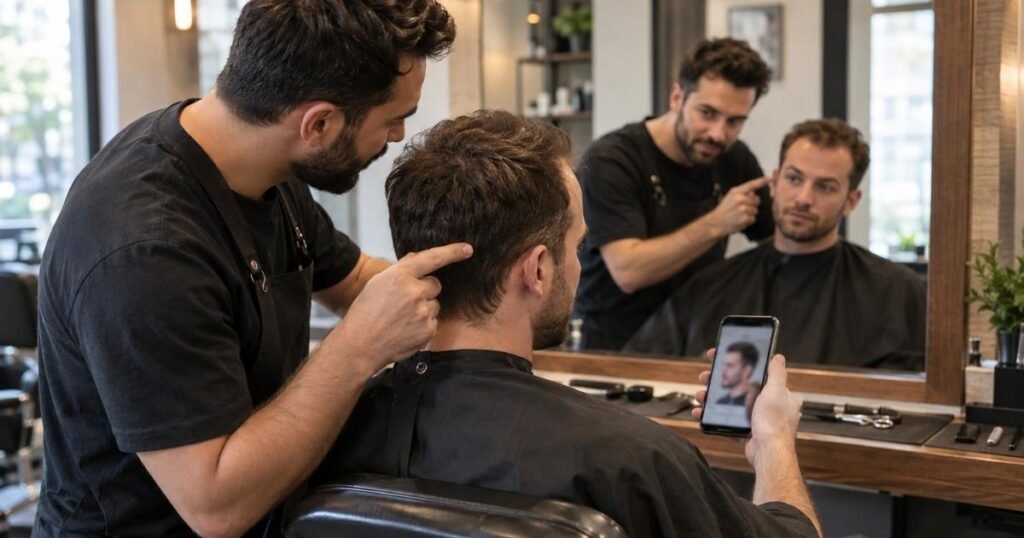
Talking about your hairline can feel awkward, but barbers see every kind and it helps them. The goal is to be specific about what you want, since the same word can mean different things at different shops.
Use Simple Terms
Break the request into parts: how long the top should be, how long the front or fringe should be, how short the sides go, where any fade starts, and how the temples are handled.
| Term | Plain meaning | Why it matters with recession |
| Taper | Gradual shortening, mostly around ears and neckline | Subtle, keeps temples soft |
| Fade | Gradual shortening that goes higher and shorter | Higher fades increase contrast at the temples |
| Guard number or grade | The clipper attachment that sets length | Sizes vary by brand, so show the length too |
| Line-up | A crisp outline at the hairline | A hard one can emphasize recession. Ask for natural |
| Fringe or bangs | Hair at the front that falls over the forehead | Can cover the front corners, depending on density |
| Texturizing | Cutting to add separation and break up bulk | Can soften the edge, but too much thins low-density hair |
| Scissor-over-comb | Cutting hair with scissors lifted by a comb | Gives a softer blend than clippers at the temples |
Some example wording, which you can adapt:
- “I’d like to keep the temples soft rather than tight, and avoid a hard line-up.”
- “My left temple is deeper than my right. Can you shape the fringe to cover that side?”
- “Can you leave the top long enough to fall forward over the front, and show me the length before cutting?”
- “I’d like a mid fade, not a high one.”
If your temples are uneven, say so early. A barber can balance the cut around asymmetry, but only if they know what you’re hoping for.
Show a Photo Example
Bring references, but choose them carefully. The most useful photos show a hairline and hair type similar to yours, not just the cut you like. Include a few angles, especially front and side, and consider bringing one example of something you don’t want.
Expect your barber to adjust the cut to your hair. A photo shows direction, not a guarantee.
Before you sit down:
- Know whether you want to embrace or soften the hairline
- Bring front and side photos
- Say how much time you’ll spend styling
- Mention cowlicks or uneven temples
- Ask for a natural hairline edge if that’s what you want
How to Style Receding Hairline Haircuts

A few principles apply to most receding hairline styles: direct hair forward or across where possible, build lift at the roots rather than the tips, and prefer matte or low-shine finishes. Those habits also help with hair that naturally separates at the temples. Blow-drying it toward the center first, then shaping it, can help hold the edge together.
Wash and Prep Hair
Wash gently, then pat the hair dry with a towel rather than rubbing, which causes friction. Leave it slightly damp, since damp hair responds better to styling than soaked or fully dry hair.
Apply Pre-Styler
A sea salt spray or a light volumizing mousse at the roots adds grip and lift. It’s most useful for fine hair and longer styles. Very short cuts, like buzz cuts and crew cuts, usually don’t need it.
Blow-Dry for Shape
Use moderate heat and direct the airflow the way you want the hair to sit, because the direction you dry in largely sets where the hairline falls. Fingers give a looser result and a brush more control. Finish with a blast of cool air to help the shape set.
Finish with Styling Product
Use a small amount, warm it in your palms, and work it through from the back toward the front so the front isn’t overloaded. Choose matte finishes where you can. Common mistakes are using too much, which weighs hair down and shows scalp, and using high shine, which makes strands clump.
Here’s a quick guide by style type:
| Style type | Blow-dry direction | Product type |
| Forward fringe (French Crop, Caesar, Side Swept Fringe) | Forward, with fingers | Matte paste or light clay |
| Lifted (Quiff, Pompadour, Faux Hawk) | Up and back from the roots | Clay or firmer paste |
| Neat and parted (Side Part, Ivy League, Comb Over) | Toward the part, then comb | Pomade or cream |
| Textured and messy (Textured Crop, Shag, Spiky Hair) | Loosely, with fingers | Sea salt spray, light clay |
| Long and loose (Curtain, Flow, Long Layered) | Gently, mostly forward | Light cream |
Best Hair Products for Receding Hairlines
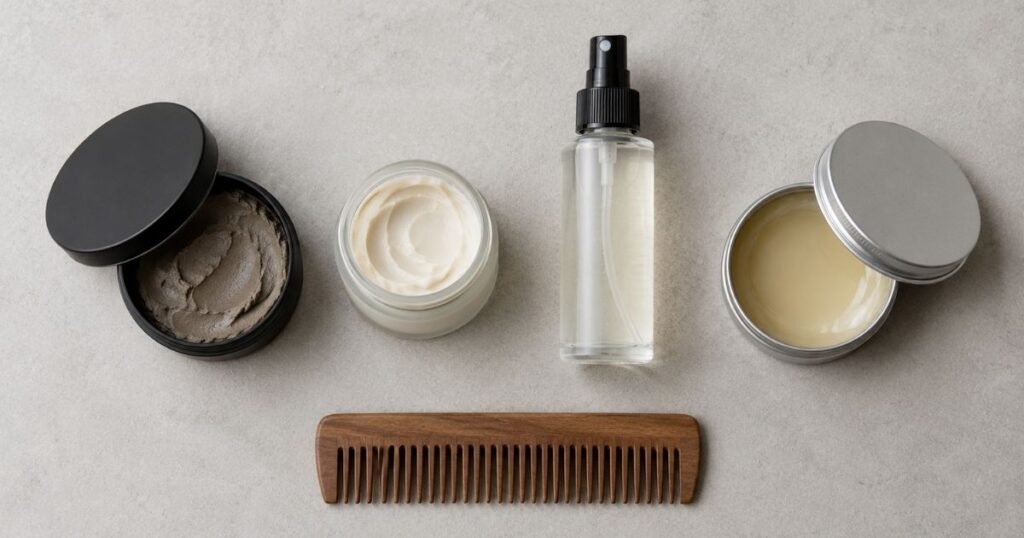
Styling products change how hair looks and behaves. They don’t treat hair loss or affect the hairline itself. Think in categories rather than brands. These are the main types, and how they differ:
| Product | Hold | Finish | Best suited to |
| Texture clay | Firm | Matte | Crops, textured and lifted styles |
| Molding paste | Medium, flexible | Low to medium | Fringes, shorter styles |
| Sea salt spray | Light | Natural, grippy | Shags, flow, pre-styling |
| Pomade | Varies | Low to high shine | Side parts, Ivy League, classic styles |
Texture Clay
Clay gives a firm, matte hold and a thicker look, which suits crops and textured styles. It can feel heavy if you use too much on fine hair, so start with a pea-sized amount.
Molding Paste
Paste sits between clay and a light cream. It holds more flexibly and usually finishes with a softer sheen, which suits fringes and shorter cuts that need reshaping through the day.
Sea Salt Spray
Sea salt spray adds texture and grip, mainly as a pre-styler. It’s helpful for shags and flow styles. Some people find it drying, so use it sparingly.
Pomade
Pomade comes water-based or oil-based, with shine from low to high. It suits neat, combed styles like side parts and the Ivy League. High-shine versions can make strands clump and show scalp on thinner hair, so a low-shine formula may be worth considering.
Read More About : Ivy League Haircut: 22+ Clean & Timeless Styles for Men
Hair Care and Maintenance for Receding Hairlines
Hair care products can change how hair looks and feels. They don’t reverse recession. Beyond the products below, a few basics are worth keeping up: look after your scalp, protect exposed skin from the sun (especially with shorter cuts), and wash out styling product at the end of the day. For haircut upkeep, see the length and maintenance table above.
If your hair loss seems to be speeding up, a GP or dermatologist is the right person to ask.
Clarifying Shampoo
A clarifying shampoo removes product buildup, which can be useful if you use clay or pomade regularly. Use it occasionally rather than daily, because it can leave hair and scalp dry.
Hydrating Conditioner
Conditioner helps smooth the hair and reduces friction when you comb or blow-dry. Apply it mainly to the mid-lengths and ends, and choose a lightweight formula for fine hair so it doesn’t weigh it down.
Hydrating Argan Oil
A very small amount on the ends or on dry hair can add smoothness. It can weigh fine hair down, so go lightly and avoid the roots if your hair goes flat easily.
FAQs About Hairstyles for Receding Hairlines
What is the best hairstyle for a receding hairline?
There isn’t one best style. It depends on your pattern, density, and how you feel about the hairline. A useful way to narrow it down is to pick an approach first: short and even (buzz or crew cut), forward and textured (a crop or fringe), or lifted with careful temples (a quiff or side part).
Do haircuts help a receding hairline?
A haircut can change how a receding hairline looks, but it can’t change the cause or regrow hair. The cut affects contrast, direction, and framing, which can make the hairline more or less noticeable.
Is a fade good for a receding hairline?
It depends on the fade height and how the temples are handled. A soft taper or a lower fade usually keeps the temples blended, while a high skin fade increases contrast and can emphasize thin corners. See the Taper Fade and High Fade sections for what to ask for.
Is a textured crop good for a receding hairline?
It’s often considered a good option, with conditions. You need enough length at the front for the fringe to reach the temples, enough density that the texture doesn’t look patchy, and a front hairline without a stubborn cowlick. Ask for soft temple blending.
Can a beard help balance a receding hairline?
It can shift visual weight toward the lower face, which some men find balances the proportions. The result depends on how full the beard grows and how it’s shaped. It’s an option, not a fix. A well-groomed beard that blends into the sides of the haircut tends to look more cohesive than one that stops abruptly.
Do bangs or fringe help hide a receding hairline?
A fringe can cover part of the forehead if you have enough density at the front, but it needs trimming to keep the length right and styling to sit properly. If you’re wondering whether a forward fringe suits your hairline, a barber can test the length before committing.
Is a buzz cut good for a receding hairline?
It’s a common choice because even short hair reduces contrast and needs almost no styling. A few cautions: pick a length with your barber, ask for a natural hairline edge, and look after your scalp. Some men like the result and others prefer more length.
Can a receding hairline look good?
Yes. Plenty of men wear a receding hairline with confidence, and a well-chosen haircut and some grooming can make a difference. There’s no obligation to hide it, either. Whether to embrace or soften it is a personal call.
What hairstyles make a receding hairline look bad?
Styles that may emphasize recession include hard line-ups, tight temple fades, very high slicked-back styles on pronounced recession, a few long strands pulled across the scalp, and heavy shine on thin hair. Outcomes vary, and some of these work for some men, so treat them as cautions rather than bans.
Are short haircuts better for receding hairlines?
Short cuts can reduce contrast, but longer styles work too. The choice depends on density and what you want to look like. If you’re choosing between a clean-cut and a relaxed look, density and upkeep are good tie-breakers.
How should I style my hair if my hairline is receding?
Three principles cover most cases: direct hair forward or across, build lift at the roots, and finish with a matte product. The styling section above has the steps.
Can hair grow back on a receding hairline?
Haircuts and styling products don’t regrow hair. Some causes of hair loss are temporary, but male pattern hair loss is usually progressive. Medical treatments exist that may slow loss or help some people regrow some hair, and a GP or dermatologist can assess which, if any, make sense for you.
Conclusion
Choosing a haircut for a receding hairline comes down to three steps. First, identify your hairline pattern and how dense your hair is. Second, decide whether you want to embrace the hairline with something short, soften it with a fringe or length, or add structure on top. Third, bring clear photos and specific terms to your barber, including how you want the temples handled.
The right cut is a personal choice, and a good barber will adapt it to your hair. If something doesn’t feel right after a few weeks, it’s easy to adjust, and trying a different approach is part of the process.

Jake Miller is a barbering and men’s hairstyle enthusiast who shares practical tips, haircut inspiration, and the latest grooming trends at BarberZylo. He enjoys exploring modern and classic hairstyles and helping readers find fresh ideas for their next look.