
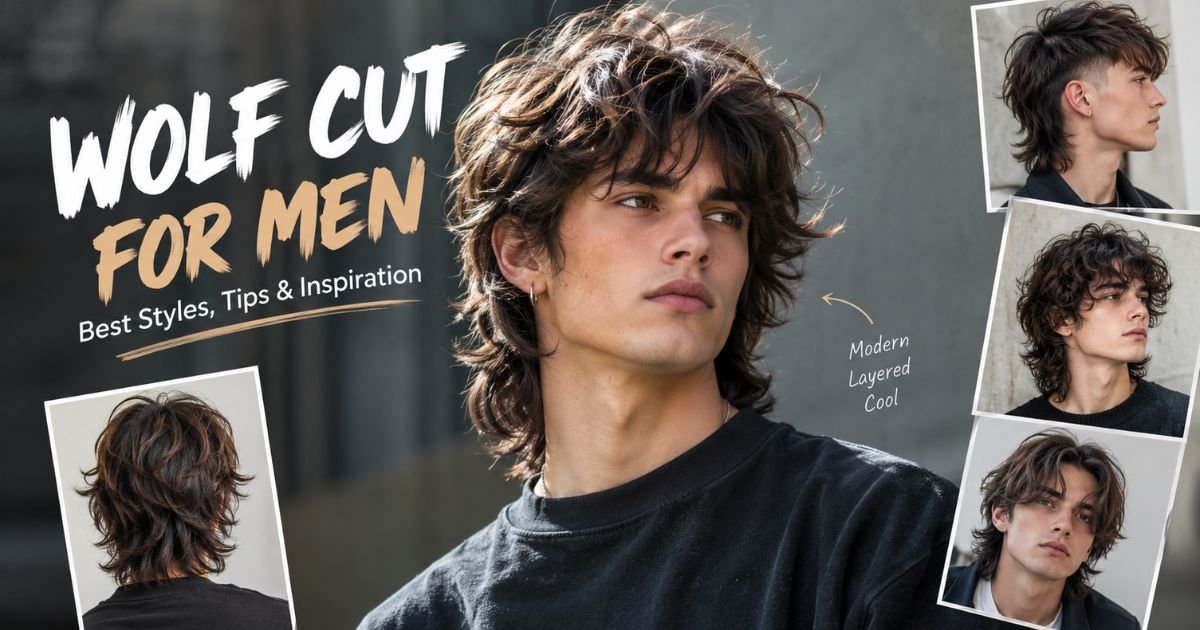
Wolf Cut for Men: Best Styles, Tips & Inspiration (2026)
A wolf cut is a layered haircut with choppy, textured layers through the top and crown, and enough length left at the back to give it a shaggy, slightly mullet-like outline. It’s meant to look lived-in rather than polished.
This guide helps you work out whether it suits your hair, which version to ask for, how to style it, and what to tell your barber. It also covers how it differs from a mullet or shag, and how to get through the grow-out phase.
A quick note on wording: Americans say “bangs” where Brits say “fringe,” and “texturizing” is spelled “texturising” in the UK. This article uses both terms where it matters. Lengths are given in inches and centimeters.
What Is the Wolf Cut?

The wolf cut combines two older ideas. From the shag, it borrows layering and texture: shorter pieces on top that create movement and lift. From the mullet, it borrows a longer back, so the hair reaches the nape or collar. The difference from a mullet is that the contrast is softened, with layers on the sides connecting the top to the back instead of leaving a sharp short-to-long jump.
Barbers and clients use the name loosely, so two people asking for a “wolf cut” can walk out with different results. Some versions are short and compact, while others are long and dramatic. The features below are what most versions share.
How to spot a wolf cut:
- Noticeable crown volume, with the top layers cut shorter than the hair beneath
- Choppy layers with feathered, broken-up ends rather than a single blunt line
- Sides that are layered and blended into the back, not buzzed short
- Length at the back that reaches at least the nape, often a little longer
- A tousled, textured silhouette instead of a sleek, combed finish
- Optional face-framing fringe or curtain bangs at the front
What Makes a Wolf Cut Different from Other Layered Haircuts?
Plenty of haircuts have layers. A basic medium-length layered cut usually blends them so smoothly that you barely see them. The goal is movement and reduced bulk, with an even outline.
A wolf cut keeps the layers visible. The top and crown are noticeably shorter than the lengths below, and the ends are deliberately broken up. Barbers often describe this as disconnected layers, meaning the lengths step down in a way you can see instead of melting into each other.
To tell the two apart in a reference photo, check three things:
| Typical layered cut | Wolf cut | |
| Crown | Gentle lift | Pronounced volume with shorter top layers |
| Ends | Smooth, blended | Choppy, feathered, deliberately broken up |
| Back shape | Even, follows the head | Longer, with a shaggy or slightly tapered outline |
Barbers get there in different ways. Many use point cutting, snipping into the ends at an angle to create a ragged edge. Some use a razor or texturizing shears. Your barber’s method matters less than the finished shape, which is why photos help so much.
Wolf Cut vs. Mullet vs. Shag
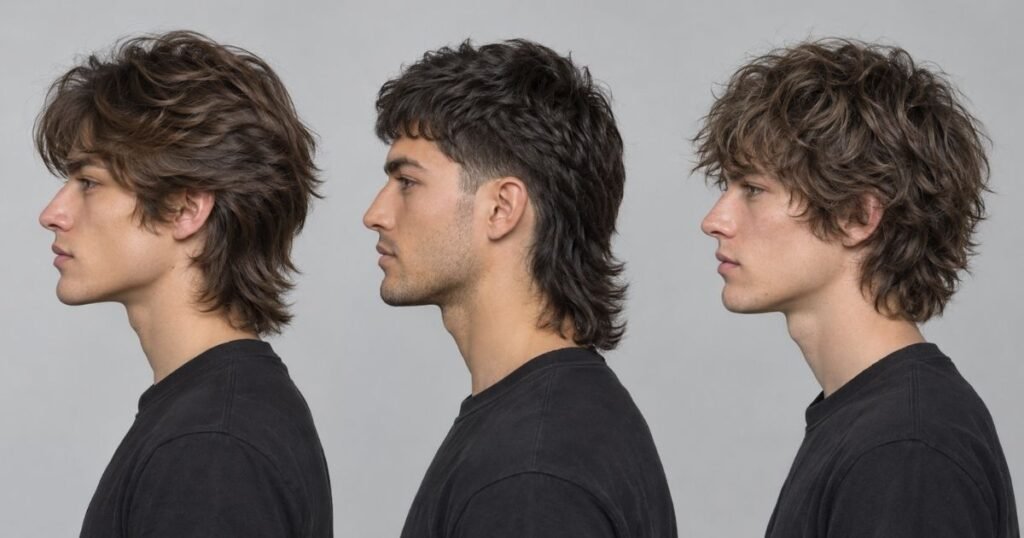
These three share a lot, and the lines between them blur in practice. Treat the table as a general guide, since barbers use the names differently.
| Wolf cut | Mullet | Shag | |
| Top and crown | Layered, with volume | Often shorter or sleeker, depending on the version | Heavily layered, with lots of texture |
| Sides | Layered and blended, usually with some length | Usually short, sometimes tapered or faded | Layered, usually with some length |
| Back and nape | Longer than the top, with a shaggy outline | Clearly the longest part | Varies, and not necessarily long |
| Fringe | Optional | Optional | Common |
| Contrast | Moderate, with a soft transition | Strong, with a clear short-to-long jump | Low to moderate, with layering throughout |
| General feel | Textured and relaxed | Bolder, with a clear back-versus-front statement | Messy and tousled all over |
If you want a softer alternative to a traditional mullet, a wolf cut is a sensible middle ground. You keep the length at the back but without the abrupt contrast. If you like heavy texture all over and don’t care about a long back, a shag may be closer to what you want.
Front views can look nearly identical across all three, so show your barber side and back photos too. If you’re torn between two, tell them which part matters most: the back length, the amount of texture, or how visible the contrast is.
Why the Wolf Cut Became So Popular

Part of the appeal is practical. The cut is built around natural texture, so waves, curls, and a bit of kink or frizz can work in your favor rather than against you. It also comes in many lengths, from a compact cut that fits a conservative workplace to a long, expressive version.
There’s also a retro angle. The cut echoes the layered shags of the 1970s and the mullets of the 1980s, but in a softer, more wearable form. Social media helped spread the name and the look, since textured, lived-in hair photographs well and is easy to share as a reference photo.
Popularity alone isn’t a reason to get a haircut, though. What matters is whether the shape works with your hair and how much effort you’re willing to put in, which the next sections cover.
Wolf Cut Men: Who Can Actually Pull This Off?
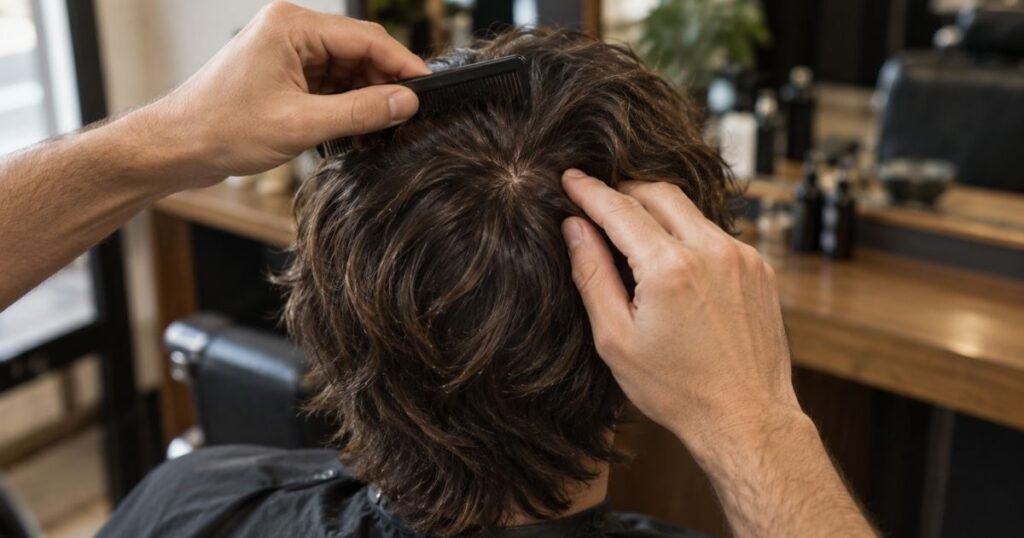
The honest answer is that it depends on several things, and hair characteristics usually matter at least as much as face shape. A skilled barber can adapt the cut by changing crown height, side length, fringe, and nape length, but not every adaptation will suit every head of hair.
Before booking, run through this quick self-check:
- Do I have enough length on top and at the nape?
- Is my hair fine, medium, or thick, and sparse or dense?
- Is it straight, wavy, curly, or coily?
- Do I have a cowlick, a strong growth direction, or a receding hairline?
- Am I willing to use a dryer, product, or a diffuser, or do I want to air-dry?
- Do my work or dress expectations limit how long or messy it can look?
The sections below go through each factor.
Face Shape Considerations
Face shape is one factor among several. Forehead height, jaw width, beard, glasses, and how much of your ears show also change how a cut looks. A better question than “which face shape suits a wolf cut?” is “what can my barber adjust to balance my proportions?”
This table lists general ideas that may be worth discussing, not rules:
| Face shape | Elements a barber may adjust | Things to consider |
| Oval | Most variations are open to you | Choose based on hair type and lifestyle rather than face shape |
| Round | Extra height at the crown, and side layers that don’t add width at the cheeks | Too much volume at the sides may emphasize width |
| Square | Softer, textured layers around the jaw | Layers that fall at jaw level can soften or cover the jawline, depending on your preference |
| Oblong | Fringe, and keeping crown height moderate | A lot of height on top can add to the appearance of length |
| Diamond | Layers or a fringe that add some width at the forehead and jaw | Volume at the cheekbones may emphasize them |
| Heart | A fringe or face-framing pieces, and some length near the jaw | A very wide forehead may look different with or without fringe |
Bring photos of people with proportions similar to yours, and ask your barber how they’d adapt the cut. A good barber will often suggest tweaks based on how your hair falls.
Hair Type Considerations
Hair texture changes how the cut looks and behaves, often more than anything else. Here’s how it tends to work across types:
| Hair type | How the cut tends to behave | What to discuss with your barber |
| Straight | Layers are clearly visible, but the cut can look flat or limp without texture | How much choppy texture to build in, and how the crown will hold up |
| Wavy | Waves can add natural movement and body, so the cut may be easier to style | How to keep layers from looking too choppy or frizzy |
| Curly | Layers shape the curl pattern and can reduce bulk. Shrinkage means hair looks shorter dry than wet | Whether they cut curls dry or wet, and how much length to leave |
| Coily or tightly textured | The cut can be adapted, but shrinkage is significant and layers need careful planning | Experience cutting your texture, expected final length, and how the shape holds as it grows |
Previous color or chemical treatments can change how hair takes layering, since damaged hair can look frayed at the ends. If you’re not sure how your hair will behave, ask your barber to explain before they cut.
Hair Length and Density Considerations
Length. You generally need enough hair on top to layer and enough at the nape to create the back shape. A shorter version needs less (more on this in the FAQ below).
Fine or thin hair. Layers can create the look of more volume at the crown, but heavy layering can also make hair look thinner, because cutting many short layers removes bulk from the ends. If your hair is fine, ask for light layering, point-cut texture rather than heavy thinning, and ends that still look full.
Thick or dense hair. The challenge is the opposite. Without weight removal, thick hair can sit in a bulky, triangular outline. Your barber may remove weight inside the cut or shape the sides so the silhouette stays balanced.
Growth patterns. A crown cowlick can push hair in an unexpected direction and affect how volume sits. Hair that grows forward at the front can change how a fringe behaves. A receding hairline or widow’s peak may change how much fringe works for you, and the crown volume can be adapted around it. A good barber should check these before cutting.
Questions worth asking:
- Is my hair dense enough for layers to look full?
- How will my cowlick or hairline affect the shape?
- Where should the shortest layer start?
- How will this look when it grows out?
Popular Variations of the Men’s Wolf Cut

Wolf cut hairstyles for men range from compact to long, and from low-effort to styled. Use the table to find a starting point, then read the version that fits.
| Variation | Length feel | Sides | Typical effort |
| The Famous Wolf Cut | Medium | Layered and blended | Moderate |
| Short Wolf Cut | Shorter, compact layers | Closer to the head | Lower to moderate |
| Wolf Cut with Curtain Bangs | Medium, with face-framing front | Layered and blended | Moderate |
| Wolf Cut with Fade | Medium top, tidier sides | Tapered or faded | Moderate, with more frequent tidy-ups |
| Long Wolf Cut | Longer all over | Long and layered | Moderate to high |
| Curly Wolf Cut | Depends on curl pattern | Layered to shape curls | Often lower, depending on curl |
The Famous Wolf Cut
“Famous” isn’t a technical term. Here it means the classic version most people picture when they hear the name. It works as a baseline for comparing the other versions.
It has medium-length layers on top with crown volume, sides that are layered and blended instead of cut short, a back that reaches the nape or collar, and textured, feathered ends. There’s no fade and no hard edge.
When it’s freshly cut, the shape is at its clearest. As it grows, the layers lose definition and the back lengthens. If you’re new to the style, this version may be a reasonable reference point, though your hair characteristics still matter.
What you might say: “I’d like a classic wolf cut with choppy layers on top and some crown volume, with length at the back and no fade.”
Short Wolf Cut
A short wolf cut keeps the layers and crown volume but shortens everything. The top is cropped, the fringe (if any) is shorter, and the nape is less long. Layers sit closer to the head.
That brings it near other short, textured styles, such as a textured crop or a short shag. What keeps it a wolf cut is the shaggy outline at the back and the choppy ends. Without them, it may be better described as a layered crop.
With less hair, there’s less room for adjustment later, and layering needs more precision. Cowlicks tend to show more at shorter lengths. Fine hair may look fuller when kept shorter, though the layer placement still matters.
Read More About : Fringe Haircuts for Men: Best Styles, Tips & How to Pull Them Off
Wolf Cut with Curtain Bangs
Curtain bangs (curtain fringe in the UK) are parted in the middle, or slightly off-center, and sweep to either side of the face. In a wolf cut, they connect the top layers to the face-framing sides.
The decision points are:
- Fringe length: eyebrow, cheekbone, or longer
- Part position: center or slightly off to one side
- How your hairline behaves: forehead height, cowlicks, and front growth direction all affect how the fringe sits
A fringe that falls into your eyes is a common complaint. A barber can cut it a little longer so it sweeps aside, or you can tuck it behind your ears. It usually needs more frequent tidying than the rest of the cut. For styling, dry the fringe in the direction of the part while it’s damp, so it sets in place.
Wolf Cut with Fade
This version pairs a layered, textured top with tapered or faded sides. It suits people who want the wolf cut’s volume but prefer tidier edges around the ears and neck.
The details to specify are:
- Fade type and height: a low taper, a temple fade, or a higher fade
- Nape treatment: whether it stays long, or becomes a tapered nape
- Top length: how much length to leave for layers
The more contrast between top and sides, the closer the cut gets to a mullet fade. Tidier sides also tend to need more frequent cleanup as they grow, and dense or fast-growing hair may show it sooner. If fades are new to you, a guide to taper vs. fade can help you pick the right terms.
Long Wolf Cut
This version leans harder into the mullet influence. The layers run longer, the sides and back stay long, and the shape is more dramatic.
It needs more care. Without weight management, long hair can look stringy at the ends or bottom-heavy. Density and texture strongly affect how it looks, with thick hair needing weight removal and fine hair needing careful layering to avoid wispy ends. Damaged ends and split ends also show more at longer lengths.
Questions to ask your barber: where should the shortest layer start, and how long should the back be? A back view is essential when choosing a reference photo for this version.
Read More About : 26 Stylish Middle Part Hairstyles for Men (2026)
Curly Wolf Cut
On curly hair, layers help shape the curl pattern and reduce bulk, so curls clump and stack instead of puffing outward. Length is harder to judge, because curls spring up when dry.
Some barbers cut curly hair dry, or curl by curl, to see how it falls. It’s reasonable to ask whether your barber has experience with your curl pattern. Curl pattern, density, and frizz tendency all change how the cut turns out.
For many people with natural curls, this can be a lower-effort version. Styling is covered below.
How to Style a Wolf Cut Male

Effort varies. Some people can air-dry and add a little product. Others need a dryer to get lift at the crown. The routine below is a flexible starting point, and the reason behind each step is included so you can adapt it.
Core routine:
- Start with damp hair. Towel-dry until it’s no longer dripping. Styling products work best on damp hair, and it’s easier to shape.
- Add a lightweight product. A lightweight texturizing spray or sea salt spray works well from roots to mid-lengths. It adds grip and movement without weighing the hair down.
- Dry for lift. If you use a dryer, flip your head forward and dry the roots with your fingers lifting at the crown. This is where crown volume comes from. Use medium heat and a heat protectant if you use heat often. Or air-dry, and scrunch or shake the hair as it dries.
- Finish lightly. Work a small amount of matte styling paste or cream through the ends. Matte products keep the look relaxed and messy rather than shiny and set.
Not everyone has a lot of time. The minimal version is steps 1, 2, and 3 with air-drying. For a layered cut that looks good without heat styling, the cut and your natural texture do most of the work. Straight, fine hair is the type most likely to need a dryer.
Styling Products for a Wolf Cut
Products are best chosen by what they do, not by brand. Start with a small amount and build up.
| Product type | What it does | May suit | Watch out for |
| Sea salt spray | Adds grip and a rough, beachy texture | Straight and wavy hair | Can feel dry on already dry or curly hair |
| Lightweight texturizing spray | Adds movement and separation | Fine and straight hair | Overuse can feel stiff |
| Mousse or volumizing spray | Lifts roots and supports crown volume | Fine or thin hair | Can weigh hair down if overused |
| Matte styling paste or cream | Defines ends while keeping a flat, non-shiny finish | Most types, in small amounts | Too much looks greasy or heavy |
| Curl cream or leave-in conditioner | Adds moisture and defines curl clumps | Wavy, curly, and coily hair | Heavy applications can flatten curls |
| Light hairspray | Holds the shape without a hard finish | Straight hair that loses lift | Can make texture feel crunchy |
| Heat protectant | Protects hair from dryer heat | Anyone using a dryer regularly | Not needed if you air-dry |
Fine hair often does better with lighter products, while thick or curly hair may need more moisture and hold. If a product looks shiny or feels heavy, it may be working against the cut’s textured finish.
How to Style a Wolf Cut for Different Hair Types
These are adjustments to the core routine, not separate routines.
| Hair type | Drying approach | Product weight | Finishing tip |
| Straight | Blow-dry for lift at the crown | Light, such as a texturizing spray | Add a little paste to the ends so layers don’t fall flat |
| Wavy | Air-dry or a quick blow-dry | Light to medium | Scrunch while damp to encourage waves |
| Curly | Air-dry or use a diffuser | Curl cream or leave-in conditioner | Avoid brushing dry curls, which can cause frizz |
| Fine | Blow-dry roots for lift | Very light, such as mousse | Avoid heavy pastes, which can flatten the cut |
| Thick | Air-dry or blow-dry, depending on bulk | Medium, with enough product to control frizz | Ask your barber about weight removal if hair feels bulky |
If a diffuser attachment is new to you, use it on low heat and cup curls gently instead of moving it around. Your hair may fall between categories, so adjust as you learn what it responds to.
How to Ask Your Barber for a Wolf Cut
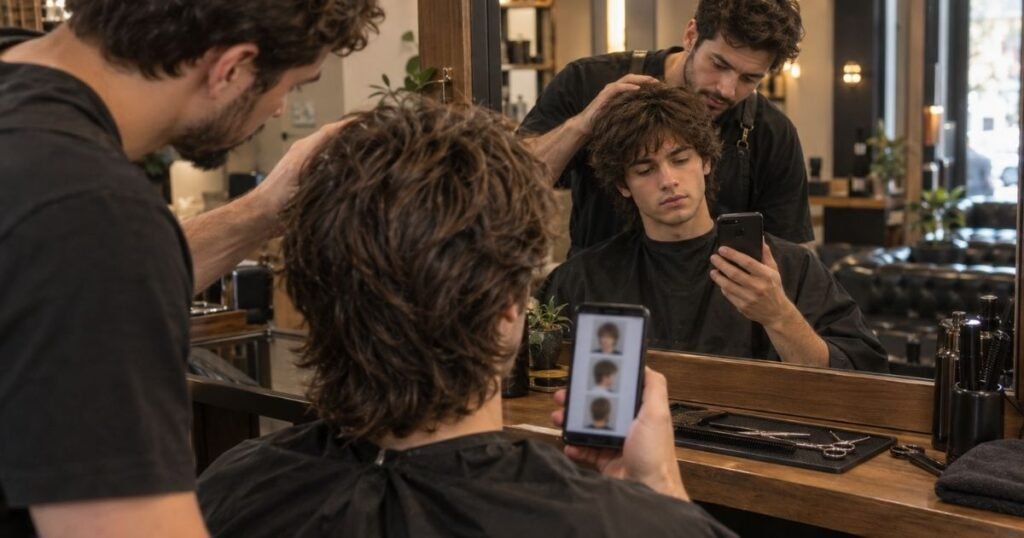
Terminology varies from shop to shop, so no single phrase guarantees the same result. Photos are your anchor, and words fill in the details.
What to bring:
- A front, side, and back reference photo if you can find them
- Photos on hair similar to yours in texture and density
- A photo of what you don’t want, if there’s a look you’d like to avoid
Words that help:
- Choppy layers or textured layers on top and at the crown
- Crown volume if you want lift at the back of the head
- Length at the back, with an idea of how long (nape, collar, or longer)
- Feathered or broken-up ends instead of a blunt edge
- Face-framing fringe or curtain bangs, if you want them
- Fade or no fade, and which type if you do
- Tapered nape, if you want the neckline tidy rather than shaggy
Tell them about your life, too. How much time you’ll spend styling, whether you blow-dry, and any work or dress code limits all affect what they should do.
Read More About : Curtain Bangs Haircuts for Men: Modern Styles and Ideas
Questions worth asking:
- Is my hair long enough for this now?
- How will you handle my cowlick or hairline?
- How will this look as it grows out?
A sample script:
“I’d like a wolf cut with choppy layers on top and some volume at the crown. I want to keep the length at the back, around my collar, and keep the sides blended in rather than short. I usually air-dry, so I’d like something that works without much styling. Here are some photos, including the back.”
If your barber suggests changes, that’s not a failure. A good barber adapts the cut to your hair, so ask them to explain their reasoning.
How to Maintain a Wolf Cut
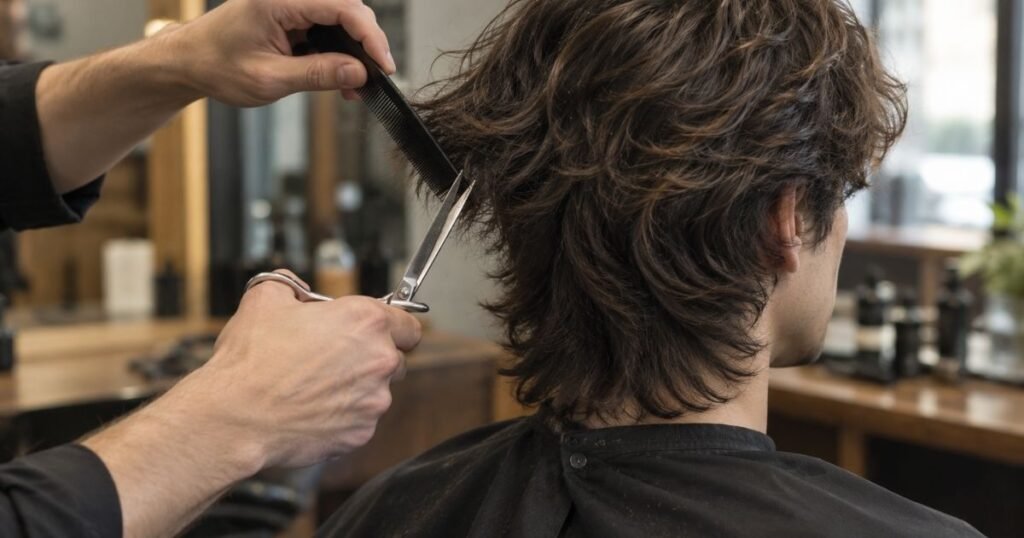
A wolf cut changes shape as it grows. The layers lose definition, the nape lengthens, and a fringe drops toward your eyes. How fast depends on your hair’s growth rate, length, and whether the sides are faded.
Instead of a fixed schedule, watch for these signs:
| Sign | What it may mean | What to ask for |
| The crown has gone flat | The top layers have grown out | A refresh of the top layers |
| Ends look stringy or heavy | The layers have lost their shape | Light point cutting or removing weight |
| The fringe sits in your eyes | The front has grown past its sweet spot | A fringe trim |
| The sides look bulky | Side layers have grown past the cut | Re-blending the sides, or a tidier taper |
| The nape looks messy | The back has lengthened | A nape clean-up |
Fade and fringe versions often need more frequent tidying than longer, softer ones. Longer versions need extra attention to the ends.
Basic care: Wash with a shampoo that suits your hair type, and condition longer or curly versions. Cutting back on heat styling helps keep ends healthy.
On cutting it yourself: Layered cuts are easy to over-cut, and layers can’t be put back. If you need a quick fix between visits, a small fringe trim is lower risk than cutting layers.
Getting through the grow-out phase. If you decide to grow the cut out, there will be an awkward stage when the layers lose shape but haven’t reached a new length. A barber can shape the length periodically so it looks intentional, such as by cleaning up the nape or keeping a soft outline. Texture products and tying hair back can help during the in-between months.
Read More About : Mens Shaggy Hairstyles: 35 Effortless & Cool Looks
FAQs About the Wolf Cut for Men
Is the Wolf Cut Still in Style in 2026?
Trend status is hard to pin down, and style claims often age quickly. What can be said is that the wolf cut is an established, recognizable name with enough variations (short, long, curly, faded) that it doesn’t depend on a single look. Whether it’s trending matters less than whether the shape suits your hair and daily routine. If you like it and it works with your hair, that’s a better reason to get it than a trend report. See the popularity section above for context.
Can You Get a Wolf Cut with Thin or Fine Hair?
It may work, depending on density and strand thickness. The key is light layering, point-cut texture instead of heavy thinning, and ends that still look full, because heavy layering can make hair look thinner. Lightweight products and a conversation with your barber about the crown usually help. The full explanation is in the hair length and density section.
How Long Does Your Hair Need to Be for a Wolf Cut?
As a rough guide, many barbers want around 4 to 6 inches (10 to 15 cm) on top for a classic version, and a short wolf cut can sometimes work with around 3 inches (about 7.5 cm). These are general figures, and your hair texture matters. Curly and coily hair shrinks, so it may need more length to look the right size once dry. If you’re not quite there, ask your barber about a textured cut that works while you grow it out. A consultation is the most reliable way to find out.
Will the Wolf Cut Suit Men Over 30?
Age matters less than hair density, hairline, texture, and personal style. Receding hairlines or changes in texture can affect how the cut sits, and shorter, tidier versions, such as a short wolf cut, a version with a fade, or softer ends, are options if you want something more controlled. If you like the look and your hair supports it, age isn’t a barrier.
Is a Wolf Cut High Maintenance?
It depends. The cut is designed to look lived-in, so many people with wavy or curly hair need little daily effort. Straight or fine hair may need a dryer and product to hold volume. Fade and fringe versions need more frequent tidying. The styling and maintenance sections above explain what to expect.
Conclusion
The best wolf cut is the version that fits your hair length, texture, and the effort you’re willing to put in. Before your appointment:
- Bring front, side, and back photos on similar hair
- Decide on a length at the back and whether you want a fringe or fade
- Mention how you usually style your hair
- Ask how the cut will grow out
Those details matter more than the name on the photo.
Jake Miller is a barbering and men’s hairstyle enthusiast who shares practical tips, haircut inspiration, and the latest grooming trends at BarberZylo. He enjoys exploring modern and classic hairstyles and helping readers find fresh ideas for their next look.


3 Comments