
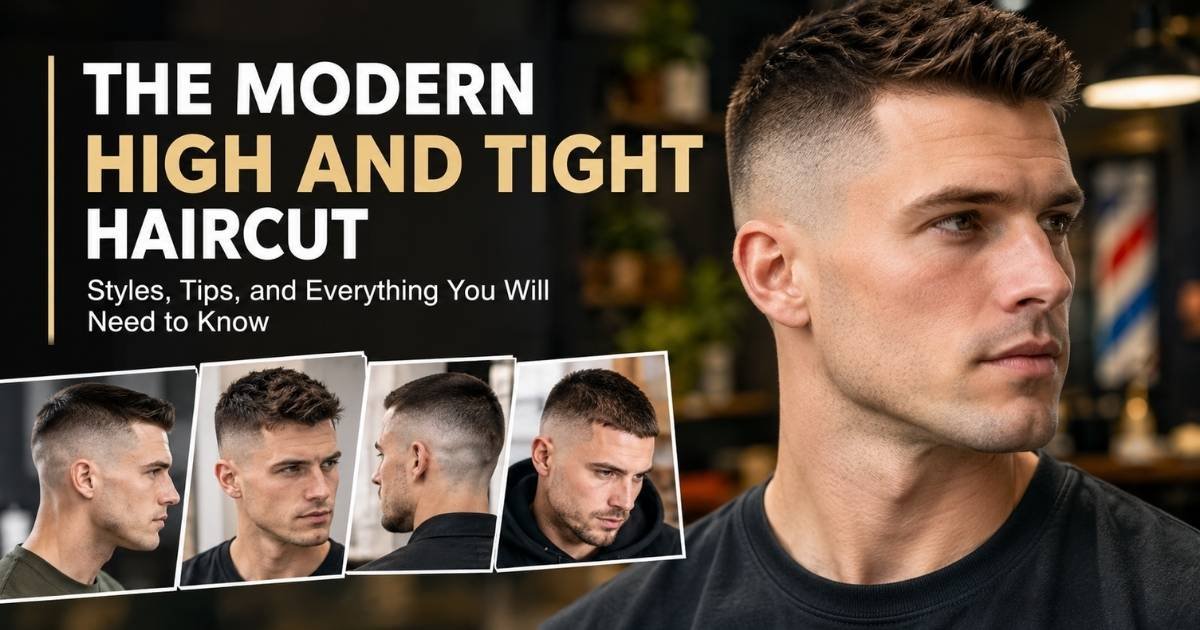
The Modern High and Tight Haircut: Styles, Tips, and Everything You Will Need to Know In 2026
What to notice: where the very short sides end, how sharply they meet the top, and how long the top stays. Those three details define the cut.
Ask three barbers for a “high and tight” and you can walk out with three different haircuts. One may clip the sides to the skin and leave a short, even top. Another may blend a fade up toward the temples and leave texture on top. A third may land somewhere in between.
That’s why this guide breaks the modern high and tight haircut into choices you can name: how high the sides go, how short they finish, how they meet the top, and how long the top stays. You’ll also see how it compares with a buzz cut, crew cut, and high fade, how hair type and hairline change the result, what to tell your barber, and how to keep it looking neat at home.
What Is the High and Tight Haircut?
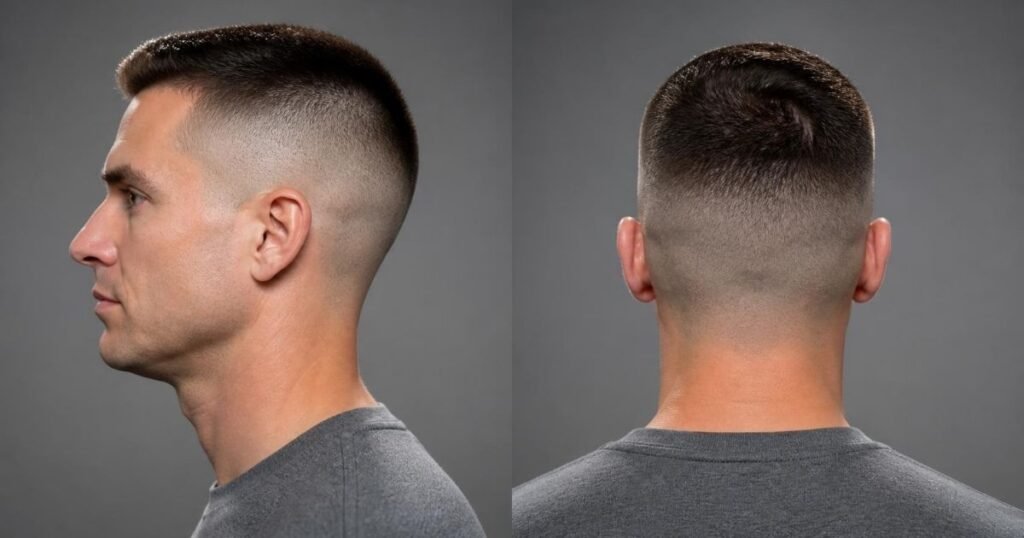
A high and tight is a short haircut with a very short back and sides, a short zone that climbs high on the head, and a top that stays noticeably longer. The contrast between those two zones is what makes it recognizable.
Four details describe almost any version:
- Side height: how far up the head the very short section reaches. In a high and tight it typically climbs toward the temple area and the curve where the head turns from side to top (barbers sometimes call this the parietal ridge).
- Side finish: how short the sides get at the bottom, whether bare skin, a shadow of stubble, or a short guard length.
- Transition: how the sides meet the top, either as a defined line or as a gradual blend (a fade or taper).
- Top: its length, texture, and styling direction.
The name is used loosely. Some people mean shaved sides under a short, flat top. Others mean a fade with a textured top. Neither is wrong, which is why describing those four details works better than relying on the name alone.
What to notice: each label is a separate decision. You can change one, such as the finish, without changing the others.
Because the sides are so short, more of your head shows: its shape, your temples, your ears, and any scars or marks. That doesn’t rule the cut out, but it’s worth thinking about before you commit to a very short haircut.
The Origins of the Classic Military High and Tight
The high and tight is widely associated with US military barbering, and with the Marine Corps in particular. Short, uniform sides are quick to maintain and easy to keep consistent, which suits service life.
Military grooming standards differ between branches and countries, and they change over time. A civilian high and tight shouldn’t be assumed to meet any regulation. If you’re serving, follow your branch’s current rules and your unit’s barber.
What Makes a Modern High and Tight Different?
“Modern” here isn’t a claim about what’s trending. It describes how many current versions are built differently from the classic: blended transitions instead of a blunt line, a wider range of top lengths and textures, and finishing details like a crisp line-up or a beard blend.
| Classic version | Modern version | |
| Sides | Clipped very short, often bare or near-bare | Skin, shadow, or a softer finish, depending on preference |
| Transition | Defined line between sides and top | Often a blended fade or taper |
| Top | Short, little or no styling | Short to long, sometimes textured |
| Styling | Minimal | A small amount of product to a few minutes with a dryer |
| Finishing | Usually none | Line-up, neckline shaping, beard blending |
Here are some of the most popular cuts for the modern and tight hairstyle.
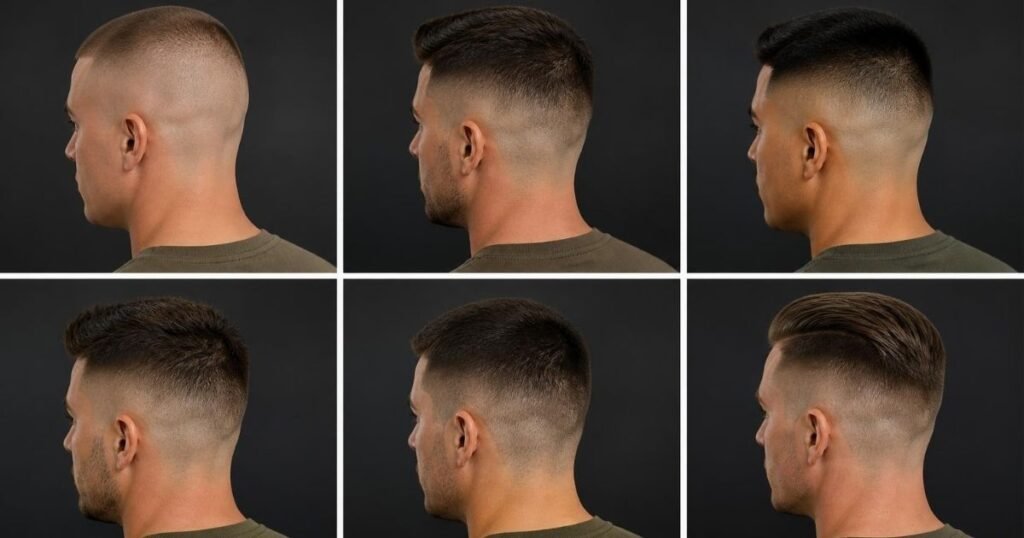
These aren’t six separate haircuts. They’re combinations of the four details above, and the same cut can often be described in more than one way. Treat them as common ways to order the style.
| Version | What changes | Sides | Top |
| Classic military | Baseline | Very short, defined line | Short, minimal styling |
| High and tight fade | Transition | Blended upward | Short to medium |
| Skin fade | Finish | Fades to bare skin | Any |
| Textured top | Top | Short or faded | Cut and styled for movement |
| Taper fade | Softer blend | Gradual, often lower contrast | Any |
| Long | Top length | Very short | Long enough to push, sweep, or lift |
Classic Military High and Tight
What to notice: the defined line where the sides meet the top, and how little blending there is.
This is the baseline. The sides and back are clipped very short, often bare or near-bare, and they meet a short top at a fairly defined line.
Because there’s so little hair, small details show: the front hairline, any cowlick at the crown, and how even the clipper work is. If your hair grows in different directions at the crown, a very short top may stand up or split instead of lying flat.
What to ask for: sides and back clipped very short, a short even top, and a defined line where they meet.
High and Tight Fade
What to notice: how gradually the sides lengthen as they rise, and where the blend ends relative to the ear and temple.
Here the sides blend gradually from the shortest length at the bottom to longer hair higher up, which softens the line where they meet the top. “High” refers to where the blend ends.
| Fade height | Where the blend sits | Effect |
| Low | Just above the ear and nape | Sides keep more hair, softer contrast |
| Mid | Roughly halfway up the side of the head | Moderate contrast |
| High | Up toward the temple area and the curve of the head | Strongest contrast, very short sides |
A high and tight usually sits at the high end. A mid fade with a short top is closer to a standard fade. Some barbers would still call it a high and tight, others wouldn’t, so name the height you want instead of relying on the label.
The high and tight with skin fade.
What to notice: where the bare skin ends and the first visible hair starts, and how smooth the blend looks above it.
A skin fade (sometimes called a bald fade) finishes at bare skin at the bottom of the sides and back. It creates the strongest contrast and draws attention to head shape. A shadow fade stops just short of bare, leaving a faint stubble.
The skin finish is usually done with a foil shaver or razor, and it comes with trade-offs. Regrowth shows sooner at the shortest point. Scalp features like moles, scars, or uneven skin tone are more visible. Shaving close can irritate some skin types.
What to ask for: “high fade, down to skin” or “high fade, down to a shadow,” plus your top length.
High and Tight with Textured Top
What to notice: the movement in the top, with pieces of different lengths instead of one flat plane.
This version leaves the top long enough to show movement. The barber removes bulk or breaks up the ends with scissors, often using point cutting or texturizing shears, so the hair separates instead of sitting in one block. A matte product finishes it.
It’s related to the textured crop, but the crop usually keeps the sides lower or fuller. Here the sides stay high and very short, so the contrast is sharper.
Fine hair may show less texture. Dense hair may benefit from weight removal. Curl pattern changes the result a lot, which the hair-type section covers.
Read More About : Ivy League Haircut: 22+ Clean & Timeless Styles for Men
High and Tight Taper Fade
What to notice: how the shortening is concentrated around the sideburn and neckline, with more length left elsewhere.
A taper shortens the hair gradually, usually concentrating on the sideburns and neckline while leaving more length through the rest of the sides. A fade shortens more dramatically, often to skin, over more of the side and back.
A taper fade version is a softer, lower-contrast take, with less stark edges around the ears and nape. The lower the short zone sits, the further the cut drifts from a high and tight, so tell your barber how high you want the shortest area to go.
Long High and Tight
What to notice: the same cut swept to the side and pushed forward, with sides that stay equally short either way.
The sides stay very short, but the top is left long enough to push forward, sweep to one side, or lift for volume. This gives the strongest contrast of any version.
It overlaps with the undercut, quiff, and pompadour. A barber may use any of those names for a similar shape, so the side height and transition are what to confirm. Hair density and the direction your hair grows at the front will affect how it sits. It takes more daily effort than the shorter versions, which the styling section covers.
High and Tight vs. Buzz Cut vs. Crew Cut
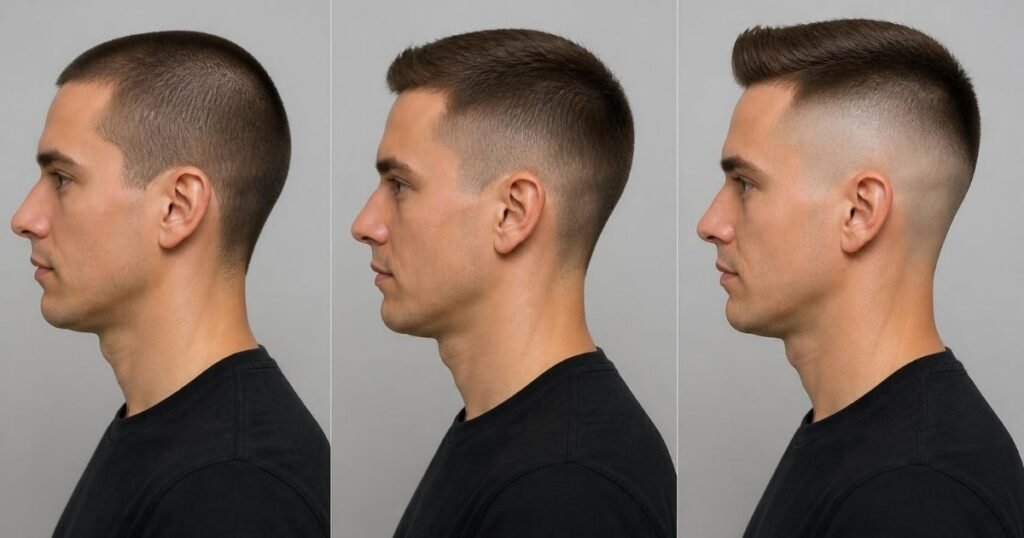
All three are short, and barbers’ terms overlap. These are typical differences, not strict rules.
| Sides | Top | Contrast | Styling | |
| Buzz cut | One length, or very close to it, all over | Same as sides | Low | None |
| Crew cut | Graduated short | Short, often longest at the front | Moderate | Minimal |
| High and tight | Very short, climbing high | Noticeably longer than the sides | High | Little to some |
High and Tight vs. Buzz Cut
A buzz cut is generally one length all over, with no designed contrast. A high and tight deliberately uses two. The classic version with a very short top can look close to a buzz cut, so the difference is intent: separate lengths for the sides and the top.
If you want one length, ask for a buzz cut and name a guard number. For a high and tight, describe the sides and top separately.
High and Tight vs. Crew Cut
A crew cut typically has graduated sides and a top that’s short but a little longer, especially toward the front. A high and tight pushes the short zone higher and widens the gap between the sides and the top.
Because definitions vary, give your barber a top length in inches or millimeters instead of relying on the name.
High and Tight vs. High Fade
This is the most common mix-up. High and tight describes an overall structure: very short sides climbing high, with a clearly longer top. A high fade is a technique and a position, and it can pair with many tops, including a quiff, a textured crop, or a longer swept style.
So a high and tight can include a high fade, but a high fade doesn’t have to be a high and tight. When you order, name the top you want first, then the fade height.
Which Face Shape Does the High and Tight Work Best For?

No face shape is a rule. With sides this short, more of the head shows, so head shape, hairline, forehead height, ears, and jawline all affect the result alongside face shape. Face shape is also approximate, and a beard can change the proportions. These are things to discuss with your barber, not verdicts:
- Oval: proportions are often considered balanced, so top length and finish can come down to preference.
- Round: a bit of height or texture on top may add vertical emphasis. Fade height may be worth discussing, since a very high fade exposes more of the sides.
- Square: very short sides can emphasize a strong jaw. Some people soften the look with texture on top, while others like the sharpness.
- Oblong: a very high fade with a flat top can emphasize length. A softer blend or a top with some volume may be worth considering.
- Diamond: short sides can highlight wide cheekbones. Texture or extra length at the front may help balance a narrower forehead.
- Heart or triangle: a wider forehead and narrower chin may pair well with beard length that adds balance, though results vary.
Is the High and Tight Suitable for Different Hair Types?
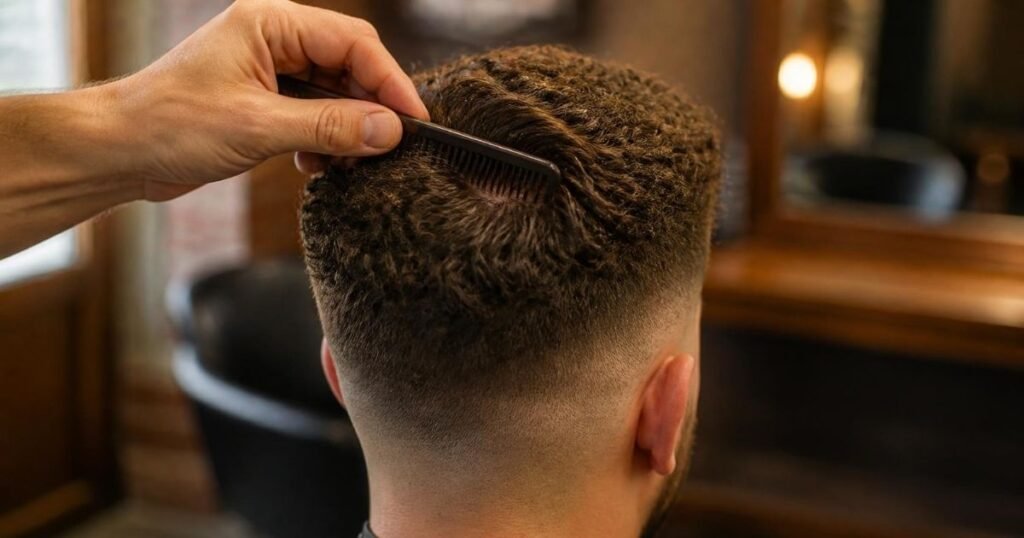
Hair type changes how the top sits, how the short sides look, how smoothly the fade blends, and how regrowth appears. Two terms help here: thickness (the width of each strand) and density (how many strands you have). Someone can have fine strands and high density, or the reverse.
High and Tight for Straight and Fine Hair
Straight hair shows the shape and edges of the cut clearly. Fine or lower-density hair can show more scalp at very short lengths, and the top may lie flat.
To keep the top from looking too flat, a barber may add subtle texture, and a lightweight product or drying the roots upward can add lift.
If you have a receding hairline or thinning at the crown, high contrast can draw attention to those areas. A shorter top or a softer transition may be worth discussing. How it looks depends on how your hair thins.
High and Tight for Thick Hair
Dense hair can make the top stand up or puff outward, and regrowth on the sides looks fuller sooner. A barber may remove weight or texturize the top so it lies flatter or shows shape. Thick strands and high density behave differently, so describe which one you have. A firmer-hold product may help control the top.
Read More About : Buzz Cut Men: 32 Bold & Clean Haircut Styles for 2026
High and Tight for Curly and Wavy Hair
Curl pattern and spring decide how the top looks. The top generally needs enough length for the curl or wave to show. A very short top can read as volume without definition. The tight sides keep bulk down, so the natural texture on top becomes the focus.
Moisture matters: a curl cream or light leave-in product can help with frizz. Some barbers prefer to cut curly hair dry so they can see how it sits, so it’s worth asking whether yours is comfortable cutting curls.
High and Tight for Coily and Afro-Textured Hair
Shrinkage means coily hair looks shorter than it actually is, so talk about length and shape with your barber and don’t judge by how it looks when it’s pulled straight. A skin fade with a defined edge can create a sharp contrast with the texture on top, but close shaving can irritate skin for some people. If irritation persists, talk to a professional.
A high-top fade or flat top has a similar silhouette, with height on top and faded sides, so show your barber photos to confirm which you want. It’s also worth finding a barber with experience cutting coily hair.
How to Ask Your Barber for a High and Tight
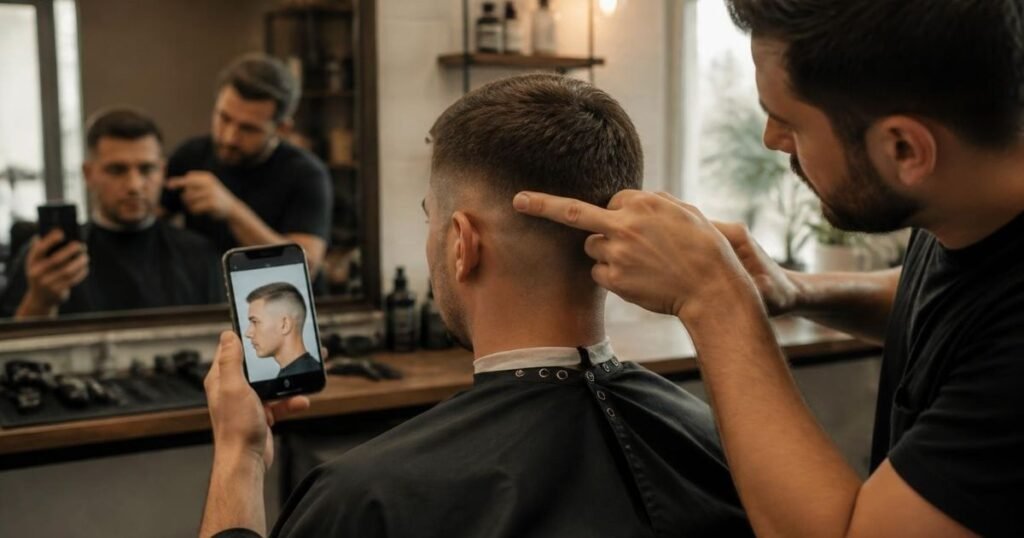
No single phrase guarantees the same result at every barbershop. These five decisions get you closest:
- Side height: low, mid, or high, and roughly where it ends relative to your ear and temple.
- Side finish: skin, shadow, or a guard length.
- Transition: a defined line or a blended fade or taper.
- Top: length and texture.
- Finishing details: a line-up, neckline shape, and sideburn treatment.
A sample script: “I’d like a high fade down to a shadow, blended into a textured top about an inch long. Square the neckline and keep the sideburns tidy.” Ask the barber to confirm the plan before clippers come out.
If you’re unsure about an extremely short cut, ask for a little more length on top and a less aggressive fade at first. Hair can be cut shorter, but not longer.
Read More About : The Caesar Haircut: A Complete Guide for Men Who Want a Sharp, Low-Maintenance Look
What Guard Lengths Should You Ask for in a High and Tight?
Clipper guards are attachments that set how much hair remains. Numbering varies by brand and region (UK barbers may say “grade”), so lengths in inches or millimeters are safer than numbers. These are approximate, based on common US sets. Check your clipper’s own chart.
| Guard | Approx. length | Typical role |
| No guard (bare blade) | Very close, short stubble | Shortest part of a fade, or a shadow finish |
| #1 | 1/8 in (3 mm) | Very short sides |
| #2 | 1/4 in (6 mm) | Softer sides |
| #3 | 3/8 in (10 mm) | Soft sides, or the upper end of a fade |
| #4 | 1/2 in (13 mm) | Longer sides, or a short top |
Skin is usually finished with a foil shaver or razor, not a guard. In the common US scheme, guards #5 to #8 step up from 5/8 in to 1 in for longer tops. Hair density and growth patterns affect how the same guard looks on different people.
How to Choose the Right Top Length and Side Height
For side height, picture where the short zone ends. A lower fade stops around the ear, and a high one climbs toward the temple and the curve of the head.
For the top, these are starting points and not rules:
| Approx. top length | Typical result |
| 1/4 to 1/2 in (6–13 mm) | Very short, little or no styling |
| 1/2 to 1 in (13–25 mm) | Short, can be lightly textured |
| 1 to 2 in (25–50 mm) | Medium, can be pushed forward and textured |
| 2 in and up (50+ mm) | Long, can be swept or lifted |
A few questions can help you decide:
- How much time do you want to spend styling?
- How strong a contrast do you want?
- How does your hairline look short?
- Do you have a cowlick or crown swirl? A bit more length can help hair lie flat.
- Does your workplace have a dress code?
How to Use Reference Photos to Explain Your Desired Cut
- Bring two or three photos, ideally showing front, side, and back.
- Pick photos where the hair type and density are similar to yours.
- Point out what you like, such as the side height, the texture, or the finish.
- Show something you don’t want, which can be just as useful.
Remember that lighting and editing can change how a haircut looks, and the result depends on your hair.
How to keep the hair high and tight
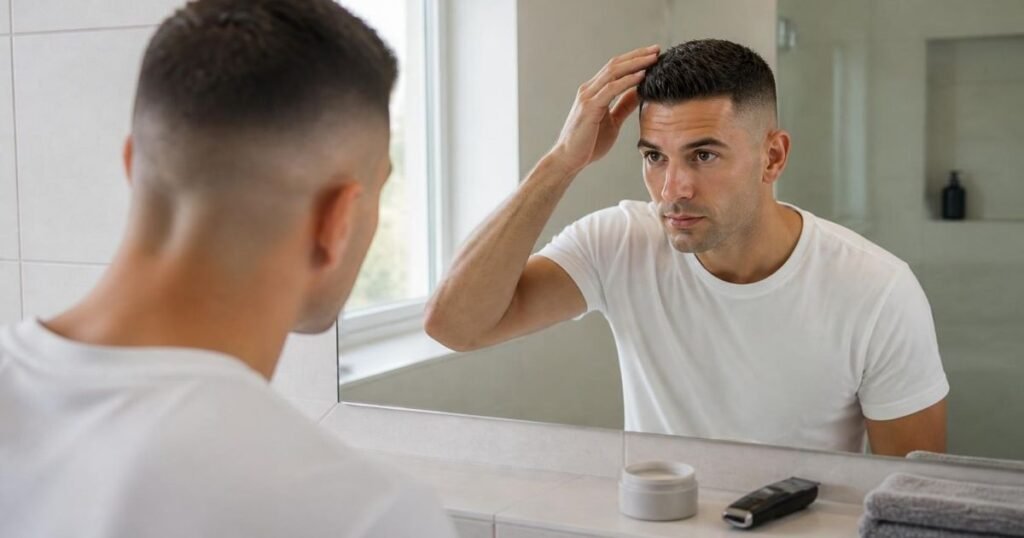
Upkeep comes down to three things: keeping the sides crisp, keeping the top in shape, and looking after exposed scalp. Styling is usually quick, but the short sides show regrowth fast.
How to Style a Modern High and Tight at Home
How much effort it takes depends on your top length.
| Product type | Finish | Typically suits |
| Matte clay | Firm hold, flat finish | Textured tops |
| Paste | Medium hold, low shine | Short to medium tops |
| Pomade | Varies, often more shine | Longer, swept styles |
| Cream | Light hold, soft finish | Curly or wavy hair |
Hold and finish vary by brand. For a textured top:
- Towel dry the hair so it’s damp.
- Dry the roots upward if you want lift.
- Warm a small amount of product between your fingers.
- Work it through from the back toward the front.
- Shape the front with your fingertips.
A very short top may need only a comb or brush. A longer top usually benefits from a dryer, a comb, and a bit more product.
How Often Does a High and Tight Need a Trim?
There’s no fixed number that suits everyone. How soon it needs attention depends on:
| Factor | Effect |
| Side finish | Skin shows regrowth soonest, a longer finish grows out more gradually |
| Growth speed | Varies from person to person |
| Hair density | Dense hair can look fuller sooner |
| How crisp you like it | A sharper look needs more frequent attention |
Signs it’s due include a blurred fade line, fuzz at the neckline, and a top that has lost its shape. As it grows out, the sides gain width and the contrast softens. Ask your barber what interval suits your hair, and whether they offer shorter clean-up visits between full cuts.
How to Maintain the Fade and Keep the Shape Looking Sharp
Do:
- Tidy the neckline with a trimmer between visits, using a mirror.
- Keep sideburns even.
- Moisturize exposed scalp, especially after close shaving.
- Think about sun protection on exposed scalp.
Avoid:
- Chasing the neckline higher each time, which changes the shape.
- Shaving over irritated skin. If irritation persists, see a professional.
The High and Tight with a Beard
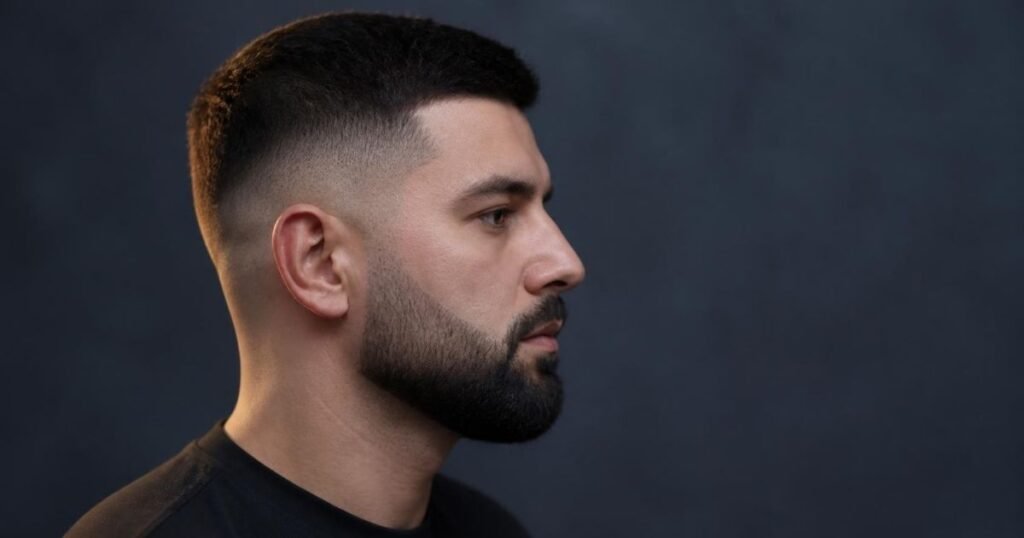
Very short sides plus a beard create strong contrast, and balance is the main question. Beard length, density, and the sideburn transition affect how it reads. The sideburns are where the fade meets the beard, and blending them makes the two look connected.
A short or medium beard keeps the focus on the cut, while a fuller beard adds weight to the lower face. Patchy areas and the contrast between hair and beard color can also change the look.
What to ask your barber:
- Blend the sideburns into the fade.
- Shape the beard line on the cheeks.
- Define the beard neckline.
What to notice: where the fade ends and the beard begins, and whether the sideburn forms one continuous line.
Frequently Asked Questions
Should the high and tight be reserved for the military?
No. It started with military grooming, but civilians wear it by choice. Service members should follow current regulations, and any workplace dress code is worth checking.
What are the dimensions for a contemporary, high and tight?
There’s no single set. The “dimensions” are side height, side finish, transition, and top length. See the guard and top-length sections for reference points.
How often does a high and tight cut need a touch-up?
It depends on your finish, growth speed, and how crisp you like it. The trim section covers the factors.
Is it possible to work with the high and tight curls/waves?
Generally yes, with enough length on top for the curl or wave to show. See the curly and coily sections for details.
What is the difference between a high and tight and a high fade?
High and tight is the overall structure, while a high fade is a technique. A high fade can pair with many tops.
Is a modern high and tight easy to maintain?
Styling is usually quick, but the sides show regrowth, so visits and neckline tidy-ups matter. See the upkeep section.
Conclusion
A modern high and tight haircut comes down to a few choices: how high the sides go, how short they finish, how they meet the top, and how long the top is. Hair type, hairline, and head shape affect how those choices look on you.
Results vary, and the same words can mean different cuts at different shops. Photos, measurements, and a quick check before the clippers start help.
Before you book:
- Decide on side height and finish.
- Choose a top length.
- Collect two or three reference photos.
- Plan how you’ll style and maintain it.

Jake Miller is a barbering and men’s hairstyle enthusiast who shares practical tips, haircut inspiration, and the latest grooming trends at BarberZylo. He enjoys exploring modern and classic hairstyles and helping readers find fresh ideas for their next look.
2 Comments