

56+ Best Hairstyles for Men With Thick Hair (2026)
Thick hair gives a barber plenty to work with, and plenty to fight. Bulk can make a cut sit wide at the sides, stand up at the crown, or look heavy once it grows out. The fix is rarely just a different product. It’s usually a cut that removes weight in the right places while keeping the fullness you like on top.
This guide covers 59 hairstyles for men with thick hair, grouped as short crops and classics, fades and tapers, undercuts and parts, lifted styles, fringes, and layered or longer cuts. Each entry covers what makes the style recognizable, what thick hair does to it, and what to ask your barber. Further down, you’ll find how to choose between styles, brief a barber, style without stiffness, and keep the shape between cuts.
“Best” here means well suited to common thick-hair problems, not a ranking. Your texture, density, hairline and routine change how any of these turns out, so treat the list as a shortlist to take to your barber. If you’d rather start with the decision, jump to How to Choose the Right Hairstyle for Thick Hair.
What Is Thick Hair in Men?
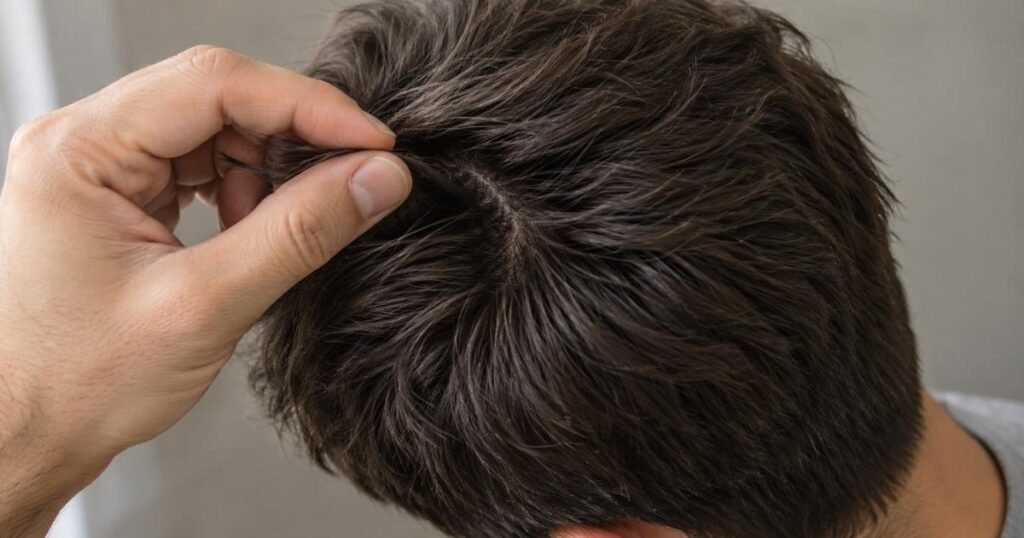
“Thick” gets used for three different things:
- Many hairs per patch of scalp (density)
- Wide individual strands (strand diameter, often called coarse hair)
- Hair that simply looks and feels voluminous
A man can have any mix of the three, and each calls for different decisions.
Two rough self-checks: part your hair and see how much scalp shows (less scalp usually means higher density), and roll a single strand between your fingers (a coarse strand feels distinct, a fine one barely registers). These are rough guides, not measurements. A barber can usually tell by feel.
Common frustrations include bulk that sits wide at the sides, longer drying time, and a tendency to turn frizzy or puffy when dry. Thick hair isn’t automatically healthier or unhealthier than other hair. It just behaves differently.
Thick Hair vs. High Hair Density
People often use “thick” and “dense” interchangeably, but they affect a haircut differently.
| Trait | What it means | Can feel like | Mainly affects |
| Scalp hair density | How many strands grow per area | Full, heavy, little scalp visible | Bulk, weight, how much scalp shows on short cuts |
| Strand diameter | How wide each strand is | Coarse and wiry, or fine and soft | Stiffness, hold, whether hair stands up or lies down |
| Texture | The strand’s shape (straight, wavy, curly, coily) | Smooth, bouncy, springy, tightly coiled | Direction, shrinkage, how layers fall |
Mixed combinations behave differently. Fine strands at high density can look full but soft, and may collapse under their own weight. Coarse strands at moderate density often stand off the head with less coverage. Knowing which describes you helps you ask for the right thing.
How Hair Texture and Density Affect Your Haircut
Texture changes what bulk looks like:
| Texture | What often happens with thick hair | Approaches worth discussing |
| Straight | Hangs heavy, shows blunt edges, can look flat or blocky | Texturizing, point cutting, angled fringes |
| Wavy | Expands sideways, can look messy if not shaped | Layers that follow the wave, light products |
| Curly | Shrinks when dry, can sit wide and round | Cutting for curl pattern, defined layers, moisture |
| Coily | Often dry, forms a dense outline | Shaping to a clear outline, tapered sides, moisture |
Growth patterns matter too. A crown swirl can lift hair, and a front cowlick (a growth direction that pushes hair against the way you comb it) can fight a fringe or part.
A few terms you’ll see throughout:
- Weight removal: taking bulk out through layering, texturizing or tapering.
- Layering: cutting different lengths so hair falls with movement. Internal layering removes weight from underneath so the outer hair still looks intact.
- Texturizing: breaking up hair so it separates and moves.
- Point cutting: snipping into the ends at an angle to soften a blunt edge.
- Thinning: removing hair with thinning shears. Heavy thinning can leave short, stray hairs, so it’s worth asking how a barber plans to do it.
Popular Hairstyles for Men With Thick Hair

Whether you want short haircuts for men with thick hair, medium-length hairstyles or long ones, the cut’s structure does more of the work than any product. This list works as a set of best haircuts for men with thick hair to shortlist from. It moves from short crops through fades, parts, lifted styles and fringes to layered and longer cuts.
If you’re not sure where to look, use this table:
| If you want… | Look at |
| Little daily styling | Crew Cut, Textured Crop, Classic Scissor Cut, Low Taper Fade, Messy Fringe |
| Short sides with a full top | Taper Fade, Mid Fade Haircut, Disconnected Undercut, Two Block |
| Texture and movement | Textured Quiff, Shaggy Haircut, Messy Layers, Surfer Waves |
| A combed, neat finish | Side Part, Comb Over, Slick Back, Ivy League Cut |
| Height on top | Brush Up, Modern Pompadour, Faux Hawk |
| Longer hair that doesn’t look heavy | Layered Haircut, Bro Flow, Long Layered Hairstyle |
Buzz Cut (With Thick Hair It Looks Stronger)
A buzz cut is one clipper length all over, with no blend and nothing to style. On dense hair it often reads as full and even because little scalp shows through, which is likely what gives it that “stronger” look. The trade-off is coarse strands: they can feel bristly and grow out wide and fuzzy sooner than finer hair. Head shape, crown swirls and hairline shape all show clearly. Bring a photo for length, and ask for a sharp edge and a neckline that suits your growth.
Crew Cut (Tapered, Not Boxy)
A crew cut keeps the sides and back short and tapered and leaves the top slightly longer. On thick hair, the taper controls how wide the sides sit, while top length decides whether hair lies flat or stands up. Coarse hair left too long can stand straight up, and a front cowlick may push the front sideways. The “boxy” version has squared top corners, so ask for a rounded top contour and a soft taper.
Ivy League Cut
An Ivy League is essentially a crew cut with enough length on top to comb or part. Barbers use the two names loosely, so a photo helps. Thick hair holds a part well, but dense, coarse hair may flip up unless the top is texturized. Ask for tapered sides and a top long enough to part, then comb it through damp hair with a light pomade or cream.
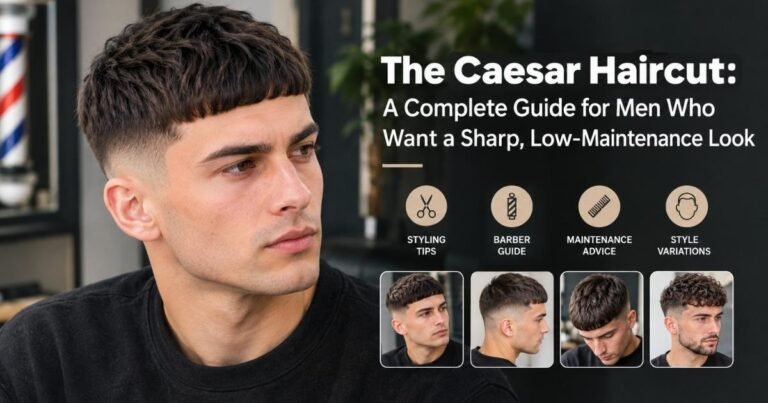
Caesar Cut (Short Fringe, Big Control)
A Caesar has a short, even-length top combed forward into a straight fringe (bangs, in the US). The short length is where the “control” comes from, since there’s little hair to puff. On straight, dense hair, though, the straight edge can look blocky. Ask your barber to texturize the fringe edge. Hairline shape and front cowlicks decide whether the fringe sits flat or lifts.
French Crop
A French crop is a short, textured top cropped forward with a short fringe, usually over faded or tapered sides. It differs from a Caesar mainly in the top: choppier and layered rather than uniform. Dense hair gives a full, textured top, but if the layers are cut too short it can stand up or look spiky. Matte clay worked in and pushed forward usually gives it shape.
Textured Crop
In a textured crop, the texture is cut in (with point cutting) instead of relying on product. That’s how a barber lightens thick hair without thinning it: the fullness stays, but the mass breaks up. If you want texture without making your hair look thinner, ask for point cutting rather than thinning shears. The fringe is optional and usually softer than a French crop’s.
Classic Scissor Cut (Textured, Easy, Timeless)
This cut is made mostly with scissors and comb, with softer sides and no hard fade, and weight comes out through layering. “Timeless” here means no sharp contrast to date it. It tends to grow out more gently than a faded cut, but because it follows your natural growth, waves and cowlicks matter more. If you’re choosing between a barber cut (clippers, fast and uniform) and a scissor cut (softer, more adaptable), this is the scissor side. It needs a barber comfortable with scissor-over-comb work.
Taper Fade
A taper fade shortens the sides and back gradually, usually leaving some length at the shortest point. Barbers and clients use “taper” and “fade” loosely, so photos help. As a rough guide:
| Cut | Where it starts | Shortest point | Contrast with a full top |
| Taper | Low, around sideburns and neckline | Leaves hair | Softest |
| Low fade | Just above the ears | Short, often close to skin | Mild |
| Mid fade | Around the temples | Short to skin | Medium |
| High fade | At or above the temples | Short to skin | Strong |
| Skin (bald) fade | Any height | Bare skin | Highest at that height |
| Shadow fade | Any height | Just above skin | Soft shadow |
On thick hair, removing bulk from the sides is what lets you keep the top full without bulky sides, which helps with hair that sticks out at the sides. The trade-off is that fades show regrowth sooner than softer cuts.
Low Fade Haircut With Messy Texture
A low fade begins near the ear and nape. The messy texture comes from internal texturizing and a matte finish, not from leaving bulk unshaped. Because a low fade leaves more hair on the sides, thick hair above it can still sit wide. If that bothers you, ask whether a tighter taper above the fade is needed. Rough-dry the top, then use paste or sea salt spray and finger-style it.
Mid Fade Haircut
A mid fade starts around temple level. It removes more side bulk than a low fade without exposing as much scalp or adding as much visual height as a high fade, so it’s a middle option for dense hair. It pairs with crops, quiffs and textured tops. Where a mid fade starts can differ by barber, so point to the spot on your head or show a photo.
High Fade Haircut
A high fade starts at or above the temples, leaving little hair on the sides under a full top. That contrast makes the top look fuller, but it also adds visual height and exposes ears, temples and head shape. On a face that already reads long, a tall top over a high fade can stretch things further (see best haircuts for oval faces). If you want the contrast but less drama, ask about a mid fade.
Skin Fade
A skin fade finishes at bare skin and can start at any height. On dense, dark hair the contrast against skin is very high. Regrowth shows quickly, and very close shaving can irritate sensitive skin or cause ingrown hairs, particularly with tightly curled growth. It differs from a shadow fade, which stops just short of skin.
Shadow Fade
A shadow fade stops just above skin, leaving a faint stubble “shadow.” Regrowth tends to be more forgiving because there’s no stark skin line to fill in. On dense, dark hair the shadow can read darker. It suits men who want contrast without bare scalp.
Read More About : 38+ Curly Hairstyles for Men Best Trending Hairstyles, Products & Care Routine
Drop Fade
In a drop fade, the fade line arcs down behind the ear toward the nape instead of running straight around. It can start at any height and works with a longer top or back. Because the curve sits behind the ear, check a back and side photo before choosing. Thick hair at the nape can look heavy if the curve isn’t blended.
Burst Fade
A burst fade is a semicircle faded around the ear, with length left behind it. It’s often paired with curly tops, mullets and longer backs. It differs from a drop fade because the drop follows the neckline, while the burst frames the ear. With thick curls, it cleans up around the ear while keeping volume on top and at the back.
Temple Fade
A temple fade focuses shortness at the temples and sideburns, with a crisp hairline edge. Definitions vary by barber, so show a photo. The top stays full. Hairline and temple shape matter, since recession shows more. The sharp edge softens as hair regrows, so expect it to need tidying more often than the rest of the cut.
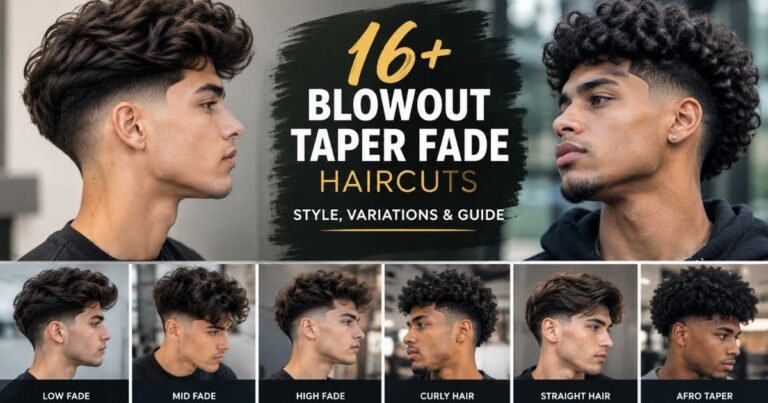
Blowout Taper
A blowout taper pairs tapered sides with a voluminous, blow-dried top. Styling effort is relatively high, since you’ll dry it with a brush or fingers for lift. Thick hair builds volume easily but can go top-heavy, so ask for internal layering. A heat protectant helps if you blow-dry often.
Curly Taper Fade
This cut tapers the sides and leaves a curly top longer. With thick curls, shrinkage means curls look shorter dry than wet, so don’t judge length when wet. Ask your barber to check it dry. Avoid heavy thinning on curls, which can cause frizz. A curl cream helps with definition. It differs from an afro fade in having looser, more defined curls over a gradual taper.
Read More About : 59+ Best Afro Hairstyles for Men ( 2026 Guide)
Afro Fade
An afro fade shapes tightly coiled hair into a full, rounded top over faded sides. Coily hair tends to be drier, so moisture matters. Shaping a clean round outline is a skill, so look for a barber experienced with coily textures. A pick or wide comb lifts and shapes it. Compared with a tapered afro, the contrast between the top and sides is higher.
Tapered Afro (For Thick Coils/Curls)
A tapered afro keeps more hair at the sides with a gradual taper and a rounded outline overall. With no hard skin line, it grows out more softly. Regular trims hold the outline in shape. If your goal is a natural look that doesn’t need frequent tidying, this is the gentler option.
Low Taper Fade
A low taper fade is the least dramatic option here. Only the sideburns and neckline are shortened, and most side hair stays. It’s minimal change and grows out gently. On thick hair, the sides may still sit wide, so if width is the issue, ask about a higher taper.
Undercut (Sleek or Textured)
An undercut has sides and back clipped short, often to one length with no gradient, and a much longer top. The sleek version is slicked back, and the textured version is messier. A dense top can look heavy, so ask for weight removal. The sides need regular tidying to stay sharp.
Disconnected Undercut
A disconnected undercut has a visible step between the short sides and the longer top, with no blend. On thick hair, the top can sit like a helmet, so ask about weight removal or layering. Tell your barber how pronounced the step should be, ideally with a photo.
Read More About : Asian Hairstyles for Men: Find the Right Haircut for Your Face Shape
Comb Over
A comb over has short sides and a top combed across to one side, usually with a hard or soft part. Thick hair holds this structure well, but growth direction and cowlicks limit the sweep, so a barber may cut to your natural direction. A cream or pomade and a comb finish it. Here it means a deliberate styled sweep, not an attempt to hide anything.
Side Part (Classic With a Modern Taper)
A side part has a visible part line, tapered sides and a top combed to one side. To find your natural part, push your hair back and see where it splits, because a cowlick may fight a forced one. Thick hair often needs blow-drying to the side while damp. “Modern” here means a softer taper rather than a skin-short side. A barber can add a hard part line, a thin shaved groove, if you want one.
Slick Back (Clean & Controlled)
A slick back needs a top long enough to comb straight back from the forehead. Coarse hair may resist lying flat, so blow-dry backward while damp, then comb with pomade. “Controlled” comes from weight removal plus the right product. A matte finish tends to look less heavy than high-shine on dense hair. A receding hairline or temples show more. It differs from a pompadour, which adds lift instead of lying flat.
Brush Up
A brush up has a short-to-medium top brushed up and slightly forward with a rough finish, over short faded sides. Dense strands stand up readily, so matte clay holds them. It differs from a quiff by being shorter, with less sweep.
Textured Quiff (Bulk-Reduced)
A quiff lifts the front up and back. Here, the bulk reduction comes from internal layering and texturizing so it lifts without becoming a solid block. Ask for texturizing instead of heavy thinning. Blow-dry the roots upward and set the shape with clay.
Read More About : The Buzz Cuts For Asian Men: 17 Masculine, Simple, Stylish & Easy Styles Options
Wavy Quiff (For Thick Hair With Natural Movement)
This quiff is cut to follow your waves instead of flattening them. Use less product. A light cream or sea salt spray and gentle drying (air-dry or diffuse) keeps natural waves from looking messy while keeping their shape.
Modern Pompadour (Tapered Sides)
A pompadour sweeps hair up and back from the forehead into a rounded front lift. “Modern” here means lower, softer height, tapered sides instead of skin-short ones, and a natural finish. Styling effort is higher: blow-dry, comb, then pomade or clay. It differs from a quiff by being smoother and more swept back. Keep height in proportion to your face (see best haircuts for oval faces).
Short Spiky Crop Haircut (Modern, Not 2005)
This is a short, texturized top styled into small, defined points. “Modern” here means softer points and matte clay instead of crunchy gel. Thick strands stand easily, so spikes can look jagged if cut too blunt. Ask for point cutting.
Faux Hawk
A faux hawk has a longer center strip styled up, with tapered (not shaved) sides. Strip width and peak height decide the look. Dense hair holds the ridge well. It differs from a mohawk, where the sides are cut away.
Mohawk
A mohawk has very short or shaved sides and a distinct strip of longer hair down the middle. Dense hair gives a solid ridge, and it can stand up or lie down depending on styling. The sides need frequent upkeep.
Angular Fringe
An angular fringe is cut on a diagonal, so the edge slopes across the forehead instead of running straight. On thick hair, the diagonal breaks up the blunt weight line of a straight fringe. Ask for a diagonal cut with point cutting.
Read More About : 20+ Worst Haircuts for Men with Oval Faces
Choppy Fringe
A choppy fringe has uneven lengths cut into it so the ends look broken. It suits wavy or curly hair, where the bounce adds to the effect. Over-choppy cuts can turn frizzy. A paste separates the pieces.
Textured Fringe
A textured fringe is short to medium, with its texture coming from the cut and a matte finish. Unlike a textured crop, where the whole top is the focus, here the fringe is the feature. It’s usually paired with short faded sides.
Messy Fringe
A messy fringe is longer and looser, designed to be air-dried. Wave or curl does most of the work, so a light sea salt spray is usually enough. It needs little daily styling, though cowlicks can flip the front.
Side Swept
A side swept cut has a medium-length top moving to one side over shorter sides, soft with no hard part line. It differs from a comb over by being less structured. To make thick hair sit flatter, blow-dry in the sweep direction while damp.
Low Fade With Textured Fringe
This is a pairing: low-fade sides with a textured fringe. Ask where the fade begins relative to the fringe so the sides don’t look heavy beneath it. See the Low Fade Haircut With Messy Texture and Textured Fringe entries for details.
Wolf Cut (Modern Shag Energy)
“Shag energy” means a layered shape: shorter layers at the crown and longer, wispier ends. On thick hair, short crown layers can puff into a rounded top, so ask where the layers start. It differs from a shaggy cut (less crown-to-nape contrast) and a mullet. Good layering is also how to keep volume without a triangular shape.
Read More About : 22+ Haircuts for Men with Round Faces That Add Definition
Shaggy Haircut
A shaggy cut has choppy layers throughout at medium length, with less contrast between crown and nape than a wolf cut. Layers remove weight so thick hair doesn’t pile at the ends. Air-dry it and add sea salt spray for texture.
Curly Shag (If Your Thick Hair Has Wave/Curl)
A curly shag is layered to follow your curl pattern. Cut it dry, or ask your barber to see the curls dry, so layers sit where they should and don’t make a triangle shape. Use moisture and a definition cream.
Messy Layers
Messy layers is a tousled finish on short-to-medium layered hair, usually straight to wavy. The look comes from rough-drying and a little texture product. The layering underneath is covered in the Layered Haircut entry.
Layered Haircut
Layering strategy matters most on thick hair. There are three types: long layers (visible, add movement), internal layers (hidden, remove weight from beneath) and short layers (add lift but can add bulk if cut too short on dense hair). Where layers start also matters, because starting them too high can puff the crown. This is the main way to keep longer thick hair from looking heavy.
Mod Cut
The mod cut is often associated with 1960s mod style: an ear-covering shape with a fringe. On dense hair there’s a helmet risk, so ask for layering at the sides and back. It differs from a bowl cut (rounder, more uniform) and a curtain cut (defined by the part).
Modern Mullet
A mullet is shorter at the front and sides and longer at the back. “Modern” means a softer transition, often with a tapered or burst fade. Thick nape hair adds weight, so the back needs shaping. It differs from a wolf cut, which is layered all around.
Bro Flow (Medium Length, Natural Movement)
A bro flow is grown-out, medium-length hair falling back from the forehead, usually covering the ears. On dense hair, sides can push outward, so ask for weight removal there. It’s low effort but still needs shape to avoid looking shapeless. It differs from surfer waves by being more swept back and less textured.
Read More About : Diamond Face Shape Hairstyles Men: 15+ Best Looks for a Sharper Style
Surfer Waves (Thick, Textured, Relaxed)
Surfer waves are beach-wave texture on naturally wavy hair, medium to long. Sea salt spray adds grip but can dry hair, so pair it with moisture. Air-dry. It differs from a bro flow by having more wave and less sweep.
Curtain Cut
A curtain cut has a center part with hair falling toward each side, roughly brow to cheek level. On thick hair, the sides can swell, so ask for layers. Part direction and cowlicks affect how it falls.
Middle Part
Here, the part is the point: hair split down the center. Find your natural part, work around cowlicks, and blow-dry in sections. If a perfectly central part fights your growth, try off-center. It differs from the curtain cut, which is a full cut around the part.
Two Block (K-Style Shape, Thick-Hair Friendly)
A two block has short sides and back and a longer top, with a soft transition that’s usually hidden under the top. “K-style” loosely refers to styling often associated with Korean men’s hair. “Thick-hair friendly” here means the short sides remove bulk where it builds, while the top can be layered. It differs from an undercut by having a less stark transition.
Bowl Cut
A modern bowl cut is tapered or shorter underneath, with a textured top and fringe, instead of a rigid helmet. Dense hair holds the round shape strongly, so thick hair gives no particular advantage here and can exaggerate a helmet look. Ask for texture and shorter sides.
Man Bun / Top Knot (Thick Hair = Better Bun)
A man bun sits at the back of the head, and a top knot sits higher. Thick hair makes a fuller bun, but also a heavier one, so use a hair-friendly tie and avoid constant tight tension at the hairline. An undercut-sides variant reduces bulk. Growing into one means an in-between stage.
Long Layered Hairstyle for Thick Hair
Layers on long thick hair remove weight and add movement. Decide where they begin so you avoid a triangle shape, and plan trims to keep the ends from thickening.
Read More About : 25+ Best Haircuts for Oval Face Men (2026 Guide)
Medium-Length Wavy Hairstyle for Thick Hair
At medium length, waves tend to expand and weight can pile at the sides. Layers help, and cutting with the wave pattern in mind keeps shape. It differs from surfer waves, which focus on beach-style finishing.
Medium-Length Curly Hairstyle for Thick Hair
Shrinkage matters most here, so cut for curl pattern and see how it sits dry. Moisture and definition products help.
Long Straight Hairstyle for Thick Hair
Long straight hair can hang heavy and flat. Layers and face-framing sections add movement (see best haircuts for oval faces on flat long hair).
Long Wavy Hairstyle for Thick Hair
Long waves need layering so they don’t form a triangle shape. Manage frizz by diffusing or air-drying.
Long Curly Hairstyle for Thick Hair
Length is deceptive when curls are wet because of shrinkage. Detangle gently, trim to keep shape, and keep curls moisturized.
How to Choose the Right Hairstyle for Thick Hair

Use these five lenses to narrow the list. They apply the definitions from earlier, so skip back if a term is unfamiliar.
By Face Shape
Face shape is a styling guideline, not a rule. Thick hair adds width at the sides, so a taper can help balance proportions. Here are things worth raising with your barber:
| Face shape | Things worth discussing |
| Oval | Often adaptable; watch for extreme height or a heavy fringe |
| Round | Height on top and shorter sides may add vertical lines |
| Square | Softer texture on top may soften angles; some prefer keeping structure |
| Oblong | Moderate height, with a fringe or side fullness |
| Heart or diamond | A side-swept or textured fringe may balance a wider forehead or cheekbones |
By Hair Texture
| Texture | Styles to look at |
| Straight | Caesar Cut, French Crop, Side Part, Slick Back, Angular Fringe |
| Wavy | Wavy Quiff, Surfer Waves, Messy Fringe, Shaggy Haircut |
| Curly | Curly Taper Fade, Curly Shag, Choppy Fringe |
| Coily | Afro Fade, Tapered Afro, Low Taper Fade |
By Hair Length and Desired Look
- Short: low styling effort and sharp edges, but regrowth shows sooner on fades.
- Medium: more movement, but thick hair can get heavy, so layering matters.
- Long: needs layering and trims to avoid a heavy, triangular shape.
By Hair Density and Strand Thickness
| Combination | Often worth discussing |
| Dense and coarse | Weight removal, matte clay, shorter sides |
| Dense but fine | Careful layering, lighter products, avoiding over-thinning |
| Moderate density, coarse | Hair may stand off the head; keep length or add texture |
On short cuts, scalp visibility is worth asking about.
By Styling Time and Maintenance
Low styling effort and low upkeep are different things. A skin fade needs little styling but frequent barber visits. A scissor cut may need more styling but grows out gently. If you want low-maintenance haircuts for men with thick hair, decide which kind of low you mean.
| Type | Examples |
| Low styling, frequent upkeep | Skin Fade, Mohawk |
| Low styling, gentle grow-out | Classic Scissor Cut, Low Taper Fade |
| Higher styling effort | Modern Pompadour, Blowout Taper |
Ask yourself: How many minutes will I realistically spend each morning? Do I mind frequent barber visits? Do I want a style that grows out neatly?
How to Ask Your Barber for a Thick Haircut

A good brief covers weight, texture, a reference photo, length and grow-out. No phrase guarantees the same result at every shop, so keep the conversation going during the cut.
Ask for Weight Removal
Weight removal takes bulk out through layering, texturizing or tapering. It’s the main answer to how to reduce bulk in thick hair. It differs from thinning, so ask how your barber plans to do it. Check how it looks dry, because hair that looks bulky after a haircut is often a weight issue.
Mention Layers or Texture
Layers add movement, and texturizing lightens inside. Point cutting is a gentle way to do it. With curls, be careful about thinning.
Show a Reference Photo
Pick photos of hair like yours in density, texture and hairline, from several angles. Show what you don’t want too. If a haircut looks different from the photo, differences in hair type are usually why. You can also show how you want your hair to fall by using your hand or a comb.
Explain Your Preferred Length and Shape
Use relative lengths (a little longer than now), say where a fade should start, how long the top should be, rounded or squared, and what neckline you like. Avoid guard numbers, which vary.
Discuss How the Haircut Will Grow Out
Ask what it will look like as it grows. Fades show regrowth quickly, and thick hair tends to grow outward before it grows down.
How to Style Thick Hair for Men

If you’re wondering how to style thick hair for men, think in steps. Prep, dry, product, finish.
Wash & Condition Properly
Prep for styling: towel-dry gently, apply conditioner to the lengths, and consider a leave-in if your hair is dry.
Use a Pre-Styler for Control
Apply sea salt spray or a leave-in to damp hair for grip or smoothing. If you blow-dry often, use a heat protectant.
Blow-Dry to Reduce Bulk
Towel-dry, rough-dry, then direct airflow downward to smooth and lift roots where you want volume. Use medium heat.
Apply Product in Small Amounts
Start small, warm it in your hands, apply from underneath, and add more only if needed.
Finish for Shape, Not Stiffness
Finger-shape and use a light brush-through. A flexible hold helps you avoid a stiff finish.
Choose a Styling Product for Your Desired Finish
| Finish you want | Product types |
| Matte, structured | Clay |
| Soft, natural | Cream |
| Flexible, separated | Paste |
| Smooth, combed | Pomade |
| Tousled | Sea salt spray |
How to Style Thick Hair Without Creating Too Much Volume
If thick hair is difficult to control or looks puffy:
- Don’t over-lift the roots.
- Flatten the sides with a damp comb as they dry.
- Start with the cut’s weight removal.
- Use lighter products.
How to Maintain Thick Hair

Frequency depends on your texture, scalp, activity and style, so look for signs, not numbers.
Get Regular Trims
Signs you need one: the shape has gone, a fade has grown out, or bulk is returning. Fades and short cuts need upkeep sooner than longer layers. Ask your barber for a recommendation for your hair.
Avoid Overwashing
How often you wash depends on scalp oil, texture and activity, and curly and coily hair is often washed less. Use a clarifying shampoo occasionally.
Keep Hair Moisturized
Apply conditioner to mid-lengths and ends. Hair porosity (how readily hair takes in and loses moisture) varies, and high-porosity hair may need richer products. Deep conditioning can help coarse or curly hair.
Control Frizz and Puffiness
Frizz comes from dryness, humidity, rough toweling, heat and cut shape. Remedies include gentle drying, moisture and a cut that removes weight. See the styling checklist above for volume rules.
Maintain the Shape Between Haircuts
Tidy the neckline and sideburns, be cautious with DIY on fades, and ask your barber about quick tidy-ups.
Best Hair Products for Men With Thick Hair

| Product type | Finish | Hold | Watch out for |
| Clay | Matte | Strong | Stiffness if overused |
| Cream | Natural | Light | May not hold height |
| Paste | Matte to satin | Medium, flexible | Can build up |
| Pomade | Smooth, often shiny | Varies | Heaviness |
| Sea salt spray | Tousled | Light | Dryness |
Texture Clay
Gives a matte finish and stronger hold for structured and textured looks. It can feel stiff if overused.
Styling Cream
Light, smooth, natural hold, good for softer or longer styles. It may not hold height.
Molding Paste
Flexible, medium hold that separates pieces and defines layered looks.
Pomade
Smooth and often shinier, suits slicked and parted styles. Matte versus high-shine finish varies by product, and heavy application can weigh dense hair down.
Sea Salt Spray
Adds grip and a tousled texture. It can dry hair, so pair it with moisture.
Hydrating Argan Oil
A few drops add softness and frizz control, mostly on the ends. Too much can look greasy.
Clarifying Shampoo
Removes product buildup. Use it occasionally, since it can dry hair.
Hydrating Conditioner
Softens hair and aids detangling. Apply to mid-lengths and ends.
Frequently Asked Questions About Managing, Cutting & Styling Thick Hair for Men
Which haircut is best for thick hair?
The best haircuts for men with thick hair include textured crops, taper fades, crew cuts, layered styles, and quiffs. Choose a cut based on your hair texture, face shape, preferred length, and how much time you want to spend styling it.
Is short hair good for thick hair men?
Yes, short haircuts can work very well for men with thick hair because they reduce length and make daily styling easier. Crew cuts, buzz cuts, French crops, and short taper fades are practical options, especially when the sides are shaped to prevent unwanted bulk.
What is the best low-maintenance haircut for thick hair men?
A crew cut, buzz cut, short textured crop, or classic taper is a good low-maintenance haircut for men with thick hair. These styles require relatively little daily styling, although fades and sharply defined edges need regular barber visits to stay neat.
Are fades good for thick hair?
Yes, fades are excellent for thick hair because they create cleaner sides while allowing you to keep length and texture on top. Low, mid, and high fades can all work, depending on your preferred contrast, head shape, and how much bulk you want to remove.
What fade works best for thick hair?
A mid fade is a versatile choice for thick hair because it balances clean sides with enough length on top for textured crops, quiffs, and brush-up styles. A low fade offers a more subtle finish, while a high fade creates stronger contrast and removes more visible bulk from the sides.
How can I style my thick hair?
Start with clean, towel-dried hair, apply a small amount of suitable styling product, and use a blow-dryer with a brush or your fingers to guide the shape. Finish with clay, paste, or styling cream depending on whether you want a matte, textured look or a softer, more natural finish.
How do I stop thick hair from looking too puffy?
Ask your barber to shape the sides and remove excess weight where your hair expands, while preserving enough length for a balanced silhouette. At home, use conditioner, avoid excessive brushing when dry if your hair is wavy or curly, and choose styling products that control volume without making your hair stiff.
How do I reduce bulk in thick hair without losing volume?
Ask for strategic internal layering or selective texturizing to remove excess weight while keeping the overall shape and fullness. Avoid aggressive thinning, especially if your hair is coarse, wavy, or curly, because excessive thinning can create frizz, flyaways, or uneven volume.
Should I ask my barber to thin or texture thick hair?
Ask your barber to assess whether your hair needs weight removal, layering, or light texturizing rather than requesting thinning automatically. The right technique depends on your hair density, strand thickness, texture, and desired shape, since too much thinning can make thick hair harder to control.
What styling products should I use for thicker hair?
Matte clay or molding paste works well for textured, controlled hairstyles, while styling cream can provide softer hold and help manage longer or wavier hair. Pomade suits slick, polished looks, but the best product depends on your hair texture, desired finish, and how much hold you need.
What shampoo and conditioner are best for thick hair?
Choose a shampoo suited to your scalp and a conditioner that matches your hair’s moisture needs, especially if your thick hair feels dry, coarse, or frizzy. A moisturizing conditioner can improve softness and manageability, while a clarifying shampoo is best used occasionally when product buildup develops rather than as a default daily cleanser.
How often should men with thick hair get a haircut?
Most men with thick hair benefit from a trim every four to eight weeks, depending on the haircut, growth rate, and how sharply defined they want the shape to remain. Short fades and precise crops often need more frequent maintenance, while layered medium-length and long hairstyles can usually go longer between trims.
Can men with thick hair wear longer hairstyles?
Yes, men with thick hair can wear longer hairstyles such as bro flows, curtain cuts, shaggy layers, man buns, and long curly styles. Strategic layering helps distribute weight and improve movement, while the right routine can prevent the hair from looking overly heavy or bulky.
What should I ask my barber if I have very thick hair?
Tell your barber how much length you want to keep, where your hair tends to puff out, and how much daily styling you are willing to do. Ask whether strategic weight removal, layers, or texturizing would suit your hair, and bring reference photos that show the cut from the front, sides, and back.
What haircut works best for boys with thick hair?
Crew cuts, textured crops, classic tapers, and short layered haircuts are practical options for boys with thick hair because they are comfortable and relatively easy to manage. For boys who prefer longer hair, a layered scissor cut can reduce heaviness while preserving natural movement and a softer shape.
Conclusion
Choosing among hairstyles for men with thick hair comes down to three questions. What does your texture do? Is density or strand thickness the main issue? How much daily effort will you accept?
Take your shortlist, a few reference photos and the barber brief from this guide, and keep the conversation going during the cut. Results vary with your hair and how your barber adapts the style. For more, see our guide to haircuts for oval faces.
Jake Miller is a barbering and men’s hairstyle enthusiast who shares practical tips, haircut inspiration, and the latest grooming trends at BarberZylo. He enjoys exploring modern and classic hairstyles and helping readers find fresh ideas for their next look.


3 Comments