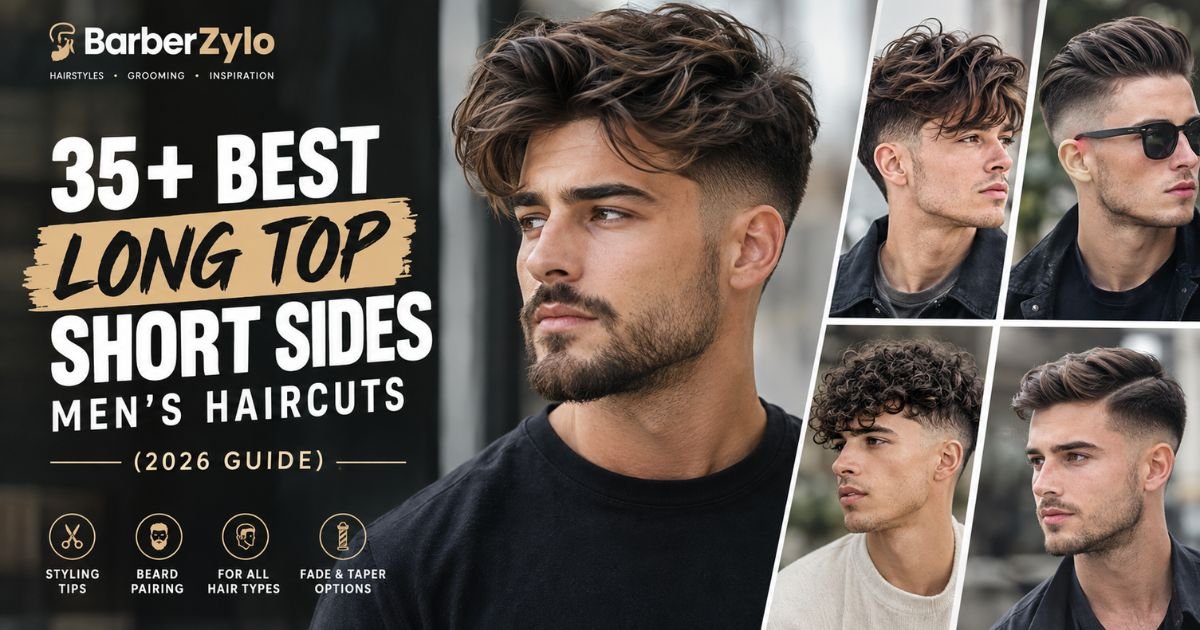
35+ Best Long Top Short Sides Men’s Haircuts (2026 Guide)
A long top short sides men’s haircuts is one idea with many versions. The top stays long enough to part, sweep, lift or texture, and the sides are cut short enough to keep the outline controlled. What changes from one version to the next is how the sides are cut (fade, taper or undercut), how the top is shaped, and how much daily effort you’re willing to put in.
This guide covers 35 variations, then helps you narrow them down by hair type, face proportions and upkeep. It also gives you the words to ask for one at the barbershop.
A note on measurements: “long” here means roughly 2 inches (5 cm) or more on top, enough for the hair to move. A few entries are shorter, and they’re labeled. All length ranges are approximate, because barbers measure differently and curly hair looks shorter than it is.
Quick-pick table
| If you want… | Entries to look at |
| The lowest daily effort | 10, 25, 28, 31, 33, 35 |
| An office-friendly, structured look | 4, 8, 17, 19, 26 |
| Waves to show | 9, 20, 28 |
| Curls or coils to show | 15, 22, 31 |
| Fine hair with lift | 18, 24, 29, 34 |
| A sharp contrast between top and sides | 3, 4, 11, 13 |
| A softer transition from top to sides | 2, 19, 25, 35 |
| To test the style with less length | 14, 16, 21, 34 |
| Something bolder | 12, 27, 30 |
Results depend on your density, texture, hairline and how your barber adapts the cut, so treat these as starting points for a conversation, not promises.
What Makes a Long Top Short Sides Haircut So Popular?
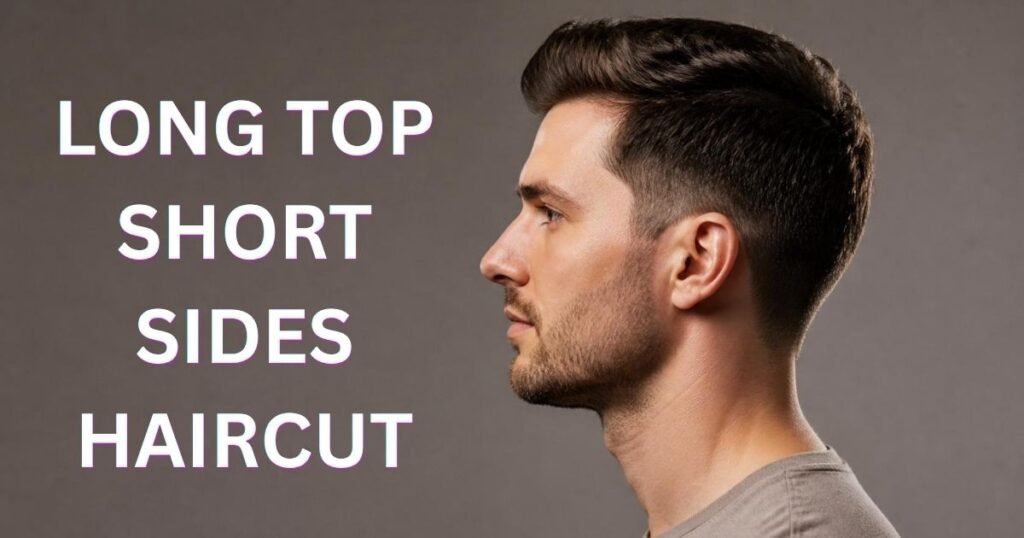
The cut has four parts. The top is the longer hair you style. The sides and back are kept short. The transition is where the length changes, and it does most of the visual work. A gradual transition (a fade or taper) looks soft and blended. An abrupt one (an undercut) looks like a deliberate step.
The main practical appeal is flexibility. Because the sides stay short and fixed, you can change what happens on top (pushed up, swept across, combed back, left loose) without needing a new haircut. The top can also stay a little unfinished and still look intentional, since the sides frame it.
It’s different from a uniform medium-length cut, where everything is similar in length, and from a short crop, where there isn’t enough top to restyle. Many versions have standard names. “Short back and sides” is common in the UK, and you’ll also hear “undercut,” “taper” or “fade with a longer top.”
How much length to leave depends on what you want to do with it. About 3 inches (8 cm) is a reasonable starting point for hair you can sweep or lift, and shorter reads are more like a crop. Hair behaviors such as cowlicks, a thin crown or a receding hairline can change how any of these cuts sits, which the next section covers.
How to Choose the Best Long Top Short Sides Style for You?
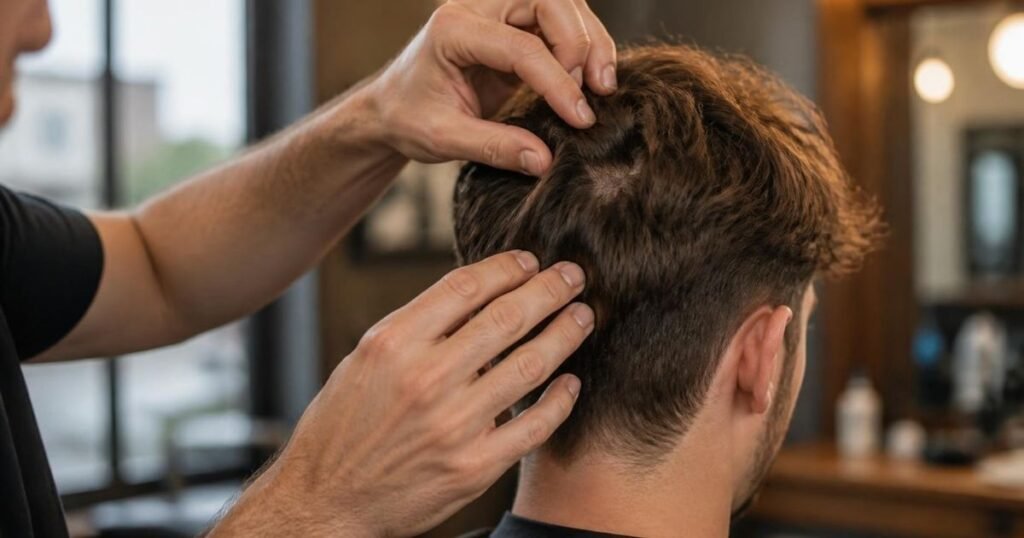
Think in this order: your hair first, then your face and head proportions, then how much effort you’ll put in, and finally how the sides are cut. A barber who has seen your hair dry and in motion is a better judge than any general rule here.
1. Consider Your Hair Type (straight, wavy, curly, thick, thin)
Texture, density and strand thickness are separate. Texture is the shape of the strand (straight, wavy, curly, coily). Density is how many strands cover the scalp. Thickness is how wide each strand is. Someone can have fine strands with high density, or thick strands with low density, and the cut behaves differently in each case.
| Hair characteristic | What to consider | Entries to explore | Watch out for |
| Straight | Holds sharp lines and parts well, but can lie flat | 1, 4, 13, 17, 19 | Needs root lift for volume |
| Wavy | Gives natural lift and movement | 9, 20, 28 | Waves shrink when dry |
| Curly or coily | Needs length measured when dry, plus moisture | 15, 22, 31 | Shrinkage and puffiness at the sides |
| Dense or thick | Fills high-contrast shapes easily | 3, 11, 26 | Bulk may need weight removal or layering |
| Fine or low-density | Soft transitions and light texture tend to look fuller | 18, 24, 29, 34 | High contrast can make the top look sparser |
Three other things deserve a mention. Cowlicks are spots where hair grows against the pattern, often at the front hairline. Crown whorls are the spiral at the back of the top of the head. Both can push hair in an unplanned direction, so ask the barber to cut with the growth. A receding hairline or thinning at the temples or crown changes which fringe and part work. A longer top can look fuller or sparser depending on the cut. No haircut reliably conceals hair loss, so it’s fair to ask your barber what they’d realistically recommend.
2. Consider Your Face Shape
Face shape is one factor among several, alongside forehead height, jaw width, head shape, ear position and beard. Height, volume and fringe are the main tools for balancing proportions.
| Face shape | Approaches that may be worth considering |
| Oval | A wide range works, so choose based on hair type and lifestyle |
| Round | Height on top and tighter sides can add vertical emphasis |
| Square | Texture or a softer fringe can soften angles, though strong structure also works |
| Oblong | Extra height may lengthen the face further, so forward or sideways movement can help |
| Diamond | A fringe or volume at the forehead may balance wider cheekbones |
| Heart | A side-swept fringe can soften a wider forehead, and fuller sides can balance a narrow chin |
| Triangle | Volume on top may balance a wider jaw |
These are tendencies, not rules. A beard, glasses or a prominent jaw can change the picture, and plenty of people wear styles that “break” these guidelines well.
3. Consider Your Lifestyle & Maintenance Level
Ask yourself these questions before choosing:
- How much time will you spend styling each day, and will you use a hair dryer?
- Does your workplace or school have a dress code?
- Do you wear helmets, caps or headphones that flatten the top?
- How often are you willing to visit a barber?
Effort has two parts: daily styling and cut upkeep. Textured, air-dried tops are usually lower effort. Pompadours, slick-backs and blowouts usually need a dryer and a firmer product. Skin fades and disconnected cuts need visits more often to stay sharp. Each entry below carries a rough effort label (lower, medium, higher), which varies with your hair.
4. Choose Between a Fade, Taper, and Undercut
| Option | What it looks like | Contrast | Grows out |
| Taper | Gradual shortening, mostly at the sideburns and neckline | Low to medium | Gently |
| Fade | Gradual shortening across more of the sides, often to very short | Medium to high | Depends on height and length |
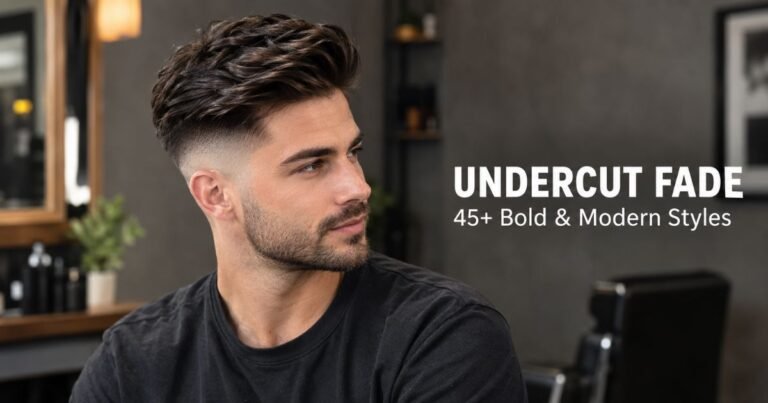
| Undercut | Short sides with a visible step up to the top | High | The step softens, so it’s noticeable |
If you’re unsure, a taper is the lower-risk choice because it keeps more hair at the sides. The fade section below explains the differences in detail.
Best Long Top Short Sides Men’s Haircuts (With Styling Tips)
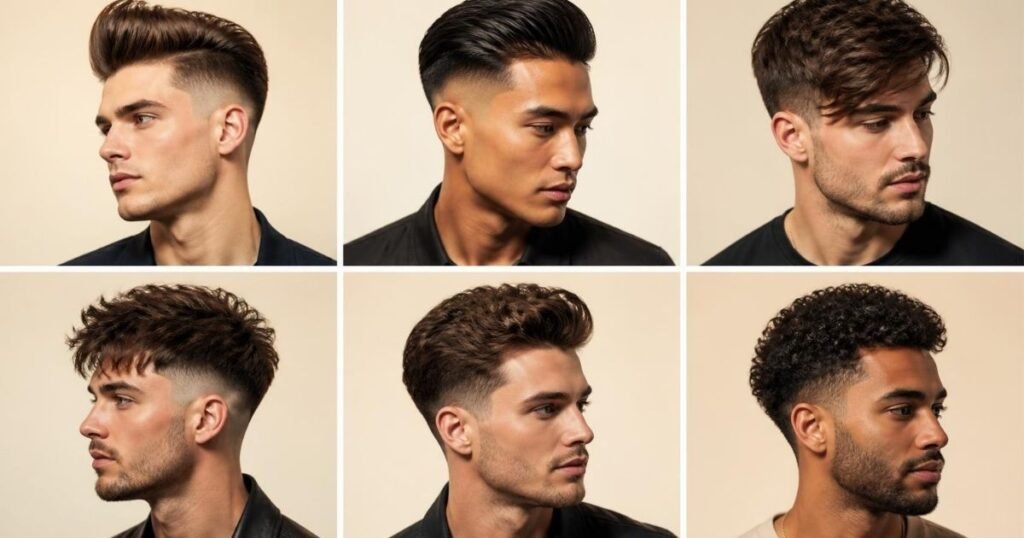
Each entry gives rough lengths, the side treatment, and an effort level, followed by what makes the style recognizable and what to ask for. Where a hair behavior matters, it’s mentioned. The same terms can mean different things to different barbers, so a photo (ideally front, side and back) is more reliable than a name.
1. Modern Pompadour Fade
Top about 3–5 in (8–12 cm), longest at the front · Sides faded · Effort: higher
The pompadour is recognizable by height at the front hairline, with hair swept up and back in a smooth rise. Fading the sides makes the rise look taller by contrast. In profile photos, look at how far the hair lifts above the forehead.
It needs enough density at the front to hold that height. Fine hair may need a blow-dry and a firmer product, and coily hair can wear a shaped version with the right cut. Ask for a fade at a specific height, with length kept at the front for a pompadour. Blow-dry upward with a round brush, then set with pomade. It differs from a quiff (entry 2) in being taller, smoother and more structured.
2. Long Quiff with Tapered Sides
Top about 3–4 in (8–10 cm) · Sides tapered · Effort: medium
A quiff lifts at the front and curves forward, looser and less rigid than a pompadour. Here the sides are tapered, meaning they’re shortened gradually, mostly around the sideburns and neckline, so more length stays through the middle. That’s the main difference from entry 1 and gives a softer transition.
A cowlick at the front hairline can push the lift off-center, so mention it. Ask for movement and softness on top. Work a matte clay through with your fingers and push the front up and forward.
3. Undercut with Long Top
Top about 3 in+ (8 cm+) · Sides clipper-short · Effort: medium
An undercut means the sides are cut to one short length with no gradual blend, leaving a visible step up to the top. Barbers use “undercut” and “disconnected” loosely, so bring a photo. Entry 11 covers the version where the line itself is the focus.
The contrast can make fine hair look thinner on top, while dense or thick hair tends to fill the shape. Ask for short sides at a specific clipper length and a top left at about 3–4 inches. Sea salt spray or a light paste gives grip without heaviness.
4. Slicked-Back Long Top with Skin Fade
Top about 3–4 in+ (8–10 cm+), long enough to comb back · Sides to skin · Effort: higher
This is a smooth, combed-back top with no part, paired with sides taken down to bare skin. The top needs to be long enough to reach the crown, or the front will pop up.
Cowlicks near the hairline can fight the direction, so blow-dry back while the hair is damp. High-shine products can clump fine hair and show more scalp, so a lighter finish may look fuller. Skin fades also look fuzzy sooner as hair grows back. Ask for the fade height and a top left long enough to comb straight back, then use a water-based pomade and fine comb.
Read More About : Slicked-Back Hairstyles: 35+ Modern, Classic & Trendy Looks for Every Hair Type
5. High Fade with Brushed-Back Top
Top about 3–4 in (8–10 cm) · High fade · Effort: medium
The difference from entry 4 is the finish: this top is brushed back with body and a matte, textured look, where the slick-back is flat and shiny. The high fade starts higher on the sides, so the top stands out more.
The top needs some body to work. Whether your barber thins or texturizes it depends on your density, since removing weight from fine hair can leave it flat. Ask for a textured but full top. Blow-dry back with a vent brush and finish with a light-hold spray.
6. Side-Swept Fringe with Short Sides
Fringe to about brow level · Sides short · Effort: lower to medium
The fringe is the feature: longer front hair swept across the forehead to one side, over trimmed sides. Straight and fine hair usually sweeps easily. A cowlick or widow’s peak can change the direction, and a fringe may help if you’d like to soften a high forehead.
Tell the barber how far the fringe should reach (brow, mid-forehead) and whether the sides should be tapered or clipper-short. Dry it sideways, then use a little light cream to keep flyaways down.
7. Messy Textured Top Fade
Top about 2–4 in (5–10 cm) · Faded sides · Effort: lower
The choppy, lived-in look here comes mainly from cutting technique (point cutting or texturizing), not just from product. Texture gives the impression of movement, but it doesn’t hide thinning, and heavy texturizing on fine hair can remove density you want to keep.
Ask for a textured, uneven finish rather than a smooth one, and style with a matte paste or root powder. It differs from entry 14 (strands pushed upward) and entry 28 (waves).
8. Classic Comb Over with Short Sides
Top about 3–4 in (8–10 cm) · Tapered or low-faded sides · Effort: medium
This is the styled comb over, with a defined side part and hair combed across, not the style used to cover baldness. Find your natural part by pushing the hair back and seeing where it falls, then follow it.
Ask for a natural or defined part with a taper or low fade. Dry the hair in the part’s direction, then comb with a medium-hold wax. Entry 17 is the version with a razored part, and entry 19 is its more conservative, scissor-led cousin.
9. Wavy Quiff with Mid Fade
Top about 3–4 in (8–10 cm) · Mid fade · Effort: lower to medium
Waves give this quiff its lift. The mid fade starts around temple height. Because waves spring up as they dry, the top may look shorter than it did when cut wet, so ask for enough length that the waves still show when dry.
Brushing dry waves often creates frizz. Apply curl cream or light mousse to damp hair, then air-dry or diffuse. In photos, notice how the wave direction pushes the front upward.
10. Layered Medium Top with Tight Sides
Top about 2–3 in (5–8 cm) · Tight sides · Effort: lower
Here the layers are internal: shorter pieces inside the top reduce bulk and add movement without making the surface look choppy. That’s the difference from entry 7.
Layers can help thick hair sit better, but fine hair needs light layering only. Ask for internal layers and tight sides. A little paste or fiber defines the layers without weighing them down.
Read More About : Comb Over Hairstyles: 30 Styles Guide for Men (2026)
11. Disconnected Undercut with Long Top
Top about 3 in+ (8 cm+) · Sides buzzed · Effort: medium to higher
The defining feature is the line. The sides are buzzed short and stop at a clear point, usually where the head curves from flat top to side, and the top is left long with no blend between them. This is the sharper disconnected look.
The step softens as the sides grow, so upkeep is visible. High contrast tends to suit dense hair best. Ask where the line should sit and what clipper length the sides should be, and blow-dry the top so it falls over the line neatly.
12. Faux Hawk Fade
Center about 2–4 in (5–10 cm) · Blended sides · Effort: medium
A faux hawk pushes the hair along the center of the head into a ridge. It’s “faux” because the sides are blended and faded, not shaved to a strip. It needs enough density along the center to hold the ridge.
Ask for blended sides and say how wide you want the ridge. Use gel or strong clay and pinch the hair toward the center. It differs from entry 14 (spikes across the whole top) and entry 30 (the shape of the fade).
13. Modern Bowl Cut (Long Top Version)
Fringe at brow level · Faded sides · Effort: medium
This cut has an even, blunt fringe and a rounded top over faded sides. Straight hair holds the blunt line best. Wavy or curly hair can puff and the fringe may spring up, so ask for a softer outline.
Describe the fringe length, how blunt you want the line, and where the fade starts. If you use a flat iron to sharpen the line, apply heat protectant first. The even line all around the front separates it from side-swept styles like entry 6.
14. Spiky Textured Top with Low Fade
Top about 1.5–3 in (4–8 cm), a shorter-top entry · Low fade · Effort: medium
Strands are separated and pushed upward. Very fine or soft hair may not hold spikes, so shorter or stiffer hair tends to work better. Ask for point cutting on top, then twist small sections with matte wax.
15. Curly High Top Fade
Top about 2–4 in+ (5–10 cm+) when stretched · Fade on sides · Effort: medium
Tall, shaped curls on top rise above a fade. In photos, look at the edge of the top: it can be rounded or flat, and that shape is something to discuss with your barber.
The result depends on your curl pattern and moisture. Find a barber comfortable cutting curls, and describe the length you want dry, not stretched. A leave-in conditioner or curl product helps definition.
16. Brushed Forward Caesar with Short Sides
Top about 1–2 in (2.5–5 cm), a shorter-top entry · Taper or fade · Effort: lower
A Caesar is a short, horizontal fringe brushed forward. It’s easiest with straight hair. A receding hairline at the temples can make the shape look different, so show your barber your hairline.
Ask for a short horizontal fringe with a taper or fade. Brush it forward with light pomade. It’s shorter and smoother than entry 21, and shorter and more directional than entry 6.
Read More About : The Modern High and Tight Haircut: Styles, Tips, and Everything You Will Need to Know In 2026
17. Long on Top with Hard Side Part
Top about 3 in+ (8 cm+) · Mid-faded sides · Effort: medium
A line trimmed or razored into the hair marks the part, which gives the cut a defined, structured look. The line needs touch-ups as it grows in.
Choose the part’s side based on natural growth, since a cowlick can complicate it. Comb with a high-shine gel or pomade to keep the line crisp. It differs from the natural part in entry 8 and from the volume-led pompadour in entry 26.
18. Voluminous Blowout with Tight Sides
Top about 3–4 in (8–10 cm) · Tight sides · Effort: higher
The blowout is as much a method as a cut: volume comes from layers plus how the top is dried. It can make fine hair look fuller but doesn’t change density. Regular heat can dry hair out, so use a heat-protectant product and dry in sections.
Ask for layers that support lift and tight sides with some temple blending. Drying the roots upward or forward lifts the front without flattening the roots. Entry 1 is a shape; this is a technique.
19. Classic Gentleman’s Taper with Longer Top
Top about 3 in (8 cm) · Tapered sides · Effort: lower to medium
This is a traditional shape: tapered sides, a side part, and a conservative finish. It works well for straight to slightly wavy hair and suits a professional setting.
Ask for a classic taper and a side part. A light wax or cream is enough. The finished look is the focus here, while entry 35 is about the scissor technique.
20. Wavy Textured Long Top with Drop Fade
Top about 3–4 in (8–10 cm) · Drop fade · Effort: lower to medium
The drop fade follows the skull: the fade line curves down behind the ear instead of running straight around. Photos from the side and back show this best.
Wave pattern determines how much texture shows. Sea salt spray or curl cream with scrunching enhances it. Compare it to entries 9 and 28: the fade shape is the point here.
21. Textured French Crop with Short Sides
Top about 1.5–3 in (4–8 cm), a shorter-top entry · Short sides · Effort: lower
A French crop is a short, textured top with a cropped fringe, slightly longer and more uneven than the Caesar in entry 16. It works with straight to wavy hair. Ask for a textured crop with a short fringe, then style with matte clay.
Read More About : Ivy League Haircut: 22+ Clean & Timeless Styles for Men
22. Curly Fringe with Tapered Sides
Curls about 2–4 in (5–10 cm) stretched · Tapered sides · Effort: medium
Curls fall forward over the forehead. Shrinkage matters most here: a fringe that hangs to the brow when wet may sit noticeably higher when dry. Ask for fringe length measured dry, and mention any cowlick. Curl cream and diffusing or air-drying keep the curls defined. It differs from entry 15 (height-led) and entry 31 (natural, rounded).
23. Middle-Parted Flow with Short Sides
Top about 3–5 in (8–13 cm) · Tapered sides · Effort: medium
A center part lets hair fall to both sides. It depends on where your hair naturally falls: a front cowlick can split it unevenly, and fine hair may show scalp along the part. Ask for a center part with tapered sides, then use sea salt spray and a light blow-dry. It’s softer and looser than the blunt shape in entry 13.
24. Brushed-Up Textured Quiff with Fade
Top about 2–4 in (5–10 cm) · Faded sides · Effort: medium
This quiff gets its lift from texture and a matte finish. It stands up more than the soft forward fall of entry 2 and is longer than entry 34. Straight to wavy hair responds best. Ask for texture and lift at the front, then use matte clay.
25. Long Textured Top with Low Taper
Top about 3–5 in (8–13 cm) · Low taper · Effort: lower
The low taper only shortens the sideburns and neckline, so the sides stay relatively full. That makes it a good option for short sides without exposing much scalp, and it grows out neatly. Ask for a low taper and a textured top, then style with a light cream.
26. Side-Parted Pompadour with Tapered Sides
Top about 3–5 in (8–13 cm) · Tapered sides · Effort: higher
This adds a defined side part to the pompadour’s height and softens the sides with a taper instead of a fade. It needs density at the front to hold. Comb it with pomade after drying. Compared with entry 1, it’s less stark.
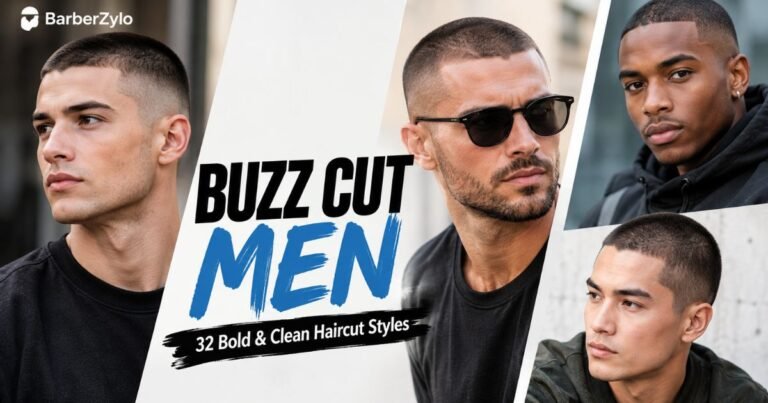
Read More About : Buzz Cut Men: 32 Bold & Clean Haircut Styles for 2026
27. Short Mullet with a Taper Fade
Top about 2–4 in (5–10 cm) · Taper fade · Effort: medium
The back is not short here. Sides and top are kept short, and extra length is left at the nape. Neck length, nape growth and shirt collars all affect how it looks. Agree with your barber how long the back should be, and use light texture products.
28. Messy Wavy Top with Low Fade
Top about 3–4 in (8–10 cm) · Low fade · Effort: lower
This is a loose, lived-in version of wavy hair over a low fade. Frizz control matters more than hold. Ask for a low fade and a relaxed top, apply curl cream, and air-dry. The low fade and casual finish differ from the structured wavy quiff in entry 9.
29. Textured Brush-Up with Mid Fade
Top about 2–3 in (5–8 cm), a shorter-top entry · Mid fade · Effort: medium
It’s shorter and more upright than entry 24, with less curve. Ask for a mid fade and a textured top, and style with paste.
30. Long Top with Burst Fade
Top about 3 in+ (8 cm+) · Burst fade · Effort: medium
A burst fade curves in a semicircle around the ear and leaves length behind it. Confirm how the nape will look, because the back stays longer. It differs from the drop fade in entry 20, which follows the skull downward.
31. Short Sides with Natural Curly Top
Top about 2–4 in (5–10 cm) · Short sides · Effort: lower
Curls are left natural and rounded, with no emphasis on a fringe or height. Shrinkage affects the length, so say how long you want it dry. Moisture and a leave-in product keep curls defined. It’s gentler than the shaped height in entry 15.
32. Long Top with a Low Skin Fade
Top about 3 in+ (8 cm+) · Low skin fade · Effort: medium
The fade goes to skin only low, near the ear and neckline, while the upper sides stay slightly longer. It works with many tops, but skin shows growth sooner, so ask exactly where the skin begins. Unlike entry 4, it isn’t tied to a slick-back.
33. Swept-Forward Textured Top with Short Sides
Top about 2–4 in (5–10 cm) · Short sides · Effort: lower
The top leans forward with textured, uneven edges, not a blunt line. Check the direction of any cowlick. Ask for forward movement and texture, then use a light paste.
Read More About : The Caesar Haircut: A Complete Guide for Men Who Want a Sharp, Low-Maintenance Look
34. Medium-Length Quiff with Tight Sides
Top about 2–3 in (5–8 cm) · Tight sides · Effort: lower
A modest lift with very short sides suits anyone testing a longer top gradually. Straight to wavy hair works best. Ask for tight sides and a short quiff, then style with clay.
35. Long Top with a Classic Scissor Taper
Top about 3–5 in (8–13 cm) · Scissor-blended sides · Effort: lower
The sides are blended with scissors over a comb instead of clippers. That tends to keep a softer, more natural outline and grows out gently, though it takes more skill and time. Ask specifically for scissor-over-comb at the sides. Entry 19 describes the finished shape, while this one is about the technique.
Long Top Short Sides Men’s Haircuts With Beard
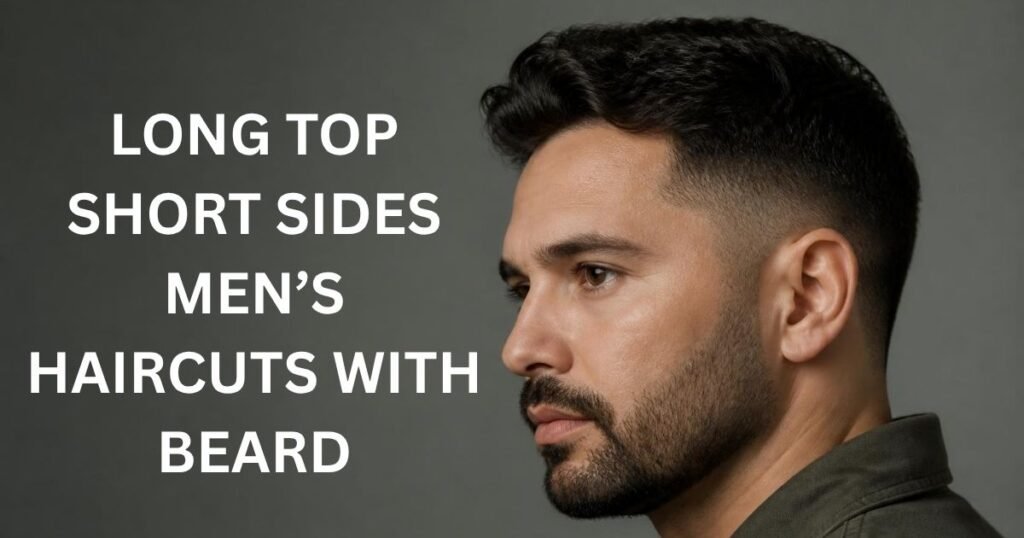
Plan the beard and the haircut together. The key points are where the side treatment meets the beard (the sideburn connection), how the beard length relates to the top, and the neckline and cheek line.
| Beard length | Top styles that may pair well | Note |
| Stubble | Textured or wavy tops | Patchy growth can look uneven at this length |
| Short boxed | Tapered or faded sides | Defined edges suit structured tops |
| Full | Slicked or brushed-back tops | Balance beard weight against top volume |
1. Stubble + Long Wavy Top
Stubble keeps contrast low, and a low taper keeps the sides tidy while the waves do the visual work. If your beard grows in patchy, stubble length may look uneven, so mention that to your barber.
2. Full Beard + Slicked Back Top
A longer beard has visual weight, so a combed-back top with some height helps keep proportions balanced. Shape the beard edges and neckline so the face doesn’t look overwhelmed. Density and top length both matter.
3. Fade + Groomed Beard Blend.
Here the fade connects into the beard at the sideburn so there’s no abrupt line. Ask about the connection point: a skin fade blends to a very short beard, and a taper blends more gradually. Tell the barber how far up your cheek line should sit.
4. Taper Fade + Short Boxed Beard
A boxed beard has squared edges with a defined cheek line and neckline. Together with a taper fade, it makes a structured look. Where the neckline sits depends on your jaw and neck, so ask your barber to place it.
Long on Top Short on Sides for Straight Hair (Complete Guide)
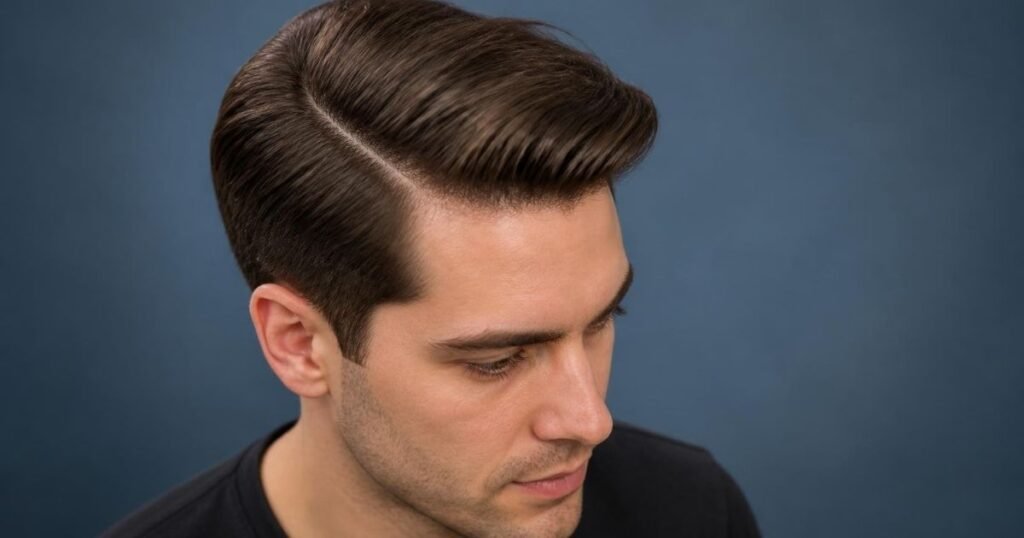
Straight hair holds blunt lines, sharp parts and clear steps well, but it can lie flat and may need help with lift. Fine straight hair behaves differently from coarse straight hair, so density still matters. The entries below add a straight-hair note only; full descriptions are in the gallery.
Best styles for straight hair
1. Textured French Crop
Straight hair holds the crop’s shape and cropped fringe cleanly. See entry 21.
2. Modern Quiff with Undercut
Without root lift, straight hair may lie flat instead of rising. See entries 2 and 3.
3. Pompadour Fade
Straight hair may need blow-drying and a firmer product to hold height. See entry 1.
4. Disconnected Undercut
Straight hair shows the step between top and sides clearly, which is good if you want that look. See entry 11.
5. Slicked Back with Side Part
Straight hair tends to slick back smoothly, but a front cowlick may need extra drying time. See entries 4 and 17.
Tips to add texture if your hair looks flat
Asking for texturizing can help, but density matters: over-thinning fine hair can make it look sparser. Beyond the cut:
- Dry the roots upward or forward, not flat to the scalp, to avoid flattening the roots at the front.
- Use your fingers while drying to create bends instead of a straight line.
- Finish with a blast of cool air to help set the shape.
- Add a little root powder or matte clay only after the hair is dry.
Products you can use for volume
- Mousse or sea salt spray on damp hair gives grip and lift before drying.
- Texture powder adds lift at the roots without weight.
- Matte clay adds hold with a dry finish, which is useful for making straight hair look less flat.
Heavy products can pull fine hair down, so start with a small amount.
Long Top Short Sides Haircuts for Curly and Wavy Hair
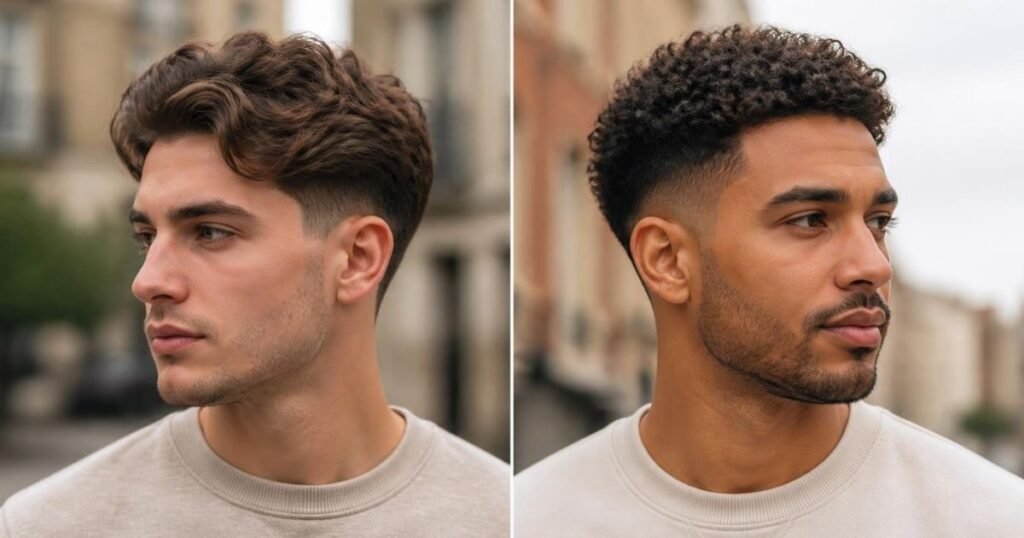
Curls and waves change how a cut is planned. The main issues are shrinkage (curls look shorter dry than wet or stretched), moisture, and how much bulk builds up at the sides.
Best long top short sides styles for curly hair
Entries 15, 22 and 31 are the curly options. Choose 15 if you want a tall, shaped top, 22 if you want curls falling forward, and 31 if you prefer a rounded, natural look. Coily hair can work with all three, particularly 15, if your barber is comfortable with that texture.
Best long top short sides styles for wavy hair
Entries 9, 20 and 28 are the wavy options. Entry 9 is a lifted quiff, entry 20 emphasizes the fade line behind the ear, and entry 28 is the most relaxed.
How curl pattern and shrinkage affect the final haircut
Shrinkage is the way curls pull upward and look shorter when dry. A curl that’s 4 inches stretched can sit at 2 inches dry. Curl pattern systems are informal, so describe your hair with photos instead of a type number. Tell your barber the length you want when dry.
How to manage volume and bulk on the sides
Curly hair often puffs outward at the sides, which can make the head look wider. Tapering or fading the sides reduces that bulk, and a fade usually grows out puffier more quickly than a taper. Controlling bulk around the temples is also worth discussing, since that’s where hair tends to push outward first. The right level depends on your density and curl.
Long Top Short Sides Fade Options
A fade shortens hair gradually. Its height is where the shortening starts. “Skin” describes how short it ends, not how high it begins, so a skin fade can be low, mid or high. Exact positions vary by barber, so show a photo.
| Fade type | Where it starts | Contrast | Pairs well with |
| Low | Just above the ear and neckline | Subtle | Side parts, natural tops |
| Mid | Around temple level | Balanced | Quiffs, brushed-back and wavy tops |
| High | Higher up the sides | Strong | Pompadours, textured crops |
| Drop | Curves down behind the ear | Medium to strong | Wavy or curly tops |
| Skin | Ends at bare skin, at any height | Strongest | Slicked or disconnected looks |
Low Fade
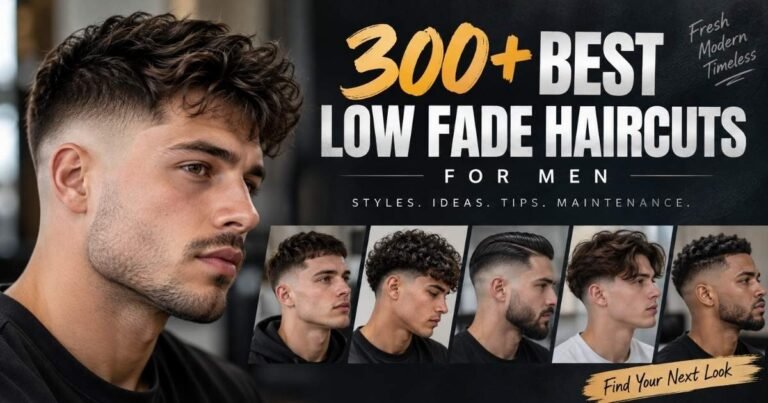
A low fade begins just above the ears and neckline, leaving most of the sides longer. It’s a subtle option that keeps the look conservative.
Mid Fade
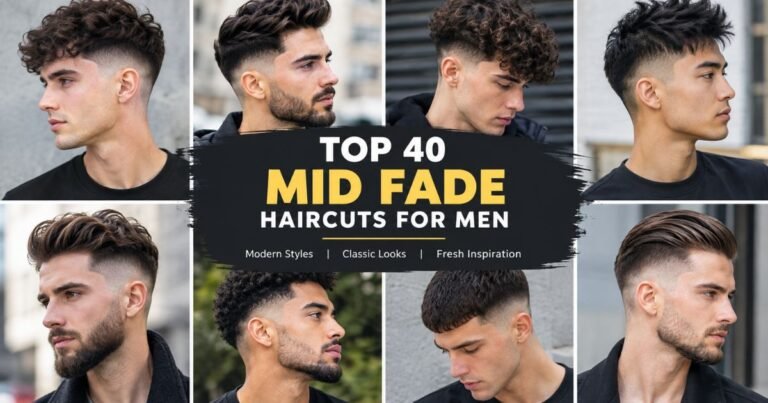
A mid fade starts around temple level. It gives noticeable contrast without the starkness of a high fade, so it suits many tops.
High Fade
A high fade starts higher up the head, so more of the side is short and the top stands out more. Positions vary between barbers, so confirm the starting point.
Drop Fade
A drop fade curves downward behind the ear, following the skull’s shape. Check it from the back to see the arc.
Skin Fade
A skin fade finishes at bare skin and can be low, mid or high. It gives the most contrast and shows regrowth sooner.
Taper Fade vs. Traditional Fade
| Taper | Fade | |
| Area covered | Sideburns and neckline | More of the sides and back |
| Typical shortness | Usually leaves some length | Often goes much shorter, sometimes to skin |
| Look | Subtle | More noticeable |
Usage varies by region and barber. In the UK, “taper” is sometimes used for what US barbers call a fade, so a photo avoids confusion.
Fade vs. Undercut: What Is the Difference?
| Fade | Undercut | |
| Transition | Gradual blend | Abrupt step |
| Contrast | Soft to strong | Strong |
| Growing out | Gradual | The step softens and becomes noticeable |
| Styling | Top blends in | Top hangs over the step |
How Can You Style a Long Top Short Sides Haircut (Step by Step)
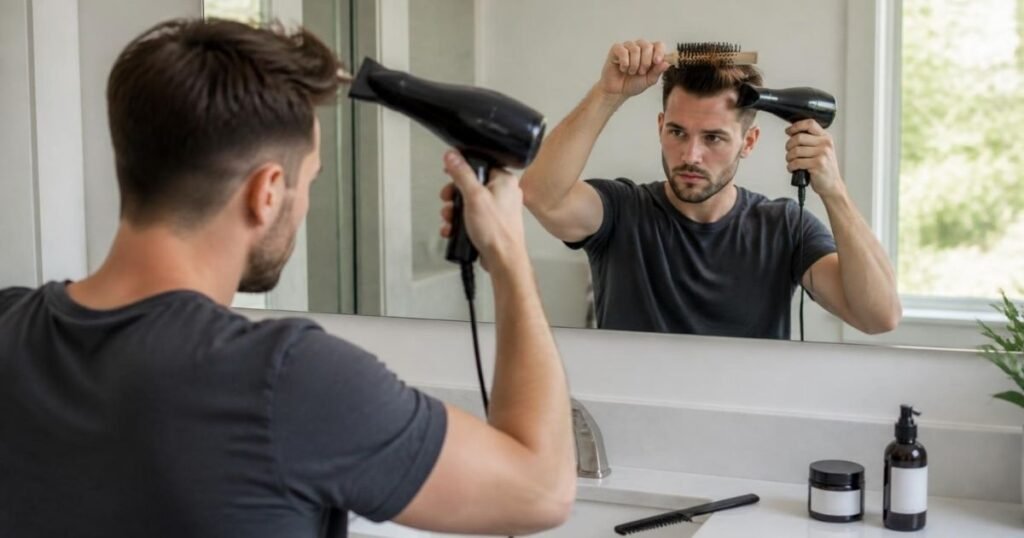
A general sequence works for most hair, and you can adjust it by type.
- Towel-dry so hair is damp, not wet.
- Apply a pre-styler (mousse, sea salt spray or curl cream) if you need grip or definition.
- Dry with direction. Blow-dry roots in the direction you want the hair to go, using a heat protectant first. Point the dryer along the hair, not across it.
- Add a finishing product in a small amount, working up if needed.
- Set the shape with your fingers, a comb or a brush, and finish with cool air.
Product choice comes down to hold strength (light, medium, strong) and finish (matte, natural, high-shine). Match them to the look: matte clay for texture, pomade for a sleek finish.
For straight hair
Lift at the roots, avoid heavy products that pull hair flat, and finish with a little texture so the front doesn’t look slick by accident.
For wavy/curly hair
Apply moisture first, scrunch, then diffuse or air-dry. Avoid brushing dry hair, which breaks up definition and causes frizz.
For thick hair
Ask your barber about weight removal. Style in sections and use a firmer hold if the top tends to puff.
For thin hair
Work volume from the roots, use light products, and note that styling can add fullness but doesn’t change density.
Product recommendations
| Product type | Finish | Hold | Works well for |
| Sea salt spray | Matte, textured | Light | Grip and wave |
| Mousse | Natural | Light to medium | Root lift |
| Matte clay | Matte | Medium to strong | Texture and structure |
| Pomade | Sleek to shiny | Medium to strong | Slick-backs and parts |
| Texture powder | Matte | Light | Root volume |
| Curl cream | Natural | Light | Waves and curls |
How to Ask Your Barber for This Haircut (So You Get Exactly What You Want)?
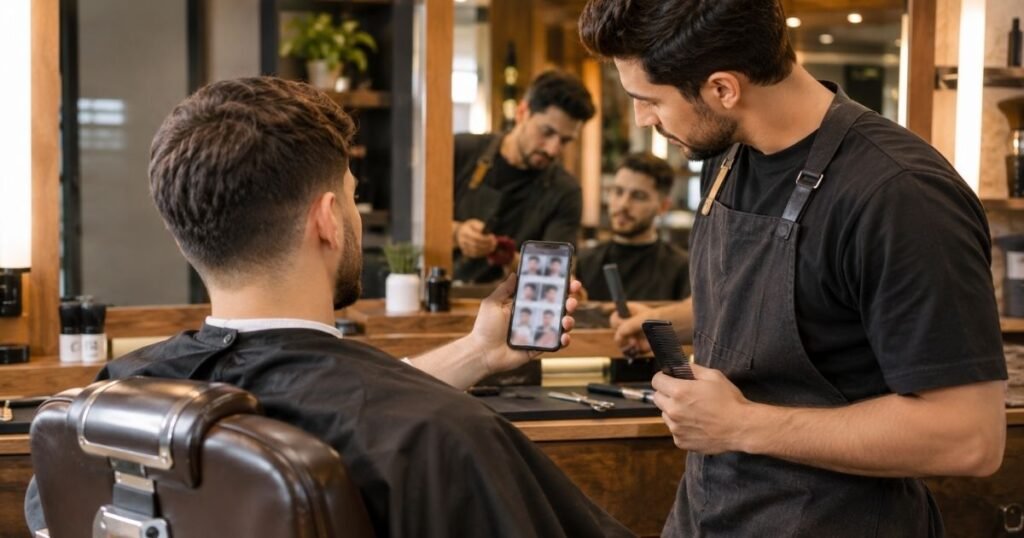
Describe the top, sides and back separately. Use measurements instead of vague words like “a bit off the top.” You could say: “Sides faded from [height] down to [length], top left at about [length], textured, with a [part/fringe] and a tapered neckline.” The same words may produce slightly different results at different shops, so photos help.
What to tell your barber about top length and side length
Use inches or millimeters. Clipper guard numbers vary by brand and country, so confirm in mm:
| US guard | Approximate length |
| #1 | 1/8 in (3 mm) |
| #2 | 1/4 in (6 mm) |
| #3 | 3/8 in (10 mm) |
| #4 | 1/2 in (13 mm) |
| #8 | 1 in (25 mm) |
I
f you’re unsure about the top, ask the barber to start longer and cut gradually.
How to choose the right fade or taper height
Think about your forehead and ear position, how much contrast you want, and how often you’ll visit. Lower is subtler, higher is bolder. You may also be choosing between clippers and scissors for the sides: clippers give crisper, shorter results, while scissor-over-comb tends to look softer.
Why reference photos matter
Bring front, side and back photos of hair similar to yours, since the same cut looks different on different textures. A photo of a style you don’t want can help as much as one you do.
How to explain your styling and maintenance preferences
Tell your barber how much time you’ll spend styling, which products you use, whether you wear glasses (short sides around the ears help frames sit neatly), and how often you plan to come back. Also ask about the neckline: tapered, rounded and squared necklines look different, so a balanced textured top with a neat neckline starts with that choice. Be open to adjustments for density, cowlicks and growth patterns.
How to Maintain a Long Top Short Sides Haircut
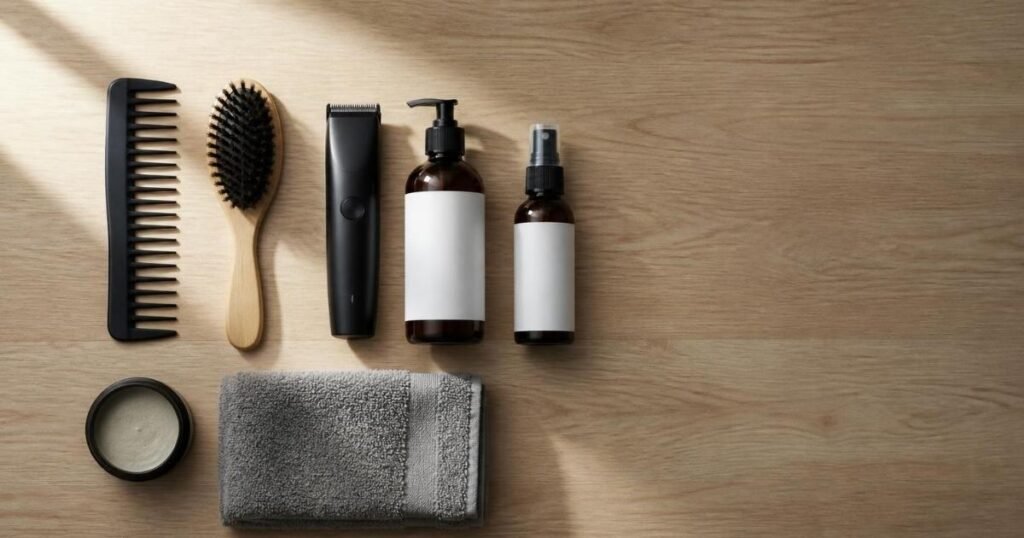
Maintenance has two parts: barber visits to keep the cut sharp, and daily styling.
How often should you trim the sides and top?
There isn’t a universal schedule. Skin fades and high fades tend to show regrowth sooner than tapers, and disconnected cuts show the step softening as hair grows. A reasonable signal is when the sides lose their definition, or the neckline looks fuzzy. Ask your barber what interval suits your cut and your hair’s growth rate.
How to keep the top healthy and manageable
Condition the top, use a heat protectant before blow-drying, and wash at a frequency suited to your hair type. Product build-up can weigh the top down, so rinse thoroughly.
How to maintain the shape between barber visits
Light neckline tidying with a trimmer can help, but avoid DIY fades, which are hard to get even. Keep your styling habits consistent so the top behaves predictably.
Frequently Asked Questions
What’s the haircut called with a long top and short sides?
It goes by several names, including short back and sides, undercut, and taper or fade with a longer top. The names overlap, so a photo is the safest way to ask.
Is a long top, short sides good for straight hair?
Often, yes. Straight hair holds clean lines and parts, though it may need root lift to avoid looking flat. See the straight-hair section for details.
Does this haircut work with a beard?
It often pairs well, depending on beard length, density and how the sides connect to it. See the beard section above.
Is it high maintenance?
It depends on the style. Textured, air-dried tops need little daily effort, while pompadours and slick-backs usually need a dryer and a firmer product. That’s separate from how often the cut needs refreshing.
How often should you get a trim?
It depends on the side treatment and how sharp you want the cut to stay. Fades and skin fades usually look overgrown sooner than tapers. Ask your barber for an interval that suits your hair.
Final Thoughts:Should You Try a Long Top Short Sides Haircut?
If you like having a top you can restyle while the sides stay tidy, this cut is worth considering. The decision comes down to four things: your hair type, your face proportions, how much daily effort you’ll accept, and how the sides are cut.
Before your next appointment:
- Save photos from front, side and back, ideally with hair like yours.
- Decide how much contrast you want between top and sides.
- Choose a rough top length, and be ready to adjust.
- Talk through your hairline, cowlicks and styling habits with your barber.

Jake Miller is a barbering and men’s hairstyle enthusiast who shares practical tips, haircut inspiration, and the latest grooming trends at BarberZylo. He enjoys exploring modern and classic hairstyles and helping readers find fresh ideas for their next look.