

Fringe Haircuts for Men: Best Styles, Tips & How to Pull Them Off
A fringe haircuts for men looks effortless in photos. In real life, how it turns out depends on a few things the photo can’t show: your hairline, how your hair grows at the front, how dense it is, and how the barber shapes the edge. Two people can bring in the same reference picture and leave with noticeably different results.
This guide covers the fringe styles worth knowing, how to choose between them, what to use to style them, how much upkeep to expect, and how to explain what you want in the chair. If you only need the barber script, skip ahead to the section on asking your barber.
One note on terms: “fringe” is the usual word in the UK, and “bangs” is the usual word in the US. They describe the same family of cut. This article uses “fringe” throughout.
What Is a Fringe Haircut?
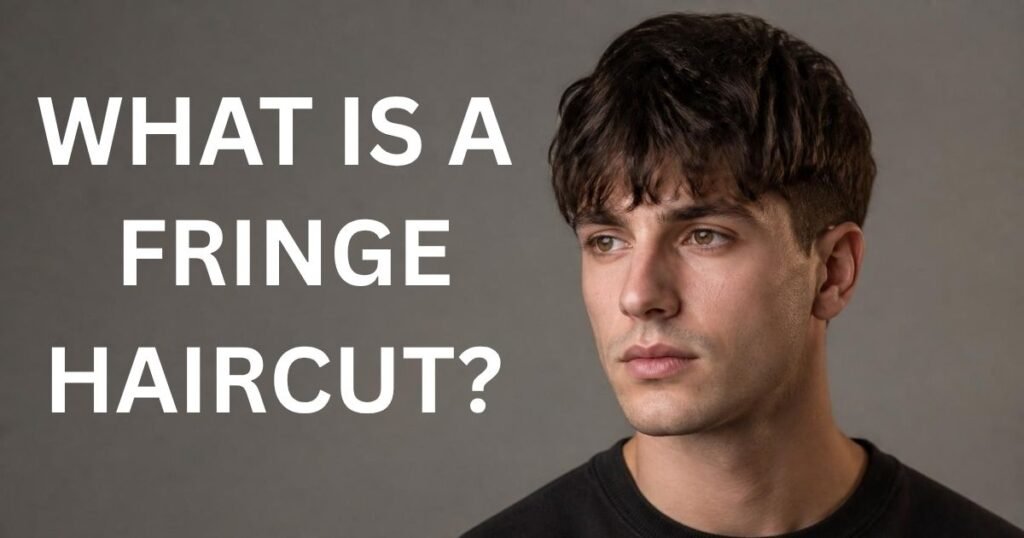
A fringe haircut leaves the hair at the front long enough to fall, sweep, or be styled over the forehead, rather than being cut short or pushed straight back. The top is usually longer than the sides, and the front section is what gives the cut its character.
“Fringe” is a category, not a single style. Every fringe is defined by five choices:
- Length: how far the front reaches relative to your eyebrows (well above, at the brow, or past it).
- Edge: whether the ends are cut in a straight line (blunt), broken up (choppy), or softly rounded.
- Texture: how smooth or separated the finished hair looks.
- Direction: forward, swept to one side, parted in the center, or pushed back.
- Sides: what happens around the ears and neckline, such as a taper, a fade, or scissor-cut sides.
Nearly everything in this article is a different combination of those five. Once you can describe your preference in those terms, picking a style and explaining it to a barber gets much easier.
How a fringe differs from similar cuts
Some neighboring cuts get mixed up with fringes. A French crop and a textured crop are specific versions of the idea, built around a shorter top. Curtain bangs are another version, defined by a center part.
| Front length | Edge | Usual direction | Sides | Styling effort | |
| Fringe (the category) | Anywhere from above the brow to past it | Blunt, choppy, or rounded | Forward, swept, parted, or pushed back | Varies | Low to moderate |
| French crop | Short, usually well above the brows | Straight or lightly textured | Forward | Short, often tapered or faded | Low |
| Textured crop | Short to medium | Choppy, separated | Forward or slightly sideways | Usually tapered or faded | Low to moderate |
| Curtain bangs | Around the brow, often longer | Soft, blended | Center part, falling to both sides | Often longer, scissor-cut | Moderate |
Barbers don’t always use these names the same way, which is one reason photos matter. More on that later.
Why Fringe Haircuts Are Worth Considering
A fringe can change how the upper half of your face reads. Hair across the forehead shifts attention away from the hairline, adds shape and movement on top, and can soften or break up strong angles. It also gives you plenty of room to adjust: the same basic idea can be short and sharp, or long and loose.
It also asks something of you. A fringe can fall into your eyes, loses its shape as it grows, and makes your front hairline and any cowlicks (a patch of hair that grows in a different direction) part of the finished look. The cut at the front matters more than the cut anywhere else.
A fringe may be worth trying if:
- You like hair that moves and doesn’t need to be arranged precisely.
- You’re comfortable with trimming it every so often to keep the shape.
- You’d like some forehead coverage without committing to long hair.
You may want to think twice if:
- You have a strong cowlick right at the front and dislike working with it.
- You really dislike hair near your eyes, for example during sport or work.
- Your workplace has strict grooming rules about hair length.
None of these is a dealbreaker. They’re just the things worth knowing before you book.
Best Fringe Haircuts for Men Right Now
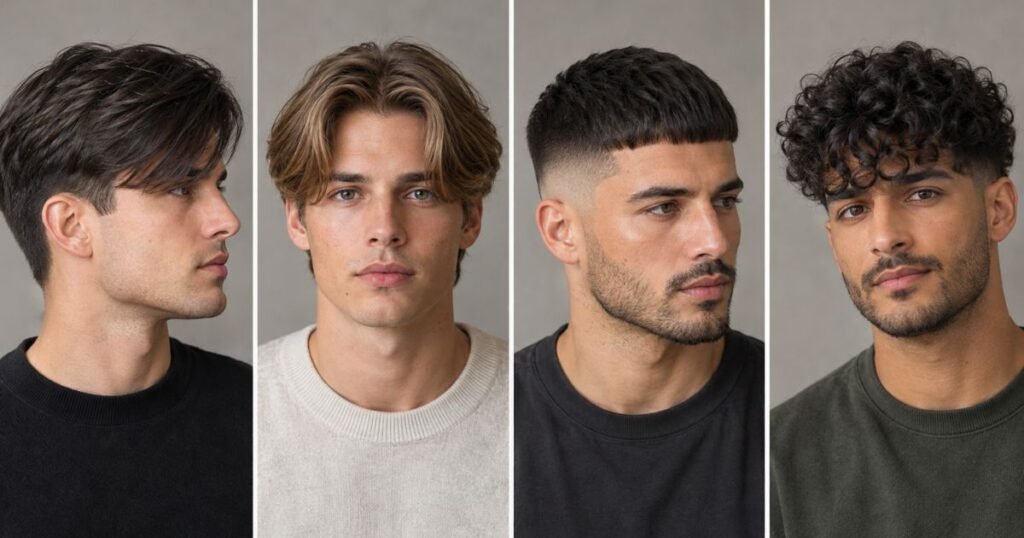
The nine styles below are established ways to wear a fringe. They overlap on purpose, because a single haircut can combine several of them. A textured fringe can also have a fade, and a long fringe can also be a curly one.
Treat a style name as a starting point. A reference photo plus a description of the length and the sides will get you closer than a name alone. Hair type and the way your barber adapts the cut will change the result either way.
1. Textured Fringe
A textured fringe is defined by its edge. Instead of one straight line, the ends are broken up so the front separates into pieces. Barbers get this effect by point cutting (snipping into the ends with the tips of the scissors) or by texturizing, which removes some bulk so the hair doesn’t sit as a single mass. The result moves and has an uneven edge.
It usually sits around or just above the brow, though that isn’t fixed. The difference from a blunt fringe is easy to spot: a blunt edge looks drawn with a ruler, while a textured one looks feathered.
Natural bend or wave often makes this easier, since the hair already wants to separate. Very fine, flat hair can look sparse if too much weight is removed, so a barber may keep a little extra density at the front.
To style it, work a small amount of product through slightly damp hair with your fingers. The styling section covers product types.
Tell your barber: “Textured, point-cut fringe at about eyebrow length, not a straight line.”
Read More About : 26 Stylish Middle Part Hairstyles for Men (2026)
2. Side Swept Fringe
What defines this one is direction. The fringe is brushed diagonally across the forehead to one side, with or without a visible part. It reads as more controlled than a forward fringe, and it generally needs a little more length to sweep properly.
The most useful tip is to work with your natural growth direction. Most people’s hair falls more easily to one side than the other. Forcing it the opposite way often means fighting it every morning. If you’ve ever noticed your hair always flipping toward the same spot, that’s the side to consider.
A cowlick at the front hairline can make a sweep harder to control, so mention it to your barber. A blow-dryer used in the direction you want the hair to go, followed by a light-hold product, is the usual approach.
3. Messy Fringe with Taper
This is the relaxed, slightly undone version. The front is left longer and loosely shaped, and the sides and back are tapered. A taper means the hair gets gradually shorter toward the ears and neckline, usually without going all the way down to bare skin. (Fades, covered in style 6, do go that short.)
“Messy” here describes how it’s styled, not how it’s cut. It still depends on a sound shape underneath. The difference from the textured fringe is where the effect comes from: texture is built into the cut, while the messy look comes mostly from how you finish it.
Natural wave tends to make this easy. Straight hair may need a texturizing product or a quick rough-up to avoid looking flat, and very thick hair may need some weight removed so the top doesn’t puff outward.
Tell your barber: the length you want at the front, and that you’d like the sides tapered rather than faded.
4. Curtain Fringe
A curtain fringe is parted in the center, with hair falling to each side so it frames the forehead. “Curtain fringe” and “curtain bangs” are used for much the same idea, though barbers and regions vary.
It needs enough length to fall rather than stand up. That usually means a longer front than a forward fringe, typically reaching around the brow or beyond.
Your growth pattern matters more here than your face shape. If your hair naturally falls off-center or has a strong cowlick near the part, a center part may take daily effort. Two common problems are hair that refuses to split evenly and ends that flick upward. Drying the hair away from the part while it’s damp helps set the direction.
Very thick or very curly hair may need extra shaping to sit evenly on both sides.
5. Long Fringe
The defining trait here is length and weight. The fringe reaches the eyebrows or passes them, and you can wear it forward, swept, or pushed back. That flexibility is the main appeal.
The trade-offs are real. A long front takes longer to dry, falls into your eyes more easily, and relies on a good shape. Without layering (cutting hair at different lengths so it moves), it can sit as one heavy block. If you’re asking for this, mention layering and ask where the shortest layers will land.
Thick or dense hair can feel heavy and may need thinning. Fine hair can go limp when long, so a slightly shorter length might hold up better. Wavy hair often benefits from the extra length. If you wear glasses, play sports, or work somewhere with grooming rules, it’s worth thinking those through before committing.
You can blow-dry it forward with a round brush, dry it with your hands, or push it back when you want it out of the way.
Read More About : Curtain Bangs Haircuts for Men: Modern Styles and Ideas
6. Fringe with Fade
This is a pairing, not a separate fringe style. A fade blends the sides from very short (often skin level) up into longer hair, creating strong contrast with a softer top.
Fades are described by where they start:
- Low fade: starts low, near the ear and neckline. Subtle.
- Mid fade: starts around the temple. A noticeable middle ground.
- High fade: starts higher on the head. Strongest contrast, and it can make the top look bigger.
- Skin fade (or bald fade): the shortest part goes down to bare skin. It can be low, mid, or high.
| Where it starts | Look | Upkeep | |
| Taper | Around the ears and neckline | Gradual, soft shortening | Grows out gently |
| Low fade | Just above the ear | Subtle contrast | Shows regrowth soon |
| Mid fade | Around the temple | Clear contrast | Shows regrowth soon |
| High fade | Higher on the head | Strongest contrast | Shows regrowth soonest |
| Skin fade | Goes to bare skin (at any height) | Sharpest finish | Shows regrowth soonest |
The practical difference from a taper: a taper blends gently and tends to look natural as it grows in, while a fade is sharper and shows regrowth faster because the contrast is higher. How soon that happens depends on how fast your hair grows and how short the sides start.
Growth patterns at the nape and temples can affect how clean the blend looks.
Tell your barber: where the fade should start (low, mid, or high) and whether it should go to skin.
7. Curly Fringe
With curly hair, the curl pattern shapes the fringe. Curly hair shrinks as it dries, so a fringe that looks brow-length when wet may sit noticeably higher once dry. It’s one of the most common surprises with curls.
For that reason, be specific about the length you want when the hair is dry and in its natural state. Many people with curls prefer a barber who is comfortable cutting them in that state, or one who checks how the curl springs up as they go.
Curl types vary a lot. Loose curls, tight coils, and waves behave differently, so a cut that works for one won’t necessarily suit another. Styling usually centers on defining the curls and managing frizz, with a light hand on product.
Tell your barber: how long you want the fringe when dry, and whether you want to keep the curl or loosen it.
8. French Crop Fringe
A French crop is a crop first and a fringe second. The top is short and combed forward into a brief fringe that sits well above the brows, with short sides. The edge is often straight or lightly textured.
It’s one of the lower-effort options, but it relies on the shape being cut accurately. Barbers don’t always agree on the boundaries between a French crop, a Caesar cut, and other forward-combed crops, so a photo helps.
Because the fringe is short and forward, it puts the hairline on display. If that’s a concern, a longer or more textured option might feel better. Thick, straight hair tends to hold this shape well. Fine hair may need texturizing, and a strong cowlick may mean the barber adjusts the length.
Read More About : Mens Shaggy Hairstyles: 35 Effortless & Cool Looks
9. Short or Blunt Fringe
These are two ideas that often go together. “Short” is about length, sitting above the brows. “Blunt” is about the edge, cut in a precise straight line.
The honest trade-off: a blunt edge shows every irregularity and every bit of regrowth. It looks sharp when freshly cut and loses its line sooner than a textured one.
Thick, straight hair usually holds a blunt line best. Wavy or curly hair may not lie in a straight line, so a barber may soften the edge. Fine hair can look thin along a hard edge, and a low hairline can make a short blunt fringe feel heavy.
Because precision is the whole point, ask whether the edge should be fully straight or slightly softened.
How to Choose the Right Fringe Haircut

The right fringe usually comes from a few practical questions asked in order, with face shape used as one input among several.
- Start with your front hairline and growth pattern. Cowlicks, a widow’s peak, receding temples, or a low hairline can all narrow or widen your options. Look at how your hair falls at the front when it’s dry and untouched.
- Think about hair type and density. Straight, wavy, curly, fine, and thick hair all behave differently. The hair types section below goes into detail.
- Decide how much length you want at the front. Think in terms of above the brow, at the brow, or past it. If you wear glasses, play sports, or work in a setting with grooming rules, factor that in.
- Be honest about effort. How much time will you spend styling each day, and how often can you realistically get a trim?
- Use face shape as a loose guide, not a deciding factor.
These are starting points to talk through with a barber, and the same style can look different on two people.
| If your priority is… | Styles to consider |
| Lowest daily effort | Textured fringe, messy fringe with taper, French crop fringe |
| Most flexibility in how you wear it | Long fringe, curtain fringe |
| A more structured, polished look | Side swept fringe, short or blunt fringe |
| Shortest length at the front | French crop fringe, short or blunt fringe |
| Working with natural curls | Curly fringe |
| Strong contrast between top and sides | Fringe with fade |
If you’re starting from short hair, the length question matters too. The FAQ below covers how long hair needs to be.
Fringe Haircuts by Face Shape
Face shape is a loose guide. Barbers also consider hair density, hairline, beard, and what you like. Many people fall between shapes, and the way a fringe is cut and styled can change how it reads. Treat what follows as tendencies to discuss, not rules.
- Oval: Many fringe styles can work, so hair type and personal preference usually matter more than shape.
- Round: Fringes with some height, or a diagonal sweep, may help avoid a wide, flat look. A very heavy, wide, straight-across fringe can emphasize width.
- Square: Softer or textured edges can balance a strong jaw. A very rigid blunt fringe can emphasize angles, though that’s a tendency and not a verdict.
- Oblong: A fringe with some fullness across the front can shorten the look of a longer forehead.
- Heart: Side swept or curtain styles may balance a wider forehead.
- Diamond or triangle: These are less commonly discussed. A barber can help weigh how fringe length and fullness interact with cheekbone or jaw width.
Instead of relying on a label, look at your forehead height and jaw width. A beard changes the balance too, since a fuller beard can shift how the whole face is proportioned.
Read More About : Wolf Cut for Men: Best Styles, Tips & Inspiration (2026)
Best Fringe Haircuts for Different Hair Types

Texture and density often affect how a fringe behaves more than face shape does. Two terms are worth separating: density is how many hairs you have, and thickness is how wide each strand is. You can have fine strands with high density, or thick strands with low density, and both change how a fringe behaves. Most people are a mix.
| Hair type | What to watch for | Worth discussing with your barber |
| Straight | Holds an edge and direction well, but can fall flat and shows cutting mistakes | Some texturizing for movement, and a clean edge |
| Wavy | Often has natural movement and body; can be unpredictable at length | Length that works with the wave, not against it |
| Curly or coily | Shrinkage, curl pattern, and moisture affect length and shape | Cutting length when dry, and a cut that respects the pattern |
| Thick or dense | Can feel heavy or puff out | Thinning or weight removal so the top sits well |
| Fine or low-density | Can look thin at the edge or limp at length | A slightly shorter or softly textured shape, lighter product |
Thinning hair or a receding hairline deserves a more careful answer than a table cell allows. Where the thinning is, how advanced it is, and how the front is cut all affect the outcome. A fringe can work well for some people, particularly a lighter, softly textured one. For others, a different approach might look better. A barber who looks at your actual hairline will give you a more useful answer than any general rule.
Styling Products That Actually Help
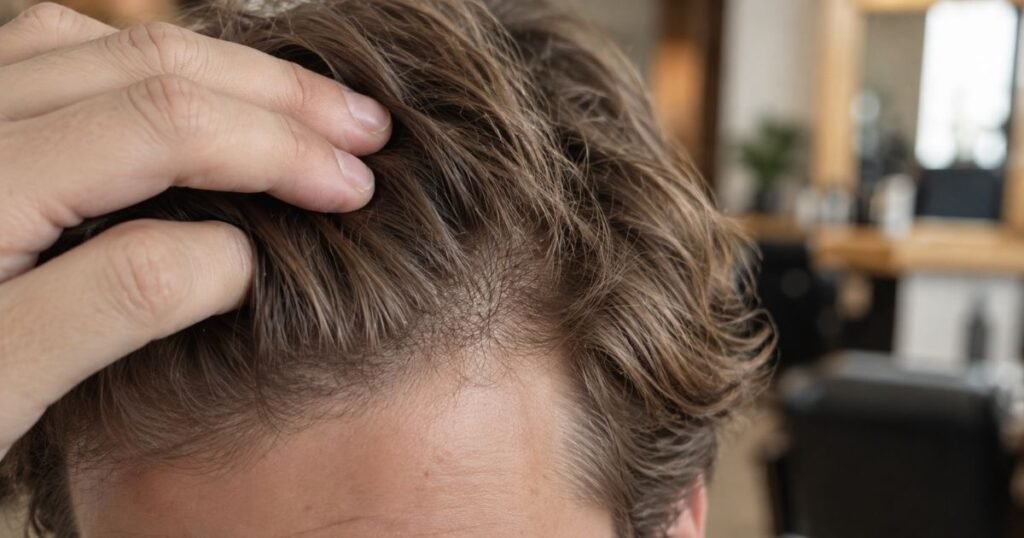
Product choice matters, but technique matters as much. Direction is set largely when the hair is damp, so how you dry it counts. A few things to keep in mind:
- Start with towel-dried or slightly damp hair.
- Dry the fringe in the direction you want it to sit. This sets the root lift (the lift at the base of the hair) and helps it stay put.
- Finish with a small amount of product, then add more only if you need it. It’s easier to add than to remove.
Here’s how product types map to goals:
| What you want | Product type | Works best when |
| Texture and separation, matte finish | Matte clay or paste | You want a textured, undone finish without shine |
| Flexible hold and direction | Light cream or lightweight pomade | You want a swept or controlled fringe that still moves |
| Volume and body | Mousse, sea salt spray, or pre-styling spray | You want lift, especially with fine or straight hair |
| Curl definition | Curl cream or gel | You have curls and want them defined |
| Control over frizz or flyaways | A small amount of oil or serum | You have dry or frizzy ends |
Fine hair generally does better with less product and lighter formulas, since heavy products weigh it down. Thicker or coarser hair may need more hold. Curly hair usually benefits from moisture-focused products.
Common problems and what to try:
- Hair flips up at the ends: try drying it down and forward with a brush while it’s damp.
- Hair splits down the middle: use a little more hold, and dry it toward the part you want.
- Hair goes flat by midday: add lift at the roots when drying, and use a lighter product.
- Hair is stiff: you’re probably using too much product, so use less and finish by hand.
This is general guidance, and what works varies with your hair.
Read More About : Wolf Cut vs Shag: The Real Differences and How to Choose the Right One
How to Maintain a Fringe Haircut

A fringe loses its shape as it grows, but how quickly depends on your hair and the style. Rather than a fixed schedule, it helps to know the signs that it’s time for a trim:
- The fringe is reaching your eyelashes or getting in your way.
- The edge has lost its shape or looks uneven.
- The sides have grown out and the blend has softened.
- The hair no longer falls in the direction it used to.
Style also matters. Blunt and faded cuts tend to look their best for a shorter time, because a crisp edge and sharp blend show regrowth quickly. Textured and messy fringes are usually more forgiving.
Between appointments, many barbers will do a quick fringe trim or neckline cleanup. Ask if yours does, since a small tidy-up can extend the cut.
How often you wash depends on your scalp and your hair: oiliness, hair type, activity level, and how much product you use all play a part. There’s no universal rule. If your hair feels heavy or greasy, wash it. If it feels dry or hard to style, you may be washing too often. Curly hair often needs a different routine from straight hair.
Sweat, humidity, and helmets or caps can all change how a fringe sits, and that’s normal.
| Style type | Typical upkeep |
| Textured or messy fringe | Forgiving of regrowth |
| Side swept or curtain fringe | Moderate; direction and length matter |
| Short or blunt fringe | Needs attention sooner to keep the line |
| Any fringe with a fade | Sides show regrowth sooner |
How to Ask Your Barber for a Fringe Haircut
Explaining a fringe clearly takes a bit of preparation. There’s no single phrase that guarantees the same result at every shop, but a clear description and a photo get you most of the way.
Before you go
- Save two or three reference photos, ideally a front view and a side view. Look for images where the hair resembles yours in texture and density.
- Notice your own hair: where your cowlicks are, how your hairline sits, and which way the front naturally falls.
In the chair, describe
- Length: where the fringe should sit relative to your eyebrow. Landmarks are clearer than inches or centimeters.
- Edge: straight, textured, or somewhere between.
- Direction: forward, swept to one side, or parted in the center.
- Sides: tapered, faded, or scissor-cut, and how short. If the barber uses scissor-over-comb, they lift the hair with a comb and cut it with scissors for a softer finish, instead of using clippers.
- Your habits: how you normally style your hair, how much time you’ll spend, and how often you can come in.
Useful words to know
- Textured / point-cut: the ends are broken up, not straight.
- Blunt: a straight, precise edge.
- Tapered: gradually shorter toward the ears and neckline.
- Faded: blended to very short, possibly skin.
- Scissor-cut sides: sides cut with scissors, so they’re softer.
- Leave length on top: keep the fringe and top longer.
A sample you can adapt:
“I’d like a textured fringe that sits around my eyebrow, point-cut so it’s not a straight line. I’d like the sides tapered, not faded. I’ve got a cowlick on the left that pushes up, so I’d like your opinion on how to handle it. I usually style it with my hands and a little paste.”
It’s usually safer to ask for slightly more length at first, because it can be cut shorter but not longer. Ask your barber whether the style suits your hair and what they’d adjust. A good barber will adapt the cut to you, and that’s a good thing.
Read More About : Spiky Hairstyles for Men: 17 Bold & Textured Styles
Frequently Asked Questions
Can men with thinning hair pull off a fringe?
It can work for some people, and it depends. The key factors are where the thinning is (temples, crown, or overall), how much density remains at the front, and how the fringe is cut. A lighter, softly textured fringe often looks more natural than a thick, heavy one. For some people, a shorter or different style may be a better fit. A barber who can see your hairline can tell you more than a general rule can.
Is a fringe high maintenance?
It depends on the style. A textured or messy fringe usually needs less daily effort, while blunt, swept, or faded versions generally need more precise styling and more frequent trims. The maintenance section above covers the signs it’s time for a trim.
How long does your hair need to be for a fringe?
It depends on the style. A short French crop fringe needs less length than a long, swept one. In general, a barber can shape a fringe once the front hair is long enough to move or lie in a direction.
Hair growth varies from person to person, but roughly half an inch (about 1.25 cm) a month is a commonly cited average. If you’re growing out short hair, ask your barber to leave extra length at the front while keeping the rest tidy. Curly hair needs more length to allow for shrinkage.
Are fringe haircuts suitable for curly hair?
For many people, yes. Curl pattern, shrinkage, and frizz affect the length and shape, so it helps to choose a barber who’s comfortable cutting curls and to be specific about the length you want when dry. The Curly Fringe section covers this in more detail.
What is the difference between a fringe and bangs?
They describe the same thing: hair that falls over the forehead. “Fringe” is the usual UK term, and “bangs” is the usual US term. In men’s styling, “fringe” often suggests a textured or shaped front section, while “bangs” is used more loosely, and barbers may use the words differently. “Curtain fringe” and “curtain bangs” are both used for the center-parted version.
Conclusion
A good fringe comes from matching the length, edge, texture, direction, and sides to your hair and your routine, not from copying a photo exactly. Hairline, density, and growth pattern shape the result, and a barber can adapt the cut to them.
Before your next appointment, save two or three reference photos, check how your hair falls at the front, and talk it through. If the first version isn’t quite right, small adjustments to length or edge usually get you there.

Jake Miller is a barbering and men’s hairstyle enthusiast who shares practical tips, haircut inspiration, and the latest grooming trends at BarberZylo. He enjoys exploring modern and classic hairstyles and helping readers find fresh ideas for their next look.


5 Comments