

14+ Hairstyles for Older Men: Stylish Cuts for Thinning Hair
A haircut that worked at 35 can quietly stop working at 60. Hair may get finer, grayer, or drier, the hairline may move, and the scalp can show through in places it never did. None of that means you need a dramatic makeover. It usually means adjusting length, sides, or styling so the cut fits the hair you have now.
This guide covers hairstyles for older men, with thinning hair as the main lens. It also includes options for full gray hair, waves, and men who want to keep some length. Each style lists typical lengths, who might want to think twice, and what to tell your barber. Skip to the quick-pick table if you want a shortlist, or jump to “How to Ask Your Barber for the Right Haircut” if you’re booking soon.
A note on measurements: lengths are given in inches and centimeters or millimeters. Clipper guard numbers vary by brand, so treat them as approximate. In the UK, barbers often say “grade” instead of “guard,” and “fringe” instead of “bangs.”
Why does the right haircut really matter as you get older!

Hair changes with age, though when and how much varies hugely from man to man. Individual strands can become finer, a process often linked to follicle miniaturization, where follicles gradually produce thinner, shorter hairs. Overall density can drop, the hairline can recede at the temples, and gray or white hair often feels coarser or drier than it used to. Many men notice that a style that once looked full now lets the scalp show.
A well-matched cut works with those changes in three ways:
- It manages contrast. The starker the difference between hair color and scalp tone, the more visible thinning becomes. Shorter lengths and softer edges tend to reduce that.
- It doesn’t depend on hair that isn’t there. A style built on volume or length in a thin area will always work against you.
- It fits the effort you’ll actually put in. A style you can’t maintain at home looks good for about two days after the barber.
Use this table as a starting point, not a prescription. The numbers refer to the styles below.
| Your situation | Styles to look at first | One thing to weigh |
| Receding at the temples | 8, 11, 1, 2 | Forward-brushed styles need enough hair at the front |
| Thinning at the crown | 1, 3, 5 | Shorter tops tend to hide the crown, but cowlicks can complicate it |
| Thin all over | 2, 1, 7 | Short, even length reduces contrast |
| Full head of gray or white hair | 4, 9, 12, 13, 14 | Texture may be coarser, so conditioning matters |
| Naturally wavy hair | 12, 13, 5 | Don’t cut it so short that the wave disappears |
| Extensive hair loss | 7, 2 | Compare a close clip with a razor shave before deciding |
| Minimal daily effort | 1, 2, 6 | Shorter styles need more frequent trims |
Best Hairstyles for Older Men With Thinning Hair.

What’s the best haircut for an older man with thinning hair? There isn’t one, but there are common starting points. Shorter tops, textured finishes, and tapered sides tend to reduce weight and contrast, which is why they show up so often. Where and how much you’re thinning will change which one works best.
Every style below gets a quick summary, then a short explanation of what defines it and who might want to think twice. For the short styles, here’s a rough guard guide. Check your clipper’s own chart, since sizing differs between brands.
| Guard | Approx. length | What it looks like |
| #1 | 1/8 in (3 mm) | Very close, scalp clearly visible |
| #2 | 1/4 in (6 mm) | Close, with a soft shadow of hair |
| #3 | 3/8 in (10 mm) | Short but visibly hair-covered |
| #4 | 1/2 in (13 mm) | Short, with some body |
1. The Crew Cut
At a glance: Top about 1/2 to 1.5 in (12–38 mm) · Short tapered sides · Minimal styling
The crew cut is the baseline many short styles are built from. The sides and back are cut close and tapered, while the top stays slightly longer and is usually graded, so it’s shortest at the front and gradually longer toward the crown. It’s typically done with clippers and a comb rather than scissors.
Shorter hair means less weight and less contrast with the scalp, so thinning tends to be less obvious than it would be with a longer cut. Fine hair usually lies flat with little effort, while stiffer hair may stand up a bit and need a dab of paste or nothing at all.
Watch for cowlicks at the crown, which can make a short top stick up, and for a hairline that has moved back unevenly. A barber can adjust the front length to suit. The edges around the ears and neck tend to look untidy before the top does, so how often you need a trim depends on how crisp you want the outline.
What to ask for: “A crew cut, tapered sides, top about an inch, a bit longer at the front.”
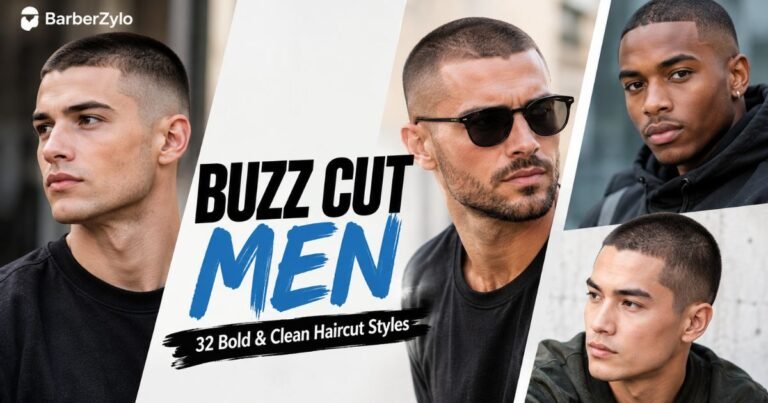
2. The Buzz Cut
At a glance: One clipper length all over (often #2–#4) · Optional tapered edges · No styling
A buzz cut comes down to one decision, which is length. The whole head is clipped to the same guard, sometimes with the edges tapered slightly.
Length changes how much scalp shows. A #1 or #2 lets more skin through. A #3 or #4 keeps more hair visible and softens the transition from hair to scalp. Gray or white hair on a fair scalp often blends more than dark hair does, while dark hair on a fair scalp creates more contrast. Starting longer and going shorter is a low-risk way to find your level, and many men do this at home with their own clippers.
A buzz cut shows head shape, including bumps, scars, and ridges. It also grows out into a fuzzy, shapeless look sooner than longer styles, though how quickly that bothers you is personal. Sunscreen matters for a closely cropped scalp.
What to ask for: “A #3 all over, with the edges tapered slightly.” Starting at #4 and stepping down is also reasonable.
3. The Ivy League Cut
At a glance: Top about 1.5–2.5 in (4–6 cm) · Tapered sides · Enough length to part or brush across
Think of the Ivy League as a crew cut with enough length on top to part or comb. The sides are tapered, and the top is usually scissor-cut so it can be parted or brushed to one side. You may also hear it called a Harvard clip, and barbers’ usage varies, so the boundary with a crew cut or a short side part can be blurry. A photo clears it up faster than a name.
The added length only helps where hair is dense enough to support it. If your crown is thinning but the front has reasonable density, this cut can keep some shape on top without leaning on volume. If the hair is very fine, the part line may show scalp.
Cowlicks near the front can fight the part. Comb it while damp and use a small amount of light product only if needed. The awkward phase comes when the top grows out and the sides haven’t yet, so book before it gets there.
What to ask for: “Ivy League, tapered sides, top long enough to part, about two inches.”
Read More About : Professional Haircuts for Men: 35+ Classic & Modern Styles
4. The Side Part with Taper
At a glance: Top about 2–4 in (5–10 cm) · Defined or natural part · Tapered sides and back
What defines this style is the part line. A natural part follows the direction your hair already wants to fall. A hard part is a shaved or cut-in line that sits more defined and polished.
Thin hair affects where the part sits. Parting through low-density hair can make scalp more visible along the line, so many barbers work with the natural growth direction. If your hairline is asymmetrical, that may also guide which side to part on.
A taper means the sides and back get progressively shorter toward the neckline, often leaving some length at the edge. (The next style goes into taper vs fade in more detail.)
For styling, a light matte cream or paste is usually enough, and blow-drying the roots upward and back gives a bit of lift. Sides grow out before the top does, so the shape softens gradually.
What to ask for: “Side part, natural line, tapered sides, scissor-cut on top.”
5. The Textured Crop
At a glance: Top about 1–3 in (2.5–7.5 cm) · Choppy, forward-moving texture · Short tapered or faded sides
Where a crew cut is neat and even, the textured crop is about movement. The top is cut with point cutting or texturizing so it separates into pieces instead of lying flat, and it’s usually pushed forward or loosely to the side.
That separation, combined with a matte finish, can reduce how much scalp shows compared with a smooth, flat top. Be careful with heavy texturizing, though, because removing too much weight from already limited hair can make it look sparse. Asking for “restrained texture” is reasonable.
Slightly wavy hair already has natural movement, so the cut often takes less effort. Very straight, fine hair may need a little more product to hold. A forward direction tends to suit crown thinning better than front thinning, since it pulls attention away from the crown.
Work a small amount of paste or clay through dry hair and finish with your fingers. The shape loosens as the sides grow in.
What to ask for: “Short textured crop, light texturizing, push forward, short tapered sides.”
6. The Tapered Fade
At a glance: Sides and back graduate to very short · Low, mid, or high placement · Any top length
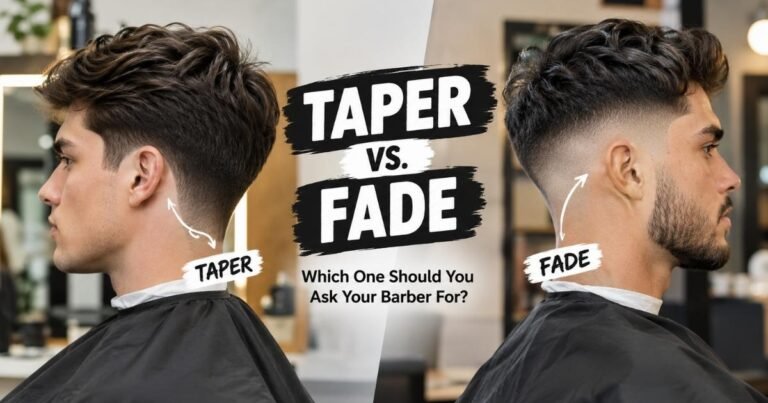
First, a distinction that causes confusion: a fade is a technique, not a haircut. It can sit under a crew cut, a quiff, or a side part. And “taper” and “fade” aren’t quite the same thing.
| Taper | Fade | |
| Gradient | Gradual, usually subtle | More visible, often to skin or very close |
| Where it ends | Typically leaves some length at the edge | Often goes very short, sometimes to bare skin |
| Overall look | Softer, more conservative | Sharper, more contrasting |
| Grow-out | Gentler | Shows more quickly |
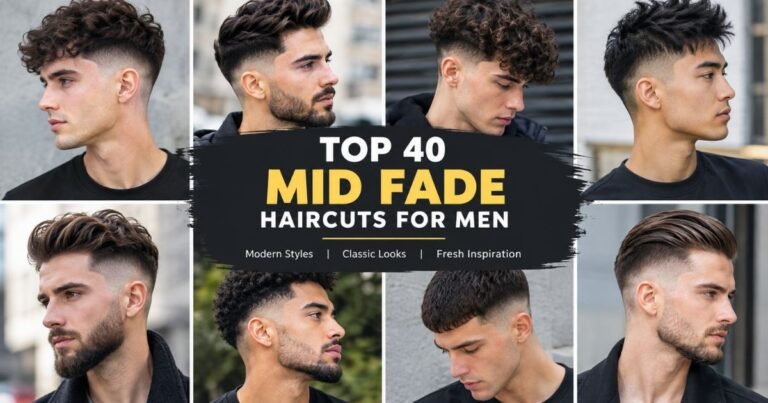
Low, mid, and high describe where the fade begins on the head. A low fade starts near the ears and neckline. A mid fade starts around the temples. A high fade starts higher on the sides.
A fade with very close sides can increase contrast and make thin temples more visible. A softer taper tends to suit men who want a clean outline without that look. Neither is “too much” at a certain age; it depends on side density, hairline, and personal preference.
Because “tapered fade” is used loosely, ask for specifics: “short on the sides, but not down to skin.”
Related read: Taper vs fade, explained.
7. The Shaved Head
At a glance: Clipper-close to razor-smooth · No styling · Regular upkeep
Shaving your head is a choice, not a surrender, and it comes in degrees. A very close clipper cut (like a #1 or shorter) leaves a soft shadow of stubble. A razor shave gives a smooth finish. Many men try a short buzz first to see how they feel before committing.
Advantages: no styling, an even look, and no decisions about the thinning areas. Trade-offs include sunscreen, possible razor irritation or ingrown hairs for some skin types, and the fact that your entire head shape is visible. Stubble also shows back within a day or two for many men, so how smooth you want it determines the routine.
A beard can balance a shaved head. Some men keep a trimmed beard so the face has a strong shape against the bare scalp.
What to ask for: “Clipper-close, no guard,” or “Razor shave, finish with a moisturizer.”
More Hairstyles for Older Men

These styles use more length or a different shape. Longer doesn’t automatically mean harder, but it generally needs reasonable density where the length falls. They’re loosely ordered from shorter to longer.
8. The Caesar Cut
At a glance: Top about 1–2 in (2.5–5 cm) · Short, fairly even fringe · Tapered sides
The Caesar is defined by its fringe. The top is cut short and relatively even, then brushed forward into a short, straight line across the forehead. It’s often discussed for receding hairlines and widow’s peaks because it changes what the front hairline shows.
The catch is that it needs enough hair at the front to form the fringe. If the front is very sparse, the line can look thin. It overlaps with the French crop and textured crop, and barbers use the terms loosely, so a photo helps. The Caesar’s key trait is evenness, where the textured crop is deliberately choppy.
Comb it forward and use a little paste. Fringe length matters if you wear glasses. A cowlick at the front can push the fringe up, which a barber may work around.
What to ask for: “Caesar cut, short even fringe, tapered sides, don’t go too short at the front.”
9. The Short Textured Quiff
At a glance: Front about 2.5–4 in (6–10 cm) · Lifted up and slightly back · Short sides
The quiff is about lift. The front is raised up and slightly back, but shorter and less sleek than a full pompadour.
Volume can make hair look fuller where density exists, but lift also draws attention to the hairline, and very fine hair may collapse after a few hours. A lighter hold and a bit of texture tend to work better than a rigid, glossy finish.
Blow-dry the front upward and back, then finish with a small amount of powder or matte clay. Expect moderate daily effort, more than a crop but less than a pompadour.
What to ask for: “Short textured quiff, about three inches at the front, short blended sides.”
Read More About : 15+ Professional Men’s Hairstyles for the Office (2026 Guide)
10. The Comb Over with Taper
At a glance: Top about 2–4 in (5–10 cm) · Defined part · Swept across · Tapered or faded sides
A modern comb over is a deliberate, tidy shape: a short to medium top with a defined part, swept to one side, with tapered or faded sides. It isn’t the long-strand version swept over a bald patch. Barbers often use “comb over” and “side part” for nearly the same thing, so a photo helps.
The more hair that has to stretch across bare scalp, the more visible it becomes, especially in wind. Moderate thinning on the front or top is usually more workable than extensive loss. A light hold and a bit of blow-dry direction keep it controlled.
What to ask for: “A short modern comb over, defined part, tapered sides, keep the top short enough that it sits naturally.”
11. The Short Side-Swept Hairstyle
At a glance: Top about 2–3.5 in (5–9 cm) · Swept to one side, no defined part · Blended sides
If you like the shape of a side part but dislike hard lines, this is the softer version. The top is swept to one side by comb or blow-dry with a slightly longer front, and there’s no defined part. It follows your natural growth direction, which makes it forgiving for cowlicks and slight waves, and it may soften receding corners.
A very sparse front can still show through, so be realistic about density. Use a light cream and minimal product, and keep the fringe clear of glasses.
How styles 3, 4, 10, and 11 differ:
| Part line | Typical top length | Sides | Defining trait | |
| 3. Ivy League | Optional, soft | 1.5–2.5 in | Tapered | Closest to a crew cut |
| 4. Side part + taper | Defined or natural | 2–4 in | Tapered | The part line |
| 10. Comb over + taper | Defined | 2–4 in | Tapered or faded | Sweep and contrast |
| 11. Short side-swept | None | 2–3.5 in | Blended | Soft movement |
What to ask for: “Short side-swept top, no hard part, blended sides.”
12. The Natural Wavy Hairstyle
At a glance: Top about 2.5–4+ in (6–10+ cm) · Shorter sides or taper · Minimal styling
The idea here is to work with the wave. Waves can change with age, becoming looser or less defined, and gray hair often feels coarser or drier, though this varies. Leave enough length for the wave to show, because very short cuts may flatten it or make it stand up.
Shorter sides or a taper keep it neat. Styling is usually a light leave-in cream, then air-dry or a diffuser. Heavy product weighs waves down.
On curly and coily hair: curl pattern and shrinkage (hair appearing much shorter when dry) change how a cut is planned. If your hair is curly or coily, it’s worth finding a barber experienced with your texture and asking how they cut it, wet or dry.
Crown thinning can expose a parting in waves, and wave strength often varies across the head.
What to ask for: “Keep the length on top so the wave shows, taper the sides, no heavy product.”
Read More About : Short Professional Men’s Hairstyles for Office: 17+ Clean, Polished Cuts
13. The Medium-Length Layered Cut
At a glance: Top about 3–5+ in (8–13+ cm) · Sides around the ear · Layers to reduce weight
Layers are shorter pieces cut over longer ones to remove weight and add movement (barbers call this weight removal). Moderate thinning may be manageable with layers, but heavy layering on fine hair can look stringy. Some stylists prefer lighter layering for fine hair.
Longer hair can also part and show scalp when wet or windy. Extensive crown thinning tends to show more at this length. Comb it back or tousle it, and use a light cream or salt spray for body.
What to ask for: “Medium length, soft layers, don’t thin it out too much, sides to the ear.”
14. The Slicked-Back Hairstyle
At a glance: Top about 3–4+ in (8–10+ cm) · Combed straight back · Short tapered sides
Slicked back means the hair is combed straight back off the forehead, which exposes the whole hairline. Some men like that, while others find it too revealing. Combing back across a thinning crown can also show scalp.
Finish matters. A matte or low-shine product usually looks more forgiving on fine hair, while heavy shine can clump strands together. It’s different from the quiff (which lifts up) and the pompadour (higher and sleeker).
Use a water-based or light pomade, cream, or gel.
What to ask for: “Slick back with a taper, not too tight on the sides.”
Hairstyles to Avoid with Thinning Hair

“Avoid” here means common approaches that tend to work against thin hair. Your hair and a skilled barber can change the outcome.
- Long strands combed over a large bald area. The longer the strands, the more they move and part in wind. If you want a comb over, choose the shorter, tidier version (style 10).
- Long, shapeless, one-length hair. Without layers or structure, thin hair can hang flat and show scalp.
- Very close sides that expose thin temples. A high contrast fade may highlight sparse areas on some men. A softer taper is a gentler alternative.
- Heavy, glossy product on fine hair. It can clump strands and reveal scalp.
- Keeping an old cut unchanged. If your density or hairline has shifted, a small adjustment may help more than a new style.
- Forcing a style against your growth pattern. Cowlicks and strong growth directions usually win.
A quick self-check: look in the mirror with wet hair, since wet hair shows density honestly. Take a phone photo from above to see the crown. Step outside on a breezy day and check how the style behaves. If the scalp shows in all three, shorter or more textured may help.
Here are some grooming tips to help you get your hair back in shape.
None of these tips will regrow hair, but they can make the hair you have look its best.
- Wash based on your scalp, not a number. Oily scalps, active lifestyles, and heavy product use may call for more frequent washing. Dry scalps may do better with less. A conditioner can help coarse or dry gray hair.
- Watch for scalp discomfort. Persistent dryness, flaking, or redness is worth mentioning to a pharmacist or dermatologist.
- Protect your scalp from the sun. Thinner hair and shorter cuts expose more skin. A hat or sunscreen helps.
- Go easy on heat. Use lower heat and keep the dryer moving.
- Plan trims around the style. Shorter, sharper styles show growth sooner, while longer styles tolerate more time. Ask your barber for an interval based on how fast your hair grows and how crisp you want the look.
- Tidy the details. Ears, nose, and eyebrows often grow longer hair with age, and a quick trim sharpens the overall look.
When to see a doctor: sudden or patchy hair loss, rapid shedding, or a painful, itchy, or sore scalp is worth a medical opinion. A haircut can’t diagnose anything.
Selecting the perfect haircut for your face shape.
There’s no perfect formula. Hairline, density, glasses, beard, and hair texture all affect the result. Face shape is one factor, and what follows are general ideas barbers often discuss, not rules.
To get a rough idea of your shape, pull your hair back and look at the width of your forehead, cheekbones, and jaw compared to the overall length.
| Face shape | Common considerations | Styles to look at (by number) |
| Oval | Fairly balanced proportions, so most styles are workable | 1, 4, 9, 14 |
| Round | May benefit from height or structure on top, with tapered sides | 3, 5, 9 |
| Square | Strong jaw, which softer tops can complement | 1, 4, 11 |
| Oblong | Length may be balanced with fringe or less height | 8, 11, 12 |
| Diamond | Wide cheekbones, where a fringe can balance a narrow forehead | 8, 11 |
| Heart | Wider forehead, where side-swept or textured fringes may help | 5, 11 |
| Triangle | Wider jaw, where volume at the top may help balance | 9, 13 |
A barber can also factor in your hairline, beard, and glasses, which often matter as much as face shape.
How to Choose the Right Hairstyle for Your Hair Type and Lifestyle
Narrowing the options comes down to three questions:
- Where and how much are you thinning? Front, crown, or all over?
- How much time and product will you really use? Be honest.
- What’s your hair’s color and texture? Fine or coarse, straight or wavy, gray or dark?
Lifestyle matters too. Think about your work, whether you wear glasses or hearing aids, and whether you wear hats often.
Haircuts for Receding Hairlines and Thinning Crowns
Hair loss tends to follow patterns, and the pattern affects the approach.
| Pattern | General approach | Styles to consider | Watch for |
| Receding temples | Soften or reshape the front, or go shorter overall | 8, 11, 1, 2 | Sparse fringes can look thin |
| Thinning crown | Keep the top shorter, with texture | 1, 3, 5 | Cowlicks at the crown |
| Overall thinning | Even, short length | 2, 1, 7 | Scalp contrast |
| Combination | Choose based on the more noticeable area | Varies | Progression over time |
Ask your barber to check your crown with a hand mirror, and to plan for how the pattern may progress.
Low-Maintenance Haircuts for Older Men
“Low-maintenance” depends on four things: daily styling time, product need, tools, and how often the cut needs refreshing. Shorter cuts need less daily styling but more frequent trims, while longer cuts do the opposite.
| Style | Daily effort | Grow-out look | Tools |
| Crew cut (1) | Very low | Edges soften first | Comb |
| Buzz cut (2) | None | Fuzzy | None |
| Ivy League (3) | Low | Awkward in-between phase | Comb |
| Textured crop (5) | Low to moderate | Loosens gradually | Fingers, paste |
| Natural wavy (12) | Low | Bulks out | Leave-in cream |
| Slicked back (14) | Moderate | Holds well | Comb, product |
This is a general guide, not tested data. Cowlicks, thickness, and wave can all change the effort.
Hairstyles for Gray and White Hair
Gray hair often feels coarser or drier, though it varies. Silver can contrast less with a pale scalp, but it can also yellow from sun exposure or product buildup.
If yellowing bothers you, some men use a toning shampoo, while others embrace the natural color or choose to color it. It’s a personal preference with no right answer.
Matte finishes often show silver well, while heavy gloss can look flat on it. Short cuts (1, 3), side parts (4), and waves (12) all suit silver and salt-and-pepper hair, as do the other styles.
Styling Products for Fine or Thinning Hair
Thin hair (naturally fine strands) and thinning hair (losing density) can both benefit from lightweight products. None of them treats hair loss.
| Product | Finish | May help with | Caution |
| Sea salt spray | Matte, textured | Texture and grip | Can dry hair |
| Volumizing mousse or spray | Light | Lift at the roots | Too much can stiffen |
| Texturizing powder | Matte | Volume and separation | Can look dusty |
| Matte clay or paste | Matte | Definition | Heavy amounts weigh hair down |
| Light cream | Natural | Soft control | Low hold |
| Pomade or wax | Varies | Slicked styles | Can clump fine hair |
| Gel | Often shiny | Strong hold | Can look stiff |
| Scalp concealers or fibers | Matte | Thinner areas | Needs matching to color |
How to apply:
- Start with towel-dried or dry hair, depending on the product.
- Use a small amount, about a pea-sized dab.
- Warm it between your palms.
- Work from the roots outward.
- Check for buildup and add more only if needed.
Read More About : Low Maintenance Men’s Haircuts: 32+ Easy Styles That Look Great
How to Ask Your Barber for the Right Haircut
No phrase guarantees the same result at every barbershop, but these steps improve your odds.
- Bring two or three reference photos. Include different angles and, if possible, hair similar to yours in color and density. A photo of what you don’t want helps too.
- Describe your hair. Mention where it’s thinning, any cowlicks, and how it behaves.
- Be specific about measurements. Top length, side length, neckline shape, whether you want skin showing, and part position.
- State your limits. How many minutes you’ll spend styling, and whether you wear glasses or hearing aids.
- Ask before the cut. How will it grow out, and how should you style it?
- Start longer. It’s easier to take more off. Ask the barber to show you the crown mid-cut.
Useful terms:
| Term | Meaning |
| Taper | Gradual shortening toward the neckline, with some length left |
| Fade | A visible gradient to very short or skin |
| Guard / grade | The clipper attachment that sets length (UK often “grade”) |
| Blend | Smoothing the transition between lengths |
| Texturize | Cutting to add movement and reduce weight |
| Layers | Shorter pieces over longer ones |
| Neckline | Natural, tapered, or blocked at the back |
| Hard part | A defined, cut-in part line |
| Fringe / bangs | Hair at the front, brushed forward |
Sample scripts:
- “Short textured crop, restrained texture, tapered sides, push forward.”
- “Ivy League, top about two inches, tapered sides, natural part.”
- “Medium length, soft layers, keep the weight on top, no heavy thinning.”
Reference photos won’t match your hair exactly, so ask the barber to adapt the style.
Read More About : Low Blowout Taper for Black Men with a Clean, Sharp Styles (2026)
FAQs
What is the most suitable cut for older men who have hair loss on their crown?
Shorter tops with tapered sides, such as the crew cut, Ivy League, or textured crop, are common starting points because they reduce contrast and weight. The result depends on your density and pattern. Ask your barber to check the crown with a mirror.
If a man in his old age is losing his hair heavily, should he go for a bald head?
It’s a personal choice. When loss is extensive, many men consider a very short clip or a shave. Try a short buzz first to see how it feels, and keep sun protection and skin comfort in mind.
Which products are best to use to add volume to thinning hair?
Lightweight options like sea salt spray, volumizing powder, and a small amount of matte clay tend to work well. Heavy or glossy products may weigh fine hair down. Start with a small amount and add only as needed.
When do old guys with baldness go to the barber?
It depends on how sharp you want the cut to look. Short, tapered styles show growth sooner, while longer styles tolerate more time. Ask your barber for a range based on how quickly your hair grows.
How should a 60 year old man wear his hair?
Age matters less than your hair situation, your work, and how much effort you’ll put in. A man who wants low effort might look at a crew cut or short crop, while someone with good density and a more formal workplace might prefer a side part or comb over. See the quick-pick table above.
What is the best haircut for a 70 year old man?
There’s no single best. Many men in their 70s prefer lower styling effort and cuts that suit changing texture, though others keep longer or styled hair by choice. Easy options include the crew cut, Ivy League, or a natural wavy cut.
What are the most popular haircuts for older men in 2026?
Popularity is hard to measure reliably and varies by region and barber, so it’s better not to claim a ranking. The styles in this guide are long-established rather than tied to a single year, and the quick-pick table can help you find one that fits your hair.
What is the best haircut for senior men?
Practicality often matters most: ease of upkeep, comfort, clearance around glasses and hearing aids, and scalp sensitivity. Shorter, tapered cuts are easier to wash and maintain, including when someone helps with grooming.
Conclusion
The best way to choose among these hairstyles for older men is to start with your own hair: where it’s thinning, what color and texture it has, and how much effort you’ll realistically put in. Then treat any style as a starting point your barber can adapt, not a fixed formula.
Before you book:
- Pick two or three styles and save reference photos.
- Note your hair’s quirks, like cowlicks or thin spots.
- Decide how much time you’ll spend styling.
Results vary with every head of hair, so expect to fine-tune after the first cut. If you see sudden or patchy hair loss, check in with a doctor.
Jake Miller is a barbering and men’s hairstyle enthusiast who shares practical tips, haircut inspiration, and the latest grooming trends at BarberZylo. He enjoys exploring modern and classic hairstyles and helping readers find fresh ideas for their next look.


5 Comments