
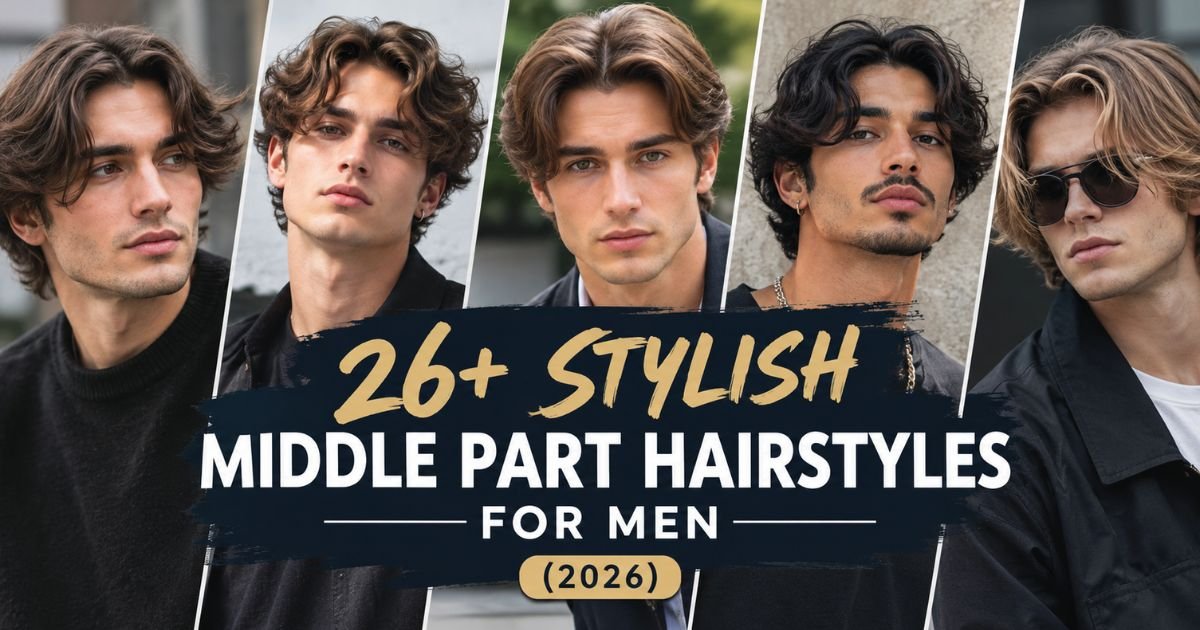
Curtain Bangs Haircuts for Men: Modern Styles and Ideas
Curtain bangs are a fringe that splits down the middle (or just off it) and sweeps toward the sides. The hair is shortest at the center of the forehead and gets longer toward the temples, so the front falls open like a pair of curtains around the eyes and cheekbones. In the UK, you’ll often hear the same thing called “curtains” or a center-parted fringe. Barbers in both countries will recognize any of those terms, but a photo removes the guesswork.
This guide covers the main versions by length, hair type, and side finish, then helps you work out whether the cut suits your hair and hairline. It also covers what to tell your barber, how to style the front, how to keep it looking right between cuts, and which product types are worth considering.
Popular Curtain Bangs Hairstyles for Men

Every version below starts from the same base: a center or near-center part, a shorter middle, and longer pieces that fall to each side. What changes is the length, how the hair is cut (layered or texturized), what’s happening on the sides, and how the hair behaves naturally. Think of the base cut as the foundation and each style as a variation you can combine with others. A medium-length, textured cut with a taper is a perfectly normal request.
| Style | What changes from the base cut | Hair it may suit | General styling effort |
| Classic | Balanced, symmetrical curtains | Straight to slightly wavy, manageable growth | Low to moderate |
| Short | Front ends near the brow | Shorter hair, fairly cooperative hairline | Low, but less forgiving |
| Medium-length | Front falls between eye and cheekbone | Most textures | Low to moderate |
| Textured | Broken-up ends, more separation | Straight or fine hair needing movement | Low |
| Layered | Stepped lengths control shape | Thick or long hair | Low to moderate |
| Wavy | Cut around the natural wave | Wavy hair | Low if you work with the wave |
| Curly | Extra length allowed for shrinkage | Loose to tight curls | Moderate, depends on moisture |
| With fade | Sides cut very short | Anyone who wants strong contrast | Low daily, frequent shape upkeep |
| With taper | Sides shorten gradually | Anyone who wants a softer side finish | Low |
| Korean-style | Light, airy fringe | Straighter, denser hair, or permed hair | Moderate |
| Straight | Smooth lines, visible part | Straight hair | Moderate (can fall flat) |
| Long | Front reaches jaw or beyond | Hair you’re willing to grow out | Moderate to high |
| For thick hair | Weight removed so the front doesn’t puff | Dense or coarse hair | Moderate |
Effort levels are general guides. Your own hair will shift them up or down.
1. Classic Curtain Bangs
The classic version is the reference shape. It has a clear part in the center, two curtains of roughly equal length, and a soft slope from the shorter middle into the sides. Nothing about it is exaggerated, which makes it a useful starting point if you’re trying the cut for the first time.
Because it’s symmetrical, it shows uneven growth more than looser versions do. If one side of your hairline sits lower or a cowlick pulls the part off center, a classic shape can look lopsided unless the barber adjusts for it.
2. Short Curtain Bangs
Short curtain bangs end around the brow line, or just below it. There’s still enough length to part and fall away from the center, but not enough to tuck behind the ears. The sides are often kept neat and close.
Don’t confuse this with a short textured fringe or a French crop. Those styles push hair forward or across the forehead. Here, the hair splits and moves outward.
The trade-off is that short hair gives you less room to correct problems. A front cowlick or a high hairline is more visible, and the pieces need to be long enough to separate cleanly rather than stand up. Photos of someone with a similar hairline are especially useful for this version.
3. Medium-Length Curtain Bangs
At medium length, the front falls somewhere between the eye and the cheekbone, and the sides sit around the ears or just below. This length gives you the most flexibility. You can part it, push it back, tuck one side, or let it fall forward, all without waiting through a long grow-out.
It also tends to be the easiest length for a barber to shape, since there’s enough hair to layer and blend. Check the length guide under “Hair Length, Growth Patterns, and Cowlicks” to see where your hair currently sits.
4. Textured Curtain Bangs
Texturizing changes the edge of the hair rather than its length. Instead of cutting straight across, a barber uses point cutting (snipping into the ends with the tips of the scissors) or a razor to break up the line. The pieces separate and move more, and the result looks looser and less deliberate.
It’s easy to mix this up with layering. Layers change the lengths within the cut. Texturizing changes how the ends finish. Most curtain-bang cuts use both.
Texturizing can help straight hair that tends to fall in one flat sheet. On very fine hair, too much of it can leave the ends wispy and make the front look thinner, so it’s worth asking how heavily the barber plans to texturize.
Read More About : Fringe Haircuts for Men: Best Styles, Tips & How to Pull Them Off
5. Layered Curtain Bangs
Layers are what let the front curve smoothly into the rest of the hair. Shorter layers near the face create the opening, and longer layers behind them connect it to the sides and back. Without them, the front can look like a separate piece sitting on top of the haircut.
Soft layers blend gradually and give a subtle sweep. More visible layers create clear steps and more movement. If you’re not sure which you want, show a photo and ask which the barber thinks is realistic for your density. Fine hair can look wispy with too many layers, while thick hair can look bulky with too few.
6. Wavy Curtain Bangs
Natural waves tend to build separation into the front without much effort. The pieces curve away from the part on their own, and the shape can look soft and loose.
The catch is that waves pull hair upward as it dries, so the front can sit shorter than it did when wet. Waves can also shift the part or frizz in humid weather. A barber who cuts wavy hair with its pattern in mind may leave a little extra length for this reason. Styling usually works best when you work with the wave, using air-drying or a diffuser, rather than flattening it with heat.
7. Curly Curtain Bangs
Curls can make a good curtain, but the result looks different from the smooth sweep you see on straighter hair. A curly version tends to look like a soft frame of curls on either side of the part.
The key thing to understand is shrinkage. Curly and coily hair springs up as it dries, so a front piece that reaches the cheekbone when stretched may sit at the brow once dry. Tell your barber you want to plan the length around where your curls actually land. Some barbers cut curls dry or in their natural state to see this more clearly, though practices vary.
Curl patterns range from loose spirals to tight coils, and density and moisture change how the shape holds. A barber with experience cutting your curl type is worth seeking out.
8. Curtain Bangs with Fade
A fade shortens the sides gradually, often down to skin, so there’s a strong visible contrast with the longer top. The curtains stay long while the sides sit tight, which makes the fringe look more defined.
There are three decisions to talk through with your barber:
- Fade height: low fades start near the ears and neckline, mid fades sit around the temples, and high fades start higher on the head.
- Where the fade meets the length: a clean blend looks smoother than an obvious line.
- Temple and sideburn treatment: these areas affect how the curtains frame the face.
Faded sides tend to show growth sooner than longer sides, so the shape usually softens as the hair comes back in. The right interval depends on how fast your hair grows and how crisp you want it to stay.
Read More About : 26 Stylish Middle Part Hairstyles for Men (2026)
9. Curtain Bangs with Taper
A taper also shortens the hair gradually, but it generally stays longer and works mainly around the sideburns and neckline. The result is a softer finish that keeps more length at the sides. The comparison table below shows how it differs from a fade.
| Fade | Taper | |
| How short it goes | Often to skin or very short | Usually keeps more length |
| Visual contrast | Strong | Softer |
| Where it works | Higher up the sides and back | Mainly sideburns and neckline |
| How it looks as it grows out | Softens faster | Changes more gradually |
Terminology varies between barbers, and a “low taper fade” to one person is a “taper” to another. A reference photo from the side or back is the most reliable way to show what you mean.
10. Korean-Style Curtain Bangs
When people search for this look, they usually mean a lighter, airier fringe: soft layers, gentle volume, and a part that falls slightly open rather than sharply. It reads as softer and less structured than a classic curtain.
These looks are often shown on straight, fairly dense hair. Fine hair may not hold the volume, and curly hair may need a different approach. Some people use a perm to build the shape into straighter hair, which is worth asking a stylist about rather than assuming it’s right for you. Different barbers use different names for similar cuts, so photos matter here.
11. Straight Curtain Bangs
Straight hair shows cut precision more than any other texture. The part line is visible, the sides lie smoothly, and mistakes are easier to spot. The usual problem is that the front can fall flat or split in the wrong place.
Fine straight hair often benefits from a little texturizing and a light touch with products. Thicker straight hair may need some weight removed so the curtains don’t hang heavily. Your natural growth pattern and cowlicks make a large difference, since there’s no curl or wave to hide them.
12. Long Curtain Bangs
In the long version, the front reaches below the cheekbones, sometimes toward the jaw, and the rest of the hair is long enough to blend with it, often around chin length or longer. This is the version with the longest grow-out.
Practical issues come up quickly. Hair gets in your eyes, and you may want to tuck it behind your ears or tie it back for sport or work. Ends need care at this length, so splits and dryness matter more. A barber may add long layers so the front connects to the rest instead of looking like a separate shelf.
13. Curtain Bangs for Thick Hair
Thick hair means two different things: density (how many strands you have) and strand thickness (how coarse each hair is). Either can make bangs push outward, puff at the temples, or refuse to stay in a part.
The usual solution is weight removal through point cutting, texturizing, or selective thinning. Ask your barber to be conservative, since over-thinning can leave the front looking ragged and cause it to stick out as it grows. Light smoothing products and controlled drying help keep the shape settled. Thick straight, wavy, and curly hair behave differently, so check the hair type table further down.
Curtain Bangs vs. Middle Part: What’s the Difference?
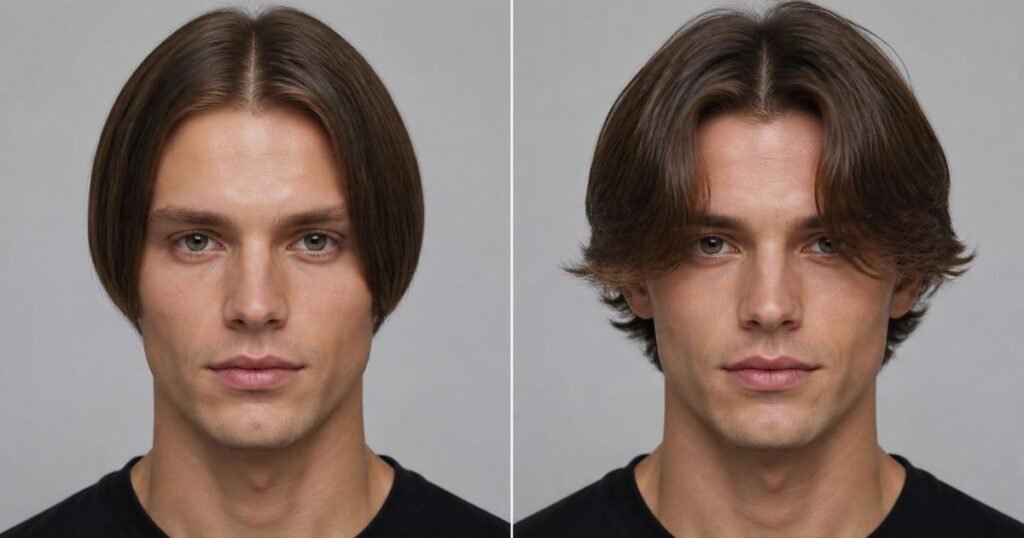
These two get confused constantly, and they’re not really alternatives. A middle part is a way of dividing your hair. Curtain bangs are a cut that’s shaped so the front falls open on both sides. You can have a middle part with no curtain bangs, but curtain bangs nearly always come with a center or near-center part.
If you only want the look of a center part, you may not need a new haircut at all.
1. Bang Length And Face Framing
Curtain bangs are cut with shorter hair at the center and longer pieces toward the sides, so the edges sweep past the eyes and cheekbones. A middle part uses whatever length your hair already has and doesn’t require any shaping of the front.
| Curtain bangs | Middle part alone | |
| What it is | A haircut with shaped front pieces | A parting of existing hair |
| Front length | Shorter in the middle, longer at the sides | Same length across |
| Needs a specific cut | Yes | No |
| Can be done on any haircut | Not without cutting the front | Yes, if the hair parts well |
How much a cut frames your face depends on your forehead height and facial proportions, so the same cut can look different on different people.
2. Styling Flexibility
Because the front pieces are shaped, curtain bangs can be worn parted in the center, pushed back, slightly off-center, or tucked behind one ear. A plain middle part has fewer options, since the hair has no built-in front shape to play with.
Cowlicks and growth direction affect both. If your hair resists a center part, a barber can often cut the curtains to work with that resistance rather than against it.
3. Which One Looks More Natural
“Natural” depends on how much effort the hair takes to look the way you want. If your hair already parts in the center and falls neatly, you may only need the part. If you want front pieces that open around your face and hair that moves when you do, curtain bangs may be worth discussing with a barber.
A quick way to decide:
- Does your hair fall to the center part without a fight? You may only need the parting.
- Do you want shaped pieces that frame your face? Curtain bangs are the better match.
- Does your hair resist the center? Ask the barber about a slightly off-center part or a cut that builds in a little extra length.
If you’re also weighing wolf cuts, shags, mullets, or general fringe haircuts, those are different shapes with different back and crown work, and each has its own comparison.
Who Should Choose Curtain Bangs?
There’s no single type of person who suits this cut. The result depends on your hair texture and density, your hairline, how your hair grows, and how the barber adapts the shape. What follows is a way to think through those factors rather than a verdict.
1. Best Hair Types for Curtain Bangs
Most hair types can work, but each behaves differently. The table describes what to expect and what to raise with your barber.
| Hair type | How curtain bangs may behave | What to consider |
| Straight | Shows the cut precisely and parts cleanly | Can fall flat or split unevenly; texturizing may help |
| Wavy | Separates naturally and moves | Waves can shift the part and shorten as they dry |
| Curly | Forms a soft curl frame | Shrinkage is significant; plan length for dry curls |
| Coily | Creates a defined shape with volume | Finding a barber experienced with coily texture matters |
| Fine or low density | May look soft and light | Over-layering can look wispy; use very light products |
| Thick or high density | Can look full | May need weight removal to avoid puffing |
If you have thick hair, see the dedicated section above. For curls, the curly section covers shrinkage in more detail.
2. Best Face Shapes for Curtain Bangs
Face shape is one factor, and it’s often not the deciding one. Forehead height, jaw width, hairline, beard, and glasses can change the balance as much as shape does. Use the table as a set of options to discuss, not predictions.
| Face shape | What to consider | What a barber might adjust |
| Oval | Proportions are generally balanced, so many lengths are worth exploring | Length based on preference |
| Round | Side pieces that fall below the cheekbones may add some vertical line | Keeping volume at the sides in check |
| Square | Softer, longer curtains may soften a strong jaw | Texture to break up the lines |
| Oblong | Fuller sides and a front that sits lower can add width | Avoiding too much height on top |
| Diamond | Pieces that fall at cheekbone level may balance wide cheekbones | Length near the temples |
| Heart | Side-swept length can balance a wider forehead | Fullness near the jaw |
| Triangle | Volume near the temples can balance a wider jaw | Weight placement |
If you wear glasses, check that the front pieces don’t collide with your frames. If you have a beard, the overall balance of the hair and beard matters more than either on its own.
3. Hair Length, Growth Patterns, and Cowlicks
This section is the reference for whether your hair can do this cut right now. Use landmarks on your face rather than measurements, since inches and clipper guards mean different things to different people.
| Version | Where the front reaches when pulled straight down | Notes |
| Short | Around the brow line | Enough to part, but little room for correction |
| Medium | Between the eye and cheekbone | Most flexible for styling |
| Long | Below the cheekbones, toward the jaw | Needs the longest grow-out |
The pull-down test: Wet your hair, comb it straight down, and note where the front reaches. Then check it dry. Wavy and curly hair usually spring up shorter, sometimes by a lot, so judge by the dry length.
Growth patterns to check:
- Front cowlicks: A cowlick at the hairline can push the part off center or lift one side of the fringe.
- Widow’s peak: A pointed hairline at the center can make a center part more or less obvious depending on how it’s cut.
- Receding temples: The shape of the hairline at the sides affects how the curtains frame the area. A barber can often adjust the length or part to account for it.
- Crown growth patterns: A double crown or strong swirl can affect how the top lies and how the front connects to it.
A barber can often adjust the part position or leave extra length around a cowlick. If you see one in the mirror, point it out at the start of the appointment.
How to Ask Your Barber for Curtain Bangs?

The aim is to give the barber enough information to make good decisions: the look you want, how your hair behaves, and how much styling you’re willing to do. No single phrase guarantees the same result in every shop, so treat the wording below as a starting point.
A few terms are worth knowing:
- Layers: hair cut to different lengths so the shape moves instead of sitting in one block.
- Texturizing: breaking up the ends so the pieces separate.
- Weight: the heaviness of hair, which affects how the front falls.
- Taper and fade: gradual shortening at the sides, with fades usually going shorter.
- Part: where the hair divides, which the bangs are cut around.
What Length To Mention
Describe the front by landmark: “I’d like it to reach around the cheekbone when it’s dry” is clearer than a number. Mention the sides and back too, since many people forget to. Say whether you want the sides left long, tapered, or faded, and how short at the neckline.
Clipper guard numbers can mean different things at different shops, so use your description and a photo rather than a guard number alone. If you’re not sure, ask the barber what length they’d start with and whether they can cut conservatively first.
Importance Of Layers
Rather than just asking for “layers,” explain what you want them to do. You might say you want soft layers that blend into the sides, or face-framing pieces without a visible step.
If your hair is fine, ask how the barber will keep the front from looking wispy. If it’s thick, ask how weight will be managed without over-thinning. These questions also tell you how much the barber has thought about your hair specifically.
Where The Part Should Sit
Tell the barber where your hair naturally falls and where you usually part it. The curtains are shaped around the part, so it matters that it’s settled during the cut. Mention whether you prefer a center part or one slightly off to the side, and ask the barber to check how the hair falls when dry.
How to form and hold the part is covered in the styling section.
Why Reference Photos Help
Photos communicate what words can’t. Bring two or three, ideally from the front and side, and choose ones with hair similar to yours in texture and density. Point out what you like (the length, the separation, the part). A “not this” photo can be as helpful as a “this” photo.
Ask what’s realistic for your hair, and be careful with heavily filtered or edited images, which may show a shape no cut could produce.
Before you sit down:
- Two or three reference photos, including a side view
- Your usual part and which way your hair falls
- How much time you’ll spend styling each day
- Products you already use
- Whether you’re growing out or want a shorter option
How to Style Curtain Bangs for Men?
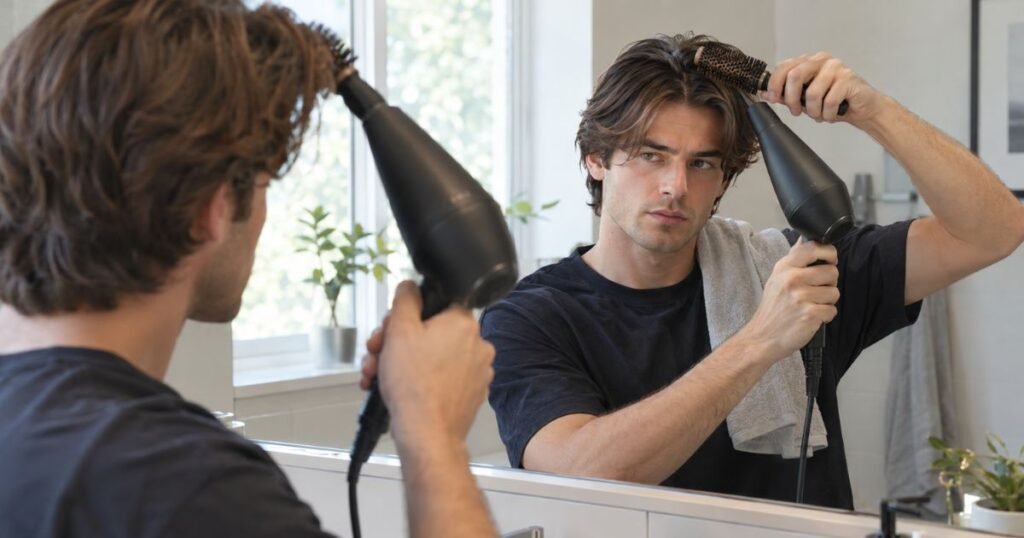
The basic logic is the same for most hair: set direction while the hair is damp, dry it to hold that direction, and finish with a small amount of product. Adjust the details for your texture.
Preparing the Hair
Start with clean hair that’s damp, not dripping. Towel-dry gently, then comb the front in the direction you want it to go. If you’re using a hot tool, apply a heat protectant first.
Pick a starting product based on your hair. A light cream or a mousse works for damp hair, and nothing heavy should go on the front. If you’d rather skip the dryer, you can air-dry the front with the part already set.
Creating the Part
Find your natural part by pushing the hair back and letting it fall. Use the tail of a comb or your fingers to set a clean line at the front. If a cowlick resists, shift the part slightly rather than forcing it.
Setting the part while the hair is damp helps it hold as it dries.
Blow-Drying Technique
Dry the front while it still has moisture, since that’s when the shape sets. Direct the airflow from the roots down, then sweep the hair outward and away from the face.
- Longer hair: use a round brush to guide the curve.
- Shorter hair: use your fingers or a comb.
- Waves and curls: use a diffuser to keep the pattern intact.
If your dryer has a cool setting, finish with it to help the shape hold. Use lower heat on fine or damaged hair.
Finishing the Look
Separate the pieces with your fingers, then add a small amount of finishing product, such as texture spray, a touch of soft pomade, or a little cream. Check the result from the front and side in good light. Less is usually better, since too much product weighs the front down. Products are covered in more detail below.
How to Add Volume and Keep the Part in Place
For lift, aim the dryer upward at the roots, then reshape the direction. A bit of root lift can stop the front from sitting flat against the forehead.
To hold the part, set it with a comb and use a light-hold product, which gives some grip without stiffness. Avoid touching the front throughout the day, since hands add oil and flatten the shape.
How to Maintain Curtain Bangs Men Haircut?
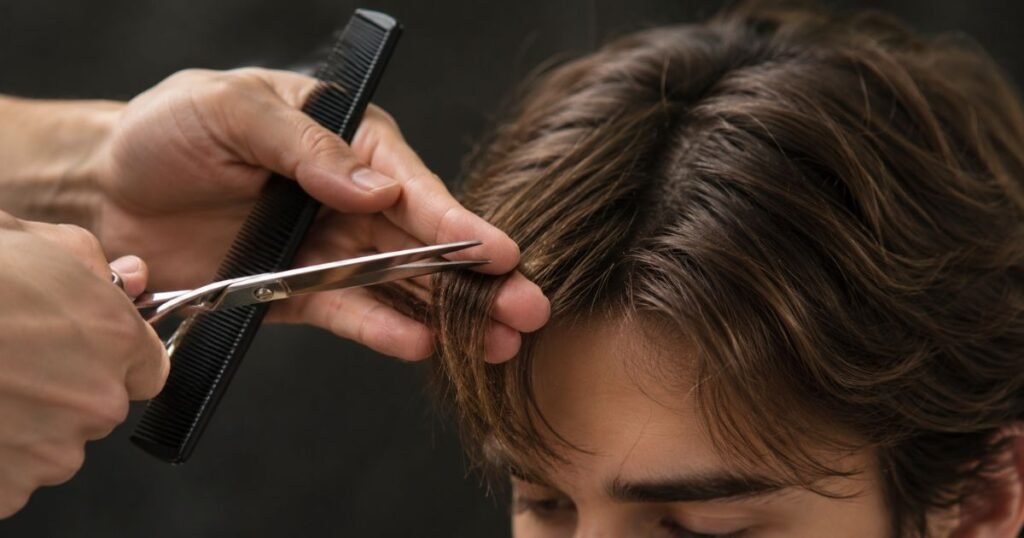
Maintenance covers four things: when to trim, a simple routine, fixing flatness, and dealing with parts that won’t cooperate.
How Often to Trim
There’s no single schedule, because it depends on how fast your hair grows, how crisp you want the shape, and what’s happening at the sides. Faded sides usually show growth sooner than longer ones.
Signs it may be time for a trim:
- The front is reaching your eyes.
- The part has stopped holding.
- The sides have lost their shape.
Ask your barber how often they’d suggest for your hair, and whether they offer quick fringe-only trims between full cuts. If you’re growing the cut out, you can often leave the front alone while the sides are tidied. Heavy trims on the front are best left to a barber, since small mistakes are very visible.
Daily Styling Routine
On wash days, follow the styling steps above, but you can shorten them once you know your hair. Between washes, a quick refresh may be enough: dampen the front, reset the part, and add a little product.
If you skip heat, air-drying with the part set can work, particularly for wavy and curly hair.
Keeping Bangs from Looking Flat
Flat fringe usually comes from oil, product buildup, heavy products, humidity, or too much weight in the front. Conditioner applied at the roots can also contribute.
What may help:
- Dry shampoo or powder at the roots
- Re-drying the front with a bit of lift
- Switching to lighter products
- Asking the barber whether the cut needs reshaping
Managing Uneven Separation and Stubborn Cowlicks
| Problem | Likely cause | What may help | What to ask the barber |
| One side falls heavier | Uneven density or growth | Dry that side with more lift | Whether to balance the weight |
| Part drifts during the day | Hair wants a different direction | Reset the part while damp | Whether to move the part slightly |
| Cowlick lifts the front | Growth direction at the hairline | Dry against the growth direction | Whether to leave extra length |
| Bangs split in the wrong place | Natural part is elsewhere | Train the part when wet | A part that fits your growth |
| Ends flip out | Layer or cutting angle | Brush under while drying | Whether the ends need adjusting |
Some cowlicks mean the cut itself needs adjusting. If you’ve tried drying and training and the front still won’t behave, it’s worth a conversation at your next appointment.
Best Hair Products for Curtain Bang

“Best” depends on your hair type, so the aim here is choosing the product type that suits your hair, not naming brands.
| Product type | What it does | Hair it may suit | Common mistake |
| Lightweight styling cream | Smooths and adds light control | Wavy, curly, or frizz-prone hair | Using too much |
| Texture spray | Adds grip and separation | Straight or fine hair | Overuse, causing dryness |
| Soft pomade | Light hold and some sheen | Most types, in tiny amounts | Applying at the roots |
| Volumizing shampoo | Cleans and leaves hair lighter | Fine or flat-prone hair | Expecting dramatic volume |
| Light conditioner | Hydrates without weight | Most hair, richer for dry curls | Applying to the roots |
Lightweight Styling Cream
Cream goes on damp hair for light control, smoothing, and frizz management. It may suit wavy or curly hair, or any hair that needs direction without stiffness. Fine hair usually needs only a very small amount.
Texture Spray
Texture spray gives separation and grip for a looser finish. It’s typically applied to dry hair. It may suit straight or fine hair that needs lift. Sea salt spray and dry shampoo can do a similar job. Too much can leave hair feeling dry or stiff.
Soft Pomade
A soft pomade gives light hold and a little sheen. A small amount is enough, since heavier products can weigh down the front. Water-based formulas tend to wash out more easily, while oil-based ones may leave more residue.
Volumizing Shampoo
These shampoos mostly clean thoroughly and leave hair lighter, which can help with lift. Don’t expect dramatic volume. How often you wash depends on your scalp and hair type, so there’s no single rule.
Light Conditioner
A light conditioner softens and detangles without weighing hair down. Apply it from the mid-lengths to the ends and keep it off the roots if your front tends to go flat. Curly or dry hair may do better with richer formulas.
FAQs
Are curtain bangs still popular for men?
There’s no hard data to cite here, so it’s better not to make a trend claim. The cut has come back in different forms over the years and is often described as a 90s-style look. Whether it suits your hair matters more than whether it’s in fashion.
Do curtain bangs work with short hair?
They can, as long as the top is long enough to part and fall to the sides. If your hair is very short, you may need to grow it a little first or consider a short textured style instead. The length guide under “Hair Length, Growth Patterns, and Cowlicks” shows where the front needs to reach.
Can men with curly hair get curtain bangs?
Often, yes, with some adjustments. Curl pattern and shrinkage change how the length sits, so plan the cut around dry curls. See the curly section and hair type table for more.
Are curtain bangs easy to maintain?
It depends on your hair type, how much you style, and what the sides are doing. They may grow out more gradually than a blunt fringe, but they still need shaping, and the part needs to be set. The maintenance section covers what to expect.
Do curtain bangs suit thinning hair?
It depends on where and how much your hair is thinning. Some people use the front length to soften the area, but a center part can also draw attention to thinning at the part line or temples. A barber can assess your options. If your hair loss is sudden or patchy, it’s worth mentioning to a doctor.
How long does hair need to be for curtain bangs?
The front needs to reach at least the brow line, and many people find the eye-to-cheekbone range easiest to work with. See the length guide for how to check where your hair reaches.
Final Thoughts on Curtain Bangs Haircuts for Men
Three decisions shape most of the outcome: how much length you want at the front, how your hair type and growth patterns will affect the result, and how much time you’ll spend styling each day.
Bring reference photos, describe where your hair naturally parts, and ask the barber what’s realistic for your hair. If something doesn’t sit right after the cut, a quick adjustment at the next visit is usually easier than guessing at home.
If you’re still deciding, the related guides on fades, tapers, medium-length cuts, and fringe styles can help you compare your options.

Jake Miller is a barbering and men’s hairstyle enthusiast who shares practical tips, haircut inspiration, and the latest grooming trends at BarberZylo. He enjoys exploring modern and classic hairstyles and helping readers find fresh ideas for their next look.


3 Comments