
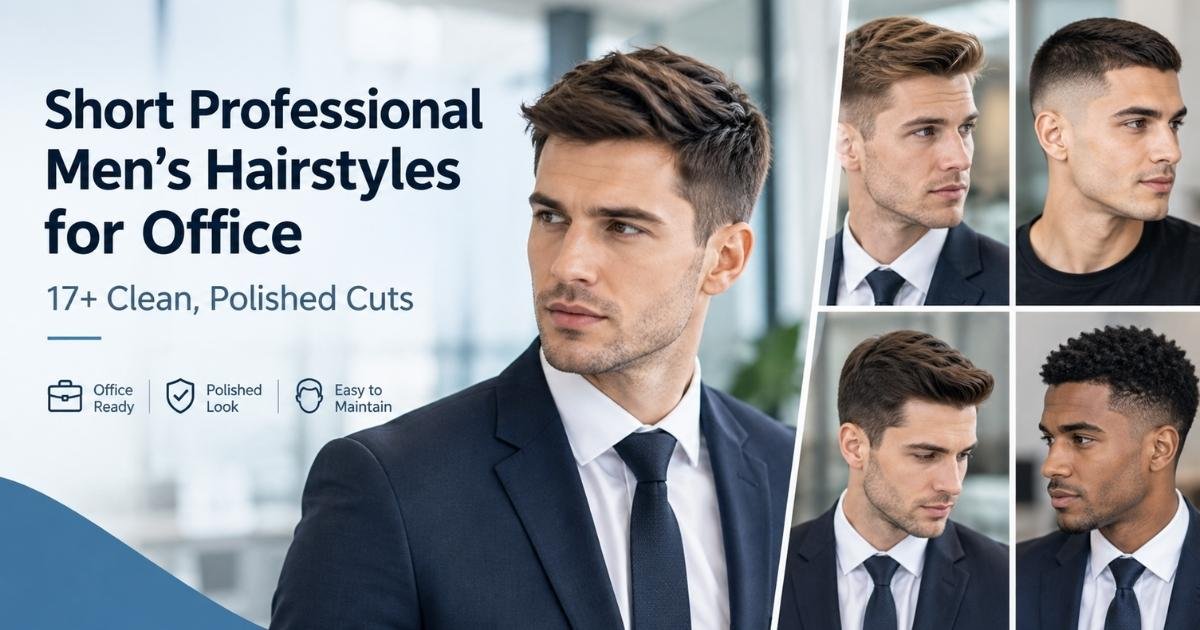
Short Professional Men’s Hairstyles for Office: 17+ Clean, Polished Cuts
A professional haircut usually comes down to three things: tidy edges, a controlled top, and styling that doesn’t draw attention to itself. Short hair makes that easy, but short cuts still differ in formality, daily effort and how well they suit your hair.
This guide covers short professional men’s hairstyles for office settings, from conservative crew cuts to textured crops. It then helps you narrow the list, style the result, and explain it to your barber. Workplaces differ, and some have written grooming policies, so treat the formality notes as general tendencies, not rules.
The Best Short Professional Men’s Hairstyles for Office
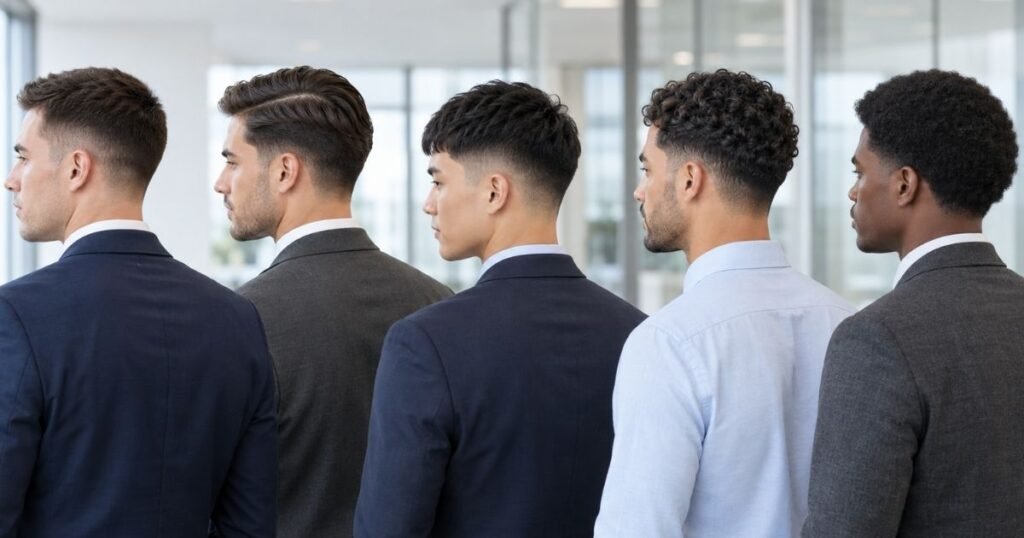
“Best” here means fit for your workplace, your hair and your routine, not a ranking. Any of the 17 cuts below can look sharp in a meeting when it’s well executed and suits your hair.
The first group covers classic men’s haircuts for the office: structured, low-contrast and easy to recognize. The later groups add texture, lift and fades, then cuts built for curl and coil.
Terms used below
A few barbering terms come up repeatedly, so here they are once:
- Taper: the hair gets gradually shorter toward the ears and nape, but some length usually remains at the bottom.
- Fade: the hair gets shorter more dramatically, down to bare skin or very close to it. Fades are covered in detail in cut 15.
- Guard numbers (US) / grades (UK): the attachments that set clipper cutting length. In most sets a number 1 guard leaves roughly 3mm (1/8 inch), and each step up adds a little more. Exact lengths vary by brand, so confirm with your barber.
- Neckline: the shape of the hair edge across the back of your neck.
At a glance
These are general tendencies. They shift with your hair and with how your barber cuts the style.
| # | Style | Typical formality | Daily styling effort | Top length (relative) |
| 1 | Classic crew cut | Conservative | Low | Short, a little longer at the front |
| 2 | Ivy League | Conservative | Low to moderate | Short to medium, enough to part |
| 3 | Side part with taper | Conservative | Moderate | Medium, parted |
| 4 | Tapered comb over | Conservative to moderate | Moderate | Medium, swept to one side |
| 5 | Buzz cut | Conservative (varies by workplace) | Almost none | Very short, uniform |
| 6 | Short brush up with low taper | Moderate | Moderate | Short to medium, lifted |
| 7 | High and tight | Conservative, high contrast | Low | Very short |
| 8 | Short textured crop | Moderate to relaxed | Low to moderate | Short, with a short fringe |
| 9 | Classic taper haircut | Conservative | Depends on the top | Varies |
| 10 | Short quiff with taper | Moderate to relaxed | Moderate to high | Medium at the front, lifted |
| 11 | French crop | Moderate | Low | Short, forward-swept |
| 12 | Caesar haircut | Moderate | Low | Short, even, forward |
| 13 | Short slick back | Moderate | Moderate | Medium, combed back |
| 14 | Short side-swept hairstyle | Moderate | Low to moderate | Medium, soft sweep |
| 15 | Low fade with short textured top | Moderate | Moderate | Short to medium, textured |
| 16 | Short curly hair with taper | Moderate | Moderate | Short to medium curls |
| 17 | Short natural afro with taper | Conservative to moderate | Low to moderate | Short, even shape |
1. Classic Crew Cut
The crew cut is the baseline for short professional hair. The sides and back are tapered short, and the top is left a little longer, especially toward the front. Hair at the front can lie flat or stand up slightly, depending on how yours grows.
It looks tidy because it has almost no loose ends. There’s no fringe to fall forward and no part to maintain, so the only styling most people do is a quick comb or a light touch of product.
At this length, head shape and hairline show more than they do on longer cuts. Hair that grows forward or stands up at the front tends to behave differently from hair that lies flat, so it helps to tell your barber how yours naturally falls.
Ask your barber for: tapered sides and back, with the top kept short and slightly longer at the front.
2. Ivy League Haircut
The Ivy League sits in the crew cut family, but the top is long enough to part or comb to the side. That extra length is the main difference. A crew cut stays short and mostly upright, while an Ivy League can be neatly combed over.
Definitions vary between barbers and regions. Some cut the sides with a taper, some with a closer fade, and some use scissors on the top while others use clippers. Showing a photo avoids confusion.
| Crew cut | Ivy League | |
| Top length | Short, slightly longer at the front | Long enough to part or comb over |
| Styling | Often none | Light comb-through, sometimes light product |
| Part | Not usually | Soft part is common |
Whether your hair holds a part depends on its texture, density and any cowlick near the front. Fine hair may need a lighter product, and a strong cowlick might suit a different parting direction.
Ask your barber for: a crew cut with enough length on top to part, and tapered sides.
3. Side Part with Taper
This is the cut to consider if you want a visible part line. The top is long enough to comb to one side, and the tapered sides keep the shape tidy without much contrast.
The part can be soft, following where your hair naturally separates, or defined, with the line sometimes cut in by the barber (a “hard part”). A softer part tends to look more natural, and a sharply defined one looks more formal.
Keeping the taper subtle generally reads as more conservative than a tight fade. For finish, a light cream or light-hold pomade is typical, with a matte to natural look.
Your barber can find the natural fall line by seeing where your hair already wants to split. A cowlick, double crown or thinner density near the part can show more scalp, so you may need the part on the other side or a softer version.
Ask your barber for: a side part with tapered sides, placed where my hair naturally falls.
Read More About : Professional Haircuts for Men: 35+ Classic & Modern Styles
4. Tapered Comb Over
A modern comb over is a more pronounced sweep of longer top hair to one side, over shorter, tapered sides. Compared with a side part, the sweep is more deliberate and the contrast between top and sides is often a little stronger. In practice, many barbers use “side part” and “comb over” almost interchangeably, so describing the finish you want matters more than the label.
This isn’t the dated idea of combing hair across a bald patch. It’s a styled cut that works with hair you have.
A light matte product keeps volume moderate. The look relies on top length and weight, so very fine hair may need a lighter product, and very thick hair may need some weight removed so it doesn’t puff.
Ask your barber for: a sweep to one side, and tell them how short you want the sides.
5. Buzz Cut
A buzz cut is clipped to one length all over. The variations are a single guard number all over, or a tapered buzz that’s slightly shorter at the edges. Either way, it needs essentially no styling.
The trade-off is exposure. A buzz cut shows head shape, hairline and scalp more than any longer style, and untidy edges around the ears and neckline become noticeable sooner. How well it works can also depend on your workplace’s expectations, so it’s worth checking if you have a written grooming policy.
Some men with thinning hair like a uniform short length because it reduces the contrast between thicker and thinner areas, though that doesn’t suit everyone. If your scalp is exposed to sun, sunscreen is worth considering.
Ask your barber for: a specific guard number (or grade in the UK), and whether you want the edges tapered.
6. Short Brush Up with Low Taper
Here the top is brushed upward and slightly back, with sides that are tapered low. “Low” means the shortening starts low, around the ear and nape, and stays gentle.
The office-friendly version keeps the lift restrained. Think a little height at the front instead of a dramatic wave. It’s a shorter, calmer relative of the quiff covered in cut 10.
Matte clay or paste gives hold without shine, and blow-drying upward and back helps set the direction. Lift depends heavily on growth direction and density, and hair that grows forward at the hairline may resist.
Ask your barber for: enough length on top to brush up, with a low, soft taper on the sides.
7. High and Tight
A high and tight has very short sides and back, often cut up high on the head, with a short top. The contrast between the sides and the top is more pronounced than in a crew cut, which has softer tapers and a less sharply defined shape.
Some people find it exceptionally neat, and others find the contrast stricter than they want. In some workplaces its military association may read as severe, though that varies.
Regrowth shows quickly because the sides are so short, and ears, head shape and hairline are more visible. Whether a fade-style version is acceptable is covered under cut 15.
Ask your barber for: how high the short section goes, and how short the top should stay.
The next group relies more on texture, lift and fringe, which gives you more room to adjust the formality up or down.
8. Short Textured Crop
A textured crop is defined by visible texture on top and a short, cropped fringe, with short sides. The texture comes from cutting technique, such as point cutting, as much as from product.
Office-friendly versions tend to keep the texture soft and the fringe short. Overly choppy or long, messy fringes read as more casual.
A light matte clay or paste defines the texture. Wavy or slightly coarse hair often holds it more easily, while very fine, flat hair may need volume support.
Ask your barber for: a short fringe with soft texture on top, and tapered sides.
Read More About : 15+ Professional Men’s Hairstyles for the Office (2026 Guide)
9. Classic Taper Haircut
This is the technique behind many cuts in this list. In a taper, hair gradually shortens toward the nape and around the ears, but some length stays at the bottom. A fade goes further, down to skin or very close to it. Most tapers keep more length at the bottom edge than a fade does, which is why they usually read as softer.
Taper details worth knowing:
- Neckline: options include a natural (rounded) neckline, a squared or blocked one, and a tapered one. A tapered neckline tends to grow out more softly than a blocked one.
- Sideburns: these can also be tapered, which keeps the area near the ear neat.
- Technique: barbers may use clippers, or scissor-over-comb (cutting with scissors while the comb lifts the hair) for a softer blend.
Because a taper pairs with almost any top, it’s a reliable foundation for conservative workplaces, though no cut is universally right. Nape growth patterns and a low hairline can affect how clean the neckline looks.
Ask your barber for: a classic taper, with your chosen top style and a natural or tapered neckline.
10. Short Quiff with Taper
A quiff has hair lifted at the front and swept up or back, with tapered sides. It needs more length and more styling than the brush up in cut 6, and it sits higher at the front. For an office, keeping the volume moderate usually works best. A pompadour is taller and more dramatic still.
Blow-drying sets the direction, and a medium-hold matte product keeps it in place. A high forehead, widow’s peak, front cowlick or fine hair can change how the quiff sits.
Ask your barber for: length at the front to lift, how much volume you want, and tapered sides.
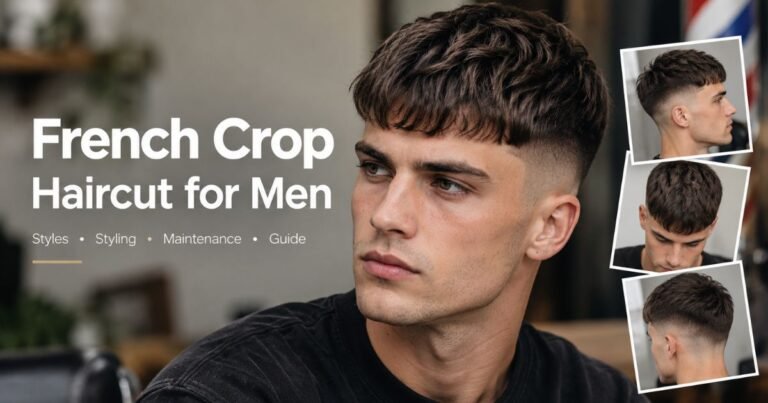
11. French Crop
A French crop has a short, forward-swept top with a straight, short fringe over short sides. Because the cut does the work, it often needs little styling.
Barbers use the crop names loosely, so describe the fringe length, texture and direction. Cut 12 compares the main crop styles side by side.
Some men with a receding hairline choose forward styles because they soften the hairline, though the effect depends on hairline shape and front density. Straight to wavy hair often takes the shape easily. Curlier hair behaves differently.
Ask your barber for: a short, straight fringe with the top cut forward, and how much texture you want.
12. Caesar Haircut
The Caesar is cut to an even, short length on top, combed forward into a straight fringe. Because there’s little texture or layering to hide mistakes, it relies on a precise cut. Once it’s cut well, styling can be minimal.
The three crop styles overlap, so here’s how they usually differ:
| Textured crop | French crop | Caesar | |
| Fringe | Short, can be uneven | Short, straight | Short, straight |
| Texture | Visible, point-cut | Light to moderate | Minimal, even |
| Top length | Short, varied | Short, forward | Short, uniform |
| Styling | Matte clay or paste | Little or light paste | Often just a comb |
Barbers may use these names differently, so a photo helps. Straight or lightly wavy hair tends to sit as intended. A crown swirl or very fine hair may change the result.
Ask your barber for: an even top length combed forward with a straight fringe.
13. Short Slick Back
A short slick back has the top combed back from the forehead. The short version still needs enough front length to lie back, otherwise it springs up.
Finish matters most here. A natural or matte look generally reads as more subdued, while a glossy, wet look may read as more fashion-forward depending on the workplace.
Combing back exposes the hairline, so a receding hairline or thin front may be more visible. Thick, coarse hair may spring forward without enough hold, and fine hair can show scalp through product. A little pomade or cream on towel-dried hair, combed through, is a common starting point.
Ask your barber for: enough length on top to comb straight back, and tell them how glossy or matte you want the finish.
Read More About : Modern Mullet Fade: The Complete Guide to Getting It Right in 2026
14. Short Side-Swept Hairstyle
A side-swept style has a soft sweep to one side with no defined part line. Cut 3 has a crisp part, and cut 4 has a deliberate sweep. This one is the relaxed option, and it suits hair that won’t hold a sharp part.
It often looks natural air-dried with a little light product. Wavy hair, or hair with natural movement, may suit it well, and cowlicks and growth direction usually decide which side it sweeps toward.
Ask your barber for: natural movement, with the hair left to fall to the side instead of a defined part.
15. Low Fade with Short Textured Top
A fade is the cut most office readers ask about. A low fade starts low on the sides and around the nape, then blends up. It differs from a taper by being shorter at the bottom, so the contrast is stronger.
Fades can reach bare skin (a skin or bald fade) or stop at very short stubble, and they can be low, mid or high. For an office, a low height with a soft blend and modest contrast is the milder option. Check any grooming policy, since expectations vary.
| Taper | Low fade | Mid to high fade | |
| How short at the bottom | Some length remains | Very short or skin | Very short or skin |
| Where it starts | Low, around ear and nape | Low on the sides | Higher up the sides |
| Contrast | Gentle | Moderate | Stronger |
| Typical formality | Most conservative | Moderate | More relaxed |
| Grow-out | Softer | Shows sooner | Shows sooner |
If you’d like a clean finish without a skin fade, a taper or a fade that stops at short stubble keeps the effect softer. For the top, a short textured finish like the one in cut 8 works well.
Head shape, scalp tone and hair growth can change how a fade reads, and fades tend to show regrowth sooner than tapers do.
Ask your barber for: the fade height, how low it goes at the bottom, and a soft contrast.
The last two cuts are built around curl and coil, where texture shapes the cut as much as length does.
16. Short Curly Hair with Taper
Curls look shorter when they’re dry, a effect often called shrinkage, so leaving enough length on top matters. A taper keeps the sides and nape neat, and the curls on top stay defined.
Some barbers cut curls dry to judge the shape. It’s worth finding a barber who regularly works with curly hair.
For styling, curl cream or a leave-in on damp hair is a common approach, and brushing dry curls can cause frizz. A diffuser can help set the curl pattern. Curl tightness, density and humidity all change the result.
Ask your barber for: tapered sides, with the curl length kept on top.
17. Short Natural Afro with Taper
This cut keeps coily hair natural on top, shaped into a rounded or evenly cut form, with tapered sides and back. Shape and edges matter: a defined hairline, tidy sideburns and a clean neckline make the difference between casual and polished.
Moisture helps coily hair hold its shape, and a wide-tooth comb or pick keeps it even. People searching for short professional haircuts for Black men often have this texture, but hair types vary within every community and this cut isn’t limited to anyone.
Density, coil tightness and hairline shape affect the outcome. Texture typing systems (such as 4A to 4C) are common but not universal.
Ask your barber for: how much length to keep on top, how even the shape should be, and how tight the taper should be.
Read More About : Low Maintenance Men’s Haircuts: 32+ Easy Styles That Look Great
How to Choose the Right Short Professional Haircut
Seventeen options is a lot. Narrow them with three filters:
- How formal is your workplace? Check any written grooming policy, particularly for client-facing or uniformed roles.
- What does your hair do? Density, texture, hairline and growth direction affect what holds up.
- How much effort do you want to put in? Daily styling time and barber visits are separate costs.
Best Haircuts for Conservative Corporate Offices
In a conservative setting, the cut generally reads as structured, low-contrast and predictable. A few features push a haircut in that direction:
- A soft taper instead of a high fade
- Defined edges around the ears and neckline
- A top that lies flat or is neatly combed
- A matte or natural finish
- No strong fringe or heavy volume
The cuts that usually fit this description are the classic crew cut (1), Ivy League (2), side part with taper (3) and classic taper (9). The buzz cut (5) or a short slick back (13) can also work, depending on the workplace.
If you like a trendier cut, you can adapt it: keep the taper lower, the texture softer and the finish more natural. Individual hair can push any style more or less formal.
Best Short Hairstyles for Business-Casual Workplaces
Business-casual settings give you more room to adjust. Think of formality as a dial with a few settings you can turn up or down:
| Adjustment | More conservative | More relaxed |
| Contrast | Soft taper | Low or mid fade |
| Texture | Smooth, combed | Visible, point-cut |
| Volume | Flat or low | Lifted |
| Shine | Matte or natural | A little more sheen |
| Fringe or front | Off the forehead | Short fringe |
| Part | Defined | Soft or none |
Styles that tend to suit this range include the brush up (6), textured crop (8), quiff (10), crops (11 and 12), slick back (13), side-swept (14) and low fade (15). Hybrid, remote and creative workplaces vary a lot. When in doubt, start more conservative and relax the cut over time.
Choosing a Cut for Your Hair Type and Hairline
Hair characteristics change how a cut behaves. Three terms are easy to confuse: fine hair (thin strands), thinning hair (reduced density) and a receding hairline (the hairline’s position). This table shows what each can change and which styles may be worth discussing.
| Factor | What it can change | Styles to discuss | Watch for |
| Thick or dense hair | Bulk, sides that flare out | Tapers, crew cut, Ivy League, textured crop | Weight removal may be needed to control volume |
| Fine strands | Less hold, can look flat | Crew cut, French crop, Caesar | Heavy products can weigh hair down |
| Thinning hair | Scalp shows through | Shorter overall length, low contrast, crew cut, buzz cut, Caesar | Long comb-over strands can reveal scalp |
| Receding hairline | How visible the hairline is | Forward styles (11, 12), textured crop, very short cuts | Combed-back or highly lifted styles expose the hairline |
| Wavy hair | Natural movement | Side-swept, textured crop, short quiff | Humidity changes the shape |
| Curly or coily hair | Shape and shrinkage | Cuts 16 and 17 | Barber experience with your texture matters |
| Cowlicks and crown swirls | Part or fringe direction | Side-swept, textured crop | A strong swirl may fight a short fringe |
Sudden or patchy hair loss is a medical question, so see a doctor if it applies to you. For everything else, a barber who can see how your hair grows is the most reliable guide.
Short Professional Haircuts That Are Easy to Maintain
“Low-maintenance” can mean two different things, and they sometimes conflict: little daily styling, or fewer barber visits. A buzz cut needs no styling, but its edges can look untidy quickly. Four things drive effort:
- Daily styling time, and how dependent the cut is on product
- How quickly the shape grows out, since tighter tapers and fades show regrowth sooner
- Edge sensitivity, meaning how obvious the neckline and ear edges look as they grow
- Your own standard for what counts as neat
Here is a rough grouping, which will shift with your hair:
- Lower daily effort: buzz cut (5), crew cut (1), high and tight (7), French crop (11), Caesar (12)
- Moderate: Ivy League (2), side part (3), brush up (6), textured crop (8), side-swept (14)
- Higher: quiff (10), slick back (13), tapered comb over (4)
There isn’t a universal trim schedule. Ask your barber what interval suits your cut and growth rate. Between haircuts, you can keep a short style looking tidy by asking whether your barber offers quick edge clean-ups, keeping a small comb on hand, and refreshing your finish with a pinch of product instead of piling more on.
Read More About : 14+ Hairstyles for Older Men: Stylish Cuts for Thinning Hair
How to Style Short Professional Men’s Hairstyles
For the office, the principle is a light touch and a controlled finish. The two sections below cover what to use and how to apply it, so the cuts above only mention styling where it’s unusual.
Choosing the Right Styling Product
Hold levels and finishes vary by brand, so use this as a starting point.
| Product | Typical finish and hold | Hair it may suit | Office note |
| Lightweight styling clay (matte) | Matte, medium hold | Thicker or textured hair, textured crops | Defines texture without shine |
| Styling cream | Natural, light hold | Fine to medium hair, short cuts | Looks the most like no product |
| Water-based pomade | Low to medium shine, flexible hold | Parts, slick backs, side sweeps | Generally washes out more easily |
| Oil-based pomade | Higher shine, stronger hold | Thick, coarse hair | Can look glossy and is harder to wash out |
| Paste or fiber | Matte, flexible hold | Textured crops, brush ups | Easy to rework during the day |
| Texture or sea-salt spray | Matte, light hold | Fine hair needing grip | Can dry hair if overused |
| Light-hold hairspray | Natural to firm, no shine | Any cut that needs to stay put | Keep a light mist |
Heavy products can weigh down fine hair. Curly hair often responds better to moisturizing creams than to stiff or drying formulas.
Creating a Neat Finish Without Overstyling
A polished result comes from using less product than you think you need. A neat style that stays in place all day usually comes from direction and a small amount of hold, not heavy product.
- Start with towel-dried or damp hair.
- If your hair needs direction, blow-dry in the direction it should lie. For lift, dry upward and back.
- Start with a small amount, about a pea-sized dab, and warm it between your palms.
- Work it through in the direction your hair grows or should lie. Starting at the back and finishing at the front avoids overloading the front.
- Shape with a comb, not just your fingers.
- Check from the side and in daylight before you leave.
Signs you’ve overdone it: the hair feels stiff, shows visible shine or clumps, or the scalp shows through the product. To fix it, run damp fingers or a comb through it, or rinse and start again with less. A quick midday refresh with a damp comb or a pinch of product warmed in your palms usually does enough.
Read More About : Haircuts for Teenage Guys: 50+ Trendy & Cool Styles
How to Ask Your Barber for a Professional Short Haircut
No single phrase gives the same result at every barbershop, so it helps to bring a few specific details. Before your appointment, think through the following:
- Reference photos. Bring two or three, ideally from different angles, and note what you like about each (the part, the fade height, the fringe).
- Sides and back. Taper or fade, how short, and what neckline you want.
- Top. Length, texture, part, fringe and direction.
- Finish. Matte or natural.
- Constraints. Your workplace and how often you can visit.
- Questions for the barber. Does this suit my hair, how should I style it, and what interval do you recommend?
Some terms are worth knowing. The head-zone terms (top, sides, back, neckline) and taper/fade/guard definitions are in the terms block near the start. These extras help too:
- Scissor-over-comb: a softer blend done with scissors instead of clippers
- Texturizing or point cutting: adds visible texture to the top
- Weight removal: thins out bulk so the hair sits flatter
- Hard part: a part line cut or shaved in
- Short back and sides: a common UK phrase for a short, tapered back and sides with a longer top
Here’s an example of how you might put it together, to adapt to your own cut:
“I’d like a classic taper on the sides and back with a natural neckline. Keep the top short but long enough to part on the left, with a soft finish. I need it to stay neat in a corporate office.”
If you have a beard, ask for the taper to blend into it so there’s no abrupt line near the sideburns or ears. Mention any cowlicks or growth patterns up front, since these affect what’s achievable.
Read More About : Boys Haircuts: 60+ Best Styles for Kids & Teens (2026)
FAQs
What are some of the best short professional men’s hairstyles for office?
Instead of one winner, think in families. Conservative baselines include the crew cut, Ivy League, side part with taper and classic taper. Cuts with more texture or lift suit business-casual settings, and cuts 16 and 17 are built for curly and coily hair. Which is best depends on your workplace, hair and effort level.
Are short hairstyles good for professional workplaces?
Generally, yes, because neat edges and moderate styling travel well. Expectations vary between workplaces, and some have written grooming policies, so check yours if you’re unsure.
How often should I trim a short professional haircut?
There isn’t a universal interval. It depends on how fast your hair grows, how tight the taper or fade is, and how much untidy edges bother you. Your barber can suggest a timeframe, and a quick edge clean-up between cuts can help if they offer it.
Do short hairstyles need styling products?
Not always. Very short cuts like a buzz cut or crew cut may need none, while others benefit from a light product for texture, hold or a part. The product table above shows what suits which finish.
Which short haircut is easiest to maintain?
It depends on what “easy” means to you. The buzz cut needs no styling but its edges can look untidy quickly, while a taper may need more styling but grows out more softly. The maintenance section above breaks down these trade-offs.
Can I style a short professional haircut differently for work and weekends?
Yes. You can adjust the hold, finish and texture, or flip the part. A matte, controlled finish suits the office, and a little more texture or movement works on weekends.
Are fades appropriate for corporate offices?
It depends on the fade height, blend and workplace. A low, soft fade is generally a milder step than a high skin fade, and a taper is the more conservative default. Check any written grooming policy, and see cut 15 for the comparison.
What is the most professional haircut for men with thinning hair?
There isn’t a single most professional option. Shorter overall length and softer contrast often work well, and a barber can advise based on your pattern. Sudden or patchy hair loss is a question for a doctor.
Can men with curly or coily hair wear short professional hairstyles?
Yes. A taper keeps the sides and nape neat while the top keeps its texture, and a barber experienced with your hair type makes a real difference. Cuts 16 and 17 cover both.
Conclusion
Choosing a short professional haircut comes down to three questions: how formal your workplace is, what your hair and hairline do, and how much effort you’ll put in. Answer those, and the 17 cuts above shrink to two or three realistic options.
For your next step, pick two or three reference photos, check any grooming policy at work, and use the barber checklist above to describe what you want. A well-cut short style should look tidy on its own, with styling as a finishing touch.
Jake Miller is a barbering and men’s hairstyle enthusiast who shares practical tips, haircut inspiration, and the latest grooming trends at BarberZylo. He enjoys exploring modern and classic hairstyles and helping readers find fresh ideas for their next look.



4 Comments